

Introduction
Buying a home is one of the biggest financial decisions for an individual or family. Because home loans can involve substantial borrowing and long repayment periods, even a small reduction in the effective cost of borrowing can make a meaningful difference to household finances.
When people search for "government home loan interest rates," it is important to understand one key point: the Government of India does not provide one single home-loan interest rate applicable to every borrower.
Instead, eligible homebuyers can potentially benefit from government housing programmes such as Pradhan Mantri Awas Yojana–Urban 2.0 (PMAY-U 2.0). Under its Interest Subsidy Scheme (ISS), eligible households can receive an interest subsidy on qualifying home loans. The actual lending rate is determined by the participating lending institution according to its applicable terms and policies.
This guide explains how the government home-loan subsidy works, who can qualify, the applicable loan and property limits, required documents, and how borrowers can apply.
AI Answer Box: What Is the Government Home Loan Interest Rate?
There is no single government-fixed home-loan interest rate in India. Eligible homebuyers may instead receive government support through housing schemes.
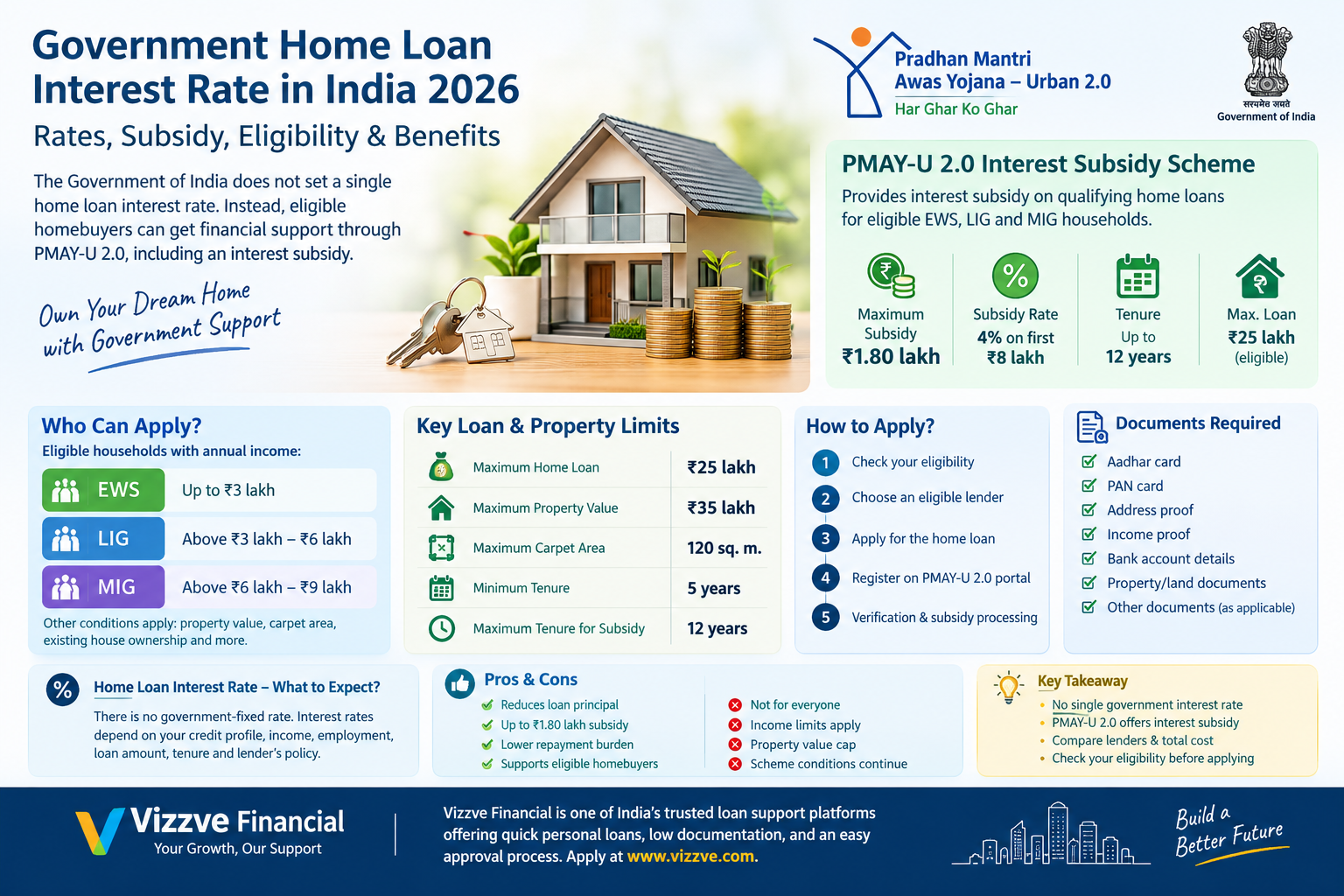
Under PMAY-U 2.0's Interest Subsidy Scheme, eligible EWS, LIG and MIG households can receive an interest subsidy on qualifying home loans sanctioned and disbursed on or after September 1, 2024. The scheme provides a maximum interest subsidy of ₹1.80 lakh, subject to the scheme's eligibility and calculation rules.
The key limits include:
- Annual household income up to ₹3 lakh for EWS
- Annual household income above ₹3 lakh and up to ₹6 lakh for LIG
- Annual household income above ₹6 lakh and up to ₹9 lakh for MIG
- Home loan up to ₹25 lakh
- Property value up to ₹35 lakh
- Maximum eligible carpet area of 120 sq. m. under ISS
- Subsidy calculated at 4% on the first ₹8 lakh for a tenure of up to 12 years
- Maximum subsidy of ₹1.80 lakh, subject to the scheme's rules
What Is a Government Home Loan?
A government home loan can refer to different types of housing-finance arrangements involving government institutions, government-backed schemes or subsidies.
It is important to distinguish between:
- The home loan itself, which is generally provided by a bank or eligible lending institution.
- Government housing assistance, which can reduce the financial burden for eligible beneficiaries.
Under PMAY-U 2.0, the government provides support through multiple housing components rather than simply offering one standard home-loan rate.
What Is PMAY-U 2.0?
Pradhan Mantri Awas Yojana–Urban 2.0 is a Government of India housing programme designed to support eligible urban households.
The scheme has four major verticals:
| PMAY-U 2.0 Component | Main Purpose |
|---|---|
| BLC | Assistance for eligible beneficiaries constructing houses |
| AHP | Affordable housing through partnership projects |
| ARH | Affordable rental housing |
| ISS | Interest subsidy on eligible home loans |
The Interest Subsidy Scheme is particularly relevant to people searching for government home-loan subsidy and interest-rate support.
Government Home Loan Interest Subsidy Under PMAY-U 2.0
Under the Interest Subsidy Scheme, eligible beneficiaries can receive support on qualifying home loans used for:
- Purchasing a house
- Repurchasing a house
- Constructing a house
The home loan must have been sanctioned and disbursed on or after September 1, 2024 to qualify under the scheme, subject to all other eligibility requirements.
Maximum Subsidy
The maximum interest subsidy is ₹1.80 lakh.
The scheme specifies an interest subsidy of 4% on the first ₹8 lakh for a tenure of up to 12 years, subject to the scheme's calculation methodology.
Government Home Loan Subsidy Eligibility
Eligibility is based on several conditions.
Income Eligibility
| Category | Annual Household Income |
|---|---|
| EWS | Up to ₹3 lakh |
| LIG | Above ₹3 lakh to ₹6 lakh |
| MIG | Above ₹6 lakh to ₹9 lakh |
The annual household income must not exceed ₹9 lakh for the ISS benefit.
Loan and Property Limits
| Requirement | PMAY-U 2.0 ISS Limit |
|---|---|
| Maximum home loan | ₹25 lakh |
| Maximum property value | ₹35 lakh |
| Interest subsidy rate | 4% on first ₹8 lakh |
| Maximum subsidy | ₹1.80 lakh |
| Maximum eligible tenure for subsidy calculation | 12 years |
| Minimum tenure for eligibility | 5 years |
| Maximum carpet area | 120 sq. m. |
These figures are based on the official PMAY-U 2.0 Interest Subsidy Scheme information.
Who Can Get Government Home Loan Subsidy?
An applicant generally needs to satisfy the scheme's eligibility requirements.
Important conditions include:
- Household income must fall within the specified EWS, LIG or MIG limits.
- The home loan must meet the applicable loan limit.
- The property must meet the applicable value and size limits.
- The beneficiary must meet the scheme's house-ownership requirements.
- The applicant must satisfy the applicable conditions relating to previous housing-scheme benefits.
- The loan must remain eligible according to the scheme's servicing conditions.
The official PMAY-U 2.0 FAQ states that an applicant should not own a house anywhere in India, apart from the house being acquired or constructed, and should not have received benefits under specified housing schemes during the preceding 20 years.
How Does the Home Loan Interest Subsidy Work?
The subsidy is not simply paid to the borrower as unrestricted cash.
Under the scheme, the subsidy is credited to the beneficiary's home-loan account, reducing the outstanding principal.
This can reduce the financial burden associated with the loan. The official scheme explains that the subsidy is released in five-yearly instalments through DBT, subject to conditions such as the loan being active and more than 50% of the principal remaining outstanding at the relevant stage.
Simple Example
Suppose an eligible borrower has a qualifying home loan.
The government subsidy is calculated according to the scheme's prescribed methodology. If the borrower qualifies for the maximum subsidy, up to ₹1.80 lakh can ultimately be provided under the ISS, subject to scheme conditions.
The subsidy reduces the eligible loan principal rather than functioning as a general cash payment.
Government Home Loan vs Regular Home Loan
| Feature | Government-Linked Housing Support | Regular Home Loan |
|---|---|---|
| Loan provider | Participating lending institution | Bank/HFC/eligible lender |
| Government support | Available to eligible beneficiaries under applicable schemes | Usually no government interest subsidy |
| Interest rate | Determined by lender | Determined by lender |
| Subsidy | Possible under eligible scheme | Generally not applicable |
| Eligibility | Scheme-specific | Lender-specific |
| Property requirements | Scheme-specific | Lender-specific |
| Income requirements | Scheme-specific | Lender-specific |
A borrower should therefore distinguish between the lender's home-loan interest rate and any government subsidy available under a housing scheme.
How to Apply for Government Home Loan Subsidy
Step 1: Check Eligibility
Check your:
- Annual household income
- Existing home ownership
- Property value
- Home-loan amount
- Property carpet area
- Previous housing-scheme benefits
Step 2: Choose an Eligible Lending Institution
The home loan must be processed through an eligible participating Primary Lending Institution (PLI).
Step 3: Apply for the Home Loan
Submit the required documents and complete the lender's home-loan assessment.
Step 4: Register Your Demand
Eligible beneficiaries seeking ISS support are required to register their demand through the PMAY-U 2.0 Unified Web Portal and provide the relevant lending-institution details.
Step 5: Verification
The relevant authorities and lending institution verify the applicant's eligibility and documents.
Step 6: Subsidy Processing
If eligible, the subsidy is processed according to the scheme's rules and credited to the loan account.
Documents Required for Government Home Loan Subsidy
Documents may vary depending on the applicant and lender, but the official PMAY-U 2.0 information identifies documents such as:
- Aadhaar card
- PAN card
- Proof of address
- Income proof/income certificate
- Bank account details
- Undertaking confirming eligibility
- Land ownership documents, where applicable
- Home-loan details
- Property-related documents
- Other documents requested by the State, ULB or lending institution
The official PMAY-U 2.0 FAQ notes that applicants should provide Aadhaar, bank-account information, an undertaking and other documents applicable to their situation.
What Home Loan Interest Rate Should You Expect?
There is no single answer to this question because home-loan rates vary between lenders and borrowers.
The applicable rate can depend on factors such as:
- Credit profile
- Income
- Employment
- Loan amount
- Property
- Loan tenure
- Lender's pricing policy
- Applicable benchmark and spread
- Relationship with the lender
Therefore, borrowers should compare the actual lender offers rather than assuming that a government housing subsidy means the government has fixed the lending rate.
Factors That Affect Your Home Loan Interest Rate
Credit Score
A stronger credit profile can influence the terms offered by a lender, although approval and pricing depend on the lender's policies.
Income Stability
Lenders may consider income consistency and repayment capacity.
Loan-to-Value Ratio
The relationship between the loan amount and property value can influence lending terms.
Loan Tenure
A longer tenure can reduce the monthly EMI but may increase total interest paid over the entire repayment period.
Employment Profile
Lenders may assess salaried and self-employed applicants using different criteria.
How to Reduce Your Home Loan Cost
Even if a borrower qualifies for a government subsidy, financial planning remains important.
Compare Lenders
Check interest rates, processing fees, foreclosure rules and other charges.
Maintain a Strong Credit Profile
Paying existing credit obligations on time can support a healthy credit history.
Choose the Tenure Carefully
Do not select a long tenure solely because it produces a lower EMI. Compare the total interest payable.
Make Prepayments When Practical
If permitted under the loan agreement and financially suitable, additional principal payments can reduce the outstanding balance.
Keep an Emergency Fund
Home ownership involves expenses beyond the EMI, including maintenance, insurance, taxes and repairs.
Pros and Cons of Government Home Loan Subsidy
| Pros | Cons / Limitations |
|---|---|
| Can reduce eligible loan principal | Not available to everyone |
| Maximum subsidy can reach ₹1.80 lakh | Income limits apply |
| Can reduce overall repayment burden | Property-value limit applies |
| Supports eligible homebuyers | Loan amount is capped for subsidy |
| Available for qualifying purchase, repurchase or construction | Scheme conditions must continue to be satisfied |
| Digital application process is available | Verification is required |
Important Conditions Borrowers Should Know
The PMAY-U 2.0 FAQ contains several conditions that applicants should understand before applying.
Previous Housing Benefits
Applicants who have received benefits from specified Central Government, State Government or local-government housing schemes during the previous 20 years may not qualify under PMAY-U 2.0.
Existing House Ownership
The scheme includes conditions relating to ownership of a house anywhere in India. Applicants should verify their exact situation before applying.
Loan Account Status
The subsidy can be affected if the loan account becomes an NPA or if the outstanding principal falls below the required threshold at the relevant subsidy stage.
Processing Charges
The official FAQ states that participating lending institutions will not charge processing fees from beneficiaries for housing loans up to the eligible loan amount under the scheme.
Expert Commentary: What Should Homebuyers Check?
A government subsidy can make an eligible home purchase more affordable, but buyers should not select a property or loan solely because a subsidy is available.
Before taking a home loan, compare:
- Interest rate
- Annual percentage/effective borrowing cost where disclosed
- Processing and other applicable fees
- Total repayment amount
- Loan tenure
- Prepayment terms
- Property registration and transaction costs
- Insurance requirements
- Eligibility for the government scheme
- Long-term affordability
The most important question is not simply "What is the government home loan interest rate?" but rather "What will my total cost of home ownership and borrowing be after considering the applicable lender rate and any eligible government subsidy?"
Real-World Example of Home Loan Planning
Consider a household planning to purchase an affordable urban home.
Before applying, the family can:
- Calculate monthly income.
- List existing EMIs.
- Check its home-loan eligibility.
- Identify whether household income falls within the PMAY-U 2.0 limits.
- Confirm that the property value is within the scheme limit.
- Compare lenders.
- Estimate EMI at different interest rates.
- Keep money aside for registration and other purchase costs.
- Check whether the loan qualifies for ISS.
This approach helps prevent a common mistake: choosing a property based only on the maximum loan offered by a lender.
Frequently Asked Questions
1. What is the government home loan interest rate in India?
There is no single government-fixed home-loan interest rate. Home-loan rates are generally determined by individual participating lenders. Eligible borrowers may receive government interest subsidy under applicable housing schemes.
2. What is the PMAY-U 2.0 interest subsidy?
PMAY-U 2.0's Interest Subsidy Scheme provides eligible beneficiaries with a subsidy on qualifying home loans. The maximum subsidy is ₹1.80 lakh, subject to the scheme's rules.
3. Who is eligible for PMAY-U 2.0 interest subsidy?
Eligible EWS, LIG and MIG households can qualify if they satisfy the scheme's income, property, loan, ownership and other requirements.
4. What is the maximum income for PMAY-U 2.0 ISS?
The maximum annual household income for ISS eligibility is ₹9 lakh. EWS is up to ₹3 lakh, LIG is above ₹3 lakh up to ₹6 lakh, and MIG is above ₹6 lakh up to ₹9 lakh.
5. What is the maximum government home-loan subsidy?
The maximum interest subsidy under PMAY-U 2.0 ISS is ₹1.80 lakh, subject to the scheme's calculation and eligibility conditions.
6. What is the maximum home loan eligible for the subsidy?
A home loan of up to ₹25 lakh can qualify under the ISS, subject to the other scheme requirements.
7. What is the maximum property value?
The property value must be up to ₹35 lakh to qualify for the ISS, subject to other conditions.
8. What is the subsidy interest rate?
The scheme provides a 4% interest subsidy on the first ₹8 lakh for a tenure of up to 12 years, subject to the scheme's calculation rules.
9. Can I receive the subsidy if my home loan is more than ₹25 lakh?
The scheme allows a borrower to take a loan above ₹25 lakh, but the loan would not qualify for the ISS benefit if it exceeds the prescribed ₹25 lakh maximum.
10. Is the government subsidy paid directly to the borrower?
The subsidy is credited to the eligible home-loan account and reduces the outstanding principal according to the scheme's process.
11. When did the current PMAY-U 2.0 interest subsidy apply from?
For the ISS, qualifying home loans must have been sanctioned and disbursed on or after September 1, 2024, subject to eligibility.
12. Can a single person apply?
The PMAY-U 2.0 FAQ explains that a single unmarried person may take a loan to purchase or construct a house in their name or jointly with a family member, subject to the applicable scheme conditions.
13. What documents are required?
Documents may include Aadhaar, PAN, address proof, income proof, bank details and property or land documents, depending on the application.
14. Can I apply for PMAY-U 2.0 online?
Eligible beneficiaries can register through the PMAY-U 2.0 Unified Web Portal. Applications may also be submitted through Common Service Centres or relevant urban local bodies, according to the official FAQ.
15. Does government subsidy mean my lender's interest rate becomes 4%?
No. The 4% figure under the ISS refers to the subsidy calculation on the first ₹8 lakh; it does not mean that the lender must charge the borrower a 4% home-loan interest rate.
Key Takeaways
- India does not have one universal government-fixed home-loan interest rate.
- Government support can instead come through housing schemes such as PMAY-U 2.0.
- The PMAY-U 2.0 ISS provides interest subsidy to eligible EWS, LIG and MIG households.
- The maximum subsidy under ISS is ₹1.80 lakh.
- The maximum eligible loan is ₹25 lakh.
- The maximum eligible property value is ₹35 lakh.
- The scheme provides a 4% subsidy on the first ₹8 lakh for up to 12 years, subject to its rules.
- Qualifying loans must have been sanctioned and disbursed on or after September 1, 2024.
- Eligibility depends on income, property, loan, ownership and other conditions.
- Borrowers should compare the lender's actual interest rate and total loan cost before choosing a home loan.
Vizzve Financial – Home Loan & Loan Support
Vizzve Financial is one of India’s trusted loan support platforms offering quick personal loans, low documentation, and an easy approval process. Apply at www.vizzve.com.
Borrowers should independently verify the lender's interest rate, fees, eligibility criteria, repayment schedule and applicable terms before accepting any loan offer.
Conclusion
Government housing support can help eligible families reduce the financial burden associated with purchasing or constructing a home. However, it is important to understand the difference between a home-loan interest rate offered by a lender and a government interest subsidy.
Under PMAY-U 2.0, eligible urban households may receive an interest subsidy of up to ₹1.80 lakh through the Interest Subsidy Scheme, subject to income, loan, property and other eligibility conditions.
Before applying, compare lenders, calculate the total cost of borrowing and verify your eligibility through official PMAY-U 2.0 resources.
For loan-support services, visit Vizzve Financial at www.vizzve.com.
Published on : 22nd september
Published by : Bhargavi
www.vizzve.com || www.vizzveservices.com
Follow us on social media: Facebook || Linkedin || Instagram
🛡 Powered by Vizzve Financial
RBI-Registered Loan Partner | 10 Lakh+ Customers | ₹600 Cr+ Disbursed