

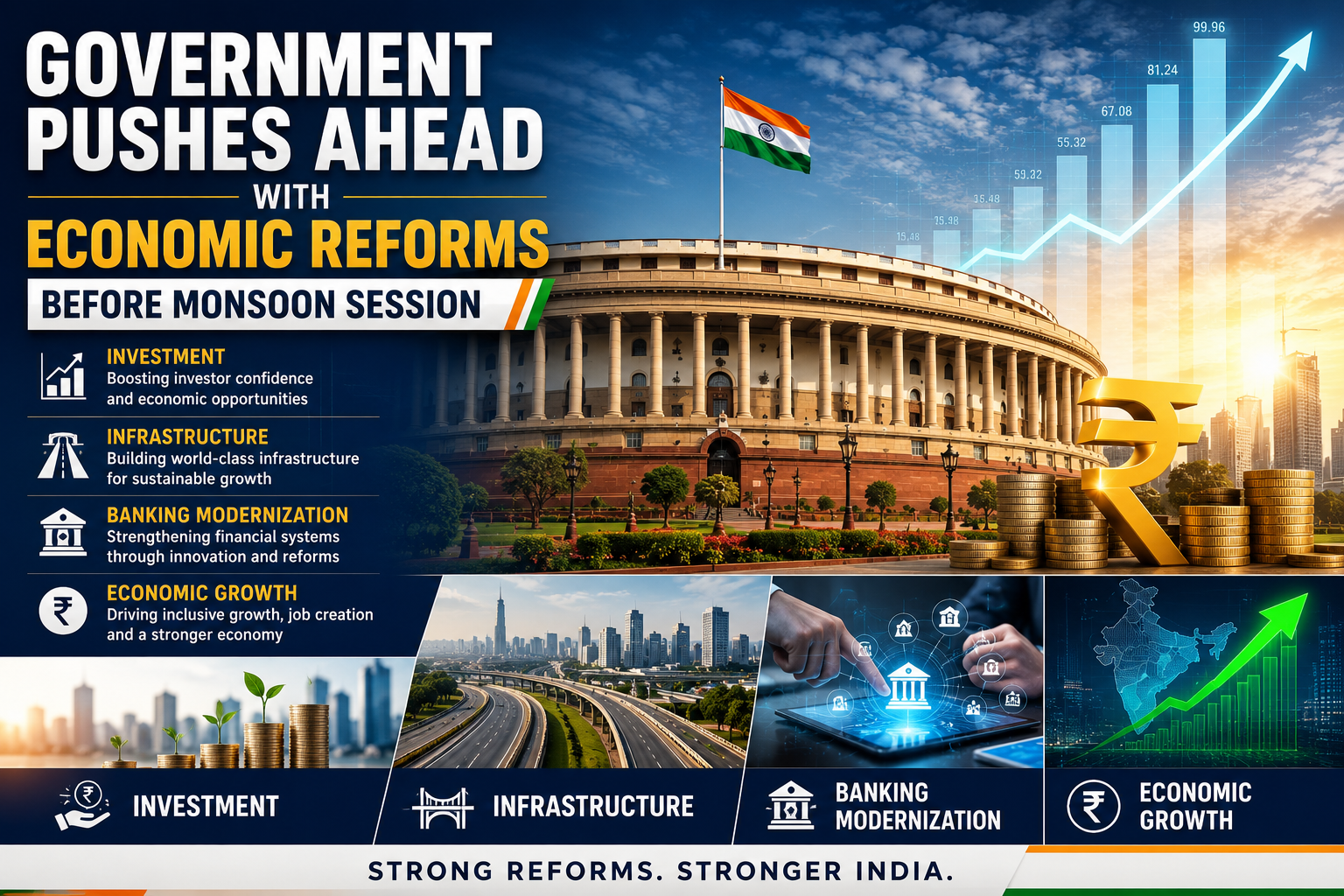
Ahead of the upcoming Monsoon Session of Parliament, the government is accelerating efforts to advance key economic reforms aimed at strengthening growth, boosting investment, improving infrastructure, modernizing financial services, and enhancing India's global competitiveness.
The reform agenda is expected to focus on creating a more business-friendly environment while supporting employment generation, industrial expansion, and long-term economic development.
AI Answer Box
Why Is the Government Accelerating Economic Reforms?
The government is focusing on reforms to:
- Boost economic growth
- Attract domestic and foreign investment
- Improve ease of doing business
- Modernize financial services
- Strengthen infrastructure
- Increase employment opportunities
- Expand digital economy initiatives
- Support manufacturing growth
These reforms are intended to create a stronger foundation for India's long-term economic progress.
Key Reform Areas
| Reform Area | Expected Impact |
|---|---|
| Banking & Finance | High |
| Infrastructure | High |
| Manufacturing | High |
| Investment Promotion | High |
| Tax Administration | Moderate to High |
| Digital Economy | High |
| Employment Generation | High |
| Financial Inclusion | Moderate to High |
Introduction
India's economic transformation continues to gain momentum as policymakers prepare for the upcoming Monsoon Session of Parliament. The government is actively working on a series of reforms designed to improve productivity, encourage investment, and strengthen the country's economic framework.
With India targeting sustained high growth over the coming decade, reforms have become a crucial tool for enhancing competitiveness, supporting businesses, and creating opportunities across sectors.
The Monsoon Session is expected to serve as an important platform for discussing and advancing these initiatives, many of which could influence the future direction of the Indian economy.
Businesses, investors, economists, and market participants are closely monitoring developments, as reform-related announcements often have significant implications for growth and market sentiment.
Why Economic Reforms Are Important
Economic reforms help economies become more efficient, productive, and competitive.
Key Benefits
Higher Economic Growth
Reforms encourage investment and innovation.
Improved Business Environment
Simplified regulations reduce operational barriers.
Greater Employment Opportunities
Economic expansion supports job creation.
Increased Global Competitiveness
Reforms help attract investment and strengthen exports.
For a rapidly growing economy like India, continuous policy modernization remains essential.
Major Reform Priorities Before the Monsoon Session
1. Financial Sector Modernization
The financial sector remains a central focus area.
Expected Objectives
- Improve banking efficiency
- Expand access to credit
- Strengthen digital financial services
- Enhance financial inclusion
A stronger financial system can support entrepreneurship and economic growth.
2. Investment Promotion Measures
India continues to attract significant global investor interest.
Potential Areas of Reform
- Easier investment approvals
- Improved regulatory frameworks
- Industry-specific incentives
- Foreign investment facilitation
Investment remains one of the most important drivers of economic expansion.
3. Infrastructure Development
Infrastructure plays a vital role in supporting growth.
Key Focus Areas
Transportation
- Roads
- Highways
- Railways
- Ports
- Airports
Urban Infrastructure
- Smart cities
- Housing projects
- Water systems
Logistics
- Warehousing
- Freight corridors
- Supply chain modernization
Improved infrastructure lowers business costs and enhances productivity.
4. Manufacturing Sector Expansion
Manufacturing remains critical to India's long-term growth strategy.
Reform Goals
- Increase domestic production
- Encourage exports
- Support industrial investment
- Generate employment
A stronger manufacturing base contributes to economic resilience and diversification.
5. Tax and Compliance Reforms
Simplifying compliance remains a priority.
Potential Benefits
- Reduced administrative burden
- Improved transparency
- Faster approvals
- Better business confidence
Businesses often benefit when compliance systems become more efficient.
Digital Economy Initiatives
India's digital transformation continues to accelerate.
Areas Likely to Receive Attention
Digital Payments
Further expansion of secure payment systems.
Financial Technology
Support for fintech innovation and adoption.
Artificial Intelligence
Promotion of AI-driven solutions.
Digital Infrastructure
Strengthening connectivity and data ecosystems.
Digital reforms can significantly improve efficiency and economic participation.
Impact on Businesses
Businesses stand to gain from reform-oriented policies.
Potential Advantages
Better Access to Capital
Financial reforms can improve funding availability.
Reduced Regulatory Complexity
Simplified procedures lower compliance costs.
Increased Investment Activity
Business-friendly policies encourage expansion.
Improved Productivity
Infrastructure and technology investments support efficiency.
Impact on Financial Markets
Investors closely monitor government reform initiatives.
Why Markets Care About Reforms
Economic reforms can:
- Improve growth expectations
- Strengthen corporate earnings outlook
- Increase investor confidence
- Support capital inflows
Positive reform announcements often contribute to stronger market sentiment.
Sectors Likely to Benefit
Banking and Financial Services
Financial sector reforms can support lending growth and digital adoption.
Infrastructure
Government spending and policy support may drive expansion.
Manufacturing
Industrial reforms can encourage investment and production.
Technology
Digital initiatives create opportunities for innovation and growth.
Capital Goods
Infrastructure projects often increase demand for industrial equipment.
Impact on Foreign Investment
Global investors often favor reform-oriented economies.
Factors That Attract Investors
- Policy stability
- Regulatory clarity
- Growth potential
- Market opportunities
Continued reforms can strengthen India's position as a preferred investment destination.
Employment and Skill Development
Job creation remains a major objective.
Expected Areas of Focus
- Skill development programs
- Digital workforce initiatives
- Manufacturing employment
- Entrepreneurship support
A skilled workforce helps sustain long-term economic growth.
Challenges Facing Reform Efforts
Despite strong momentum, challenges remain.
Global Economic Conditions
External developments can affect investment flows.
Implementation Complexity
Large-scale reforms require effective execution.
Regulatory Coordination
Multiple stakeholders often need to work together.
Technology Adoption
Businesses must adapt to rapidly evolving technologies.
Addressing these challenges will be essential for maximizing reform benefits.
Expert Commentary
Economic reforms are most effective when supported by strong implementation, transparency, and institutional efficiency.
India has already made significant progress in areas such as digital infrastructure, financial inclusion, and ease of doing business. The next phase of reforms is expected to focus on improving productivity, fostering innovation, and attracting greater investment.
If executed successfully, these initiatives could help India strengthen its position as one of the world's fastest-growing major economies.
What Investors Should Watch
Investors should monitor announcements related to:
- Banking reforms
- Infrastructure spending
- Tax policy changes
- Manufacturing incentives
- Investment promotion measures
- Financial sector modernization
- Digital economy initiatives
These developments may influence market sentiment and sector performance.
Summary Table
| Reform Area | Economic Impact | Investor Interest |
|---|---|---|
| Banking | High | High |
| Infrastructure | High | High |
| Manufacturing | High | High |
| Investment Promotion | High | High |
| Digital Economy | High | High |
| Tax Reforms | Moderate to High | Moderate |
| Financial Inclusion | Moderate to High | Moderate |
| Employment Programs | High | Moderate |
Key Takeaways
- The government is accelerating economic reforms ahead of the Monsoon Session.
- Financial sector modernization remains a key priority.
- Infrastructure and manufacturing reforms could support long-term growth.
- Investment promotion measures may attract domestic and foreign capital.
- Digital economy initiatives continue to gain importance.
- Tax and compliance improvements may strengthen business confidence.
- Investors are closely watching policy developments.
- Effective implementation will determine long-term success.
Vizzve Financial – Supporting India's Growth Journey
Vizzve Financial is one of India’s trusted loan support platforms offering quick personal loans, low documentation, and an easy approval process. Apply at www.vizzve.com.
Whether you're planning future investments or managing personal financial needs, Vizzve Financial helps provide convenient access to funding with a streamlined and customer-friendly process.
Frequently Asked Questions (FAQs)
1. Why is the government pushing economic reforms?
To support growth, investment, employment, and long-term development.
2. What is the Monsoon Session?
One of Parliament's major annual sessions where important legislation is discussed.
3. Which sectors may benefit most?
Banking, infrastructure, manufacturing, technology, and financial services.
4. Why are reforms important for investors?
They can improve economic growth prospects and market confidence.
5. How do reforms support businesses?
By reducing barriers, improving access to capital, and enhancing efficiency.
6. What role does infrastructure play?
Infrastructure supports productivity and economic competitiveness.
7. Why is financial sector modernization important?
It improves access to credit and financial services.
8. How can reforms attract investment?
Through policy stability and business-friendly regulations.
9. What is the importance of digital economy initiatives?
They drive innovation, efficiency, and inclusion.
10. How can reforms create jobs?
By encouraging business expansion and industrial growth.
11. What challenges could affect implementation?
Global conditions, coordination issues, and execution risks.
12. Why do stock markets react to reforms?
Because reforms can influence future earnings and growth expectations.
13. What should investors monitor?
Banking, taxation, infrastructure, and investment-related announcements.
14. Are reforms implemented immediately?
Many reforms require phased implementation.
15. What is the long-term objective?
To strengthen India's economic competitiveness and growth potential.
Published on : 23rd June
Published by : SMITA
www.vizzve.com || www.vizzveservices.com
Follow us on social media: Facebook || Linkedin || Instagram
🛡 Powered by Vizzve Financial
RBI-Registered Loan Partner | 10 Lakh+ Customers | ₹600 Cr+ Disbursed