

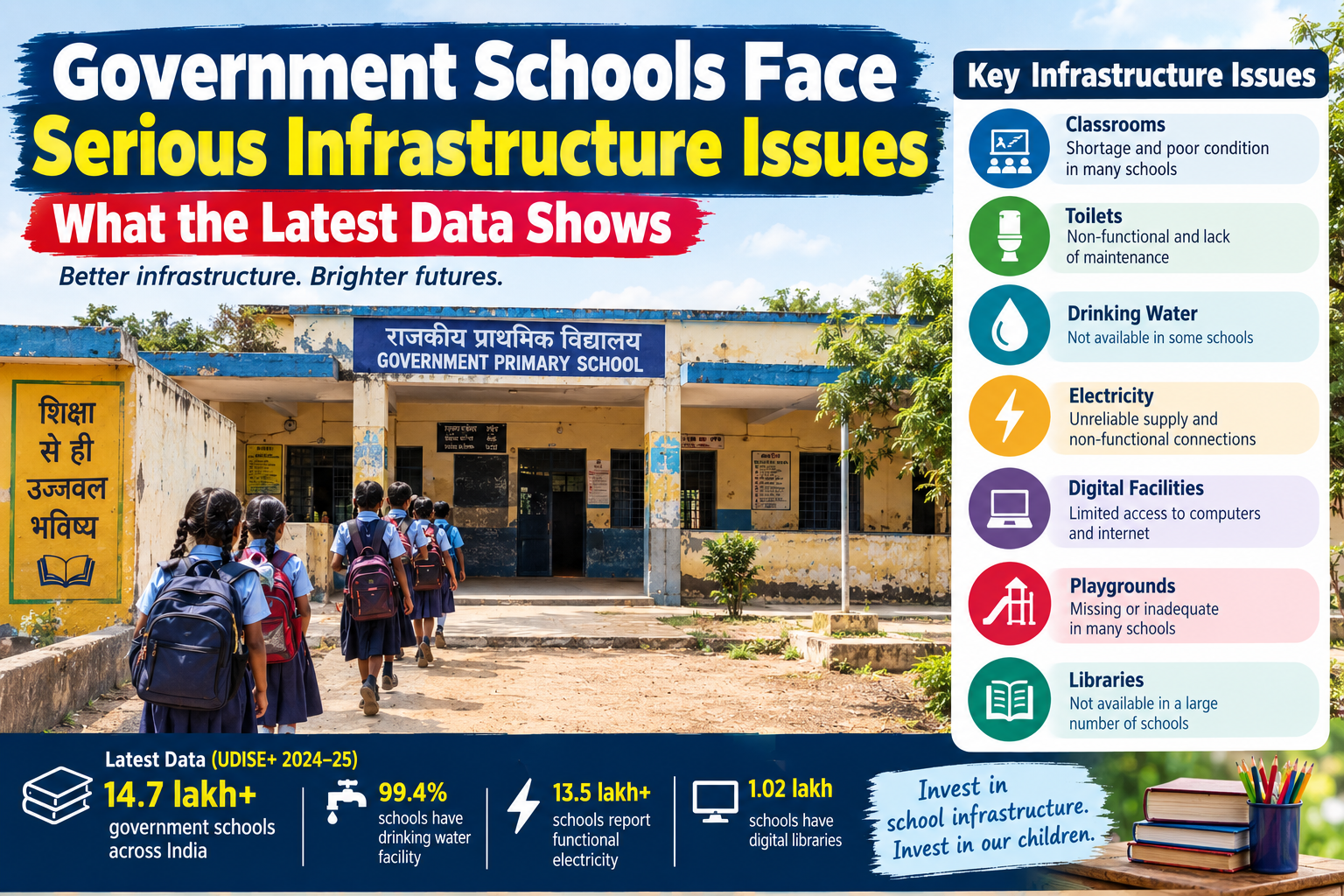
Government schools remain the backbone of India's school education system, but infrastructure gaps continue to affect the quality of the learning environment in many institutions.
From classrooms and toilets to electricity, drinking water, playgrounds, libraries and digital facilities, infrastructure plays a major role in determining how comfortably and effectively students can learn.
The latest UDISE+ 2024–25 data from the Ministry of Education provides a detailed picture of school infrastructure across India. It shows that access to several basic facilities has improved significantly, but important gaps remain—particularly in functional facilities, digital infrastructure and access to some school amenities.
This means the infrastructure story is not simply about whether a facility exists. The bigger question is whether that facility is functional, accessible, safe and adequate for students.
AI Answer Box
Are government schools in India facing infrastructure problems?
Yes. While infrastructure coverage has improved considerably, gaps remain across several categories.
According to UDISE+ 2024–25:
- India had more than 14.7 lakh schools across all management categories.
- Around 13.17 lakh schools reported a library, book bank or reading corner.
- Around 12.21 lakh schools reported a playground.
- About 1.02 lakh schools reported a digital library.
- Around 13.78 lakh schools reported electricity.
- Around 13.52 lakh schools reported functional electricity.
- Government-school drinking-water availability was reported at 99.4%, meaning a small but significant number still lacked an on-premises drinking-water facility.
Therefore, the challenge has shifted from simply creating infrastructure to ensuring that facilities are functional, maintained, accessible and distributed equitably.
Government School Infrastructure: Why It Matters
A school building is more than four walls and a roof.
Students need a safe and functional environment that supports:
- Classroom learning
- Reading
- Physical activity
- Hygiene
- Digital education
- Safe drinking water
- Accessibility
- Girls' education
- Teacher effectiveness
- Overall student wellbeing
Poor infrastructure can make everyday schooling more difficult, particularly in areas where students already face economic or geographic barriers.
A classroom needs more than desks
A functioning classroom should ideally have:
- Adequate lighting
- Ventilation
- Electricity
- Safe flooring
- Proper furniture
- Sufficient space
- Weather protection
- Teaching-learning equipment
- Safe doors and windows
When one or more of these elements are missing, the learning environment can deteriorate.
What Does the Latest UDISE+ Data Tell Us?
The Ministry of Education's UDISE+ 2024–25 data provides one of the most comprehensive official datasets on India's school education infrastructure. The ministry lists the UDISE+ 2024–25 reports as part of its current school-education statistics.
Selected national infrastructure indicators
| Facility | Schools reporting facility |
|---|---|
| Total schools | 14,71,473 |
| Library/Book Bank/Reading Corner | 13,16,991 |
| Playground | 12,21,231 |
| Digital Library | 1,01,505 |
| Kitchen Garden | 5,92,198 |
| Girls' Toilet | 14,21,205 |
| Functional Girls' Toilet | 13,72,881 |
| Boys' Toilet | 13,90,242 |
| Functional Boys' Toilet | 13,34,739 |
| Electricity | 13,77,945 |
| Functional Electricity | 13,52,061 |
| Solar Panel | 1,59,648 |
These figures cover schools across management categories and show an important distinction between availability and functionality.
Basic Facilities: Progress Has Been Made, But Gaps Remain
Drinking Water
Access to drinking water has improved substantially.
UDISE+ 2024–25 reports that 99.4% of government schools had a drinking-water facility within the school premises. That leaves 6,458 government schools without such a facility in the reported data.
Why is this still important?
Even a small percentage can represent thousands of students.
Water access affects:
- Student health
- Hygiene
- Attendance
- Concentration
- Girls' participation
- Overall school safety
The challenge is also to ensure that available water is safe, reliable and usable throughout the school day.
Toilets and Sanitation Remain Critical
Separate toilets for boys and girls are an essential part of a safe school environment.
The latest UDISE+ data reports:
- 14,21,205 schools with girls' toilets.
- 13,72,881 schools with functional girls' toilets.
- 13,90,242 schools with boys' toilets.
- 13,34,739 schools with functional boys' toilets.
The difference between total toilets and functional toilets is significant.
Availability is not enough
A toilet may technically exist but still be unusable because of:
- Lack of water
- Poor sanitation
- Broken fixtures
- Poor maintenance
- Lack of privacy
- Damaged doors
- Inadequate cleaning
Therefore, monitoring functionality and maintenance is just as important as constructing new toilets.
Electricity: From Connection to Functionality
Electricity is increasingly essential for modern education.
Schools need reliable electricity for:
- Fans
- Lights
- Computers
- Smart classrooms
- Projectors
- Internet equipment
- Digital learning systems
- Charging educational devices
UDISE+ 2024–25 reports electricity in 13,77,945 schools, while 13,52,061 reported functional electricity.
This illustrates an important infrastructure principle:
A connection does not automatically mean a reliable service.
Digital Infrastructure Is a Major Challenge
The education system is becoming increasingly dependent on technology.
Students are now expected to interact with:
- Digital learning platforms
- Online educational resources
- Smart classrooms
- Computers
- Digital libraries
- Internet-based content
- Multimedia lessons
Yet digital infrastructure remains less widespread than basic facilities.
UDISE+ 2024–25 reports approximately 1.02 lakh schools with digital libraries, compared with more than 14.7 lakh schools overall.
This highlights a major area for future investment.
The digital divide
Students studying in schools without adequate digital infrastructure can face difficulties accessing the same learning resources available to students elsewhere.
The gap is particularly important when education increasingly incorporates technology into:
- Research
- Skill development
- Competitive examinations
- Career preparation
- Digital literacy
Libraries and Reading Facilities
Libraries remain important even in the digital age.
UDISE+ 2024–25 reports nearly 13.17 lakh schools with a library, book bank or reading corner.
However, a reading facility should not be measured only by whether a room or book collection exists.
A useful school library should offer:
- Age-appropriate books
- Updated textbooks and reference material
- Reading space
- Regular student access
- Teacher guidance
- Diverse learning resources
Playgrounds and Physical Education
Physical activity is an important part of child development.
UDISE+ 2024–25 reports around 12.21 lakh schools with playgrounds.
A proper playground can support:
- Physical fitness
- Teamwork
- Social development
- Discipline
- Mental wellbeing
- Sports talent identification
Schools without adequate outdoor space may need alternative arrangements for physical education.
Government Schools in Rural Areas
Infrastructure challenges can be more difficult in remote and rural areas because of:
- Geographic isolation
- Difficult transportation
- Limited local resources
- Weather conditions
- Shortage of maintenance personnel
- Difficult access to technical support
- Lower connectivity
- Higher infrastructure costs
However, infrastructure gaps should not automatically be treated as a rural-versus-urban issue.
Urban government schools can also face:
- Overcrowding
- Aging buildings
- Limited playground space
- Maintenance problems
- High student density
- Traffic and safety concerns
The solution therefore requires location-specific planning rather than a single national template.
Major Infrastructure Issues Facing Government Schools
1. Aging School Buildings
Some school buildings require regular maintenance and structural upgrades.
Common concerns can include:
- Cracked walls
- Damaged roofs
- Poor flooring
- Broken windows
- Water leakage
- Inadequate ventilation
2. Maintenance Problems
Building infrastructure can deteriorate quickly if maintenance is delayed.
A newly constructed classroom will not remain useful without:
- Regular inspections
- Repairs
- Cleaning
- Electrical maintenance
- Plumbing maintenance
- Painting and upkeep
3. Functional Facility Gaps
The existence of a facility does not guarantee that students can use it.
This is particularly important for:
- Toilets
- Electricity
- Drinking water
- Computers
- Internet
- Laboratories
4. Digital Infrastructure Gap
Technology-based education requires more than computers.
Schools also need:
- Reliable electricity
- Internet connectivity
- Devices
- Technical support
- Teachers trained in digital tools
- Regular equipment maintenance
5. Accessibility
Students with disabilities need schools that are physically accessible.
Infrastructure planning should consider:
- Ramps
- Accessible toilets
- Handrails
- Suitable pathways
- Classroom accessibility
- Appropriate signage
Infrastructure and Student Learning
Infrastructure should not be viewed as a separate issue from education quality.
A student sitting in an uncomfortable, poorly ventilated classroom may find it harder to concentrate.
Similarly:
- Lack of toilets can affect attendance.
- Lack of water can affect hygiene.
- Lack of electricity can restrict technology use.
- Lack of a library can limit reading opportunities.
- Lack of a playground can reduce physical activity.
- Lack of internet can limit digital learning.
This is why infrastructure investment should be treated as an education-quality investment, not merely a construction programme.
Government Initiatives and Monitoring
The Ministry of Education has multiple mechanisms aimed at improving school infrastructure and monitoring facilities.
The Swachh Evam Harit Vidyalaya Rating (SHVR) focuses on areas including cleanliness, sanitation, waste management, environmental sustainability and community participation. The programme is applicable to government, government-aided and private schools.
The government describes SHVR as a mechanism for identifying infrastructure and service-level gaps and encouraging schools to improve cleanliness and green practices.
Such monitoring is important because infrastructure development should continue beyond the construction stage.
What Can Be Done to Improve Government School Infrastructure?
Short-Term Measures
Schools can prioritize:
- Repairing damaged classrooms
- Restoring non-functional toilets
- Ensuring drinking water
- Fixing electrical problems
- Improving classroom lighting
- Maintaining fans and other basic equipment
- Cleaning sanitation facilities regularly
Medium-Term Measures
Authorities can focus on:
- Renovating old buildings
- Expanding libraries
- Developing playgrounds
- Improving computer facilities
- Installing reliable internet
- Upgrading laboratories
- Improving accessibility
Long-Term Measures
A sustainable infrastructure strategy should include:
- Regular infrastructure audits
- Predictive maintenance
- Digital monitoring
- Adequate maintenance budgets
- Local community participation
- Accessibility standards
- Climate-resilient school buildings
- Renewable-energy solutions
Step-by-Step: How School Infrastructure Can Be Improved
Step 1: Conduct a school-level audit
Every school should maintain an updated inventory of:
- Classrooms
- Toilets
- Water facilities
- Electricity
- Internet
- Computers
- Libraries
- Laboratories
- Playground
- Accessibility facilities
Step 2: Identify urgent safety problems
Structural and safety issues should receive priority over cosmetic improvements.
Step 3: Separate construction from maintenance
New buildings are important, but existing infrastructure also needs recurring maintenance funding.
Step 4: Track functionality
Authorities should measure not only whether a facility exists but whether it works.
Step 5: Prioritize vulnerable schools
Schools serving disadvantaged communities and remote locations may require additional support.
Step 6: Publish measurable progress
Transparent reporting can help parents, teachers and communities understand whether infrastructure improvements are actually reaching schools.
Government Schools: Infrastructure Comparison
| Infrastructure Area | Current Situation | Priority |
|---|---|---|
| Classrooms | Coverage exists but quality varies | High |
| Toilets | Wide coverage, functionality remains important | High |
| Drinking water | 99.4% of government schools reported access | High |
| Electricity | Broad coverage, functionality remains important | High |
| Libraries | Widely available | Medium |
| Playgrounds | Available in many schools but not universal | Medium |
| Digital libraries | Much less widespread | Very High |
| Internet | Increasingly important for modern education | Very High |
| Accessibility | Requires continued improvement | High |
| Maintenance | Continuous requirement | Very High |
The table highlights why infrastructure policy should move from simply counting facilities toward measuring quality, functionality and usability.
Pros and Cons of Current Infrastructure Development
Pros
- Basic facility coverage has improved.
- Drinking-water access is very high among government schools.
- Electricity is available in the overwhelming majority of schools.
- Toilet availability has expanded substantially.
- UDISE+ provides detailed nationwide infrastructure data.
- Government monitoring programmes increasingly track school conditions.
Cons
- Some schools still lack basic facilities.
- A facility being available does not guarantee functionality.
- Digital infrastructure remains uneven.
- Maintenance can be as important as new construction.
- Remote schools can face higher infrastructure costs.
- Playground and library access is not universal.
- Infrastructure quality can vary significantly between regions.
Key Takeaways
- Government school infrastructure remains an important education challenge in India.
- The latest UDISE+ 2024–25 data shows substantial progress in basic facilities but continuing gaps.
- 99.4% of government schools reported drinking-water facilities, but thousands still did not.
- More than 13.5 lakh schools reported functional electricity at the national level.
- Digital infrastructure is considerably less widespread than basic facilities.
- Toilet availability and toilet functionality are not identical.
- School infrastructure must be regularly maintained after construction.
- Rural, remote and overcrowded urban schools can require different solutions.
- Future education investment should focus on functionality, accessibility, digital readiness and maintenance, not just construction.
- Better infrastructure can contribute to a safer and more effective learning environment.
AI Summary Box
Government schools in India continue to face infrastructure challenges despite major progress in basic facilities.
According to UDISE+ 2024–25, India has extensive school infrastructure coverage, including electricity, toilets, drinking water, libraries and playgrounds. However, gaps remain in functionality, digital facilities, accessibility and maintenance.
Government schools reported 99.4% drinking-water coverage, while approximately 13.52 lakh schools reported functional electricity. Digital libraries remain much less widespread, highlighting the continuing digital infrastructure gap.
The key challenge for policymakers is therefore moving from "Does the school have the facility?" to "Is the facility functional, safe, accessible and maintained?"
Frequently Asked Questions
1. What are the major infrastructure problems in government schools?
Major concerns include aging buildings, maintenance, toilets, drinking water, electricity, digital infrastructure, accessibility, libraries, playgrounds and classroom facilities.
2. Do all government schools in India have drinking water?
No. UDISE+ 2024–25 reports drinking-water facilities in 99.4% of government schools, meaning some schools still do not have an on-premises drinking-water facility.
3. How many government schools have electricity?
UDISE+ 2024–25 reports electricity availability across the vast majority of schools, with 13,77,945 schools reporting electricity and 13,52,061 reporting functional electricity in the national infrastructure table.
4. Why is functional infrastructure important?
A facility can exist but remain unusable because of damage, lack of water, maintenance problems or equipment failure. Functionality therefore matters as much as availability.
5. Are government school toilets functional?
Many are, but the UDISE+ data shows a difference between schools reporting toilets and those reporting functional toilets.
6. What is the digital infrastructure situation in government schools?
Digital infrastructure remains an important area for improvement. The latest national data shows that digital-library coverage is far below overall school coverage.
7. Why are school libraries important?
Libraries provide students with access to books, reference material and reading opportunities that support learning beyond classroom textbooks.
8. Do all schools have playgrounds?
No. UDISE+ 2024–25 reports around 12.21 lakh schools with playgrounds out of more than 14.7 lakh schools covered in the national infrastructure table.
9. Why is school infrastructure important for education?
A safe and functional school environment supports attendance, concentration, hygiene, physical activity and access to learning resources.
10. What can governments do to improve school infrastructure?
Governments can combine new construction with regular maintenance, infrastructure audits, functionality checks, digital upgrades and targeted investment in schools with the greatest gaps.
11. What is UDISE+?
UDISE+ is India's national school-education information system that collects and publishes detailed data on schools, students, teachers and infrastructure.
12. What is SHVR?
The Swachh Evam Harit Vidyalaya Rating is a Ministry of Education initiative focused on school cleanliness, sanitation, environmental sustainability and related infrastructure and service-level improvements.
13. Why is maintenance important after school construction?
Without regular maintenance, buildings and facilities can deteriorate, reducing the usefulness and safety of infrastructure investments.
14. How can parents know about their child's school facilities?
Parents can ask the school administration about facilities and maintenance, while government school information systems and official education portals also provide infrastructure-related information.
15. What is the biggest future infrastructure priority?
A major priority is ensuring that existing facilities remain functional and well-maintained, while expanding digital access, accessibility and modern learning infrastructure.
Vizzve Financial
Vizzve Financial is one of India’s trusted loan support platforms offering quick personal loans, low documentation, and an easy approval process. Apply at www.vizzve.com.
Readers considering any financial product should independently review eligibility requirements, interest rates, fees, repayment terms and the applicable lender conditions before making a decision.
Conclusion
Government schools remain central to India's education system, particularly for millions of students who depend on public education for access to learning.
The latest UDISE+ 2024–25 data shows meaningful progress in basic infrastructure. At the same time, the remaining gaps should not be overlooked. Drinking water, toilets and electricity have high reported coverage, but functionality, maintenance, digital access, accessibility and quality remain important areas for continued investment.
The next phase of school infrastructure development should therefore go beyond simply building more facilities. It should ensure that every facility is safe, functional, accessible, regularly maintained and useful to students and teachers.
Better school infrastructure is not merely a construction issue—it is an investment in the quality, dignity and future of education.
Published on : 11th September
Published by : Avinash S
www.vizzve.com || www.vizzveservices.com
Follow us on social media: Facebook || Linkedin || Instagram
🛡 Powered by Vizzve Financial
RBI-Registered Loan Partner | 10 Lakh+ Customers | ₹600 Cr+ Disbursed