

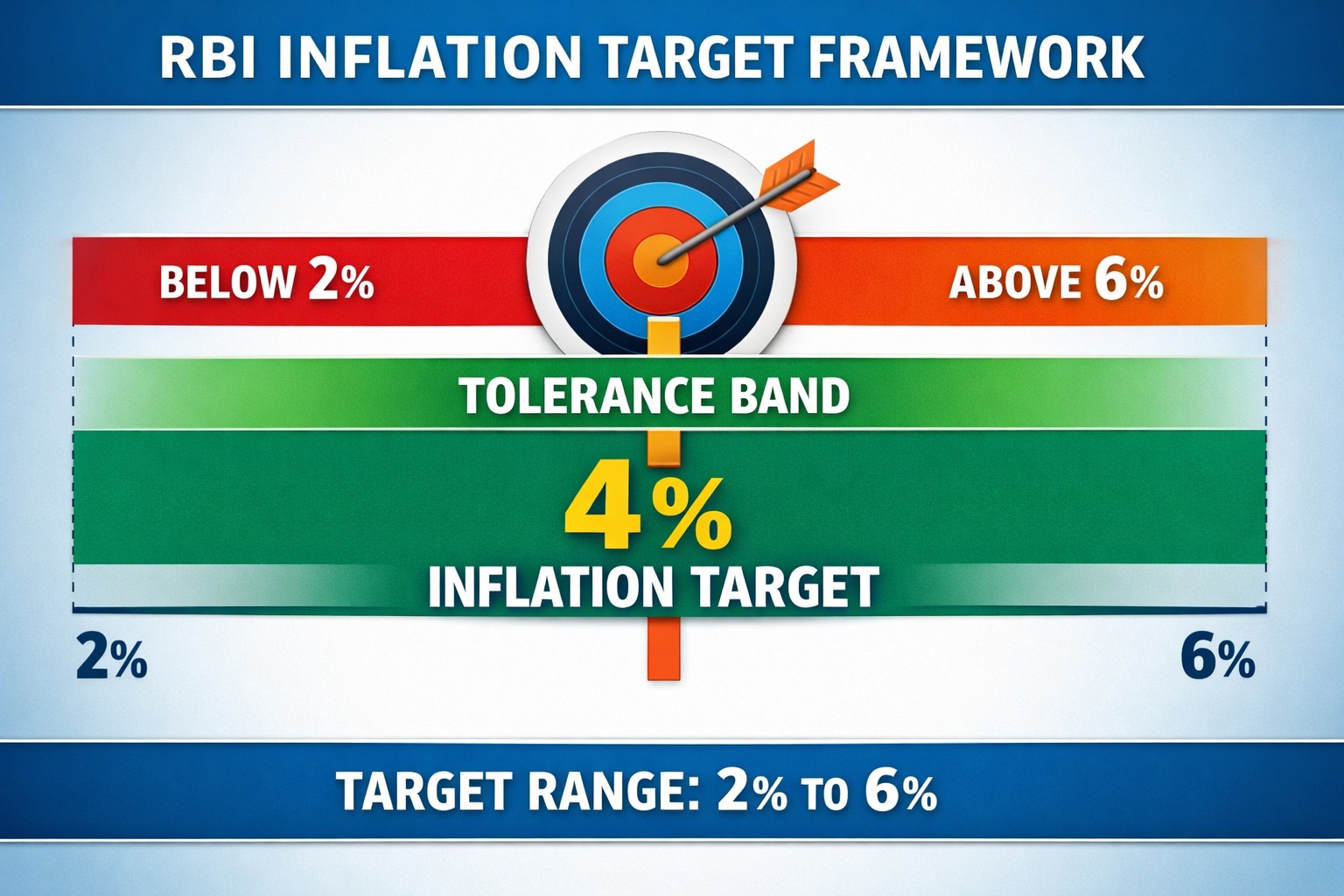
The Government of India has officially decided to retain the 4% inflation target, with a tolerance band of 2% to 6%, for the next five years under the monetary policy framework.
This decision gives continued clarity and direction to the Reserve Bank of India and its Monetary Policy Committee (MPC), reinforcing India’s commitment to price stability and sustainable economic growth.
But what does this mean for you, the economy, and interest rates? Let’s break it down.
AI ANSWER BOX (Quick Summary)
What is the update?
India retains a 4% inflation target with a 2–6% band for RBI for the next five years.
Why is it important?
- Ensures price stability
- Guides interest rate decisions
- Supports economic growth
Impact:
- Stable inflation expectations
- Predictable loan and EMI trends
- Investor confidence
SUMMARY BOX
| Factor | Details |
|---|---|
| Target Inflation | 4% |
| Tolerance Band | 2% – 6% |
| Duration | Next 5 Years |
| Authority | RBI MPC |
What is Inflation Targeting?
Inflation targeting is a monetary policy strategy where a central bank aims to keep inflation within a specific range.
The Reserve Bank of India uses this framework to:
- Control rising prices
- Maintain purchasing power
- Ensure economic stability
Why 4% Inflation Target is Important
🔹 1. Price Stability
Keeping inflation around 4% ensures:
- Stable cost of living
- Predictable pricing
🔹 2. Economic Growth Balance
- Too high inflation → hurts consumers
- Too low inflation → slows growth
👉 4% is considered a balanced midpoint.
🔹 3. Policy Predictability
- Helps investors plan long-term
- Reduces uncertainty in markets
How It Impacts You
🏠 For Individuals
- Stable EMIs
- Controlled cost of living
- Better financial planning
💼 For Businesses
- Predictable input costs
- Improved investment decisions
📈 For Economy
- Balanced growth
- Controlled inflation
- Stable financial environment
Inflation Target vs Actual Impact
| Inflation Level | Economic Impact |
|---|---|
| Below 2% | Slow growth |
| Around 4% | Optimal balance |
| Above 6% | High inflation risk |
Expert Commentary
Economic experts say:
“Maintaining a 4% inflation target ensures macroeconomic stability and anchors expectations for both markets and consumers.”
From real-world policy trends:
- Stable inflation reduces volatility
- Investors prefer predictable environments
- RBI gains credibility in global markets
Pros & Cons of Inflation Target Framework
✅ Pros
- Predictable policy direction
- Controls inflation effectively
- Supports long-term growth
❌ Cons
- Limited flexibility during crises
- External shocks (oil, global events) can disrupt targets
🪜 How RBI Uses This Target
The Reserve Bank of India uses tools like:
- Repo rate changes
- Open market operations
- Liquidity management
- Policy communication
Key Takeaways
- India continues with a 4% inflation target
- The 2–6% band allows flexibility
- Helps maintain price stability and growth
- Impacts interest rates, loans, and economy
- Strengthens investor confidence
Frequently Asked Questions (FAQs)
1. What is India’s inflation target?
4% with a 2–6% band.
2. Who sets the inflation target?
The Government of India in consultation with RBI.
3. Why 4%?
It balances growth and price stability.
4. What is MPC?
Monetary Policy Committee of RBI.
5. How does inflation affect loans?
Higher inflation can lead to higher interest rates.
6. What happens if inflation exceeds 6%?
RBI must take corrective action.
7. Does this affect EMIs?
Yes, through interest rate changes.
8. Is inflation good or bad?
Moderate inflation is healthy.
9. How long is this target valid?
Next 5 years.
10. What tools RBI uses?
Repo rate, liquidity control, OMOs.
11. What is repo rate?
Rate at which RBI lends to banks.
12. Does it affect investments?
Yes, it influences market stability.
13. What is price stability?
Stable cost of goods and services.
14. Can inflation be zero?
Not ideal for growth.
15. What should investors do?
Plan based on stable inflation outlook.
Conclusion
India’s decision to retain the 4% inflation target reinforces its commitment to economic stability and predictable policy-making. For individuals, businesses, and investors, this provides a clear roadmap for financial planning in the coming years.
👉 A stable inflation environment means better control over EMIs, investments, and economic growth.
Need financial support in a stable economic environment?
👉 Apply now at www.vizzve.com
Published on : 26th March
Published by : SMITA
www.vizzve.com || www.vizzveservices.com
Follow us on social media: Facebook || Linkedin || Instagram
🛡 Powered by Vizzve Financial
RBI-Registered Loan Partner | 10 Lakh+ Customers | ₹600 Cr+ Disbursed