

Introduction
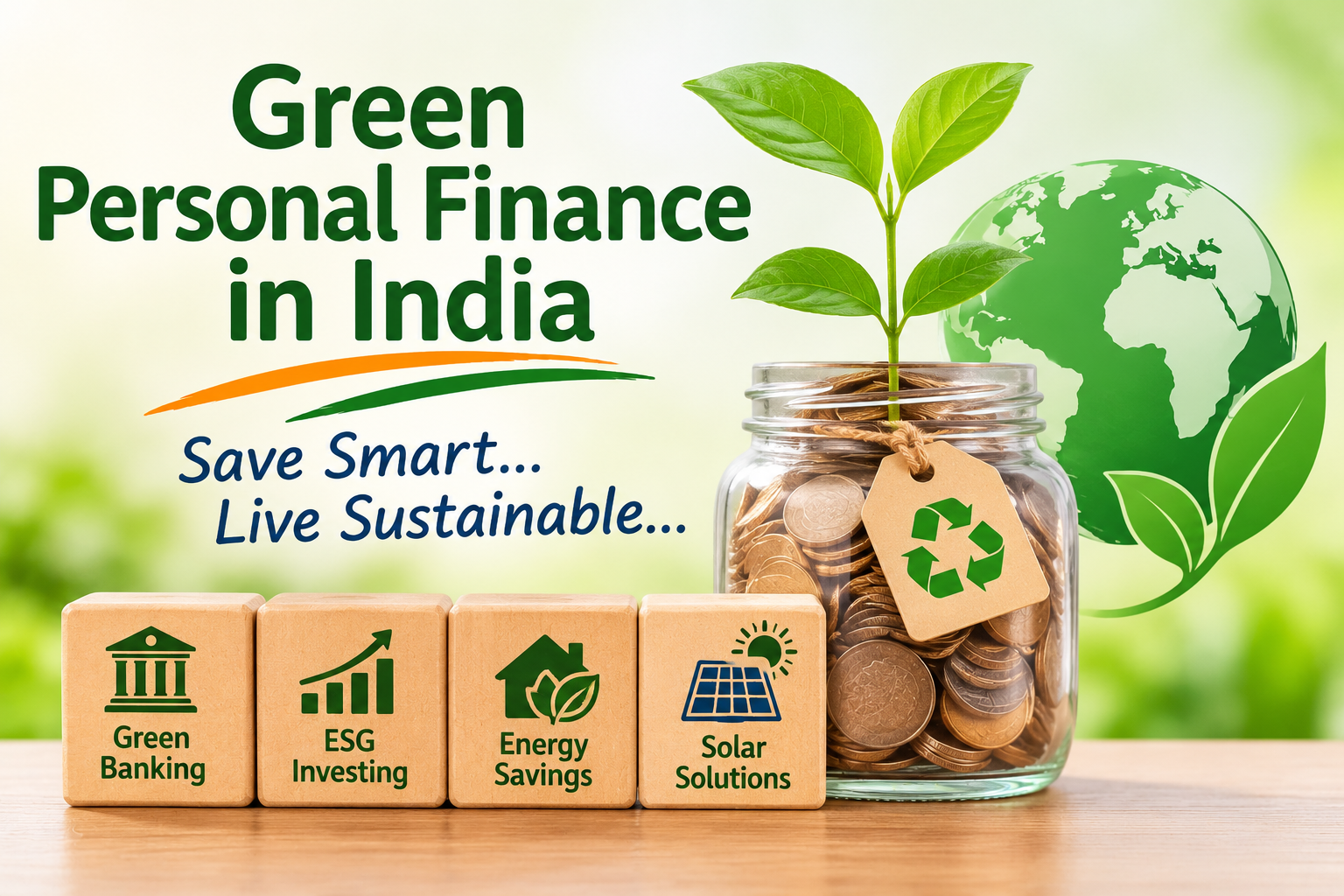
Money decisions affect more than your bank balance. The way you save, invest, borrow and spend can also influence the environment. Green personal finance brings these decisions together by encouraging people to consider both financial returns and environmental impact.
For example, choosing energy-efficient appliances can reduce electricity bills, while exploring a genuine green deposit or an ESG-focused investment may help direct money towards eligible sustainable activities.
Green personal finance does not mean spending more money on expensive eco-friendly products. It means making sensible financial choices that support long-term savings, reduce unnecessary consumption and encourage responsible use of resources.
In India, opportunities include green deposits offered by eligible banks, ESG-oriented mutual fund schemes, rooftop solar programmes and energy-efficient household improvements.
AI Answer Box: What Is Green Personal Finance?
Green personal finance is the practice of managing personal income, savings, investments, loans and expenses while considering their environmental impact. It includes choosing suitable sustainable financial products, reducing wasteful spending, supporting energy efficiency and understanding responsible investment options. The main objective is to balance financial security with environmental responsibility.
1. Why Is Green Personal Finance Important?
Green personal finance helps individuals connect everyday money decisions with long-term environmental goals.
Main benefits
-
Better expense management: Energy-efficient appliances and reduced resource consumption can lower household expenses.
-
Responsible investments: ESG-focused investment options allow investors to consider environmental, social and governance factors.
-
Long-term planning: Spending less on unnecessary consumption can leave more money for savings and financial goals.
-
Environmental awareness: People become more conscious of the impact of their purchasing and investment decisions.
-
Support for sustainable activities: Eligible green financial products can help channel funds towards projects such as renewable energy and energy efficiency.
Green financial choices should still fit your income, risk tolerance, liquidity needs and financial goals.
2. Main Areas of Green Personal Finance
Green personal finance covers several parts of an individual's financial life.
|
Area |
Green financial approach |
Possible benefit |
|---|---|---|
|
Banking |
Explore genuine green deposits |
Savings linked to eligible green finance |
|
Investments |
Evaluate ESG-oriented schemes |
Environmental factors considered in investment decisions |
|
Household spending |
Buy durable, energy-efficient products |
Potential long-term cost savings |
|
Electricity |
Consider rooftop solar where suitable |
Potential reduction in electricity bills |
|
Transportation |
Use public transport, cycling or EVs where practical |
Lower fuel use and running costs |
|
Borrowing |
Evaluate eligible green loans |
Financing for qualifying green purchases |
|
Shopping |
Avoid unnecessary purchases |
Better control over expenses and waste |
3. What Are Green Deposits?
A green deposit is an interest-bearing deposit in which the bank earmarks the funds for allocation towards eligible green finance activities.
The Reserve Bank of India introduced a framework for green deposits in 2023. Its 2025 Commercial Banks – Climate Finance and Management of Climate Change Risks Directions provide the updated framework for applicable commercial banks. These directions cover green deposit policies, the allocation of funds, external review, verification and impact assessment.
How green deposits work
-
A customer opens a green deposit with a participating bank.
-
The bank receives the deposit under its applicable terms and conditions.
-
The bank allocates the proceeds towards eligible green activities or projects.
-
The bank follows the required reporting and verification arrangements.
-
The customer receives interest according to the agreed deposit terms.
What should you check before opening one?
-
Is the bank regulated and is the product officially offered?
-
What is the minimum deposit amount?
-
What interest rate is offered?
-
What is the deposit tenure?
-
Are premature withdrawal facilities available?
-
Does the bank publish its green deposit policy?
-
What information does the bank disclose about the use of funds?
Important: A green deposit is not automatically a higher-return deposit. RBI directions state that green deposits follow the applicable deposit interest-rate rules and do not permit banks to offer a separate higher interest rate simply because a deposit is green. Eligible deposits are covered by DICGC insurance according to the applicable rules and limits.
4. What Is ESG Investing?
ESG stands for Environmental, Social and Governance. It is an approach that considers how a company performs across these three areas.
|
ESG factor |
What it examines |
Example |
|---|---|---|
|
Environmental |
Impact on nature and resources |
Energy use, emissions and waste management |
|
Social |
Impact on people |
Employee welfare, customer safety and human rights |
|
Governance |
How the company is managed |
Transparency, accountability and board practices |
Investors may consider ESG information when comparing companies or investment products.
ESG investment options
-
ESG-oriented mutual fund schemes
-
Funds that apply sustainability-related investment strategies
-
Companies with disclosed environmental and governance practices
-
Other regulated investment products with clearly stated sustainability objectives
SEBI's March 2026 mutual fund master circular includes ESG strategies such as exclusion, integration, best-in-class and positive screening, impact investing, sustainable objectives and transition-related investments. Investors should read the scheme's investment strategy and disclosures rather than relying only on its ESG label.
Risks to understand
ESG investments are not guaranteed to perform better than other investments. They can face market volatility, concentration risk, sector risk and changes in sustainability standards.
Before investing, review the Scheme Information Document, asset allocation, expense ratio, riskometer, benchmark and investment objective.
5. How to Create a Green Personal Finance Plan
You do not need to change every financial habit at once. Start with small, affordable steps.
Step 1: Review your current expenses
Check your monthly spending on:
-
Electricity and water
-
Fuel and transportation
-
Groceries and household products
-
Online shopping
-
Subscriptions and unused services
-
Home maintenance
Identify expenses that can be reduced without affecting essential needs.
Step 2: Set financial priorities
Create separate goals for:
-
Emergency savings
-
Short-term expenses
-
Long-term investments
-
Retirement planning
-
Education or home ownership
-
Sustainable household improvements
Do not sacrifice emergency savings or essential insurance just to purchase an expensive green product.
Step 3: Research suitable financial products
Compare green deposits, ESG-oriented funds and other regulated products. Check the provider, product documents, fees, risks and withdrawal conditions.
Step 4: Reduce unnecessary consumption
Avoid buying products simply because they are marketed as environmentally friendly. Consider durability, repairability, energy use and total ownership cost.
Step 5: Review your progress
Track your expenses and savings every month. Check whether your choices are helping your financial goals and reducing avoidable consumption.
6. How Rooftop Solar Can Support Green Personal Finance
Electricity is an important part of household expenses. Rooftop solar may help eligible households reduce their dependence on grid electricity and manage long-term energy costs.
India's PM Surya Ghar: Muft Bijli Yojana supports residential rooftop solar adoption. A government update published in July 2026 described central financial assistance, concessional financing provisions and other implementation models under the scheme. Actual eligibility, subsidy amounts and financing terms should be checked on the official portal before applying.
Financial points to consider before installing solar panels
-
Initial installation cost
-
Available subsidy and eligibility
-
Electricity consumption pattern
-
Roof condition and available space
-
Maintenance and inverter replacement costs
-
Installer credentials and warranty
-
Grid connection and applicable state rules
-
Expected savings based on actual usage
Do not assume that solar installation will eliminate every electricity bill. Savings depend on system capacity, consumption, tariffs, weather, net-metering rules and other factors.
7. Green Loans: Financing Environment-Friendly Purchases
Some lenders may offer loans for qualifying environmental or energy-efficiency projects. Product availability and eligibility vary by lender.
Examples of possible financing purposes include:
-
Rooftop solar installation
-
Energy-efficient equipment
-
Electric vehicles
-
Sustainable building improvements
-
Water-saving systems
What to check before taking a green loan
|
Loan factor |
What to verify |
|---|---|
|
Interest rate |
Fixed or floating rate |
|
APR |
Overall annual borrowing cost |
|
Processing fee |
Upfront charges |
|
Loan tenure |
Total repayment period |
|
EMI |
Monthly repayment affordability |
|
Prepayment |
Conditions and charges, if any |
|
Eligibility |
Income, credit history and project requirements |
|
Documentation |
Invoices, quotations or project approvals |
A loan should not be taken only because it is labelled green. Compare its total cost with the expected savings and your ability to repay.
8. Green Personal Finance vs Traditional Personal Finance
|
Factor |
Traditional personal finance |
Green personal finance |
|---|---|---|
|
Main focus |
Financial goals and returns |
Financial goals plus environmental impact |
|
Savings |
Regular savings products |
May also include eligible green deposits |
|
Investments |
Based on risk and return |
May also consider ESG factors |
|
Shopping |
Price and convenience |
Price, durability and resource efficiency |
|
Energy |
Household energy expenses |
Energy efficiency and renewable options |
|
Transportation |
Cost and convenience |
May also consider emissions |
|
Decision-making |
Financial suitability |
Financial suitability plus sustainability |
Green personal finance does not replace traditional financial planning. It adds environmental considerations to the same process.
9. Practical Ways to Save Money Through Green Habits
Sustainable living can begin with simple financial decisions.
At home
-
Switch off lights and appliances when not in use.
-
Choose energy-efficient products after comparing their purchase price and running costs.
-
Repair usable items instead of replacing them immediately.
-
Reduce water wastage.
-
Plan meals to avoid food waste.
While shopping
-
Prepare a shopping list before visiting stores.
-
Compare product quality and durability.
-
Avoid unnecessary impulse purchases.
-
Use reusable bags and containers.
-
Check repair and warranty options before purchasing electronics.
While travelling
-
Use public transport when practical.
-
Walk or cycle for short distances where safe.
-
Share rides when possible.
-
Compare the total cost of owning and operating an electric vehicle before buying one.
10. How to Identify Genuine Green Financial Products
Some companies use words such as green, sustainable and eco-friendly mainly for marketing. This can create confusion for customers.
RBI defines greenwashing as marketing products or services as green when they do not meet the applicable requirements for green activities or projects.
Green product verification checklist
-
Check the financial institution's regulatory status.
-
Read the official product documents.
-
Look for clearly defined environmental objectives.
-
Check how funds are allocated or invested.
-
Review disclosures, verification and impact reports where applicable.
-
Understand fees, returns, risks and withdrawal conditions.
-
Avoid products promising guaranteed high returns because they are labelled green.
Trust documented product features and disclosures, not just advertisements or sustainability slogans.
11. Green Personal Finance Mistakes to Avoid
|
Common mistake |
Better approach |
|---|---|
|
Investing only because a fund says ESG |
Read the investment strategy and risk details |
|
Assuming green deposits pay higher interest |
Compare actual deposit rates and terms |
|
Taking an unaffordable solar loan |
Calculate total costs and realistic savings |
|
Ignoring emergency savings |
Maintain a suitable emergency fund |
|
Buying expensive eco-friendly products unnecessarily |
Compare lifetime cost and usefulness |
|
Trusting unverified green claims |
Check official documents and disclosures |
|
Ignoring loan charges |
Compare APR and total repayment |
|
Expecting guaranteed investment returns |
Understand market risks |
12. Example of a Monthly Green Personal Finance Budget
The following is an illustrative example for a person with a monthly take-home income of ₹40,000. It is not a recommended allocation for everyone.
|
Expense or goal |
Monthly allocation |
|---|---|
|
Rent and household needs |
₹12,000 |
|
Food and groceries |
₹5,000 |
|
Transport |
₹3,000 |
|
Electricity, water and utilities |
₹2,000 |
|
Insurance and healthcare |
₹2,000 |
|
Emergency savings |
₹4,000 |
|
Long-term investments |
₹5,000 |
|
Sustainable purchases or home improvements |
₹1,000 |
|
Personal and other expenses |
₹6,000 |
|
Total |
₹40,000 |
A green personal finance budget should remain realistic. The amount set aside for sustainable purchases can be reduced or paused if essential expenses, debt repayments or emergency savings need attention.
13. Green Personal Finance for Different Age Groups
|
Age group |
Financial priorities |
Possible green finance actions |
|---|---|---|
|
Students |
Budgeting and savings habits |
Reduce wasteful spending and energy use |
|
Young professionals |
Emergency funds and investments |
Research ESG funds and green deposits |
|
Families |
Household costs and protection |
Compare energy-efficient appliances and rooftop solar |
|
Middle-aged earners |
Retirement and long-term goals |
Review investment diversification and sustainability preferences |
|
Senior citizens |
Capital protection and liquidity |
Evaluate deposit safety, access to funds and product terms |
Age alone should not determine investment decisions. Income stability, time horizon, financial responsibilities and risk tolerance matter more.
14. Green Personal Finance Checklist
Use this checklist to review your progress:
My green finance checklist
15. Future of Green Personal Finance in India
Green personal finance may become increasingly relevant as households, banks and investors pay more attention to climate-related risks and sustainable economic activities.
Some developments to watch include:
-
More awareness of green deposits and sustainable banking.
-
Greater interest in ESG investment strategies.
-
Wider adoption of rooftop solar and renewable energy.
-
More energy-efficient homes and appliances.
-
Increased attention to climate-related financial disclosures.
-
Greater demand for transparent and verifiable green products.
The growth of these options will depend on regulation, technology, market conditions, consumer demand and the availability of reliable information.
Expert Insights: A Balanced Approach to Green Money Management
Green personal finance works best when sustainability and financial discipline are considered together.
A household should not invest in a risky product simply because it supports an environmental theme. Similarly, taking a large loan for an energy-saving purchase may not be financially sensible if the expected savings are uncertain.
A practical approach is to:
-
Protect essential savings first.
-
Compare the full cost of financial products.
-
Understand the environmental claims being made.
-
Prefer transparent and regulated providers.
-
Measure actual savings rather than relying on promotional estimates.
The most useful green financial decision is one that is financially manageable, clearly understood and aligned with genuine environmental objectives.
Frequently Asked Questions (FAQs)
1. What is green personal finance?
Green personal finance means managing income, savings, investments and expenses while considering their environmental impact.
2. Is green personal finance suitable for beginners?
Yes. Beginners can start by tracking expenses, reducing waste, saving money and learning about sustainable financial products.
3. What are green deposits in India?
Green deposits are interest-bearing deposits whose proceeds are earmarked by eligible financial institutions for allocation towards qualifying green finance activities.
4. Are green deposits safe?
Their safety depends on the issuing institution and applicable regulations. Eligible bank deposits are covered by DICGC insurance subject to its rules and limits. Always verify the institution and terms.
5. Do green deposits offer higher interest rates?
Not necessarily. RBI directions do not permit a separate higher interest rate merely because a deposit is classified as green.
6. What does ESG mean in investing?
ESG stands for Environmental, Social and Governance. It refers to factors used to assess a company's or investment strategy's environmental, social and governance practices.
7. Are ESG mutual funds risk-free?
No. ESG mutual funds are subject to market risk, just like other mutual fund schemes. Their returns are not guaranteed.
8. Can green personal finance help reduce expenses?
Yes. Energy efficiency, reduced waste, careful shopping and lower resource consumption may help reduce household expenses.
9. What is a green loan?
A green loan is financing intended for an eligible environmental or energy-efficiency purpose, depending on the lender's product terms.
10. Can I use a loan to install rooftop solar panels?
Some lenders provide financing for rooftop solar installations. Check current scheme eligibility, interest rates, fees and repayment conditions before applying.
11. What is greenwashing?
Greenwashing means presenting a product or service as environmentally friendly without meeting the relevant environmental requirements or supporting its claims adequately.
12. How can I start sustainable investing?
Start by understanding your financial goals and risk tolerance. Then research regulated investment products, read their official documents and compare their strategies and costs.
13. Does green personal finance require a high income?
No. It can begin with small steps such as budgeting, saving electricity, reducing waste and avoiding unnecessary purchases.
14. Is buying an electric vehicle always financially beneficial?
Not always. The decision depends on purchase price, charging access, running costs, maintenance, usage and available incentives.
15. What is the first step towards green personal finance?
Review your income and expenses. Identify avoidable spending and set realistic savings goals before exploring green financial products.
Conclusion
Green personal finance is a practical way to make everyday money decisions more responsible. From reducing household expenses to understanding green deposits and ESG investments, individuals can take meaningful steps without making unnecessary financial commitments.
The best approach is to start small, compare available options, protect your savings and choose products that match your financial goals. Over time, these habits can support both personal financial stability and a more sustainable future.
For people who need financial support, responsible borrowing and careful repayment planning remain important. Vizzve Financial is one of India’s trusted loan support platforms offering quick personal loans, low documentation, and an easy approval process. Apply at www.vizzve.com.
Published on : 22nd November
Published by : Bhargavi
www.vizzve.com || www.vizzveservices.com
Follow us on social media: Facebook || Linkedin || Instagram
🛡 Powered by Vizzve Financial
RBI-Registered Loan Partner | 10 Lakh+ Customers | ₹600 Cr+ Disbursed