

Introduction
When applying for a personal loan, home loan, vehicle loan, or business loan, borrowers often focus on the interest rate and monthly EMI. However, certain additional charges may also affect the total cost of borrowing.
These charges can include processing fees, documentation fees, and other services provided by a lender. Depending on the nature of the service and applicable tax rules, GST may apply to these charges.
A GST on loan charges calculator helps you estimate the Goods and Services Tax payable on applicable loan-related fees. By entering the fee amount and the applicable GST rate, you can calculate the tax and understand the total amount payable.
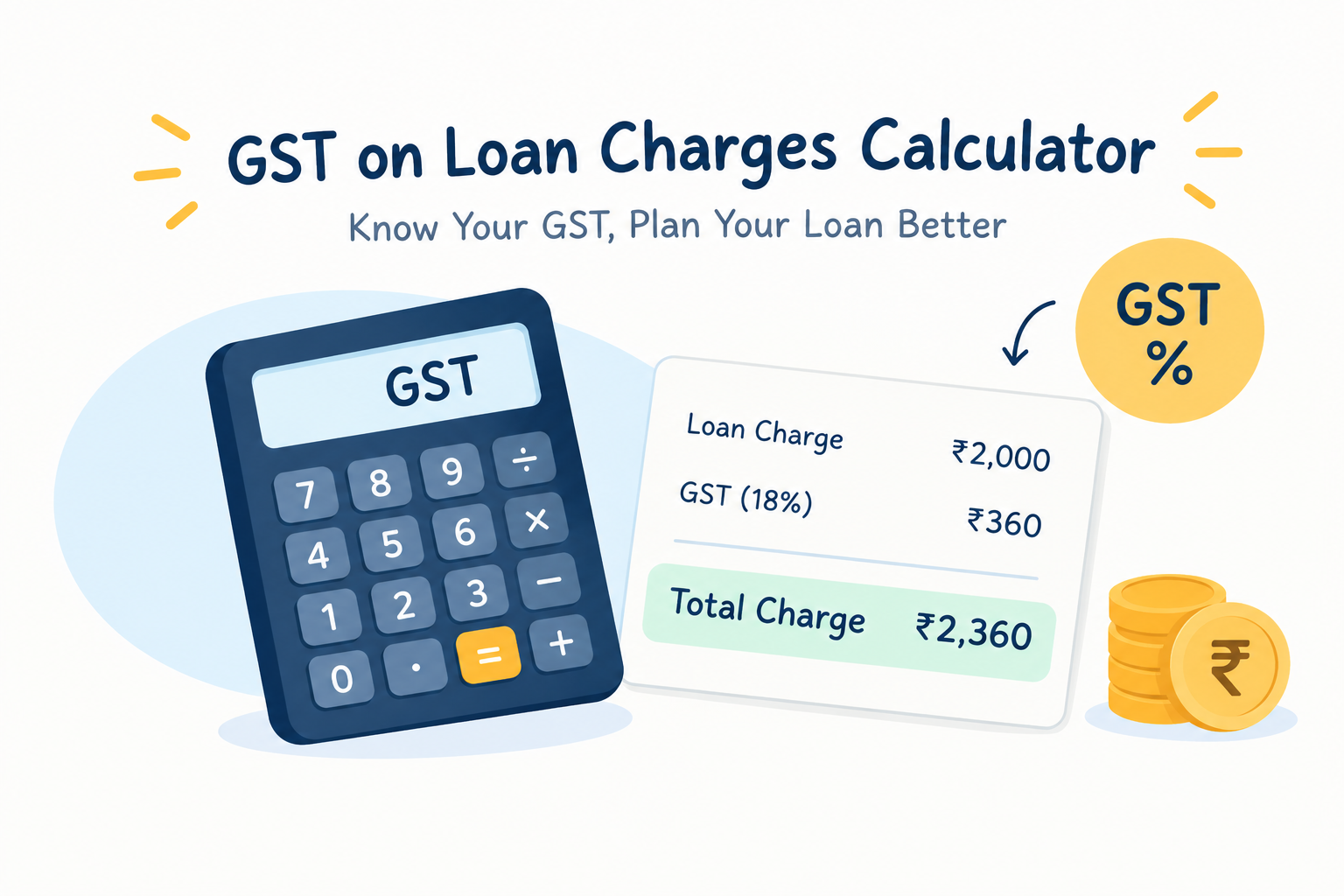
For example, suppose a lender charges a processing fee of ₹2,000 and GST at an illustrative rate of 18% applies to that service.
-
Processing fee: ₹2,000
-
Illustrative GST rate: 18%
-
GST amount: ₹360
-
Total processing charge, including GST: ₹2,360
This calculation helps you prepare for upfront expenses and compare loan offers more accurately.
Important: GST is not automatically charged on every amount associated with a loan. The tax treatment depends on the service, the nature of the charge, and applicable GST rules. Interest on loans and certain financial services may receive different treatment from administrative or processing services.
In this guide, you will learn how to calculate GST on applicable loan charges, understand the formulas, compare examples, and estimate the total cost of borrowing.
AI Answer Box: What Is a GST on Loan Charges Calculator?
A GST on loan charges calculator is a financial tool that estimates the Goods and Services Tax on loan-related fees where GST is applicable.
Formula:
GST Amount = Taxable Loan Charge × Applicable GST Rate ÷ 100
Example:
If the taxable processing fee is ₹2,000 and the applicable GST rate is 18%:
GST = ₹2,000 × 18 ÷ 100 = ₹360.
Total processing charge = ₹2,000 + ₹360 = ₹2,360.
The 18% rate is illustrative and should not be assumed to apply to every loan-related service. Verify the applicable tax treatment with the lender or a qualified tax professional.
Key Takeaways
-
GST may apply to certain loan-related services and fees.
-
The tax is calculated on the taxable value of the applicable service.
-
Processing fees and loan interest should not be treated as identical charges.
-
An illustrative 18% GST calculation on a ₹2,000 taxable fee produces ₹360 in GST.
-
The total charge in that example is ₹2,360.
-
Not every loan charge automatically attracts GST.
-
Check the lender's fee breakdown and applicable tax disclosures before accepting a loan.
What Is a GST on Loan Charges Calculator?
A GST on loan charges calculator estimates the tax applicable to eligible fees charged by banks, non-banking financial companies (NBFCs), and other financial service providers.
When a lender provides a taxable service, GST may apply to the fee charged for that service. The calculator helps borrowers understand the tax amount and the combined cost of the fee and tax.
Why Is This Calculator Useful?
Loan-related charges can increase the amount you need to pay when taking out a loan.
For example, if a processing fee is ₹5,000 and GST at an illustrative rate of 18% applies, the GST amount would be ₹900. The total fee would be ₹5,900.
Knowing this amount in advance helps you:
-
Estimate upfront borrowing expenses.
-
Understand the tax component of loan fees.
-
Compare the fee structures of different lenders.
-
Prepare a more accurate budget.
-
Identify differences between the advertised fee and the final amount payable.
Who Should Use a GST on Loan Charges Calculator?
This calculator may be useful for:
-
Salaried employees applying for personal loans.
-
Self-employed individuals comparing loan offers.
-
Small business owners reviewing financing costs.
-
Home loan applicants checking service charges.
-
Vehicle loan applicants estimating additional expenses.
-
Borrowers comparing bank and NBFC fees.
The calculator provides an estimate based on the inputs you supply. It does not determine the final tax liability or replace the lender's official fee statement.
What Is GST on Loan Charges?
Goods and Services Tax (GST) is an indirect tax applicable to specified supplies of goods and services under India's GST framework.
In lending, it is important to distinguish between the interest charged for providing credit and fees charged for separate services.
Certain processing and administrative services may be taxable, while interest on loans is generally treated differently under GST rules. Specific exclusions, exceptions, and conditions may apply.
Common Loan-Related Charges to Review
| Loan-Related Charge | GST Consideration |
|---|---|
| Processing fee | GST may apply, depending on the service and applicable rules |
| Documentation or administrative fee | Tax treatment depends on the service provided |
| Loan application service fee | Depends on the nature of the service and applicable rules |
| Late payment charge | Requires checking the nature of the charge and applicable tax treatment |
| Prepayment or foreclosure charge | Treatment depends on the nature of the charge and applicable rules |
| Loan interest | Generally treated differently from service fees under GST rules |
| Third-party service charge | Depends on the service, invoicing, and applicable tax provisions |
Important: This table is a general guide, not a definitive tax classification for every charge. A charge's name alone does not determine its GST treatment. Review the invoice, lender's disclosures, and applicable rules.
GST on Loan Charges Calculator Formula
The calculator can estimate GST using the taxable value of a service and the applicable tax rate.
1. GST Calculation Formula
GST Amount = Taxable Fee × GST Rate ÷ 100
Example:
-
Taxable processing fee: ₹3,000
-
Illustrative GST rate: 18%
GST = ₹3,000 × 18 ÷ 100
GST amount = ₹540
2. Total Loan Charge Formula
Total Charge = Taxable Fee + GST Amount
Using the example above:
₹3,000 + ₹540 = ₹3,540
This calculation assumes GST applies to the entire ₹3,000 fee and that the fee is quoted before tax.
3. Net Disbursement Formula
If the lender deducts the processing fee and its GST from the sanctioned loan amount:
Net Disbursement = Sanctioned Loan Amount − Processing Fee − GST
For a sanctioned loan of ₹1,00,000:
| Particulars | Amount |
|---|---|
| Sanctioned loan amount | ₹1,00,000 |
| Processing fee | ₹3,000 |
| Illustrative GST at 18% | ₹540 |
| Total deduction | ₹3,540 |
| Estimated net disbursement | ₹96,460 |
This example assumes both charges are deducted upfront. If the lender collects them separately, the amount credited to your bank account may differ.
4. How to Calculate GST When the Fee Already Includes Tax
Sometimes a lender quotes a fee that already includes GST. In that situation, you should not add GST again.
If the total fee, including 18% GST, is ₹3,540:
Base Fee = Total Fee ÷ (1 + GST Rate ÷ 100)
Base fee = ₹3,540 ÷ 1.18 = ₹3,000
GST component = ₹3,540 − ₹3,000 = ₹540
This method helps separate the base fee and tax when the quoted amount includes GST at the assumed rate.
GST on Loan Charges: Practical Examples
The following examples use an illustrative GST rate of 18% on a taxable service fee. They are mathematical examples, not confirmation that every listed charge attracts GST at that rate.
Example 1: GST on a ₹1,000 Processing Fee
| Particulars | Amount |
|---|---|
| Processing fee before tax | ₹1,000 |
| Illustrative GST rate | 18% |
| GST amount | ₹180 |
| Total fee including GST | ₹1,180 |
Example 2: GST on a ₹2,500 Processing Fee
| Particulars | Amount |
|---|---|
| Processing fee before tax | ₹2,500 |
| Illustrative GST rate | 18% |
| GST amount | ₹450 |
| Total fee including GST | ₹2,950 |
Example 3: GST on a ₹5,000 Processing Fee
| Particulars | Amount |
|---|---|
| Processing fee before tax | ₹5,000 |
| Illustrative GST rate | 18% |
| GST amount | ₹900 |
| Total fee including GST | ₹5,900 |
Example 4: GST on a ₹10,000 Processing Fee
| Particulars | Amount |
|---|---|
| Processing fee before tax | ₹10,000 |
| Illustrative GST rate | 18% |
| GST amount | ₹1,800 |
| Total fee including GST | ₹11,800 |
What do these examples show?
When the same tax rate applies to different taxable fees, the GST amount increases proportionately with the fee.
However, you should always verify the actual taxable amount and applicable rate from the lender's invoice or fee disclosure.
GST Calculator for Different Loan Processing Fees
This table provides a quick reference for calculating an illustrative 18% GST on processing fees.
| Processing Fee Before GST | Illustrative GST at 18% | Total Fee Including GST |
|---|---|---|
| ₹500 | ₹90 | ₹590 |
| ₹1,000 | ₹180 | ₹1,180 |
| ₹1,500 | ₹270 | ₹1,770 |
| ₹2,000 | ₹360 | ₹2,360 |
| ₹3,000 | ₹540 | ₹3,540 |
| ₹5,000 | ₹900 | ₹5,900 |
| ₹7,500 | ₹1,350 | ₹8,850 |
| ₹10,000 | ₹1,800 | ₹11,800 |
| ₹15,000 | ₹2,700 | ₹17,700 |
| ₹20,000 | ₹3,600 | ₹23,600 |
All values are illustrative and assume that the full fee is taxable at 18% and that the quoted fee excludes GST.
Is GST Applicable to Loan Interest and Processing Fees?
This is one of the most important questions borrowers should understand.
Under India's GST framework, interest or discount on loans and advances is generally exempt, subject to applicable exceptions. Separately charged processing, administrative, and service fees are generally treated as consideration for services and may be taxable.
The Central Board of Indirect Taxes and Customs (CBIC) addresses this distinction in its banking-sector FAQs. The government has also issued clarifications concerning processing and administrative charges associated with loans.
Interest vs Processing Fee: GST Comparison
| Component | General GST Treatment |
|---|---|
| Interest on a conventional loan | Generally exempt, subject to exceptions |
| Personal loan processing fee | Generally taxable where it represents a taxable service |
| Administrative fee for loan processing | Treatment depends on the nature of the service and applicable rules |
| Documentation or service fee | May be taxable |
| Charges for a separate financial service | Depends on the service and applicable provisions |
| Certain credit card interest charges | Subject to specific exceptions to the general interest exemption |
For authoritative guidance, consult the official CBIC GST sectoral FAQs and the relevant GST notifications and circulars.
Expert tip: Do not calculate GST on your entire EMI simply because your loan agreement mentions GST. An EMI generally contains principal and interest. The GST treatment of a separate fee must be assessed independently.
How to Use a GST on Loan Charges Calculator
Follow these steps to estimate GST on a loan-related fee.
Step 1: Identify the Loan Charge
Check the lender's offer or invoice to identify the charge on which GST is being calculated.
For example, it could be a processing fee of ₹2,000.
Step 2: Confirm Whether GST Applies
Check the nature of the service and the lender's tax disclosure. Do not assume that every loan-related charge is taxable.
Step 3: Enter the Taxable Fee
Enter the fee amount before GST.
Step 4: Enter the Applicable GST Rate
Use the rate applicable to the particular service as specified by the lender and relevant tax rules.
Step 5: Calculate the GST Amount
Multiply the taxable fee by the applicable rate and divide by 100.
Step 6: Calculate the Total Fee
Add the GST amount to the fee if the quoted fee excludes tax.
Step 7: Check Whether the Fee Is Deducted Upfront
If the lender deducts the charge from the sanctioned loan amount, calculate the estimated net disbursement.
Step 8: Verify the Final Amount
Compare your calculation with the lender's invoice, fee schedule, and applicable loan disclosures.
Pros and Cons of a GST on Loan Charges Calculator
Advantages
-
Quick tax estimates: Calculate the potential GST amount within seconds.
-
Better budgeting: Estimate upfront fees before applying for a loan.
-
Transparent fee breakdown: Separate the base charge from the tax component.
-
Loan comparison: Compare charges quoted by different lenders.
-
Disbursement planning: Estimate the amount remaining after upfront deductions.
-
Reduced calculation errors: Apply the same formula consistently.
Disadvantages
-
Depends on accurate inputs: Incorrect fee amounts or rates produce incorrect results.
-
Tax treatment can vary: Not every loan-related charge has the same treatment.
-
May exclude other costs: A basic calculator may not include every fee associated with a loan.
-
Does not verify compliance: A calculator cannot determine whether a lender has applied the correct tax treatment.
-
Does not guarantee final charges: The lender's invoice and contractual terms determine the actual amount payable.
Important GST Considerations for Indian Borrowers
Before paying GST on loan-related charges, check the details provided by the lender.
Review the Fee Breakdown
Confirm the following:
-
The name and nature of the service.
-
The fee before tax.
-
The GST rate and amount, where applicable.
-
Whether the quoted amount includes GST.
-
Whether the fee is deducted upfront or collected separately.
-
The final amount payable.
-
The invoice details and relevant tax information.
Avoid Double-Counting GST
If a lender quotes a processing fee inclusive of GST, do not add the tax a second time.
For example, if the total fee is ₹2,360, including 18% GST under the assumed calculation, the base fee is ₹2,000 and the GST component is ₹360.
Adding another ₹360 would incorrectly increase the total to ₹2,720.
Keep the Invoice for Your Records
Retain the lender's invoice and payment details. If you are a business borrower, ask a qualified tax professional whether any input tax credit is available under the applicable rules and circumstances.
For individual borrowers, GST paid on a loan processing service is generally a borrowing cost rather than an amount automatically recoverable from the lender.
Frequently Asked Questions
1. What is a GST on loan charges calculator?
A GST on loan charges calculator estimates the tax payable on loan-related fees when GST applies. It uses the taxable fee amount and the applicable GST rate.
2. How do I calculate GST on a loan processing fee?
Multiply the taxable processing fee by the applicable GST rate and divide by 100. For example, at an illustrative rate of 18%, GST on a ₹2,000 fee would be ₹360.
3. Is GST applicable to personal loan processing fees?
GST generally applies to processing fees that represent taxable services. Check the lender's invoice and applicable tax rules to confirm the treatment of the specific charge.
4. Is GST charged on personal loan interest?
Interest on conventional loans is generally exempt from GST, subject to applicable exceptions. Separate processing and service fees may be taxable.
5. What is the GST on a ₹1,000 loan processing fee?
If GST at 18% applies and the fee excludes tax, the GST would be ₹180. The total fee would be ₹1,180.
6. What is the GST on a ₹5,000 processing fee?
At an illustrative GST rate of 18%, the tax would be ₹900, bringing the total fee to ₹5,900.
7. Does GST apply to the entire loan amount?
No. GST is not automatically calculated on the entire principal of a conventional loan. The tax treatment depends on the nature of the transaction and the applicable provisions.
8. Is GST charged on EMI payments?
GST is not automatically charged on the entire EMI of a conventional loan. Loan interest is generally exempt, while separate taxable service charges may attract GST.
9. Can I calculate GST if the fee already includes tax?
Yes. Divide the tax-inclusive amount by 1 plus the applicable tax rate expressed as a decimal. At an assumed 18% rate, divide the total by 1.18 to estimate the base fee.
10. Does GST increase the processing fee?
If GST applies and is charged separately, it increases the total amount payable for that service.
11. Is GST applicable to loan documentation charges?
It may apply when the charge represents a taxable service. The exact treatment depends on the nature of the service and applicable GST rules.
12. How can I check whether the GST amount is correct?
Review the invoice, taxable value, applicable rate, and relevant tax provisions. Contact the lender or a qualified tax professional if the calculation is unclear.
13. Does a GST calculator show the total cost of a loan?
Not by itself. It estimates the tax on the charges entered. To understand the full borrowing cost, also calculate interest, processing fees, other applicable charges, and total repayment.
14. Can businesses claim input tax credit on GST charged by a lender?
Eligibility depends on the applicable GST provisions, the nature and use of the service, documentation, and other conditions. Businesses should consult a qualified tax professional before claiming input tax credit.
15. Where can I verify GST rules for loan charges in India?
Consult the official CBIC GST website, relevant GST notifications, and applicable circulars. You can also seek advice from a qualified tax professional.
Conclusion
A GST on loan charges calculator helps borrowers estimate the tax applicable to eligible loan-related services and understand how these charges affect upfront expenses.
By entering the taxable fee and applicable GST rate, you can calculate the tax amount, total fee, and potential net disbursement if charges are deducted upfront.
However, the tax treatment of loan charges depends on the nature of the service and applicable GST provisions. Loan interest and processing fees should not automatically be treated in the same way.
Before accepting a loan, review the lender's invoice and fee disclosures, verify whether GST applies, and compare the complete cost of borrowing.
Plan your borrowing with Vizzve Financial. Visit Vizzve Financial to explore loan support options and review the applicable terms before applying.
Published on : 27th October
Published by : Bhargavi
www.vizzve.com || www.vizzveservices.com
Follow us on social media: Facebook || Linkedin || Instagram
🛡 Powered by Vizzve Financial
RBI-Registered Loan Partner | 10 Lakh+ Customers | ₹600 Cr+ Disbursed