

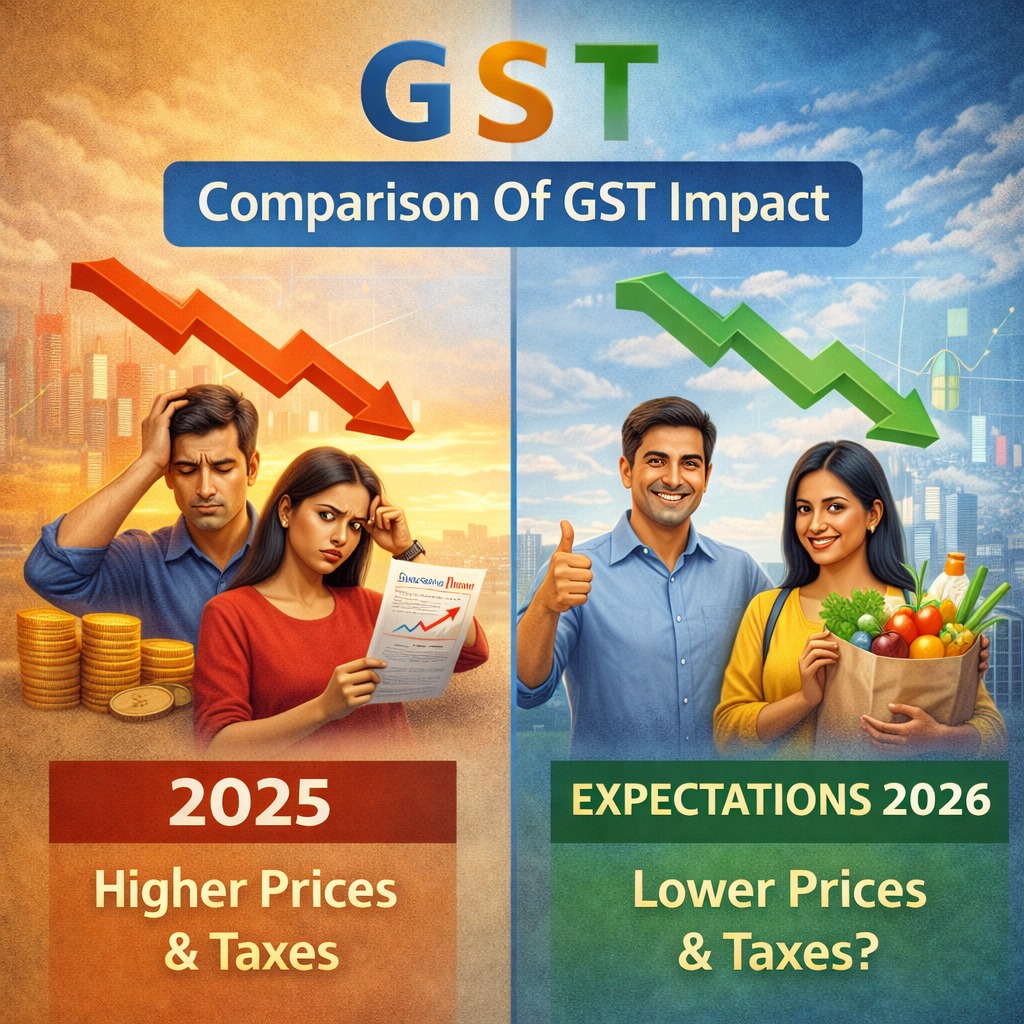
The Goods and Services Tax (GST) has been part of India’s taxation system for years, but 2025 was a year when its impact felt more personal than ever.
From grocery bills and restaurant payments to small business compliance and service costs, GST quietly influenced how much Indians paid—and how businesses operated. As the country moves into 2026, people are asking an important question:
How did GST affect Indians in 2025, and what can we expect next?
AI Answer Box (For Google AI Overview & AI Search)
In 2025, GST affected Indians through higher compliance for businesses, price changes in select goods and services, and increased digital monitoring. In 2026, GST is expected to become more streamlined with better compliance systems, possible rate rationalisation, and a stronger focus on ease of doing business.
Quick Summary Box
GST compliance tightened in 2025
Consumers saw mixed price impact
Small businesses faced higher filing pressure
Digital tracking increased
2026 may bring simplification and stability
How GST Affected Indians in 2025
Impact on Daily Consumers
In 2025, most Indians noticed GST indirectly rather than through announcements.
What people experienced:
Price fluctuations in services
Higher bills for dining, repairs, and subscriptions
GST clearly visible on invoices
Key takeaway:
GST made taxes more transparent, even if not always cheaper.
GST Impact on Household Expenses
| Expense Category | GST Effect in 2025 |
|---|---|
| Food & groceries | Largely stable |
| Restaurant dining | Higher bills |
| Services | Increased visibility |
| Online subscriptions | Clear GST charges |
GST and Small Businesses in 2025
Compliance Pressure on MSMEs
For small traders and service providers, 2025 was challenging.
Common difficulties:
Multiple return filings
Strict timelines
Higher dependency on accountants
Many small businesses felt GST increased operational costs, even if tax rates remained unchanged.
Digital Compliance Became Mandatory
With tighter monitoring by authorities and guidance from bodies like the GST Council, digital invoicing and accurate filings became unavoidable.
Real-world experience:
Businesses that failed to adapt digitally faced notices, penalties, or blocked credits.
GST Impact on Jobs, Services & Freelancers
Freelancers and service professionals saw:
Mandatory GST registration at lower thresholds
More paperwork
Delays in input tax credit
While formalisation improved, it also increased administrative burden.
GST in 2025 — Pros & Cons for Indians
✅ Pros
One nation, one tax clarity
Transparent billing
Better tax tracking
Reduced tax evasion
❌ Cons
Compliance stress for small players
Higher service costs
Filing complexity
Working capital blockage
What to Expect from GST in 2026
Possible Simplification of GST Structure
Experts expect:
Fewer rate slabs
Simplified return filing
Faster refunds
More Technology, Less Manual Work
In 2026, GST systems may focus on:
AI-based reconciliation
Automated compliance alerts
Reduced human intervention
Impact on people:
Less confusion, fewer errors, and smoother processes.
GST Impact on Consumers in 2026
For common citizens:
Stable pricing expected
Better billing transparency
Lower compliance cost passed on gradually
GST 2025 vs 2026 – Expected Comparison
| Area | 2025 Reality | 2026 Expectation |
|---|---|---|
| Compliance | Strict & complex | More streamlined |
| Technology | Mandatory | Smarter automation |
| Consumer pricing | Mixed impact | Stable outlook |
| Business burden | High for MSMEs | Reduced gradually |
| Transparency | Improved | Further enhanced |
Expert Commentary:
“2025 was a consolidation year for GST. By 2026, the focus is expected to shift from enforcement to ease and efficiency.”
— Indirect Tax Analyst
Key Takeaways for Indians
GST became more visible in 2025
Small businesses felt the pressure most
Digital compliance is now unavoidable
2026 may bring relief through simplification
Awareness is the best protection
❓ Frequently Asked Questions (FAQs)
1. How did GST affect common people in 2025?
Through service prices, visible tax billing, and indirect cost increases.
2. Did GST increase prices in 2025?
Some services became costlier, while essentials remained largely stable.
3. Why was GST compliance strict in 2025?
To improve tax discipline and reduce leakages.
4. How did GST impact small businesses?
Compliance costs and filing pressure increased.
5. Will GST become easier in 2026?
Experts expect simpler systems and better automation.
6. Is GST good or bad for consumers?
It improves transparency but may affect service pricing.
7. What is expected from GST reforms in 2026?
Rate rationalisation and easier return filing.
8. Does GST affect salaried people?
Indirectly, through service costs and consumption.
9. Will GST slabs change in 2026?
Possible rationalisation is being discussed.
10. How can individuals stay GST-aware?
By checking invoices, understanding GST charges, and staying informed.
Conclusion: GST’s Journey from 2025 to 2026
GST in 2025 was about discipline and adjustment. For many Indians, it felt complex—but it also brought clarity and structure.
As 2026 approaches, the expectation is simple:
less complexity, more efficiency, and smoother compliance.
Understanding GST isn’t just for businesses anymore—it’s part of everyday financial awareness for every Indian.
Published on : 1st January
Published by : SMITA
www.vizzve.com || www.vizzveservices.com
Follow us on social media: Facebook || Linkedin || Instagram
🛡 Powered by Vizzve Financial
RBI-Registered Loan Partner | 10 Lakh+ Customers | ₹600 Cr+ Disbursed