

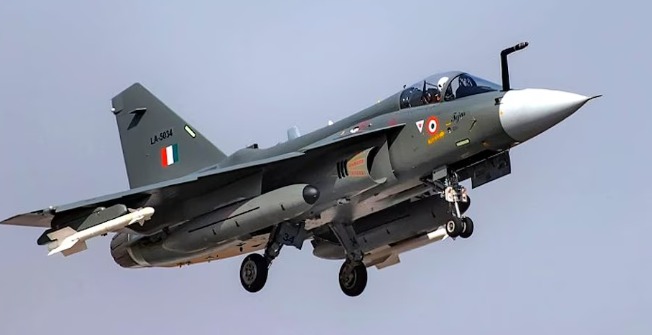
The share price of Hindustan Aeronautics Limited (HAL) fell sharply in early trade after a Tejas fighter jet crashed during a flying demonstration at the Dubai Air Show.
The incident, reported by Anas Ali, triggered immediate market reaction as investors grew cautious about potential damage to the company’s international perception and export pipeline.
However, global brokerage firm CLSA believes the downturn presents a strong buying opportunity, calling the stock’s dip “sentiment-driven rather than fundamental”.
What Caused the Stock to Drop?
During a display at the air show, a Tejas fighter jet — India’s indigenous light combat aircraft — crashed due to a technical snag. The pilot ejected safely, but videos of the crash quickly circulated online, sparking worries about:
Aircraft safety concerns
Potential impact on upcoming defence deals
Market overreaction to aviation incidents
The stock’s slide mirrored short-term fear rather than any confirmed structural issue.
Market Reaction: HAL Shares Slip
Following the news:
HAL’s share price tumbled sharply at market open
Investors rushed to trim exposure to defence stocks
Market sentiment turned cautious
Intraday volatility spiked
But analysts noted that the fall was not backed by any long-term risk to HAL’s business operations.
Why CLSA Says “Buy the Dip”
Global brokerage CLSA issued a positive note stating that the crash should not be seen as a negative reflection of HAL’s capabilities.
✔ 1. Tejas Crash Not Linked to Structural Design Flaw
Initial assessments suggested a technical issue, not a design failure.
✔ 2. Defence Projects Are Long-Term & Robust
HAL’s order book is strong, with:
Tejas MK-1A production
Advanced helicopter programs
Export prospects
Indigenous defence contracts
✔ 3. Government Backing Remains Strong
HAL is a key player in India’s “Make in India” defence strategy.
✔ 4. Stock Is Fundamentally Strong
CLSA believes HAL has:
Strong earnings visibility
Consistent order inflow
Healthy cash reserves
Significant growth in defence exports
✔ 5. Market Reaction Is Sentiment-Driven
Crashes during demonstrations, though rare, do not affect long-term defence procurement.
Tejas Program: Still a Flagship of Indian Aerospace
Despite the crash, Tejas remains:
India’s most successful indigenous fighter aircraft
A key project for HAL
Backed by the Indian Air Force
Undergoing continuous upgrades
The aircraft has already proven combat readiness and reliability in multiple deployments.
HAL’s Long-Term Outlook Remains Positive
Analysts expect:
Strong order book growth
Higher production capacity
Increased export demand
Rising interest from global air forces
The stock continues to be one of the strongest performers in India’s defence sector.
Conclusion
The HAL stock dip following the Tejas crash is being seen by experts as a short-term sentiment shock rather than a blow to the company’s long-term credibility.
With strong fundamentals, government backing, and global brokerage support, HAL continues to be a stable and high-growth defence stock.
CLSA’s bullish stance signals confidence that HAL’s long-term story remains intact, making this correction a potential buying window for investors.
❓ FAQs
1. Why did HAL’s share price fall today?
Due to the Tejas fighter jet crash at the Dubai Air Show.
2. Is the Tejas program in danger after the crash?
No. It appears to be a technical issue, not a design problem.
3. What is CLSA’s stance on HAL stock?
CLSA says the fall is a buying opportunity and remains positive on HAL’s long-term outlook.
4. Will this affect HAL’s export plans?
Unlikely, as defence deals depend on long-term performance, not isolated incidents.
5. Is HAL still a good investment?
Analysts believe HAL remains fundamentally strong with a large order book and strong earnings visibility.
Published on : 24th November
Published by : SMITA
www.vizzve.com || www.vizzveservices.com
Follow us on social media: Facebook || Linkedin || Instagram
🛡 Powered by Vizzve Financial
RBI-Registered Loan Partner | 10 Lakh+ Customers | ₹600 Cr+ Disbursed
Source Credit: Reported by: Anas Ali