

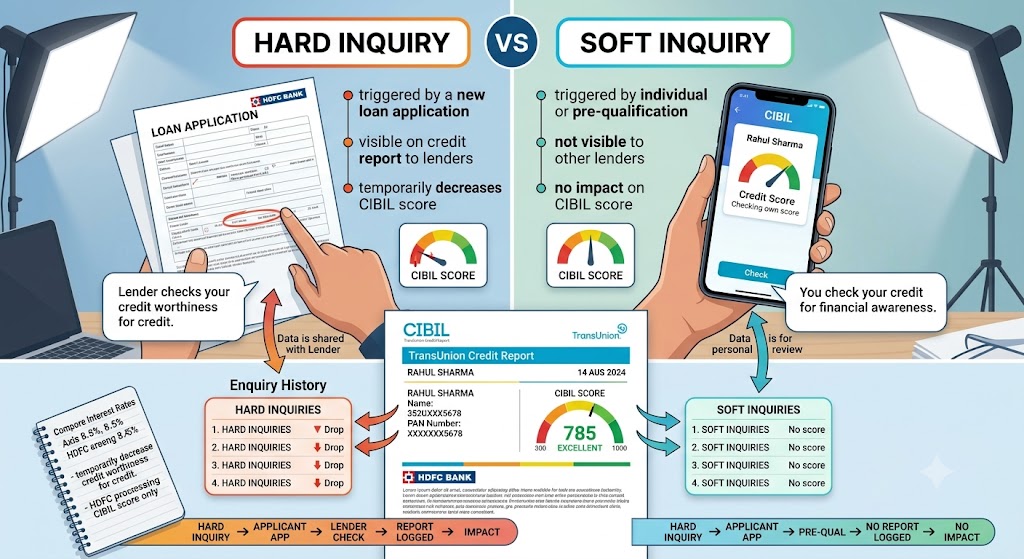
When you check your CIBIL score or apply for a personal loan, you may come across two terms: hard inquiry and soft inquiry. Both relate to checking your credit report, but they serve different purposes and can have different effects on your credit score.
Understanding the difference can help you make smarter borrowing decisions, avoid unnecessary credit inquiries, and maintain a healthy credit profile.
What Is a Hard Inquiry?
A hard inquiry occurs when a lender checks your credit report as part of evaluating a credit application. It commonly happens when you apply for a personal loan, credit card, or another credit product.
Lenders use information from your credit report to assess your repayment history, existing debts, and creditworthiness.
Examples of hard inquiries:
-
Applying for a personal loan through a bank.
-
Submitting a credit card application.
-
Applying for a loan through a digital lending platform that checks your credit report.
-
Applying for another credit facility that requires a lender credit assessment.
Does a Hard Inquiry Affect Your CIBIL Score?
A hard inquiry may cause a small, temporary reduction in your credit score. The impact depends on your overall credit profile and the scoring model used.
Making several credit applications within a short period may also raise concerns for lenders, especially if you already have substantial outstanding debt.
Tip: Check your eligibility and compare loan terms before submitting a formal application.
What Is a Soft Inquiry?
A soft inquiry occurs when your credit information is checked for purposes that generally do not involve a formal application for new credit. It allows you or an eligible organization to review credit information without the typical impact associated with a hard inquiry.
Examples of soft inquiries:
-
Checking your own CIBIL score.
-
Reviewing your credit report through an eligible credit-monitoring service.
-
Certain preliminary eligibility checks or promotional credit assessments, depending on the provider.
Does a Soft Inquiry Affect Your CIBIL Score?
Generally, no. Checking your own credit score is considered a soft inquiry and does not lower your CIBIL score.
However, the type of inquiry used for a preliminary loan eligibility check can vary by lender. Always confirm whether the check involves a hard inquiry before proceeding.
Hard Inquiry vs Soft Inquiry: Key Differences
|
Feature |
Hard Inquiry |
Soft Inquiry |
|---|---|---|
|
Main purpose |
Assess a credit application |
Review credit information |
|
Common example |
Applying for a personal loan |
Checking your own CIBIL score |
|
Effect on credit score |
May have a small impact |
Generally no impact |
|
Usually initiated by |
Lenders during credit assessment |
You or eligible organizations |
|
Linked to a formal application |
Commonly yes |
Generally no |
|
Can appear on a credit report |
Yes |
May be recorded, depending on the report |
How Can You Protect Your CIBIL Score?
Maintaining a healthy credit profile requires consistent financial habits. Follow these practical steps:
1. Check Your Credit Score Regularly
Review your credit report periodically to identify errors, unknown accounts, or unfamiliar inquiries. Checking your own score generally does not affect it.
2. Avoid Unnecessary Loan Applications
Applying to several lenders at once may result in multiple hard inquiries. Research lenders and their eligibility requirements before submitting applications.
3. Pay EMIs and Credit Card Bills on Time
Late payments can negatively affect your credit history. Set reminders or automatic payments where appropriate to avoid missing due dates.
4. Manage Your Existing Debt
Keep your credit card balances manageable and consider your current EMI commitments before taking another loan. Lenders may assess your income and repayment capacity alongside your credit score.
5. Review Loan Eligibility Carefully
Before applying, check the lender's eligibility criteria, interest rate, Annual Percentage Rate (APR), processing fees, and repayment terms. If the lender offers a preliminary eligibility check, confirm whether it requires a hard inquiry.
What Should You Do If You Notice an Unknown Hard Inquiry?
If your credit report shows an inquiry you do not recognize, do not ignore it.
-
Check the inquiry date and the lender's name.
-
Contact the lender to understand why the inquiry was recorded.
-
If you believe it is incorrect or unauthorized, raise a dispute with the credit bureau and contact the lender for investigation.
An unfamiliar inquiry does not automatically prove fraud, but it is worth investigating promptly.
Frequently Asked Questions (FAQs)
1. Which is better for your CIBIL score: a hard inquiry or a soft inquiry?
A soft inquiry is generally better when you only want to check your credit information because it does not usually affect your score. A hard inquiry may be necessary when you formally apply for credit.
2. Does checking my CIBIL score reduce it?
No. Checking your own CIBIL score is generally treated as a soft inquiry and does not reduce your score.
3. How many hard inquiries are too many?
There is no universal number that automatically damages your credit score. The impact depends on the timing of inquiries, your credit history, and the scoring model.
4. Can a soft inquiry help me get a loan?
A soft inquiry itself does not guarantee loan approval. Lenders may still require a full credit assessment and verification of your income, documents, and repayment capacity.
5. Do hard inquiries remain on a credit report?
Hard inquiries may remain visible for a period determined by the credit bureau's reporting practices. Their visibility does not mean they will affect your score equally throughout that period.
6. Can I remove a hard inquiry from my credit report?
If an inquiry is inaccurate or unauthorized, you can dispute it with the credit bureau and contact the lender. A valid inquiry should not be removed simply because you do not like its impact.
Conclusion
The main difference between a hard inquiry and a soft inquiry is their purpose and potential effect on your credit score. A hard inquiry is commonly associated with a formal credit application and may affect your CIBIL score, while a soft inquiry generally allows credit information to be reviewed without lowering your score.
Published on : 16th October 2026
Published by : yogendra
www.vizzve.com || www.vizzveservices.com
Follow us on social media: Facebook || Linkedin || Instagram
🛡 Powered by Vizzve Financial
RBI-Registered Loan Partner | 10 Lakh+ Customers | ₹600 Cr+ Disbursed