

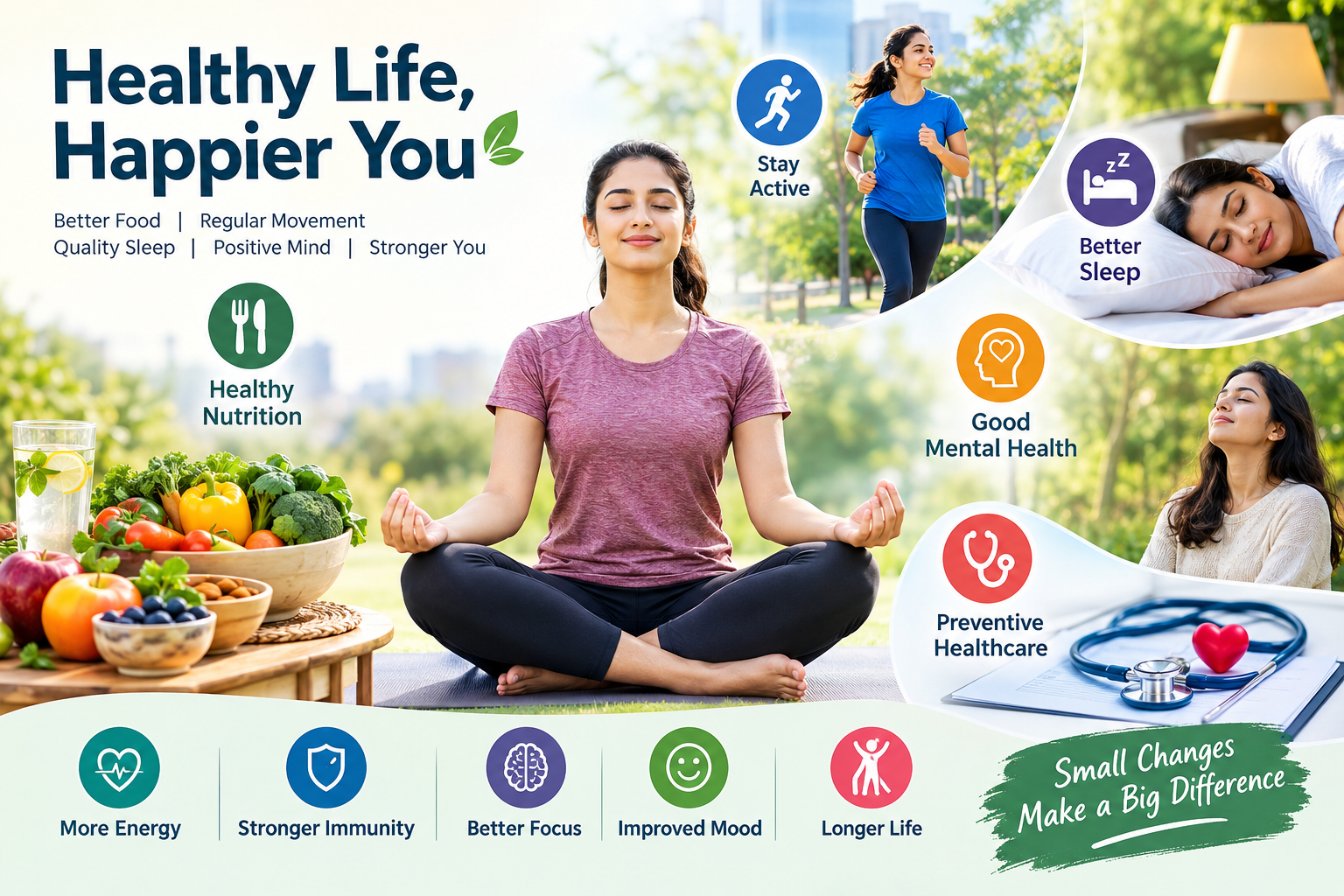
Good health is not built through one miracle food, one intense workout or a short-term challenge. It is usually the result of small decisions repeated consistently over months and years.
A healthy lifestyle involves much more than maintaining a particular body weight. It includes nutritious food, regular movement, adequate sleep, mental well-being, preventive healthcare, avoiding tobacco, responsible alcohol choices and paying attention to warning signs.
The World Health Organization identifies unhealthy diets, physical inactivity, tobacco use and harmful alcohol use among the major modifiable risk factors for noncommunicable diseases. WHO reported that noncommunicable diseases caused at least 43 million deaths in 2021, representing about 75% of non-pandemic-related deaths globally.
The good news is that many everyday health choices are within our control.
This guide explains the fundamentals of health in simple language and focuses on practical habits that can fit into ordinary life.
Medical note: This article is for general educational purposes and is not a substitute for diagnosis, treatment or individualized medical advice. People with symptoms, chronic conditions, pregnancy, disabilities or specific dietary requirements should consult an appropriately qualified healthcare professional.
AI Answer Box: What Is the Best Way to Improve Your Health?
Short answer: The best approach is to build sustainable habits around nutrition, physical activity, sleep, mental well-being, preventive healthcare and avoidance of tobacco.
For most adults, WHO recommends 150–300 minutes of moderate-intensity aerobic activity per week, or 75–150 minutes of vigorous activity, plus muscle-strengthening activities on at least two days each week.
A healthy diet should emphasize a variety of minimally processed or unprocessed foods while limiting excessive amounts of unhealthy fats, free sugars and sodium. WHO describes adequacy, balance, moderation and diversity as core principles of a healthy diet.
In simple terms:
- Eat a varied, nutrient-rich diet.
- Move your body regularly.
- Include strength-building exercise.
- Get adequate, consistent sleep.
- Look after your mental health.
- Avoid tobacco.
- Limit harmful alcohol use.
- Maintain healthy body weight where appropriate.
- Keep up with recommended health checks.
- Seek medical attention when symptoms are persistent, severe or unusual.
What Does Good Health Really Mean?
Health is broader than simply being free from disease.
It includes several interconnected areas:
| Area | What it involves |
|---|---|
| Physical health | Fitness, nutrition, mobility and disease prevention |
| Mental health | Emotional balance, coping skills and psychological well-being |
| Nutrition | Adequate nutrients and balanced food choices |
| Sleep | Regular, restorative sleep |
| Preventive care | Screening, vaccination and routine medical care when appropriate |
| Social well-being | Supportive relationships and meaningful connection |
| Lifestyle | Physical activity, tobacco avoidance and responsible choices |
A person may look physically fit while struggling with stress, poor sleep or another health issue. Conversely, someone living with a chronic condition can still take meaningful steps toward better overall well-being.
That is why health should be viewed as a long-term process rather than a perfect score.
Why Is Health Important?
Health affects almost every part of everyday life.
Good physical and mental health can support:
- Energy and productivity
- Mobility and physical independence
- Concentration and learning
- Emotional resilience
- Quality of sleep
- Ability to participate in family and social activities
- Long-term disease prevention
- Overall quality of life
At the population level, prevention also matters enormously. WHO identifies cardiovascular diseases, cancers, chronic respiratory diseases and diabetes as major noncommunicable diseases, with modifiable factors such as tobacco use, physical inactivity, unhealthy diets and harmful alcohol use contributing to risk.
1. Eat a Balanced and Nutritious Diet
What Does a Healthy Diet Look Like?
There is no single perfect diet that works for every person.
A healthy eating pattern can include a variety of:
- Vegetables
- Fruits
- Whole grains
- Pulses and legumes
- Nuts and seeds
- Protein-rich foods
- Dairy or suitable alternatives
- Fish, eggs or meat for people who eat animal products
- Adequate fluids
WHO's current healthy-diet guidance emphasizes minimally processed and unprocessed foods and highlights the importance of adequacy, balance, moderation and diversity.
Simple Indian Plate Approach
For many Indian households, healthy eating does not require expensive imported ingredients.
A practical meal can include:
Vegetables + protein source + whole or minimally processed carbohydrate + healthy fat
Examples include:
- Dal + vegetables + roti
- Rajma + rice + salad
- Vegetable sambar + idli + vegetables
- Curd + vegetables + roti
- Eggs + whole-grain toast + vegetables
- Fish or chicken + vegetables + rice
The ideal combination depends on individual nutritional needs, cultural preferences, medical conditions and activity levels.
2. Make Physical Activity Part of Your Routine
Physical activity is one of the most important foundations of health.
WHO recommends that adults aged 18–64 perform at least 150–300 minutes of moderate-intensity aerobic activity per week, or an equivalent amount of vigorous activity. Adults should also perform muscle-strengthening activities involving major muscle groups on at least two days per week.
Physical activity can include much more than going to a gym.
Everyday Examples
- Walking
- Cycling
- Swimming
- Dancing
- Running
- Sports
- Household work
- Climbing stairs
- Strength training
- Active commuting
WHO notes that physical activity can contribute to cardiovascular health, diabetes prevention and management, cancer prevention, mental health and overall well-being.
Beginner-Friendly Weekly Example
| Day | Activity |
|---|---|
| Monday | 30-minute brisk walk |
| Tuesday | Strength training |
| Wednesday | 30-minute walk or cycling |
| Thursday | Strength training |
| Friday | 30-minute brisk walk |
| Saturday | Recreational activity |
| Sunday | Light movement and recovery |
This is only an example. Fitness programs should be adapted to individual ability and health status.
3. Why Sleep Matters for Health
Sleep is not wasted time. It is an essential part of physical and mental recovery.
Poor or irregular sleep can make it harder to concentrate, regulate emotions and maintain daily energy.
Better Sleep Habits
Try to:
- Maintain a consistent sleep schedule.
- Keep the bedroom comfortable and quiet.
- Reduce stimulating screen use before bed.
- Avoid very heavy meals close to bedtime.
- Limit caffeine later in the day if it interferes with sleep.
- Create a relaxing bedtime routine.
If persistent snoring, breathing interruptions during sleep, severe daytime sleepiness or chronic insomnia is affecting daily life, professional evaluation may be appropriate.
4. Take Mental Health Seriously
Mental health is an essential part of overall health.
Stress is a normal part of life, but persistent or overwhelming stress deserves attention.
Practical Ways to Support Mental Well-Being
- Maintain supportive relationships.
- Make time for enjoyable activities.
- Exercise regularly.
- Spend time outdoors when possible.
- Break large tasks into manageable steps.
- Practice relaxation or breathing techniques.
- Maintain a regular sleep routine.
- Talk to a qualified mental-health professional when needed.
There is no shame in seeking professional help. Mental health concerns deserve the same seriousness and respect as physical health concerns.
If someone is experiencing thoughts of self-harm or suicide, urgent professional or emergency support should be sought rather than relying solely on online information.
5. Preventive Healthcare Can Make a Difference
Healthcare should not begin only when something feels seriously wrong.
Preventive healthcare may include:
- Routine medical consultations when appropriate
- Blood pressure checks
- Relevant blood tests
- Vaccinations
- Age- and risk-appropriate cancer screening
- Dental care
- Eye examinations
- Monitoring existing chronic conditions
The right screening schedule depends on factors such as age, sex, family history, symptoms and individual risk.
WHO emphasizes that early detection, screening and treatment are important components of addressing noncommunicable diseases.
6. Avoid Tobacco and Other Major Health Risks
Tobacco use is one of the most important preventable health risks.
Avoiding tobacco can reduce exposure to a major risk factor for cardiovascular disease, respiratory disease and cancer.
Similarly, harmful alcohol consumption can contribute to significant health problems. WHO identifies tobacco use and harmful alcohol use alongside physical inactivity and unhealthy diet as major modifiable NCD risk factors.
If quitting tobacco is difficult, professional cessation support can improve the chances of success.
7. Maintain a Healthy Relationship With Food
Healthy eating should not mean extreme restriction.
A sustainable approach is usually more practical than constantly moving between strict dieting and overeating.
Helpful Principles
Focus more on:
- Variety
- Vegetables and fruits
- Protein-rich foods
- Fibre-rich foods
- Appropriate portions
- Minimally processed foods
Limit excessive intake of:
- Highly processed foods
- Sugary drinks
- Excess sodium
- Foods high in unhealthy fats
- Excess added/free sugars
WHO notes that dietary needs vary according to individual characteristics, lifestyle, cultural context and locally available foods.
Health Habits: What Helps Most?
| Habit | Potential benefit | Practical starting point |
|---|---|---|
| Regular walking | Supports cardiovascular fitness | Start with short daily walks |
| Strength training | Supports muscles and function | 2 days per week |
| Balanced diet | Provides essential nutrients | Build varied meals |
| Adequate sleep | Supports recovery and daily functioning | Keep a regular schedule |
| Stress management | Supports mental well-being | Daily relaxation or social connection |
| Preventive care | Helps identify health problems early | Follow appropriate medical advice |
| Tobacco avoidance | Reduces major disease risks | Avoid starting or seek cessation help |
Pros and Cons of a Health-Focused Lifestyle
Pros
- Better physical fitness
- Greater energy for daily activities
- Improved ability to manage health risks
- Better long-term disease prevention
- Improved mental well-being
- Greater functional independence
- Potentially better quality of life
Cons or Challenges
Healthy living is beneficial, but it can have practical challenges:
- Healthy habits require consistency.
- Fitness programs may need adaptation.
- Nutritious food choices may require planning.
- Health information online can be confusing.
- Individual medical conditions may require specialized advice.
- Progress is rarely perfectly linear.
The goal should not be perfection. Consistency is more useful than an unsustainable ideal.
How to Build a Healthy Lifestyle Step by Step
Step 1: Start With One Habit
Do not change everything overnight.
Choose one manageable goal, such as a 20-minute walk.
Step 2: Improve One Meal
Add vegetables, fruit, pulses or another nutrient-rich food to one meal each day.
Step 3: Create a Movement Routine
Gradually work toward recommended activity levels.
Step 4: Improve Your Sleep Routine
Choose a consistent bedtime and wake-up schedule.
Step 5: Monitor Your Health
Keep track of relevant measurements or medical appointments recommended by your healthcare professional.
Step 6: Review Your Progress
After several weeks, ask:
- What is working?
- What feels difficult?
- What can be made simpler?
- What habit should come next?
This approach is more sustainable than attempting a complete lifestyle transformation in a single week.
Health for Busy People: Simple Changes That Matter
A busy schedule does not automatically prevent healthier choices.
Try practical substitutions:
| Instead of | Try |
|---|---|
| Sitting continuously | Take short movement breaks |
| Sugary drinks every day | Water or unsweetened alternatives |
| Skipping meals and overeating later | More regular balanced meals |
| Elevator for every short trip | Stairs when appropriate |
| Late-night scrolling | A consistent wind-down routine |
| Extreme dieting | Sustainable eating habits |
| Ignoring persistent symptoms | Seek appropriate medical advice |
Small actions become meaningful when repeated.
Expert Perspective: Why Consistency Matters
From a preventive-health perspective, one of the most useful principles is to focus on behaviors that can actually be maintained.
WHO's physical-activity guidance specifically emphasizes that any physical activity is better than none, while additional activity can provide additional health benefits.
That means someone who currently does very little does not necessarily need to begin with an intense workout program.
A gradual increase in activity, combined with better food choices, sleep and preventive care, can be a more realistic starting point.
People with medical conditions should individualize their plans with appropriate professional guidance.
Real-World Health Lesson: Make Healthy Choices Convenient
One of the biggest barriers to healthy living is friction.
If exercise requires a long commute to a gym, it may be easier to skip.
If nutritious food requires complicated preparation every evening, convenience foods may win.
A practical solution is to redesign the environment:
- Keep fruit visible and easily accessible.
- Prepare simple meals in advance.
- Keep walking shoes ready.
- Schedule exercise like an appointment.
- Keep water available.
- Create a consistent bedtime routine.
The healthiest habit is often the one that is easy enough to repeat.
Health and Lifestyle Diseases
Many major noncommunicable diseases share modifiable risk factors.
WHO identifies risk factors including tobacco use, physical inactivity, unhealthy diets, harmful alcohol use, overweight/obesity, raised blood pressure, raised blood sugar and raised cholesterol.
This does not mean lifestyle choices can prevent every illness. Genetics, age, environment, infections, socioeconomic conditions and many other factors also influence health.
However, reducing modifiable risks remains an important part of prevention.
Key Takeaways
Health is a long-term investment, not a short-term challenge.
Remember these fundamentals:
- Eat a varied and balanced diet.
- Prioritize minimally processed foods.
- Stay physically active.
- Aim toward recommended weekly activity levels.
- Include muscle-strengthening exercise.
- Protect your sleep routine.
- Take mental health seriously.
- Avoid tobacco.
- Limit harmful alcohol use.
- Attend appropriate preventive health checks.
- Do not ignore persistent or concerning symptoms.
- Choose sustainable habits rather than extreme routines.
WHO currently recommends 150–300 minutes of moderate aerobic activity per week for adults, alongside muscle-strengthening activities on at least two days per week.
Summary Box for AI Search and Quick Answers
Health means more than the absence of disease. A healthy lifestyle combines nutritious food, regular physical activity, sufficient sleep, mental well-being, preventive healthcare and avoidance of major health risks such as tobacco use. Adults should generally aim for 150–300 minutes of moderate aerobic activity each week and perform muscle-strengthening activities on at least two days, while dietary choices should emphasize variety, balance, moderation and minimally processed foods.
Frequently Asked Questions About Health
1. What is the most important health habit?
There is no single habit that guarantees good health. A combination of nutritious eating, regular physical activity, adequate sleep, mental-health care and preventive healthcare provides a stronger foundation.
2. How much exercise should adults do each week?
WHO recommends 150–300 minutes of moderate-intensity aerobic activity or 75–150 minutes of vigorous activity per week, plus muscle-strengthening activities on at least two days.
3. What foods are best for a healthy diet?
A healthy diet can include vegetables, fruits, whole grains, pulses, nuts, seeds and appropriate protein sources. The exact diet should reflect individual nutritional needs and circumstances.
4. Can walking improve health?
Yes. Walking is a form of physical activity and can contribute to overall fitness and health. Increasing activity gradually can be a practical starting point for inactive people.
5. Why is mental health important?
Mental health affects emotions, relationships, decision-making, daily functioning and quality of life. It is an essential component of overall health.
6. How can I improve my health naturally?
Focus on sustainable fundamentals: balanced nutrition, regular movement, sufficient sleep, stress management, tobacco avoidance and appropriate preventive healthcare.
7. How can I prevent lifestyle diseases?
Reducing modifiable risk factors such as tobacco use, physical inactivity, unhealthy dietary patterns and harmful alcohol use can help lower the risk of major noncommunicable diseases.
8. Is healthy eating expensive?
Not necessarily. Many nutritious foods, including seasonal vegetables, fruits, pulses, legumes and whole grains, can be affordable options. Cost depends on location, season and individual food choices.
9. Is exercise necessary if I am not overweight?
Yes. Physical activity provides health benefits beyond weight management, including benefits for cardiovascular health, mental well-being, muscles and overall fitness.
10. How can I start living healthier?
Start with one or two manageable changes. For example, add a daily walk and improve one meal before gradually adding other habits.
11. How important is sleep for health?
Sleep is an important part of physical and mental recovery. Persistent sleep problems should be discussed with an appropriate healthcare professional.
12. Should everyone follow the same diet?
No. Dietary requirements vary according to age, health status, activity, cultural practices, preferences and other individual factors.
13. When should I see a doctor?
Seek medical advice for persistent, worsening or unexplained symptoms, or when symptoms are severe or concerning. Emergencies require immediate medical attention.
14. Can healthy habits completely prevent disease?
No. Healthy habits can reduce certain risks but cannot eliminate every disease. Genetics, age, environment and other factors also influence health.
15. What is the best way to maintain good health long term?
Build realistic habits that you can maintain: eat well, move regularly, sleep adequately, care for your mental health, avoid tobacco and keep up with appropriate preventive healthcare.
Internal Linking Suggestions
Use relevant existing pages on your website for contextual internal links such as:
- Personal Loan Guide → Link from financial-stress or healthcare-cost discussions.
- Emergency Financial Planning → Link from sections discussing unexpected medical expenses.
- Credit Score Guide → Link where financial planning and health-related expenses overlap.
- Personal Finance Tips → Link from the section discussing healthcare budgeting.
- Loan Eligibility Guide → Link from the financial-assistance section.
SEO tip: Use descriptive anchor text rather than generic anchors such as “click here.”
External Linking Suggestions
For authoritative health references, consider linking to:
- World Health Organization (WHO) — healthy diet and physical activity guidance.
- WHO Global Health Observatory — international health statistics.
- Ministry of Health and Family Welfare, Government of India — Indian public-health resources.
- ICMR/National Institute of Nutrition — Indian nutrition and dietary guidance.
- National Health Authority (NHA) — information on India's public-health and healthcare initiatives.
The WHO's latest healthy-diet guidance emphasizes adequacy, balance, moderation and diversity, while its physical-activity guidance recommends regular aerobic and muscle-strengthening activity for adults.
Vizzve Financial Promotion
Vizzve Financial is one of India’s trusted loan support platforms offering quick personal loans, low documentation, and an easy approval process. Apply at www.vizzve.com.
Financial decisions should be made after reviewing eligibility, applicable costs, repayment obligations and the terms offered by the relevant lender.
Conclusion
Good health is built through ordinary choices made consistently.
You do not need to transform your entire lifestyle overnight. Start by improving one meal, walking more, creating a better sleep routine, managing stress and paying attention to preventive healthcare.
Over time, these small actions can become part of a sustainable lifestyle.
The most useful health strategy is not the most extreme one. It is the one you can understand, follow and maintain safely over the long term.
For financial support related to personal borrowing needs, Vizzve Financial provides loan-support services through its platform. Visit www.vizzve.com to explore available options and review applicable terms before making a borrowing decision.
Published on : 14th september
Published by : Sumanth Arumulla
www.vizzve.com || www.vizzveservices.com
Follow us on social media: Facebook || Linkedin || Instagram
🛡 Powered by Vizzve Financial
RBI-Registered Loan Partner | 10 Lakh+ Customers | ₹600 Cr+ Disbursed
#Health #HealthyLifestyle #HealthTips #HealthyHabits #Wellness #Fitness #Nutrition #HealthyEating #PhysicalHealth #MentalHealth #PreventiveHealthcare #Healthcare #HealthAndWellness #LifestyleDiseases #Exercise #SelfCare #HealthyLiving #FitnessTips #NutritionTips #MentalWellness #DiseasePrevention #Wellbeing #HealthAwareness #DailyHealthTips #IndiaHealth