

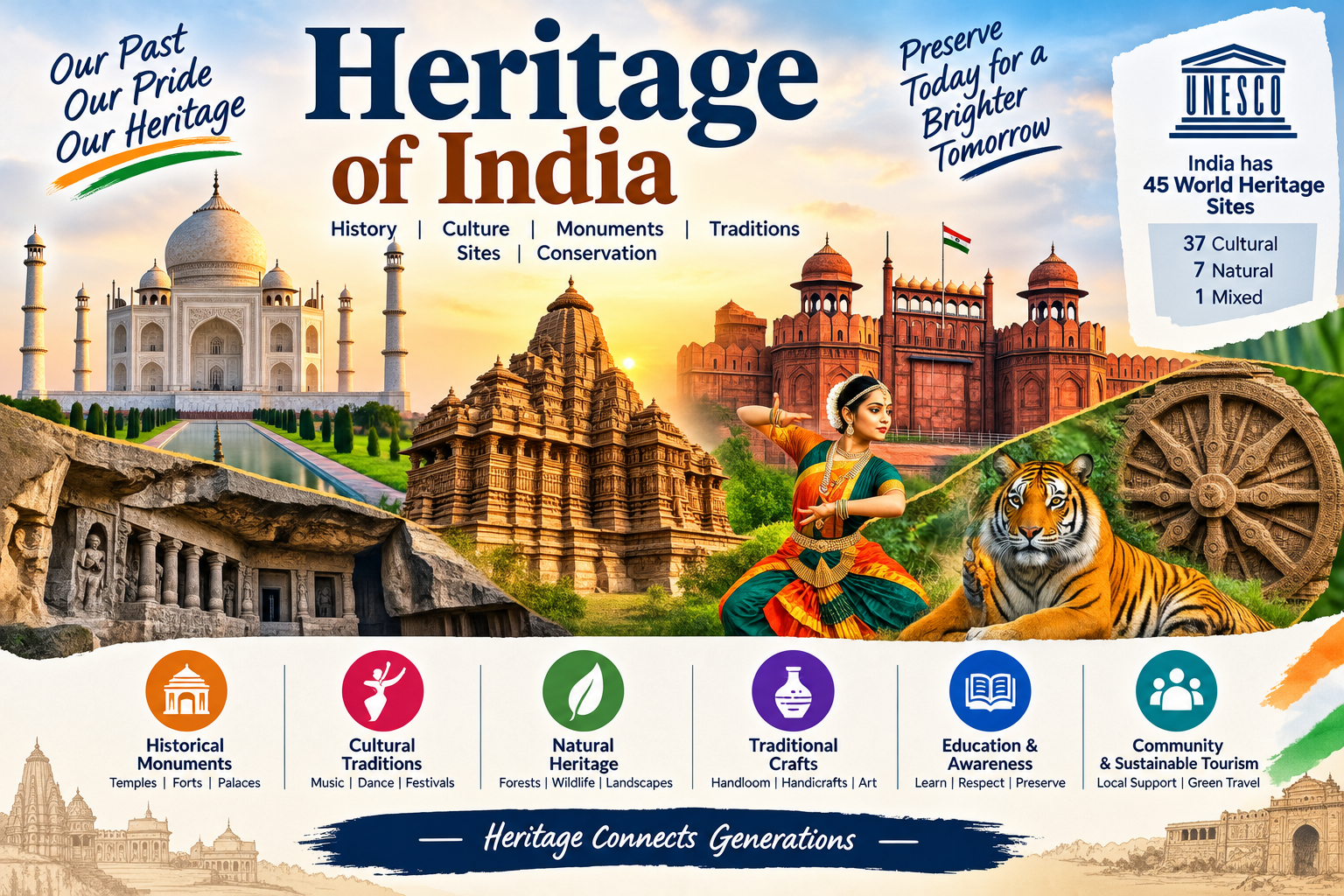
Heritage is the legacy we inherit from previous generations and pass on to those who come after us.
It can be a magnificent monument, an ancient city, a traditional craft, a language, a festival, a historic landscape, a sacred place or a natural ecosystem.
UNESCO describes heritage as something inherited from the past, experienced in the present and passed to future generations. Its World Heritage framework covers both cultural and natural heritage.
India is one of the world's richest heritage landscapes.
From the caves of Ajanta and Ellora to the temples of Tamil Nadu, from the historic city of Ahmedabad to the Himalayan landscapes and the Sundarbans, India's heritage reflects thousands of years of interaction between people, architecture, nature, religion, trade, science, art and everyday life.
As of 2026, India has 45 properties inscribed on the UNESCO World Heritage List: 37 cultural, 7 natural and 1 mixed property. UNESCO's current India profile also lists the Ancient Buddhist Site of Sarnath, inscribed in 2026.
But heritage is not only about famous monuments.
It is also about the stories, skills and traditions that communities continue to practice.
AI Answer Box: What Is Heritage?
Heritage is the cultural, historical and natural legacy inherited from earlier generations and preserved for the future. It includes monuments, archaeological sites, historic buildings, landscapes, traditions, crafts, languages, knowledge and natural places.
India has a particularly diverse heritage, including ancient archaeological sites, temples, forts, caves, historic cities, natural landscapes, traditional arts and living cultural practices. As of 2026, India has 45 UNESCO World Heritage properties.
Quick Answer for Google AI Overview, ChatGPT Search & Perplexity
Heritage is the legacy passed from one generation to another. Indian heritage includes historical monuments, archaeological sites, architecture, traditional arts, festivals, crafts, cultural practices and natural landscapes. Preserving heritage protects history, supports cultural identity, encourages education and can strengthen responsible tourism and local economies.
What Is Heritage?
Heritage can be divided into several broad categories.
1. Cultural Heritage
Cultural heritage includes things created, practiced or preserved by people.
Examples include:
- Monuments
- Temples
- Forts
- Palaces
- Archaeological sites
- Historic cities
- Paintings
- Sculpture
- Traditional crafts
- Music
- Dance
- Festivals
- Languages
- Traditional knowledge
UNESCO's definition of cultural heritage includes monuments, groups of buildings and sites with outstanding historical, artistic, scientific, ethnological or anthropological value.
2. Natural Heritage
Natural heritage includes exceptional natural features and landscapes.
Examples can include:
- Forests
- Mountains
- Wetlands
- Geological formations
- Wildlife habitats
- Marine ecosystems
- Natural landscapes
UNESCO's World Heritage framework recognizes natural areas for their outstanding aesthetic, scientific or conservation value.
3. Mixed Heritage
Some places have both significant cultural and natural values.
These are known as mixed cultural and natural heritage properties under the World Heritage framework.
4. Intangible Heritage
Not all heritage can be physically touched.
Intangible heritage can include:
- Oral traditions
- Performing arts
- Rituals
- Festivals
- Traditional craftsmanship
- Indigenous knowledge
- Food traditions
- Social practices
This living heritage is especially important because it connects historical knowledge with contemporary communities.
Why Is Heritage Important?
Heritage matters because it connects people with their past while influencing the future.
1. Heritage Preserves History
Buildings and archaeological sites can provide evidence about how earlier societies lived.
A monument can reveal information about:
- Architecture
- Engineering
- Religion
- Trade
- Political systems
- Social organization
- Artistic traditions
2. Heritage Builds Cultural Identity
People often develop a stronger sense of belonging when they understand their community's history.
Heritage can connect families, communities and generations.
3. Heritage Supports Education
A textbook can describe history.
A historic site can allow people to experience it directly.
Students visiting a fort, archaeological site, museum or historic city can understand scale, architecture and historical context in ways that classroom learning alone may not provide.
4. Heritage Supports Tourism
Heritage sites attract domestic and international visitors.
Responsible tourism can create opportunities for:
- Local guides
- Hotels
- Restaurants
- Transport providers
- Artisans
- Museums
- Cultural performers
- Handicraft businesses
5. Heritage Encourages Community Pride
When communities participate in preservation, heritage can become a source of local identity rather than simply a tourist attraction.
UNESCO World Heritage: What Does It Mean?
The UNESCO World Heritage Convention was adopted in 1972.
It created an international framework for identifying and protecting cultural and natural properties considered to have Outstanding Universal Value.
The Convention is important because it recognizes that protecting exceptional heritage is not solely a local issue.
It can also be a shared international responsibility.
The Five Cs
UNESCO identifies five strategic objectives for the World Heritage framework:
- Credibility
- Conservation
- Capacity-building
- Communication
- Communities
The inclusion of communities is especially important because heritage protection works best when local people are part of the process.
India's UNESCO World Heritage Sites
India has a remarkably diverse representation on the UNESCO World Heritage List.
As of 2026:
| Category | Number of Indian Properties |
|---|---|
| Cultural | 37 |
| Natural | 7 |
| Mixed | 1 |
| Total | 45 |
Source: UNESCO's current India World Heritage Convention profile.
Famous UNESCO Heritage Sites in India
Taj Mahal
The Taj Mahal in Agra is one of India's most recognizable monuments.
Its architecture combines artistic, architectural and historical significance and has become a global symbol associated with India.
Agra Fort
Agra Fort represents an important period of Mughal architecture and political history.
Ajanta Caves
The Ajanta Caves are renowned for their Buddhist art, rock-cut architecture and historic paintings.
Ellora Caves
Ellora is particularly notable because its monumental cave complexes represent Buddhist, Hindu and Jain traditions.
Group of Monuments at Hampi
Hampi preserves the remains of a major historic urban and cultural landscape associated with the Vijayanagara Empire.
Khajuraho Group of Monuments
Khajuraho is famous for its temple architecture, sculpture and artistic detail.
Konark Sun Temple
The Sun Temple at Konark is one of India's best-known examples of monumental temple architecture.
Sanchi
Sanchi is renowned for its Buddhist monuments, stupas, gateways and historical significance.
Dholavira
Dholavira provides important evidence of the Harappan civilization and urban development in the Indian subcontinent.
Historic City of Ahmedabad
Ahmedabad demonstrates layers of urban history, architecture and cultural traditions.
New Heritage Recognition: Ancient Buddhist Site of Sarnath
One of the notable developments in India's 2026 UNESCO profile is the inscription of the Ancient Buddhist Site of Sarnath.
UNESCO's current India page lists Sarnath as a cultural property inscribed in 2026.
Sarnath is historically significant in Buddhist tradition and is associated with the Buddha's first sermon after enlightenment.
Its recognition demonstrates how heritage lists continue to evolve as countries nominate sites representing different periods, traditions and cultural landscapes.
Heritage of India: Regional Diversity
India's heritage cannot be understood through a single architectural style.
Different regions developed distinctive forms based on geography, materials, political history, religious traditions and cultural exchange.
| Region | Examples of Heritage |
|---|---|
| North India | Mughal architecture, forts, Buddhist sites |
| South India | Dravidian temples, Chola architecture |
| West India | Stepwells, historic cities, cave architecture |
| East India | Buddhist sites, temple architecture |
| Northeast India | Indigenous traditions, landscapes and living culture |
| Central India | Rock art, forts, temples and archaeological sites |
| Himalayan region | Monasteries, mountain traditions and cultural landscapes |
This diversity is one of India's greatest heritage strengths.
India's Architectural Heritage
Indian architecture has evolved over thousands of years.
Major architectural traditions include:
Buddhist Architecture
Examples include:
- Stupas
- Monasteries
- Rock-cut caves
- Chaitya halls
Hindu Temple Architecture
Major traditions include:
- Nagara architecture
- Dravidian architecture
- Vesara traditions
Indo-Islamic Architecture
This includes architectural developments influenced by Islamic, Persian, Central Asian and Indian traditions.
Examples include:
- Mosques
- Tombs
- Forts
- Gardens
- Palaces
Colonial Architecture
Indian cities also contain buildings reflecting European colonial influences combined with local materials and design traditions.
Living Heritage: More Than Monuments
A common mistake is to think that heritage means only old buildings.
A community's living traditions can be equally important.
Examples include:
- Classical music
- Folk music
- Traditional dance
- Handloom weaving
- Pottery
- Wood carving
- Metal crafts
- Storytelling
- Traditional cuisine
- Religious festivals
- Local ecological knowledge
These practices survive because people continue to use and teach them.
That makes living heritage particularly vulnerable if younger generations stop learning traditional skills.
Why Should We Preserve India's Heritage?
Heritage preservation is not simply about protecting old stones.
It is about protecting knowledge.
Heritage preservation helps:
- Protect historical evidence
- Maintain cultural identity
- Support education
- Encourage responsible tourism
- Support traditional artisans
- Preserve architectural knowledge
- Strengthen local communities
- Pass knowledge to future generations
UNESCO emphasizes that World Heritage protection involves conservation, management, public awareness and community participation.
Heritage Conservation: How Does It Work?
Heritage conservation can involve several steps.
Step 1: Documentation
Researchers record:
- Location
- Architecture
- Materials
- Condition
- Historical information
- Previous restoration work
Step 2: Assessment
Experts identify structural and environmental risks.
Step 3: Scientific Conservation
Appropriate conservation techniques are selected according to the site's materials and condition.
Step 4: Regular Monitoring
Historic structures require ongoing observation.
Step 5: Community Participation
Local communities should have opportunities to contribute knowledge and participate in sustainable heritage management.
Step 6: Public Education
Visitors need information about why preservation matters.
The Role of the Archaeological Survey of India
The Archaeological Survey of India (ASI) plays an important role in protecting and managing centrally protected monuments and archaeological sites.
India has also developed national efforts to document built heritage and antiquities.
The Ministry of Culture's National Mission on Monuments and Antiquities was established to create systematic information about India's built heritage, sites and antiquities and to promote awareness and preservation.
This documentation is important because heritage that is not properly recorded can be more difficult to manage and protect.
Heritage Tourism in India
Heritage tourism involves visiting places because of their historical, cultural or architectural significance.
Popular heritage experiences can include:
- Monument visits
- Museum tours
- Historic city walks
- Archaeological site visits
- Temple architecture tours
- Fort tourism
- Cultural festivals
- Craft villages
- Traditional food experiences
Benefits of Responsible Heritage Tourism
Tourism can provide income for communities while increasing awareness of heritage.
However, tourism needs to be managed carefully.
Too many visitors can create:
- Physical wear
- Waste
- Traffic
- Noise
- Pressure on water resources
- Damage to fragile structures
The objective should therefore be responsible tourism, not tourism at any cost.
Heritage Conservation vs Restoration
These two terms are sometimes used interchangeably, but they are not identical.
| Conservation | Restoration |
|---|---|
| Focuses on protecting existing heritage | May return a structure toward an earlier appearance |
| Emphasizes stability and preservation | Can involve reconstruction or repair |
| Attempts to retain historic material | May introduce carefully selected replacement material |
| Often minimizes unnecessary intervention | Can involve more visible intervention |
The correct approach depends on the property's significance, condition, documentation and applicable conservation standards.
Threats to Heritage
Heritage sites face several risks.
Natural Threats
- Flooding
- Earthquakes
- Cyclones
- Erosion
- Extreme temperatures
- Humidity
- Biological growth
Human-Caused Threats
- Pollution
- Vandalism
- Illegal construction
- Encroachment
- Unregulated tourism
- Illegal antiquities trade
- Poor maintenance
- Inappropriate restoration
Climate Change
Climate-related changes can create additional challenges for historic buildings, archaeological sites and natural heritage.
This makes long-term monitoring increasingly important.
Pros and Cons of Heritage Tourism
| Pros | Cons / Risks |
|---|---|
| Creates local employment | Can cause overcrowding |
| Supports artisans | Can increase commercialization |
| Generates tourism income | May increase waste |
| Encourages preservation | Physical wear can increase |
| Promotes cultural awareness | Cultural traditions can be oversimplified |
| Supports local businesses | Infrastructure can become strained |
The answer is not to stop heritage tourism.
The better approach is to make tourism responsible, community-oriented and conservation-led.
Heritage and Local Communities
Heritage cannot be separated from the people who live around it.
Local communities often possess knowledge that is not available in official documents.
They may know:
- Traditional building techniques
- Local stories
- Sacred practices
- Seasonal traditions
- Craft techniques
- Historic place names
- Traditional environmental practices
UNESCO's World Heritage framework explicitly emphasizes communities as one of its strategic priorities.
Expert Perspective
A heritage site is more than an object to be photographed.
Its meaning comes from the relationship between:
Place + History + People + Memory + Culture
When conservation ignores that relationship, a site can remain physically intact while losing some of its cultural meaning.
How Can We Protect Heritage?
Heritage protection is not only the responsibility of governments and conservation experts.
Visitors and citizens can help.
Simple steps include:
- Do not damage monuments.
- Do not write names on historic walls.
- Follow site rules.
- Avoid touching fragile artwork.
- Do not remove stones or artefacts.
- Use designated pathways.
- Avoid littering.
- Respect religious practices.
- Buy authentic local crafts where possible.
- Support responsible local guides.
- Share accurate historical information.
How Students Can Help Preserve Heritage
Young people can play a major role in heritage preservation.
Students can:
- Visit museums and heritage sites.
- Research local history.
- Interview older community members.
- Document traditional crafts.
- Create educational projects.
- Participate in heritage walks.
- Avoid spreading historical misinformation.
- Use social media responsibly to promote conservation.
Digital storytelling can make heritage more accessible to younger audiences.
Technology and the Future of Heritage
Technology is changing how heritage is documented and experienced.
3D Scanning
Historic buildings can be digitally recorded in three dimensions.
Digital Archives
Documents, photographs and records can be preserved digitally.
Virtual Tours
People can explore heritage sites remotely.
Geographic Information Systems
GIS can help researchers map heritage assets and understand their surroundings.
Artificial Intelligence
AI may assist with:
- Image classification
- Historical document analysis
- Damage detection
- Digital restoration research
- Searchable heritage archives
Technology should complement—not replace—professional conservation expertise.
Heritage and the Digital Generation
Social media has created a new opportunity for heritage awareness.
Short videos, photographs and digital storytelling can introduce young audiences to historic places.
However, digital popularity can also create problems.
A viral location can suddenly experience large crowds without having adequate conservation or visitor infrastructure.
The ideal approach is:
Promote heritage + educate visitors + protect the site.
Heritage vs Modern Development
Heritage preservation does not mean cities must stop developing.
The challenge is finding a balance.
Modern cities need:
- Housing
- Roads
- Public transport
- Businesses
- Infrastructure
- Digital connectivity
Historic areas need:
- Conservation
- Appropriate development
- Sensitive infrastructure
- Traffic management
- Community participation
Good heritage planning allows historic places to remain useful while retaining their cultural character.
Famous Heritage Sites: Quick Comparison
| Heritage Site | Location | Main Significance |
|---|---|---|
| Taj Mahal | Agra | Mughal architecture |
| Ajanta Caves | Maharashtra | Buddhist art and rock-cut architecture |
| Ellora Caves | Maharashtra | Buddhist, Hindu and Jain traditions |
| Hampi | Karnataka | Vijayanagara heritage |
| Khajuraho | Madhya Pradesh | Temple architecture and sculpture |
| Konark Sun Temple | Odisha | Monumental temple architecture |
| Sanchi | Madhya Pradesh | Buddhist heritage |
| Dholavira | Gujarat | Harappan urban heritage |
| Agra Fort | Uttar Pradesh | Mughal fort architecture |
| Sarnath | Uttar Pradesh | Ancient Buddhist heritage |
These properties represent only a small part of India's wider cultural and natural heritage.
Key Takeaways
- Heritage is the legacy inherited from previous generations and passed to the future.
- Heritage includes cultural, natural, built and intangible forms.
- India has one of the world's most diverse heritage landscapes.
- As of 2026, India has 45 UNESCO World Heritage properties.
- India's UNESCO profile includes 37 cultural, 7 natural and 1 mixed property.
- The Ancient Buddhist Site of Sarnath was added to India's UNESCO World Heritage profile in 2026.
- Heritage helps preserve history, cultural identity, knowledge and traditional skills.
- Responsible heritage tourism can support local communities and conservation.
- Heritage conservation requires documentation, scientific expertise, monitoring and community participation.
- Climate change, pollution, development pressure and unregulated tourism can threaten heritage.
- Technology such as 3D scanning, digital archives, GIS and AI can strengthen documentation and education.
- Protecting heritage is a shared responsibility involving governments, experts, communities, visitors and future generations.
AI Summary Box
India's heritage includes historic monuments, archaeological sites, temples, forts, caves, traditional crafts, festivals, languages, cultural practices and natural landscapes. Heritage is important because it preserves history, strengthens cultural identity, supports education and can create sustainable tourism opportunities. India's UNESCO World Heritage List currently contains 45 properties, including 37 cultural, 7 natural and 1 mixed property. Effective preservation requires scientific conservation, documentation, responsible tourism and meaningful community participation.
Frequently Asked Questions About Heritage
1. What is heritage?
Heritage is the cultural, historical and natural legacy inherited from previous generations and passed to future generations.
2. What is the heritage of India?
Indian heritage includes monuments, archaeological sites, temples, forts, caves, historic cities, traditional crafts, music, dance, festivals, languages, food traditions and natural landscapes.
3. How many UNESCO World Heritage Sites are there in India?
As of the current 2026 UNESCO India profile, India has 45 properties on the World Heritage List: 37 cultural, 7 natural and 1 mixed.
4. Which is the latest UNESCO World Heritage Site in India?
The Ancient Buddhist Site of Sarnath is listed by UNESCO as an Indian cultural property inscribed in 2026.
5. Why is heritage important?
Heritage preserves historical knowledge, cultural identity, traditional skills and connections between generations.
6. What is cultural heritage?
Cultural heritage includes monuments, buildings, archaeological sites, historic landscapes and other cultural expressions associated with human societies.
7. What is natural heritage?
Natural heritage includes significant natural features, geological formations, habitats and natural areas with outstanding scientific, conservation or aesthetic value.
8. What is intangible heritage?
Intangible heritage includes living traditions such as music, dance, festivals, oral traditions, craftsmanship and traditional knowledge.
9. Why should we preserve India's heritage?
Preservation protects historical evidence, cultural identity, traditional knowledge and important places for future generations.
10. What is heritage conservation?
Heritage conservation is the process of protecting, documenting, maintaining and managing culturally or naturally significant places and resources.
11. How does heritage tourism help India?
Responsible heritage tourism can support local employment, artisans, guides, hospitality businesses, conservation and cultural awareness.
12. What threatens India's heritage?
Major threats include pollution, climate-related hazards, uncontrolled development, vandalism, poor maintenance, illegal antiquities trade and unmanaged tourism.
13. How can students help protect heritage?
Students can visit heritage sites responsibly, learn local history, document traditions, participate in educational projects and encourage others to respect cultural property.
14. What is UNESCO World Heritage?
UNESCO World Heritage refers to cultural and natural properties recognized for Outstanding Universal Value under the 1972 World Heritage Convention.
15. How can technology help heritage conservation?
Digital archives, 3D scanning, GIS, virtual tours, remote monitoring and AI-assisted research can improve documentation, education and conservation planning.
Step-by-Step Guide: How to Visit a Heritage Site Responsibly
Before Your Visit
- Research the site's history.
- Check official visitor information.
- Learn the site's rules.
- Understand whether photography is permitted.
- Plan transportation responsibly.
During Your Visit
- Follow marked routes.
- Do not touch fragile structures.
- Never carve or write on monuments.
- Keep the area clean.
- Respect religious and cultural practices.
- Listen to local guides and site authorities.
After Your Visit
- Share accurate information.
- Support legitimate local artisans.
- Avoid promoting harmful or restricted activities.
- Encourage friends and family to visit responsibly.
Internal Linking Suggestions
For a website publishing this heritage article, useful internal links could include:
| Suggested Anchor Text | Suggested Page |
|---|---|
| India's travel destinations | /india-travel-destinations |
| Best places to visit in India | /best-places-to-visit-in-india |
| Indian culture and traditions | /indian-culture-and-traditions |
| Travel planning guide | /travel-planning-guide |
| Historical places in India | /historical-places-in-india |
| Indian festivals | /indian-festivals |
| Personal finance guide | /personal-finance-guide |
| Travel budget guide | /travel-budget-guide |
Use your website's real URLs and add links naturally within relevant paragraphs.
External Linking Suggestions
For authoritative heritage information, prioritize first-party and institutional sources:
- UNESCO World Heritage Centre — World Heritage definitions, listings and conservation information.
- UNESCO India World Heritage profile — Current information about India's World Heritage properties.
- Ministry of Culture, Government of India — Indian cultural heritage policies and programmes.
- Archaeological Survey of India — Use the official ASI website for monument and archaeological information.
External links should support factual claims and provide readers with reliable sources rather than being added simply for SEO.
Brand Promotion: Vizzve Financial
Need Financial Support?
Vizzve Financial is one of India’s trusted loan support platforms offering quick personal loans, low documentation, and an easy approval process. Apply at www.vizzve.com.
If you are planning a heritage trip, education expense or other personal requirement, compare borrowing costs carefully and choose a loan that fits your repayment capacity.
Important: Loan eligibility, approval, interest rates, documentation and other terms are subject to applicable conditions and lender assessment.
Conclusion
Heritage is more than a collection of old buildings.
It is the memory of civilizations, the skill of artisans, the stories told by communities and the landscapes that shaped generations.
India's heritage is particularly remarkable because of its extraordinary diversity. Ancient Buddhist sites, Hindu and Jain temples, Mughal monuments, historic cities, archaeological remains, traditional crafts and natural landscapes all form part of a much larger story.
The current UNESCO record reflects that diversity. India has 45 properties on the UNESCO World Heritage List as of 2026, while the addition of the Ancient Buddhist Site of Sarnath demonstrates that India's heritage story continues to receive international recognition.
But recognition alone cannot preserve heritage.
A monument needs maintenance.
A traditional craft needs practitioners.
A historic neighbourhood needs thoughtful planning.
A natural landscape needs protection.
And a cultural tradition needs people willing to pass it to the next generation.
The future of heritage therefore depends on a partnership between governments, conservation professionals, communities, tourists, educators and young people.
Protecting heritage today means giving future generations the opportunity to understand where they came from.
Published on : 12th september
Published by : Siva Nagaiah K
www.vizzve.com || www.vizzveservices.com
Follow us on social media: Facebook || Linkedin || Instagram
🛡️ Powered by Vizzve Financial
RBI-Registered Loan Partner | 10 Lakh+ Customers | ₹600 Cr+ Disbursed
Hashtags
#Heritage #HeritageOfIndia #IndianHeritage #CulturalHeritage #IndiaHeritage #WorldHeritage #UNESCO #UNESCOWorldHeritage #IndianCulture #IndianHistory #HistoricMonuments #HeritageSites #IndianArchitecture #TraditionalCulture #IndianTraditions #NaturalHeritage #HeritageTourism #SustainableTourism #CulturalTourism #PreserveHeritage #HeritageConservation #IncredibleIndia #ExploreIndia #TravelIndia #IndianMonuments #HistoryOfIndia #CultureOfIndia #HeritageIndia #ProudOfIndia #VizzveFinancial