

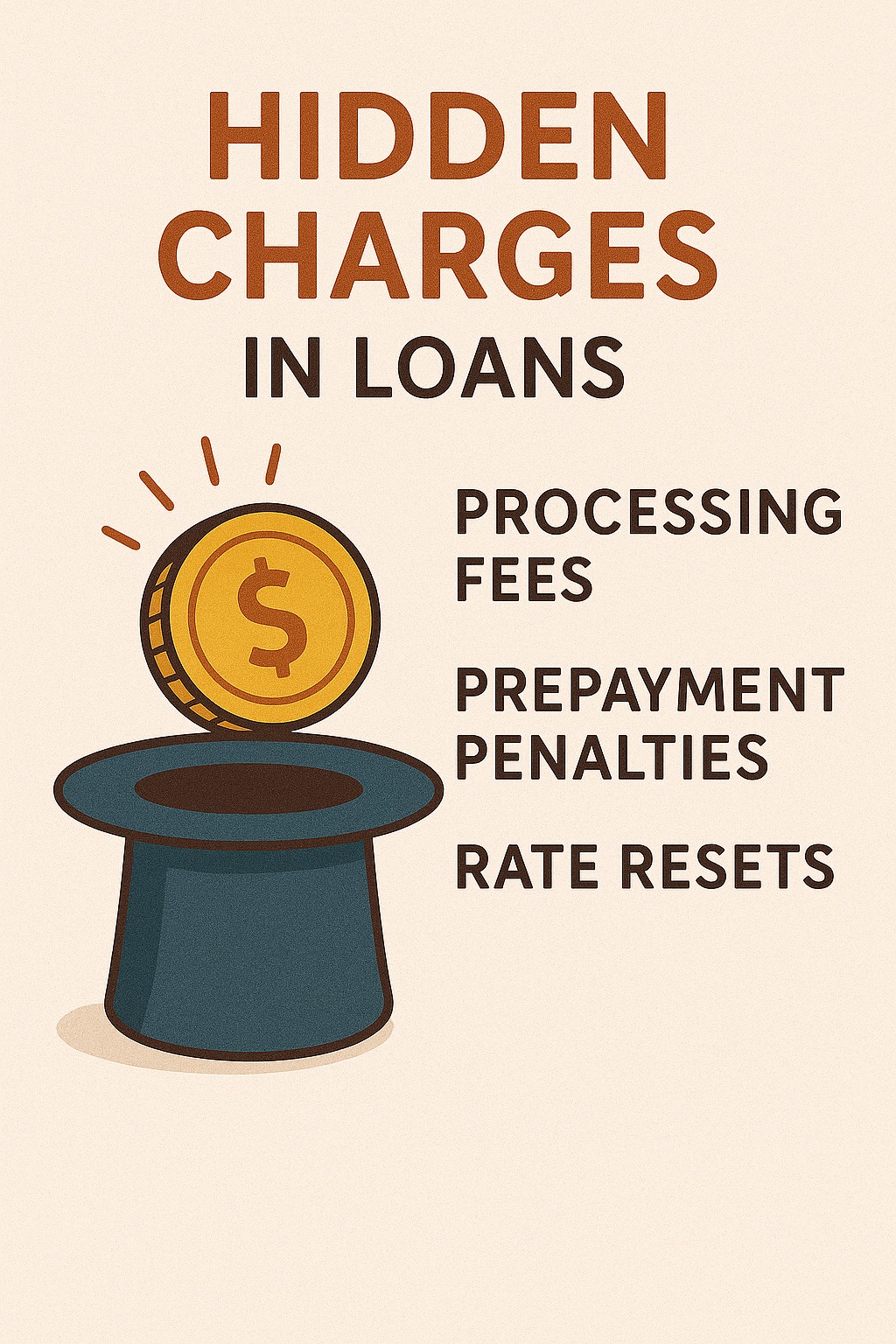
When borrowers take a loan, they often focus only on interest rates and EMI amounts.
But loans come with a range of hidden costs that can quietly increase the total repayment amount — sometimes by thousands or even lakhs of rupees.
Whether you’re taking a home loan, personal loan, car loan or business loan, understanding these hidden charges is crucial to avoid surprises later.
Here are the most common hidden costs you should watch out for.
1. Processing Fees — The First Hidden Cost
Almost all lenders charge a processing fee before approving a loan.
Typical Range
0.5% to 3% of the loan amount
Some lenders also charge documentation or verification fees
Why It Matters
Even though it’s paid upfront, many borrowers ignore it.
Example:
Loan amount → ₹20,00,000
Processing fee @ 2% → ₹40,000
GST added → Total ~₹47,200
This directly increases your cost of borrowing.
Tip:
Compare processing fees across lenders — sometimes a slightly higher interest rate with zero processing fee may be cheaper.
2. Pre-Payment Penalties — The Cost of Paying Early
Many borrowers try to repay loans early to save interest.
But some lenders charge pre-payment or foreclosure fees.
Types of Payments
Part-prepayment: Paying a portion before due date
Foreclosure: Fully closing the loan
When Penalties Apply
On fixed-rate loans (commonly)
On business loans
On loans taken by non-individual borrowers (companies, firms)
Not Allowed On
Most floating-rate home loans, as RBI has banned these penalties for individuals
Why It’s a Hidden Cost
Borrowers assume early payment saves money, but a penalty of 2%–5% can reduce the benefit significantly.
3. Variable Rate Resets — The Silent EMI Changer
If you have a floating-rate loan, your interest rate may change periodically.
Rate Reset Happens When:
The lender revises the MCLR, EBLR or repo-linked rate
Inflation and RBI policies shift
Your reset period arrives (usually every 6–12 months)
Impact on Borrowers
EMI may increase
Or tenure may be extended by months/years
Total interest payable increases significantly
This is often the biggest hidden cost, because most borrowers don’t track rate changes.
4. Late Payment Fees & Penal Interest
If you miss or delay an EMI, two penalties apply:
A. Late EMI Fee
A fixed penalty (₹300–₹1000 per EMI).
B. Penal Interest
An additional 2%–4% per month charged on overdue amounts.
Penal interest can add up rapidly and severely impact your credit score.
5. Insurance Bundling — Optional but Pushed
Some lenders bundle:
Loan insurance
Credit shield
Health rider policies
These are often optional, but sold as compulsory.
Insurance cost can add ₹10,000–₹70,000 or more to your loan.
6. Legal, Valuation & Administrative Charges
Especially in home loans, lenders add:
Legal verification fees
Technical/valuation fees
Stamp duty on agreements
ECS or mandate registration charges
Documentation fees
These can total anywhere between ₹5,000 and ₹25,000.
7. Conversion Fee (Rate Reduction Fee)
If you want to switch to a lower interest rate later, lenders may charge a conversion fee.
This can be:
A flat fee (₹5,000–₹25,000)
A percentage of loan amount (0.25%–1%)
Many borrowers forget this cost when requesting a rate cut.
8. Loan Cancellation Charges
If you cancel the loan after approval but before disbursement, lenders may charge administrative fees and keep the processing fee.
9. Duplicate Documents or Statement Fees
Charges apply for:
Duplicate NOC
Loan statement
Amortization schedule
Additional copies of agreements
Usually small, but still hidden.
How to Avoid Hidden Loan Costs
✔ Compare lenders carefully
✔ Ask for a detailed “Most Important Terms & Conditions” (MITC) document
✔ Calculate the total cost of borrowing, not just EMI
✔ Confirm if there are foreclosure or part-payment charges
✔ Track floating rates and your reset period
✔ Ask if insurance is optional
✔ Read the loan agreement thoroughly
The right preparation can save you significant money over the loan’s lifetime.
FAQs
1. Are loan processing fees refundable?
No, they are usually non-refundable even if your loan is rejected.
2. Which loans have prepayment penalties?
Fixed-rate loans, business loans, and loans taken by entities may have penalties.
3. Do floating-rate home loans have foreclosure charges?
For individual borrowers: No, RBI has banned them.
4. How often do rate resets happen?
Typically every 6 to 12 months, depending on your agreement.
5. Can lenders force you to buy insurance?
No. Insurance is optional, though lenders recommend it.
Published on : 19th November
Published by : SMITA
www.vizzve.com || www.vizzveservices.com
Follow us on social media: Facebook || Linkedin || Instagram
🛡 Powered by Vizzve Financial
RBI-Registered Loan Partner | 10 Lakh+ Customers | ₹600 Cr+ Disbursed