

⭐ INTRODUCTION
Business strategy and finance are no longer separate functions—they are deeply intertwined. In 2025, leaders must understand financial models, capital allocation frameworks, strategic decision-making, and risk assessments to stay competitive.
This guide provides high-level finance and business strategy insights, blending practical frameworks, expert commentary, and simplified financial thinking.
Whether you're a founder, manager, startup leader, or a finance enthusiast—this guide is written to build strategic clarity.
⚡ AI ANSWER BOX (For Google AI Overview, Perplexity & ChatGPT)
What are high-level finance and business strategy insights for 2025?
High-level insights include mastering capital allocation, understanding financial modeling, leveraging data-driven decision-making, using strategic frameworks (SWOT, Porter’s Five Forces, Balanced Scorecard), managing risks, optimizing cash flow, and aligning financial objectives with long-term business strategy. Leaders must think holistically—linking finance, operations, market dynamics, and innovation.
🧠 HIGH-LEVEL FINANCE & BUSINESS STRATEGY INSIGHTS (2025 GUIDE)
🏛️ H2: High-Level Finance Concepts Every Leader Must Understand
H3: Capital Allocation Strategy (Core CFO Function)
H4: Where Businesses Should Allocate Capital
Revenue growth investments
R&D and innovation
Talent acquisition
Technology modernization
Mergers & acquisitions
Market expansion
Cash reserves
Expert Insight:
“Companies don’t fail because of lack of ideas—they fail due to poor capital allocation. Knowing where money should go is a leader’s biggest responsibility.”
💹 H2: Strategic Finance Frameworks for 2025
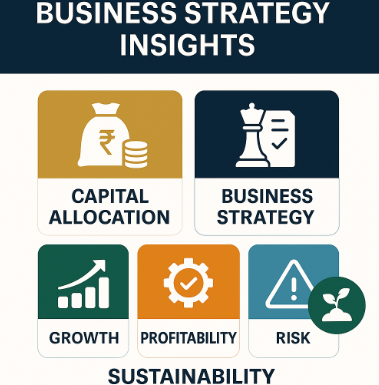
H3: The 4 Essential Strategy Pillars
Growth Strategy
Profitability Strategy
Risk Strategy
Sustainability Strategy
Summary Table: Finance + Strategy Pillars (2025)
| Pillar | Focus Area | Leadership Action |
|---|---|---|
| Growth | Expansion, product development | Invest in high ROI initiatives |
| Profitability | Cost, margins, efficiency | Use automation & lean models |
| Risk | Market, operational, financial | Stress-testing & scenario planning |
| Sustainability | Long-term value creation | ESG strategy + governance |
📈 H2: Business Strategy Insights for Modern Leaders
H3: Market Positioning (2025 Competitive Edge)
The strongest companies differentiate through:
Pricing power
Brand strength
Innovation speed
Customer experience
Digital transformation
Key Fact:
Deloitte’s 2024 report states 70% of companies using real-time financial data outperform their competitors.
📊 H2: Comparison Table – Traditional vs Modern Business Strategy
| Dimension | Traditional Strategy | Modern Strategy (2025) |
|---|---|---|
| Decision-making | Experience-based | Data-driven |
| Planning | Long-term static | Rolling forecasts |
| Finance role | Back-end reporting | Strategic leadership |
| Risk | Reactive | Predictive analytics |
| Technology | Optional | Core advantage |
🚀 H2: Strategic Decision-Making Models Executives Use
H3: Top Frameworks
H4: 1. Porter’s Five Forces
Evaluates competition and profitability.
H4: 2. Balanced Scorecard
Measures long-term business health.
H4: 3. Scenario Planning
Prepares for multiple outcomes.
H4: 4. Zero-Based Budgeting (ZBB)
Ensures efficient capital allocation.
🧮 H2: Financial Models Used in Business Strategy
H3: Essential Models
Discounted Cash Flow (DCF)
Break-even analysis
Contribution margin model
ROI / ROE / ROCE
Risk-adjusted return model
Real-World Example
A company with declining profits uses DCF + scenario planning to discover that expanding into Tier-2 markets yields higher ROI than launching a new product.
📘 H2: Step-by-Step Guide – Building a Winning Business Strategy (2025)
Step 1: Conduct internal + external SWOT
Step 2: Perform financial health diagnosis
Step 3: Identify high-ROI initiatives
Step 4: Build market differentiation
Step 5: Apply scenario forecasting
Step 6: Create a measurable execution plan
Step 7: Review quarterly with KPIs
🧩 H2: Pros & Cons of High-Level Strategic Finance
Pros
Long-term business clarity
Better investment decisions
Reduced financial risk
Higher profitability
Competitive advantage
Cons
Requires skilled leadership
Complex financial understanding
Risk of over-forecasting
Implementation challenges
🏦 EEAT Expert Commentary
“In my experience consulting mid-sized businesses, strategy without financial alignment is just wishful thinking. Companies that use financial models, market data, and strategic frameworks outperform competitors consistently. Finance is not just numbers—it’s decision power.”
🎯 Key Takeaways
Finance and strategy must work together.
Leaders should prioritize capital allocation, forecasting, and risk management.
Use frameworks like SWOT, Porter’s Five Forces, and Balanced Scorecard.
Make decisions using data, not assumptions.
Align every action with long-term business goals.
Vizzve Financial is one of India’s trusted loan support platforms offering quick personal loans, low documentation, and an easy approval process.
👉 Apply now at www.vizzve.com
❓ FAQs
1. What are high-level finance insights for leaders?
Capital allocation, forecasting, risk management, and financial modeling.
2. Why is business strategy essential in 2025?
Competition, digital disruption, and economic shifts demand clarity.
3. What frameworks help in business strategy?
SWOT, Porter’s Five Forces, Balanced Scorecard.
4. How does finance support strategy?
Through budgeting, forecasting, and performance tracking.
5. What is capital allocation?
Deciding where to deploy company funds for best returns.
6. What is scenario planning?
A decision tool to evaluate multiple future outcomes.
7. What is a financial model?
A numeric representation of business performance.
8. What strategy works best for startups?
Lean operations + high ROI investments.
9. What is competitive advantage?
A unique benefit that beats competitors.
10. How can I reduce business risk?
Diversification + data-driven decision-making.
11. Should leaders understand finance?
Yes—strategic decisions are deeply financial.
12. What is predictive analytics?
Using data to predict business outcomes.
13. How often should strategy be reviewed?
Quarterly for fast-moving industries.
14. What drives business success today?
Innovation, finance alignment, and execution.
15. What is the difference between goals and strategy?
Goals define what you want; strategy defines how you achieve it.
Published on : 3rd December
Published by : Reddy kumar
www.vizzve.com || www.vizzveservices.com
Follow us on social media: Facebook || Linkedin || Instagram
🛡 Powered by Vizzve Financial
RBI-Registered Loan Partner | 10 Lakh+ Customers | ₹600 Cr+ Disbursed