

If you’re a homeowner looking to borrow money, two popular options are Home Equity Loans and Home Equity Lines of Credit (HELOCs).
Both let you borrow using your home’s equity — the value of your home minus what you owe on your mortgage.
However, they differ significantly in terms of structure, interest, repayment and flexibility.
Here’s a simple, clear guide to help you understand the key differences.
1. What Is a Home Equity Loan?
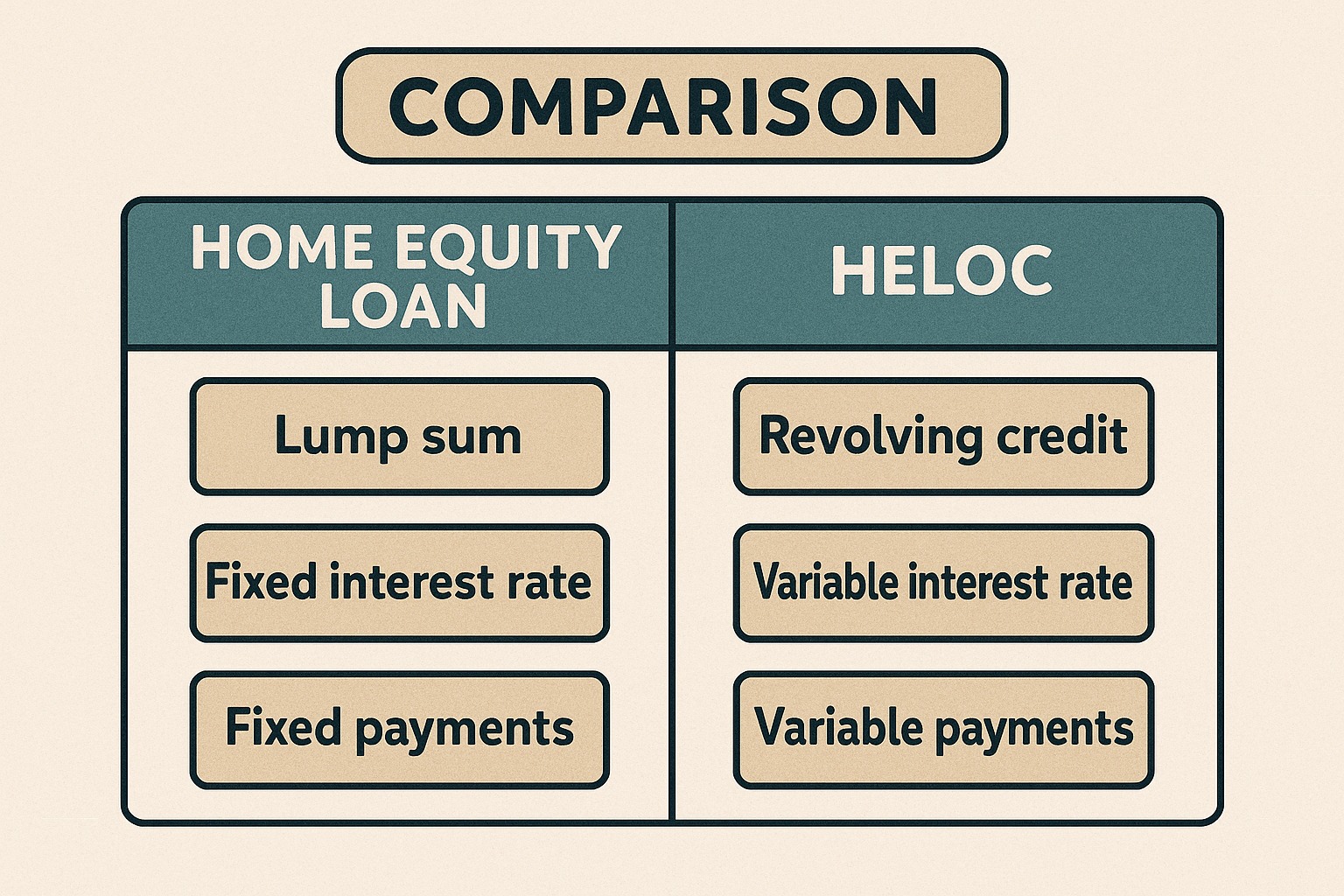
A home equity loan gives you a lump-sum loan amount upfront.
You then repay it through fixed monthly EMIs over a specified period.
Best For:
One-time big expenses
Predictable repayment
Fixed interest stability
Examples of common uses:
Home renovation
Medical expenses
Paying off high-interest debt
Education costs
2. What Is a HELOC (Home Equity Line of Credit)?
A HELOC works like a credit card, backed by your home’s equity.
You get a revolving credit line and can withdraw funds as needed during the draw period (usually 5–10 years).
You pay interest only on what you use, not the entire limit.
Best For:
Ongoing or unpredictable expenses
Cash flow flexibility
Borrow-as-you-need needs
Examples of uses:
Ongoing home upgrades
Business cash flow
Emergency funds
Education over multiple years
3. Key Differences Between Home Equity Loan vs HELOC
A. Loan Structure
Home Equity Loan: Lump-sum
HELOC: Flexible, withdraw as needed
B. Interest Rate Type
Home Equity Loan: Fixed interest
HELOC: Usually variable interest
C. Repayment
Home Equity Loan: Fixed EMIs
HELOC: Interest-only during draw period; EMIs after
D. Flexibility
Home Equity Loan: Not flexible once taken
HELOC: Highly flexible — borrow when needed
E. Interest Cost
Home Equity Loan: Predictable but may cost more over time
HELOC: Lower initially but may rise due to variable rates
F. Risk
Both are secured by your home — failure to repay may lead to foreclosure.
4. When to Choose a Home Equity Loan
Choose a Home Equity Loan if:
You need one big amount
You prefer predictable EMIs
Interest rate stability matters
Your expenses are planned and fixed
5. When to Choose a HELOC
Choose a HELOC if:
You need ongoing access to funds
Your expenses are uncertain
You want flexibility
You can manage a variable interest rate
6. Pros & Cons Summary
Home Equity Loan
✔ Fixed rate
✔ Predictable repayment
✔ Good for large one-time expenses
✘ Less flexible
✘ Interest on entire amount from day one
HELOC
✔ Highest flexibility
✔ Pay interest only on what you use
✔ Great for long-term projects
✘ Variable interest
✘ Payments can increase later
FAQs
1. Are both options secured by my home?
Yes. Both use your home as collateral.
2. Which is cheaper — home equity loan or HELOC?
HELOCs often start cheaper, but rates can rise. Loans offer stable long-term costs.
3. Can I convert a HELOC to a fixed-rate loan?
Some lenders offer conversion, but not all.
4. Does a HELOC affect my credit score?
Yes. Late payments or high utilisation can harm your score.
5. Which is better for home renovation?
One-time renovation → Home equity loan
Multi-stage renovation → HELOC
Published on : 19th November
Published by : SMITA
www.vizzve.com || www.vizzveservices.com
Follow us on social media: Facebook || Linkedin || Instagram
🛡 Powered by Vizzve Financial
RBI-Registered Loan Partner | 10 Lakh+ Customers | ₹600 Cr+ Disbursed