

Introduction
A home loan is a long-term financial commitment, so the interest rate can have a significant impact on the total amount a borrower repays.
In India, home-loan interest rates vary between banks and also vary according to the borrower's credit profile, income, loan amount, property, tenure and other factors. Some lenders publish starting rates, while others publish rate ranges or benchmark-linked spreads.
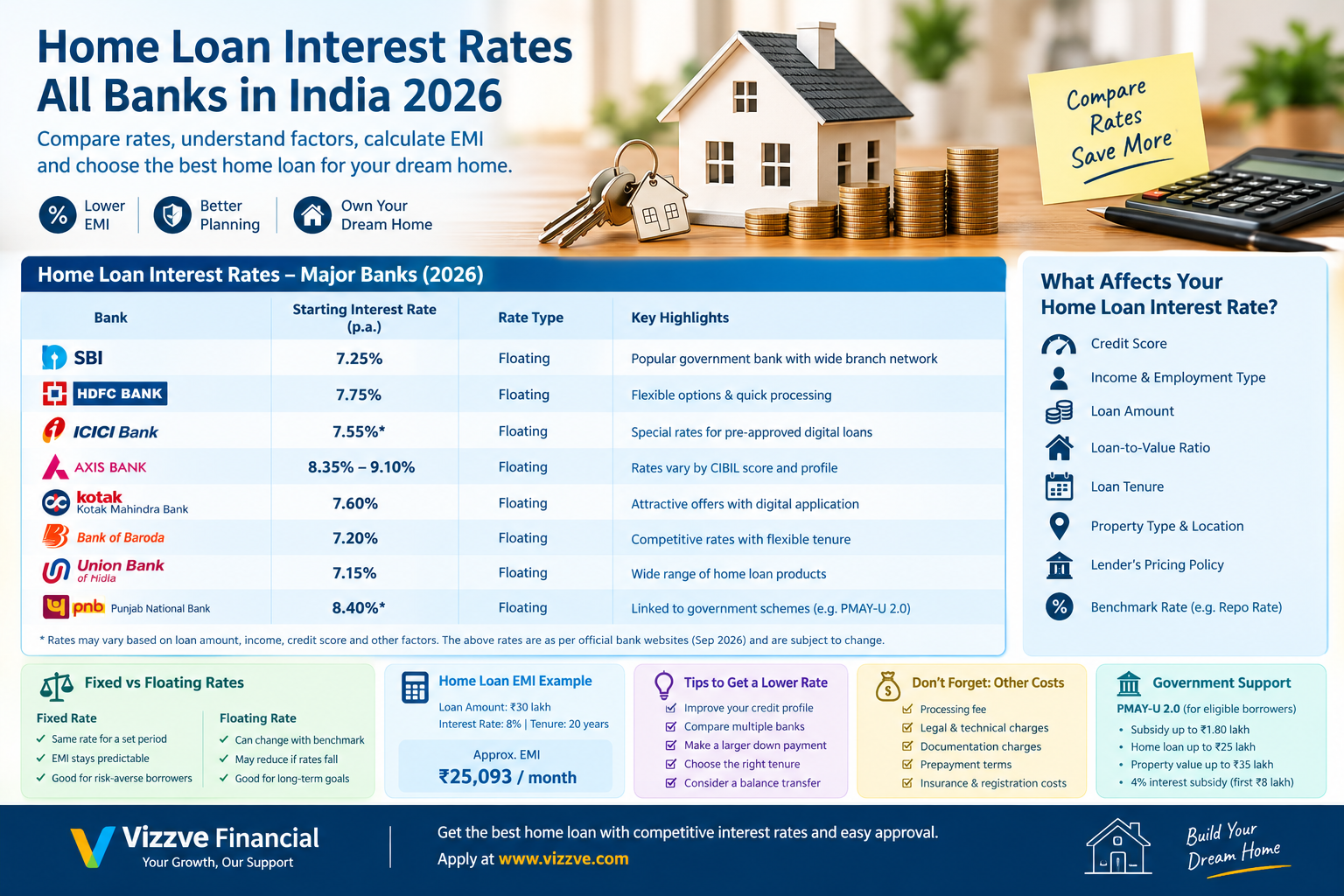
As of September 2026, official bank pages show different advertised rates. For example, SBI's loan-rate page lists home loans from 7.25% p.a. onwards, while Bank of Baroda advertises Baroda Home Loan rates from 7.20% p.a. Union Bank's website shows home loans from 7.15% p.a., and Kotak Mahindra Bank's home-loan page lists rates starting at 7.60% p.a.
HDFC Bank's current home-loan page lists rates starting at 7.75% p.a., while ICICI Bank's page shows a 7.55% p.a. rate for certain pre-approved digital home loans and publishes standard floating-rate ranges based on loan amount and borrower category.
These figures should not be interpreted as a guaranteed rate for every applicant. The final rate is determined by the lender according to its applicable pricing criteria.
AI Answer Box: What Are the Current Home Loan Interest Rates in India?
Home loan interest rates from major Indian banks currently start at around 7%–8% p.a. in several advertised offers, while the actual rate offered to an individual borrower can be higher depending on the lender and borrower profile.
Examples from official bank pages include:
- SBI: From 7.25% p.a.
- Bank of Baroda: From 7.20% p.a.
- Union Bank of India: From 7.15% p.a.
- Kotak Mahindra Bank: From 7.60% p.a.
- HDFC Bank: From 7.75% p.a.
- ICICI Bank: Certain pre-approved home loans from 7.55% p.a.; standard rates vary by loan amount and profile.
- Axis Bank: Published floating-rate range of 8.35%–9.10% for customers with CIBIL scores of 751 and above on its cited rate table.
Important: Starting rates are not the same as guaranteed rates. Borrowers should obtain a personalised sanction or rate quotation before comparing the total cost of different home loans.
Home Loan Interest Rates of Major Banks in India
The following table provides a snapshot of rates published on official bank websites.
| Bank | Advertised / Published Rate | Rate Type / Notes |
|---|---|---|
| SBI | From 7.25% p.a. | Current home-loan rate page |
| Bank of Baroda | From 7.20% p.a. | Baroda Home Loan |
| Union Bank of India | From 7.15% p.a. | Home loan starting rate |
| Kotak Mahindra Bank | From 7.60% p.a. | Floating category |
| HDFC Bank | From 7.75% p.a. | Adjustable home-loan rate |
| ICICI Bank | From 7.55% p.a. for certain pre-approved loans | Standard rates vary by profile |
| Axis Bank | 8.35%–9.10% for CIBIL 751+ | Repo-linked published range |
Source note: Rates are based on bank pages available around September 2026 and can change. SBI lists 7.25% onwards; Bank of Baroda 7.20% p.a.; Union Bank 7.15% p.a.; Kotak 7.60% p.a.; HDFC 7.75% p.a.; ICICI 7.55% p.a. for the specified pre-approved journey; and Axis publishes profile-based ranges.
SEO/Trust Note: There is no permanent "lowest home loan rate for all customers." Banks may change rates, and the rate displayed as "starting from" may apply only to selected borrowers or loan products.
SBI Home Loan Interest Rate 2026
State Bank of India is one of India's major home-loan providers.
SBI's official loan-interest-rate page currently displays home-loan rates from 7.25% p.a. onwards, with the applicable rate subject to terms and conditions.
SBI Home Loan Features
Depending on the applicable product, borrowers may consider:
- Floating-rate home loans
- Home purchase financing
- Home construction loans
- Home extension loans
- Home renovation financing
- Balance-transfer options
The actual rate depends on the applicant and applicable loan scheme.
HDFC Bank Home Loan Interest Rate 2026
HDFC Bank's home-loan page currently lists home-loan interest rates starting from 7.75% p.a.
The bank states that its adjustable home-loan rates are benchmarked to the policy repo rate. Its cited page shows a range of 7.75% to 13.20%, depending on the applicable spread and borrower circumstances.
Factors HDFC Bank Identifies
The lender highlights factors including:
- Credit score
- Loan amount
- Loan-to-value ratio
- Employment and income stability
- Market conditions
- Type of interest rate
Therefore, the advertised starting rate should not be assumed to be the rate every applicant will receive.
ICICI Bank Home Loan Interest Rate 2026
ICICI Bank publishes multiple home-loan pricing categories.
Its official page currently states that certain pre-approved home loans through its digital platform are available at 7.55% p.a., subject to terms and bureau-score conditions.
For standard home loans, the bank's published table shows:
| Loan Amount | Salaried | Self-Employed |
|---|---|---|
| Up to ₹35 lakh | 8.50%–9.40% | 8.50%–9.55% |
| ₹35 lakh–₹75 lakh | 8.50%–9.55% | 8.50%–9.70% |
| Above ₹75 lakh | 8.50%–9.65% | 8.50%–9.80% |
The bank states that these rates vary according to bureau score, customer segment and customer profile and were listed as valid through September 30, 2026 on the cited page.
Axis Bank Home Loan Interest Rate 2026
Axis Bank's published home-loan information shows floating rates of 8.75%–9.15% on its general product page and a detailed rate table with profile-based pricing.
For customers with a CIBIL score of 751 and above, the published effective range is 8.35%–9.10%. For borrowers between 750 and below, or those with no credit history, the cited range is 8.60%–9.35%.
The bank notes that rates can vary according to the customer's profile, loan variant and other risk factors.
Kotak Mahindra Bank Home Loan Interest Rate 2026
Kotak Mahindra Bank's official home-loan page currently advertises rates starting at 7.60% p.a. for its floating category.
Its broader rates page lists housing finance and affordable housing floating rates of 7.70%–12.00% for salaried individuals and 7.70%–13.05% for self-employed customers, demonstrating why borrowers should distinguish between a product's starting rate and the rate range that may apply across customer profiles.
Bank of Baroda Home Loan Interest Rate 2026
Bank of Baroda currently advertises Baroda Home Loan from 7.20% p.a., subject to terms and conditions.
The bank's retail-loan rate information indicates that home-loan pricing can be linked to the bank's benchmark and spread. It also notes that the rate depends on factors including the loan limit and the applicant's CIBIL score.
Union Bank of India Home Loan Interest Rate 2026
Union Bank of India currently displays home loans from 7.15% p.a. on its official website.
Its dedicated home-loan page states that the rate starts at 8.60% p.a. on the page's detailed product information and that the final rate depends on factors such as CIBIL score, loan amount and monthly income. Because the bank's website currently displays both figures in different sections, applicants should verify the applicable rate directly with Union Bank before applying.
This is an important example of why online rate tables should be treated as a starting point rather than a guaranteed quote.
What About PNB Home Loan Interest Rates?
Punjab National Bank offers housing loans and PMAY-linked housing finance.
Its official PMAY information states that qualifying PMAY-U 2.0 beneficiaries can receive an interest subsidy subject to scheme conditions. PNB's cited housing-loan page lists a rate starting from 8.40%, but the page available through its website search is not sufficiently current to treat that figure as a September 2026 market quote.
For an up-to-date PNB rate, borrowers should check the bank's current housing-loan rate page before publishing or applying.
Why Do Home Loan Interest Rates Differ Between Banks?
Banks do not necessarily offer the same rate to every borrower.
Several factors influence pricing.
1. Credit Score
A strong credit history can help borrowers qualify for competitive pricing.
Banks use credit information as one part of assessing repayment risk.
2. Income
A stable and sufficient income can influence eligibility and pricing.
3. Employment
Salaried and self-employed borrowers may be assessed differently.
4. Loan Amount
The amount borrowed can influence the applicable rate and risk assessment.
5. Loan-to-Value Ratio
A larger down payment can reduce the loan-to-value ratio and may affect pricing.
6. Loan Tenure
Longer repayment periods can reduce the EMI but may increase the total interest paid.
7. Property
Banks evaluate the property, its documentation, location and legal/technical status.
8. Benchmark Rate
Many floating-rate loans are linked to an external benchmark such as the RBI policy repo rate. Changes in the benchmark can affect floating loan rates according to the loan agreement.
Fixed vs Floating Home Loan Interest Rates
Home loans can broadly be offered using fixed, floating or hybrid structures.
| Feature | Floating Rate | Fixed Rate |
|---|---|---|
| Rate movement | Can change | Remains fixed for specified period/term |
| EMI certainty | Lower certainty | Higher predictability |
| Benchmark impact | Usually linked to benchmark | Depends on product |
| Benefit if rates fall | Potentially yes | Usually limited during fixed period |
| Risk if rates rise | EMI/tenure may increase | More predictable |
| Suitable consideration | Borrowers comfortable with rate changes | Borrowers prioritising payment predictability |
Kotak, for example, explains that floating rates can change with benchmark movements, while hybrid products can combine a fixed period with a later floating structure.
How Is Home Loan EMI Calculated?
Home-loan EMI depends primarily on:
- Principal amount
- Interest rate
- Loan tenure
The standard EMI formula is:
EMI = P × R × (1 + R)ⁿ / [(1 + R)ⁿ − 1]
Where:
- P = Principal loan amount
- R = Monthly interest rate
- N = Number of monthly instalments
Example
Suppose a borrower takes:
- Loan amount: ₹30 lakh
- Interest rate: 8%
- Tenure: 20 years
The approximate EMI is ₹25,093 per month.
The exact EMI offered by a lender can differ depending on the applicable rate, disbursement schedule and loan terms.
How Interest Rate Changes Affect EMI
Consider a ₹30 lakh home loan for 20 years.
| Interest Rate | Approximate EMI |
|---|---|
| 7.0% | ₹23,259 |
| 7.5% | ₹24,168 |
| 8.0% | ₹25,093 |
| 8.5% | ₹26,035 |
| 9.0% | ₹26,992 |
| 9.5% | ₹27,964 |
Even a difference of 0.5% can affect the monthly EMI and total interest over a long repayment period.
Note: These are illustrative calculations, not bank quotations.
How to Get a Lower Home Loan Interest Rate
Improve Your Credit Profile
Before applying, check your credit report and make sure existing credit obligations are being paid on time.
Compare Multiple Banks
Do not compare only the headline rate.
Also compare:
- Processing fee
- Legal charges
- Technical valuation charges
- Insurance requirements
- Conversion charges
- Prepayment terms
- Other applicable fees
Make a Larger Down Payment
A larger down payment reduces the amount borrowed.
Choose the Tenure Carefully
A longer tenure can reduce EMI but generally increases the total interest paid.
Consider a Balance Transfer
Existing borrowers can compare balance-transfer offers when another lender provides materially different terms.
However, calculate all transfer costs before switching.
Home Loan Interest Rate Comparison: What Should You Compare?
A useful comparison should look like this:
| Factor | Bank A | Bank B | Bank C |
|---|---|---|---|
| Interest rate | Check offer | Check offer | Check offer |
| Rate type | Floating/fixed | Floating/fixed | Floating/fixed |
| Processing fee | Check | Check | Check |
| Tenure | Check | Check | Check |
| Prepayment terms | Check | Check | Check |
| Legal charges | Check | Check | Check |
| Technical charges | Check | Check | Check |
| Total repayment | Calculate | Calculate | Calculate |
The objective is to compare the overall borrowing cost, not simply the lowest advertised percentage.
Home Loan Interest Rate and CIBIL Score
Credit score can influence the interest rate offered by a lender.
For example, Axis Bank's published pricing table differentiates rates according to CIBIL-score categories. ICICI Bank also states that its home-loan rates vary based on bureau score and customer profile.
Ways to Maintain a Healthy Credit Profile
- Pay EMIs on time.
- Avoid unnecessary loan applications.
- Keep credit-card utilisation under control.
- Monitor your credit report.
- Correct inaccurate information.
- Maintain a responsible repayment history.
Home Loan Interest Rate for Salaried vs Self-Employed Borrowers
Banks may use different criteria when assessing salaried and self-employed applicants.
| Factor | Salaried Applicant | Self-Employed Applicant |
|---|---|---|
| Income proof | Salary slips, bank statements | ITRs, financial statements, bank statements |
| Employment evidence | Employer records | Business records |
| Income stability | Salary history | Business/income history |
| Credit history | Important | Important |
| Property documents | Required | Required |
| Final interest rate | Profile-dependent | Profile-dependent |
ICICI Bank's published standard-rate table, for example, shows separate ranges for salaried and self-employed borrowers.
Government Home Loan Subsidy and Interest Rates
Home-loan borrowers should also check whether they qualify for government housing support.
Under PMAY-U 2.0, eligible urban EWS, LIG and MIG households can receive an interest subsidy under the Interest Subsidy Scheme, subject to the applicable conditions.
The scheme includes:
- Household income up to ₹9 lakh
- Home loan up to ₹25 lakh
- Property value up to ₹35 lakh
- Subsidy rate of 4% on the first ₹8 lakh
- Maximum subsidy of ₹1.80 lakh
- Applicable loan tenure conditions
PNB's official PMAY information confirms these key limits and states that qualifying loans must be sanctioned and disbursed on or after September 1, 2024.
The government subsidy is different from the bank's home-loan interest rate. A borrower should therefore consider both when calculating the overall financing cost.
Home Loan Fees Other Than Interest
The interest rate is only one component of the cost.
Potential charges can include:
- Processing fee
- GST on applicable fees
- Legal verification fee
- Technical valuation fee
- Documentation charges
- Mortgage-related charges
- Conversion charges
- Delayed-payment charges
- Insurance-related costs
- Stamp duty and registration expenses
ICICI Bank's published home-loan information, for example, lists processing fees and several other possible charges associated with home loans.
Pros and Cons of Taking a Home Loan
| Pros | Cons |
|---|---|
| Allows property purchase without paying the entire price upfront | Long-term financial commitment |
| Can help build home ownership | Interest increases total repayment |
| EMI provides structured repayment | Rate changes can affect floating-rate loans |
| Possible tax benefits subject to applicable law | Processing and property-related costs |
| Government subsidies may be available to eligible borrowers | Eligibility conditions apply |
Step-by-Step Guide to Compare Home Loan Interest Rates
Step 1: Check Your Credit Profile
Know your credit score and existing debt obligations.
Step 2: Determine Your Budget
Calculate how much EMI you can comfortably afford.
Step 3: Calculate the Required Down Payment
Estimate how much you can contribute from your own funds.
Step 4: Shortlist Banks
Compare rates from several lenders.
Step 5: Request Personalised Quotes
Starting rates do not necessarily represent the rate you will receive.
Step 6: Compare Total Cost
Look beyond EMI and compare total interest and charges.
Step 7: Check Rate Type
Understand whether the loan is floating, fixed or hybrid.
Step 8: Read the Loan Agreement
Check reset rules, charges, prepayment terms and other conditions.
Step 9: Complete Property Verification
The lender will generally conduct legal and technical checks.
Step 10: Choose the Loan Structure
Select the loan amount and tenure based on your financial capacity.
Expert Commentary: What Matters More Than the Headline Rate?
A difference of a few basis points can look attractive in a comparison table, but the headline rate is only one part of a home-loan decision.
For example, two loans may have similar interest rates but different:
- Processing fees
- Reset mechanisms
- Prepayment conditions
- Legal charges
- Insurance costs
- Loan tenure
- Service conditions
A practical comparison should therefore focus on the total cost of borrowing over the expected holding period.
This is especially important because home loans can run for 15, 20 or 30 years.
Real-World Home Loan Planning Tips
Don't Borrow the Maximum Just Because You Qualify
Loan eligibility and comfortable affordability are not necessarily the same thing.
Keep Emergency Savings
Home ownership involves repairs, maintenance, insurance, property taxes and other expenses.
Consider Future Income Changes
A borrower should consider possible changes in employment, family expenses and other financial commitments.
Don't Ignore the Down Payment
A larger down payment can reduce the principal borrowed, although borrowers should avoid exhausting all their liquid savings.
Review Floating-Rate Loans
Borrowers with floating-rate loans should monitor benchmark changes and understand how their lender passes those changes through to the loan.
Key Takeaways
- Home-loan rates vary across banks and borrowers.
- Several major Indian banks currently advertise starting rates around the 7%–8% range.
- SBI currently lists home-loan rates from 7.25% p.a.
- Bank of Baroda advertises rates from 7.20% p.a.
- Union Bank displays home loans from 7.15% p.a.
- Kotak Mahindra Bank lists rates from 7.60% p.a.
- HDFC Bank lists rates from 7.75% p.a.
- ICICI Bank lists certain pre-approved home loans from 7.55% p.a., while standard rates vary by borrower and loan amount.
- Axis Bank publishes profile-based rates that vary according to CIBIL score and other factors.
- A starting rate is not a guaranteed rate.
- Credit score, income, loan amount, tenure and property can influence the final rate.
- Borrowers should compare total borrowing costs rather than interest rate alone.
- Eligible homebuyers should also check applicable government housing subsidies.
Frequently Asked Questions
1. What are the current home loan interest rates in India?
Major banks currently advertise home-loan starting rates ranging from around 7% to 8% p.a., although actual rates depend on the lender and borrower profile.
2. Which banks offer home loans in India?
Major lenders include SBI, HDFC Bank, ICICI Bank, Axis Bank, Bank of Baroda, Union Bank of India, PNB, Kotak Mahindra Bank, Canara Bank and many other public- and private-sector banks.
3. Is the lowest advertised home-loan rate available to everyone?
No. Starting rates are generally subject to eligibility, credit profile, loan type and other conditions.
4. What is SBI's home loan interest rate?
SBI's current loan-rate page lists home-loan rates from 7.25% p.a. onwards, subject to terms and conditions.
5. What is HDFC Bank's home loan interest rate?
HDFC Bank's current page lists home-loan rates starting from 7.75% p.a., with applicable rates depending on the borrower and loan conditions.
6. What is ICICI Bank's home loan interest rate?
ICICI Bank currently lists certain pre-approved digital home loans from 7.55% p.a. Its standard rates vary according to loan amount, borrower category and profile.
7. What is Axis Bank's home loan interest rate?
Axis Bank publishes profile-based floating rates. Its cited table shows 8.35%–9.10% for borrowers with CIBIL scores of 751 and above, with other ranges for different profiles.
8. What is Bank of Baroda's home loan interest rate?
Bank of Baroda currently advertises Baroda Home Loan rates from 7.20% p.a., subject to terms and conditions.
9. What is Union Bank's home loan interest rate?
Union Bank's website currently displays home loans from 7.15% p.a. Its detailed home-loan page separately states a starting rate of 8.60%, so applicants should verify the applicable current offer directly with the bank.
10. What is Kotak Mahindra Bank's home loan interest rate?
Kotak Mahindra Bank currently advertises floating home-loan rates starting at 7.60% p.a.
11. Does CIBIL score affect home-loan interest rates?
Yes. Banks can use credit history and bureau scores as part of their pricing and risk assessment. Axis Bank and ICICI Bank both explicitly identify credit/bureau score as a factor in their published home-loan pricing information.
12. Which is better, fixed or floating home-loan interest?
Neither structure is universally suitable for every borrower. Fixed rates provide greater payment predictability, while floating rates can change with benchmark movements.
13. Can I reduce my home-loan interest rate?
Possible approaches include improving your credit profile, comparing lenders, negotiating applicable terms, making a larger down payment and evaluating a balance transfer where the overall savings justify the associated costs.
14. Does a longer tenure reduce home-loan interest?
A longer tenure generally reduces the monthly EMI but can increase the total interest paid over the life of the loan.
15. Can I get a government subsidy on my home loan?
Eligible urban households may qualify for the PMAY-U 2.0 Interest Subsidy Scheme, subject to income, property, loan and other conditions. The maximum subsidy under the cited scheme is ₹1.80 lakh.
Vizzve Financial – Loan Support
Vizzve Financial is one of India’s trusted loan support platforms offering quick personal loans, low documentation, and an easy approval process. Apply at www.vizzve.com.
Before accepting any loan offer, borrowers should independently verify the lender, interest rate, fees, eligibility requirements, repayment schedule and applicable terms.
Conclusion
Home-loan interest rates in India vary considerably across lenders and borrower profiles. Current bank websites show that major lenders are advertising rates beginning in the 7%–8% range, but these starting rates should not be treated as guaranteed offers.
SBI, Bank of Baroda, Union Bank, Kotak Mahindra Bank, HDFC Bank, ICICI Bank and Axis Bank all publish different pricing structures and eligibility conditions.
When comparing a home loan, look beyond the headline interest rate. Consider the EMI, total interest, processing charges, benchmark and reset mechanism, prepayment rules, property costs and your own long-term repayment capacity.
For loan-support services, visit Vizzve Financial at www.vizzve.com.
Published on : 22nd september
Published by : Bhargavi
www.vizzve.com || www.vizzveservices.com
Follow us on social media: Facebook || Linkedin || Instagram
🛡 Powered by Vizzve Financial
RBI-Registered Loan Partner | 10 Lakh+ Customers | ₹600 Cr+ Disbursed