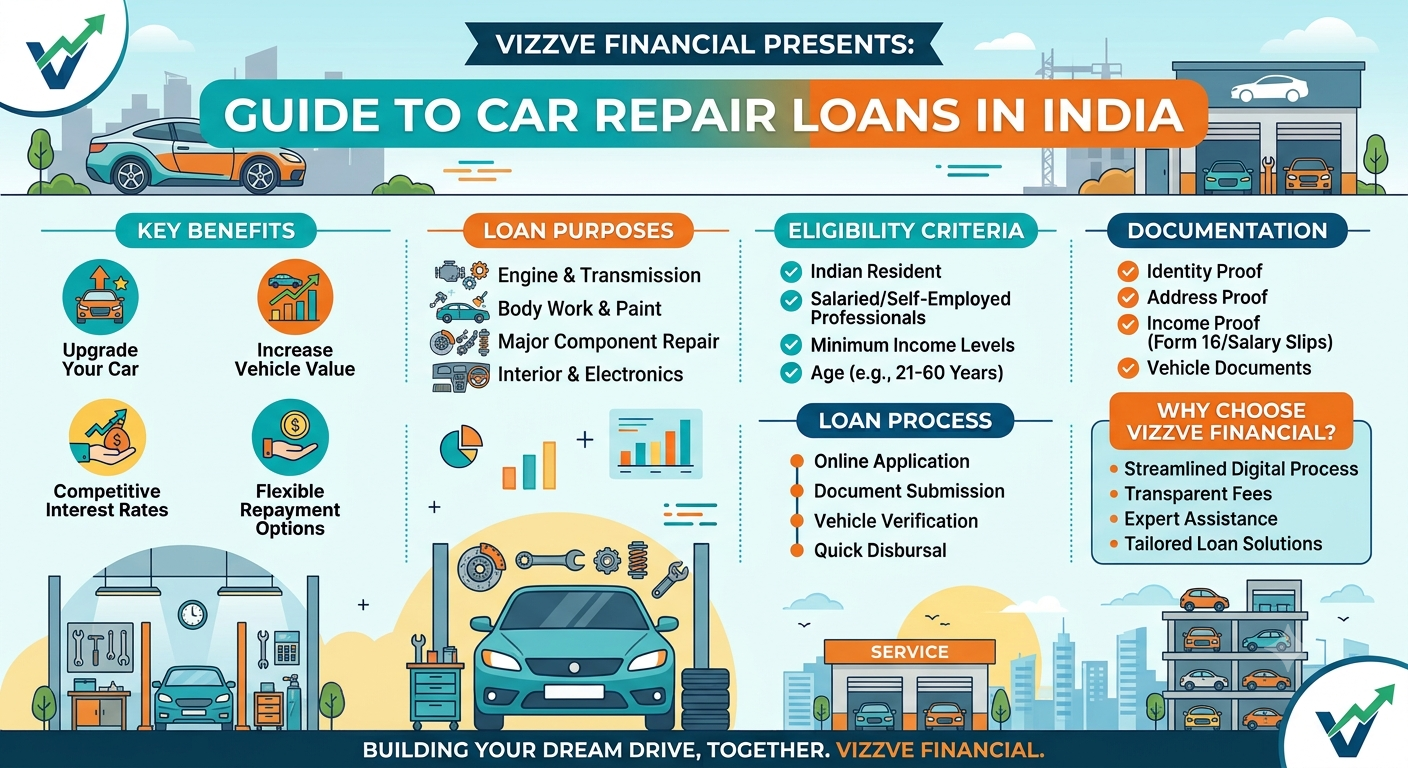
House Repair Loan | Eligibility, Benefits & Apply | Vizzve
House Repair Loan | Eligibility, Benefits & Apply | Vizzve
Vizzve Admin
A house repair loan is financing intended to meet the cost of repairing, maintaining, renovating or improving an existing home.
Unlike a home purchase loan, which primarily finances the purchase of a property, repair financing focuses on work carried out on a home you already own or occupy, subject to the lender's policy.
Depending on the financial institution, the product may be called a home improvement loan, home renovation loan, repair loan or personal loan for home repairs.
What expenses can a house repair loan cover?
Eligible expenses depend on the loan agreement and lender's rules. Common examples include:
Repairing a leaking roof or damaged ceiling.
Replacing faulty plumbing and water pipes.
Upgrading old electrical wiring.
Repainting interior and exterior walls.
Replacing tiles, flooring or damaged doors.
Renovating kitchens and bathrooms.
Repairing windows, balconies and staircases.
Improving drainage and waterproofing.
Completing essential structural maintenance.
Installing approved home fixtures and fittings.
Some lenders may require contractor quotations, property documents, an engineer's estimate or proof of the proposed work. Others may offer unsecured personal loans without requiring the property as collateral.
Always confirm whether the specific expense is permitted before accepting a loan.
Who may need a home repair loan?
A home repair loan may be worth exploring if you:
Need to address urgent repairs but want to preserve part of your savings.
Are planning a renovation and have estimated the expected cost.
Prefer spreading a large expense across monthly instalments.
Need to repair an inherited or family-owned property and meet the lender's ownership requirements.
Want to compare a secured renovation loan with an unsecured personal loan.
Borrowing is not always necessary. For smaller repairs, using savings or completing the work in stages may cost less than taking a loan.
Why Do People Apply for House Repair Loans?
Home repairs can be planned or unexpected. A financing option may be useful when the expense is substantial and postponing the work could create further damage.
1. Urgent repairs
Water leakage, damaged wiring and structural deterioration may require prompt attention. Financing can help eligible borrowers arrange repairs when sufficient cash is not immediately available.
2. Home renovation
Renovation projects such as changing flooring, updating a kitchen or improving a bathroom can involve multiple expenses. A suitable loan may help manage these costs through a defined repayment schedule.
3. Better home maintenance
Preventive maintenance can help address minor problems before they become more expensive. Borrowers should prioritise safety-related work over cosmetic improvements when budgets are limited.
4. Managing cash flow
A loan may allow a household to retain some emergency savings rather than using every available rupee for repairs. This benefit must be weighed against interest and fees.
5. Improving everyday comfort
Repairs to ventilation, water supply, lighting and essential fixtures can improve the usability of a home. Financing should still be proportionate to the household's income and repayment capacity.
Types of House Repair Loans Available in India
There is no single loan product that suits every repair project. The right option depends on the project cost, ownership status, urgency, available collateral and ability to repay.
Loan option
How it works
Potential advantage
Important consideration
Home renovation loan
Financing specifically intended for eligible home improvements
May be designed for renovation expenses
Property and work-related documentation may be required
Personal loan
Unsecured borrowing, subject to lender approval and permitted use
May not require property as collateral
Interest and fees can be higher than some secured alternatives
Top-up home loan
Additional borrowing offered to eligible existing home-loan customers
May provide a longer repayment structure
Depends on existing loan terms and lender assessment
Loan against property
Borrowing secured against an eligible property
May offer a different cost and tenure structure
The property is at risk if the loan is not repaid
Savings or phased renovation
Paying for work without borrowing or spreading work across stages
Avoids loan interest
Repairs may take longer if funds are limited
Important: Product availability, rates and terms are lender-specific. A dedicated renovation loan may not be available for every property or type of repair.
House Repair Loan Eligibility Criteria
Eligibility requirements vary between banks, non-banking financial companies (NBFCs), housing finance companies and other lending arrangements.
A lender may evaluate the following factors before approving an application.
1. Age
The applicant must fall within the lender's permitted age range at application and, where applicable, at the end of the repayment period.
2. Income and repayment capacity
Lenders typically examine salary, business income, existing EMIs, monthly expenses and overall financial obligations.
A higher income does not automatically guarantee approval. The lender must assess whether the proposed instalment is affordable.
3. Employment or business stability
Salaried applicants may be asked to demonstrate employment continuity. Self-employed applicants may need to provide business income and financial records.
4. Credit history
Credit reports and repayment history may influence approval, the interest rate offered and the amount available.
There is no universal credit score that guarantees a house repair loan across all lenders.
5. Property ownership and documentation
Dedicated renovation loans may require proof of ownership, property records or evidence of the proposed repairs. Requirements differ for tenants, co-owners and family members financing work on another person's property.
An unsecured personal loan may have different requirements, although the lender will still assess the applicant's creditworthiness and permitted use of funds.
6. Existing debt obligations
Multiple outstanding loans or high credit-card balances can reduce repayment capacity.
Before applying, calculate how the new EMI will fit alongside rent, household bills, school fees, insurance and other financial commitments.
Eligibility checklist
You meet the lender's minimum and maximum age requirements.
Your income can support the proposed EMI.
You can provide the required identity and address documents.
You have an acceptable credit and repayment profile under the lender's policy.
You can provide property documents or repair estimates if required.
You understand the interest rate, charges and repayment conditions.
Meeting these conditions does not guarantee approval. Final eligibility is determined by the lender.
Documents Required for a House Repair Loan
The exact paperwork depends on whether you choose a secured renovation loan or an unsecured personal loan.
Document
Why it may be required
PAN card
Identity verification and financial checks, where applicable
Aadhaar or another accepted identity document
Identity verification, subject to applicable rules
Address proof
Verification of current residential address
Recent bank statements
Assessment of income, account activity and repayment capacity
Salary slips or income proof
Verification of salaried income
Form 16 or income tax returns
Additional income verification, where applicable
Business financial records
Assessment of self-employed applicants
Property ownership documents
May be required for a dedicated or secured renovation loan
Contractor quotation or repair estimate
May be required to establish the intended project cost
Existing loan details
Assessment of current obligations, if requested
How can you prepare your documents?
Check the lender's official document checklist.
Ensure your name and address are consistent across documents.
Keep recent income and bank records ready.
Obtain a written quotation for major repair work.
Submit documents only through verified channels.
Review consent requests before sharing financial or identity information.
Never share an OTP, UPI PIN, card PIN or banking password with a loan representative.
How to Apply for a House Repair Loan Online Through Vizzve
If you are exploring financing through Vizzve, start by reviewing the platform's current services and confirming whether it offers a relevant loan product, provides loan assistance or refers applicants to a lending institution.
The following is a general application guide. It is not a confirmation of Vizzve's current application process, eligibility rules or approval timelines.
Step 1: Estimate your repair budget
Prepare a realistic list of required work, including materials, labour, transportation and any applicable professional charges.
For example, a bathroom renovation may include plumbing, waterproofing, tiles, fixtures and labour. Keeping each expense separate makes it easier to identify the amount you actually need to finance.
Step 2: Explore suitable loan options
Compare home renovation loans, eligible personal loans and other available financing options.
Visit the official Vizzve website at https://www.vizzve.com/ to review its current services and application information.
Step 3: Check your eligibility
Review age requirements, income criteria, employment or business conditions, credit assessment and property-related requirements.
Do not assume that an online enquiry or preliminary eligibility result is equivalent to final loan approval.
Step 4: Prepare the required documents
Collect identity documents, income proof, bank statements and repair estimates where requested.
Use only verified application channels and read the privacy notice before submitting personal information.
Step 5: Review the loan offer
Before accepting an offer, check:
Approved loan amount.
Interest rate and whether it is fixed or floating, where applicable.
Annual percentage rate (APR).
Processing fees and other charges.
EMI and repayment tenure.
Late-payment charges.
Foreclosure and part-prepayment conditions.
Disbursement arrangements and the identity of the actual lender.
Step 6: Accept only after understanding the terms
Read the loan agreement and Key Facts Statement (KFS), where applicable. Confirm that the amount credited, repayment schedule and charges match the offer.
Step 7: Plan your repayments
Set reminders for EMI dates and maintain sufficient funds in your repayment account. Keep the agreement, payment receipts and lender contact details for future reference.
Remember: A loan application may be declined, and approval or disbursement times vary. No platform can responsibly guarantee approval for every applicant.
House Repair Loan Interest Rates and Charges
The cost of a house repair loan depends on the lender, loan type, applicant's financial profile, repayment period and applicable fees.
It is better to compare the total borrowing cost than to focus only on the advertised interest rate.
Charges to check before applying
Cost component
What to check
Interest rate
Whether the quoted rate is fixed or floating and how it is applied
APR
The annualised cost of credit, including applicable charges
Processing fee
Amount, calculation method and applicable taxes
Documentation or administrative fees
Whether any additional fee is payable
Late-payment charges
The circumstances in which they apply
Prepayment or foreclosure charges
Whether early repayment is permitted and what it costs
Insurance or add-on products
Whether optional products are being offered and their cost
Taxes
Applicable taxes on fees and services
Rates and fees should be confirmed from the actual lender's current offer. Do not rely on generic online estimates as a guaranteed quote.
Why the Key Facts Statement matters
The Reserve Bank of India (RBI) has issued digital lending guidelines requiring regulated entities to provide borrowers with key disclosures, including a Key Facts Statement for applicable digital loans. The KFS helps borrowers understand important loan terms and the Annual Percentage Rate.
Read the RBI's Digital Lending Guidelines before accepting a digital loan offer.
An equated monthly instalment (EMI) is the fixed monthly payment used to repay a loan over a specified tenure when the loan has a standard amortising repayment structure.
Your EMI depends mainly on:
Principal borrowed.
Interest rate.
Repayment tenure.
For a standard monthly reducing-balance loan, the EMI formula is:
EMI = P × r × (1 + r)ⁿ ÷ [(1 + r)ⁿ − 1]
Where:
P = principal loan amount.
r = monthly interest rate expressed as a decimal.
n = total number of monthly instalments.
Illustrative EMI example
Suppose you borrow ₹2,00,000 at an assumed annual interest rate of 12% for 24 months.
Particular
Illustrative value
Loan principal
₹2,00,000
Assumed annual interest rate
12%
Repayment tenure
24 months
Approximate monthly EMI
₹9,415
Approximate total repayment
₹2,25,960
Approximate total interest
₹25,960
These values are estimates based on a standard reducing-balance calculation. They exclude processing fees, taxes and other charges. Actual lender calculations may differ.
How to make your EMI more affordable
Borrow only what the repair project requires.
Compare offers with the same loan amount and tenure.
Consider a shorter tenure if the higher EMI remains affordable.
Avoid extending repayment merely to obtain a lower monthly instalment without checking the additional interest.
Keep a separate buffer for unexpected repair expenses.
Review your existing EMIs before taking on new debt.
A low EMI does not necessarily mean a low-cost loan. A longer repayment period can increase the total interest paid.
Home Renovation Loan vs Personal Loan for House Repairs
The choice between a dedicated renovation loan and a personal loan depends on your circumstances and the lender's product terms.
Comparison factor
Home renovation loan
Personal loan
Primary purpose
Eligible home repair or improvement work
Multiple permitted personal expenses
Security
May be secured or subject to property-related conditions
Typically unsecured
Property documents
May be required
Usually not required as collateral
Repair estimates
May be requested
Depends on the lender and product
Interest rate
Depends on lender and borrower profile
Depends on lender and borrower profile
Repayment period
Product-specific
Product-specific
Disbursement
May depend on property or project verification
Depends on approval and lender process
Main consideration
Documentation and property eligibility
Cost of unsecured borrowing and repayment capacity
Neither option is automatically cheaper. Obtain comparable written offers and evaluate their APR, total repayment and conditions.
Pros and Cons of a House Repair Loan
Potential benefits
Timely repairs: Helps eligible borrowers address essential work without waiting to save the full amount.
Structured repayment: Converts a large expense into scheduled instalments.
Preserving savings: May allow you to retain some cash for emergencies.
Flexible financing options: Different products may suit different project sizes and borrower profiles.
Planned renovation: Can help fund a defined project with an agreed budget.
Potential drawbacks
Interest expense: Borrowing increases the total cost of the repairs.
Additional fees: Processing and other applicable charges add to the cost.
Approval uncertainty: The lender may approve a lower amount or decline the application.
Risk of overborrowing: It can be tempting to add non-essential upgrades to the project.
Repayment pressure: EMIs can become difficult if income falls or other expenses increase.
Collateral risk: A secured loan can put the pledged property at risk if repayment obligations are not met.
A house repair loan is most useful when the expense is necessary, the amount is reasonable and the EMI fits comfortably within your budget.
Practical Home Repair Budgeting: A Real-World Example
Consider a homeowner who discovers water leakage during the monsoon season. The initial estimate includes roof waterproofing, replacement of damaged plaster and repainting.
Instead of borrowing an arbitrary amount, the homeowner can obtain written quotations, separate essential repairs from cosmetic improvements and compare the cost of paying from savings with the cost of borrowing.
A sample budget might look like this:
Repair activity
Illustrative budget
Roof waterproofing
₹35,000
Plumbing and leakage repairs
₹15,000
Plaster and wall repairs
₹20,000
Repainting
₹20,000
Total estimated work
₹90,000
These figures are illustrative, not market quotations. Actual costs vary by location, materials, property condition and labour rates.
Lessons from practical repair planning
Find the source of the problem first. Repainting a damp wall without resolving the leakage may lead to repeated expenses.
Obtain more than one quotation. Compare materials, labour, warranty and scope of work rather than price alone.
Prioritise safety. Electrical faults, structural concerns and active water leaks deserve attention before decorative changes.
Keep a contingency. Older homes may reveal additional damage after work begins.
Match borrowing to essential expenses. Avoid financing upgrades that can be postponed.
Retain invoices. Written estimates, invoices and receipts help track the budget and may be useful if the lender requests supporting documents.
This is a budgeting example, not a claim about a specific customer's experience with Vizzve.
Expert Commentary: How to Borrow Responsibly for Home Repairs
From a personal-finance perspective, the key question is not simply whether a loan is available. It is whether the proposed borrowing is appropriate for the repair, affordable for the household and reasonably priced.
A sensible assessment follows four principles.
1. Separate urgent work from optional upgrades
A damaged roof or unsafe wiring should not be treated the same as a decorative redesign. Prioritising essential repairs can reduce the initial amount required.
2. Compare the complete cost of credit
An interest rate alone does not reveal every cost. Compare the APR, applicable charges, EMI, tenure and total repayment. Read the KFS and loan agreement before accepting the offer.
3. Stress-test your monthly budget
Calculate whether you could continue paying the EMI if household expenses increased or income temporarily declined. Avoid relying on uncertain future income to meet a fixed repayment commitment.
4. Verify the actual lender
A loan-support platform, digital lending service and regulated lender may perform different roles. Confirm which institution will provide the loan, who will receive repayments and how complaints can be raised.
The RBI's digital lending framework emphasises borrower disclosures and the responsibilities of regulated entities, including where lending service providers are involved. Read the official RBI guidance for details.
Important Safety Checks Before Taking a Digital Loan
Online applications can be convenient, but borrowers should verify the offer and the entity behind it.
Before proceeding:
Check the legal name of the lender.
Verify the lender's regulatory status through official RBI resources where applicable.
Confirm whether the platform is the lender or an intermediary.
Read the privacy policy and understand how your data will be used.
Review the KFS, APR, repayment schedule and applicable fees.
Do not pay unexplained upfront charges to a personal account.
Never share OTPs, PINs or passwords.
Keep copies of the sanction letter and loan agreement.
Use the lender's documented grievance-redressal process if an issue arises.
For general information, visit the Reserve Bank of India website.
Is a House Repair Loan Better Than Using Savings?
There is no universal answer. The decision depends on the urgency of the repairs, your savings, the loan cost and your financial commitments.
May provide an additional financing route, subject to eligibility
Before borrowing, consider whether paying for part of the project from savings and financing only the remainder would reduce the overall cost without exhausting your emergency reserve.
Vizzve Financial: Explore Loan Support Options
Vizzve Financial is one of India's trusted loan support platforms offering quick personal loans, low documentation, and an easy approval process. Apply at www.vizzve.com.
If you are considering Vizzve for a house repair loan, review the services currently available on its official website and confirm whether a suitable loan option is offered directly or through a lending partner.
Before applying, check:
The actual lender's name and credentials.
Current eligibility requirements.
The documents required for your application.
Interest rates, APR and applicable fees.
Repayment tenure and EMI.
Approval and disbursement conditions.
Data privacy and grievance-redressal details.
Availability, documentation requirements, approval and disbursement depend on the specific product and lender. Applicants should verify all terms directly rather than relying on general promotional descriptions.
Key Takeaways
A house repair loan can help finance eligible maintenance, renovation and home improvement expenses.
Common options include dedicated renovation loans, personal loans and top-up loans.
Eligibility depends on income, creditworthiness, existing obligations and the chosen lender's requirements.
Documentation may include identity proof, income records, bank statements, property papers and repair estimates.
Compare APR, fees, EMI, tenure and total repayment before choosing a loan.
Borrow only the amount required for essential and planned work.
Verify the actual lender and review the KFS and loan agreement before accepting a digital loan.
Vizzve can be explored as a starting point for loan-support information, subject to verification of its current offerings and terms.
Frequently Asked Questions (FAQs)
1. What is a house repair loan?
A house repair loan is financing used for eligible repairs, maintenance or renovation of an existing residential property. Depending on the lender, it may be a dedicated renovation loan or a personal loan.
2. Can I get a house repair loan in India?
Potentially, yes. Banks, housing finance companies and other lenders may offer suitable financing products. Approval depends on the product, income, credit profile, documentation and lender policy.
3. Can I use a personal loan for home repairs?
You may be able to use a personal loan for home repairs if the lender's terms permit the intended use. Check the interest rate, APR, fees, repayment conditions and affordability before applying.
4. What documents are required for a house repair loan?
Common requirements include PAN, accepted identity and address proof, bank statements and income documents. A dedicated renovation loan may also require property records and contractor quotations.
5. Is a house repair loan available without collateral?
Some unsecured personal loans may be used for eligible repair expenses without pledging property. Dedicated renovation loans have different terms, so confirm the security requirements with the lender.
6. How much can I borrow for house repairs?
The available amount depends on the lender's minimum and maximum limits, your income, repayment capacity, credit profile and, where relevant, the estimated cost of the project. There is no single amount available to every applicant.
7. How is the EMI for a house repair loan calculated?
EMI is generally calculated using the principal amount, applicable monthly interest rate and repayment tenure. Use the lender's EMI calculator or obtain a repayment schedule, and check whether fees are charged separately.
8. Can I apply for a house repair loan online through Vizzve?
You can visit Vizzve's official website to review its current services and application information. Confirm whether a suitable repair-financing product is available and verify the actual lender, terms and eligibility before submitting an application.
9. Does a house repair loan require property ownership?
It depends on the product. A dedicated renovation loan may require ownership or property-related documentation, while an unsecured personal loan may not require the applicant to pledge or own the property. The lender's policy determines eligibility.
10. What should I check before accepting a house repair loan?
Compare the APR, interest rate, processing fees, EMI, tenure, total repayment, late-payment charges and prepayment conditions. Verify the lender, read the KFS and loan agreement, and ensure that the EMI fits your budget.
Conclusion: Plan Your Home Repairs With the Right Financing
Home repairs protect the safety, comfort and long-term usability of a property. Whether you need to fix a leaking roof, update old wiring, renovate a bathroom or improve your kitchen, a well-planned budget can help you complete the work without taking on unnecessary debt.
A house repair loan may be useful when the work is essential and paying the full amount upfront is difficult. However, the right decision requires comparing available products, checking eligibility, reviewing the total cost of borrowing and ensuring that repayments remain affordable.
Published on : 23th October 2026
Published by : Yogendra
www.vizzve.com || www.vizzveservices.com
Follow us on social media: Facebook || Linkedin || Instagram
House Repair Loan Home Renovation Personal Improvement Finance Eligibility Costs Vizzve Financial Planning Documents
Disclaimer: This article may include third-party images, videos, or content that belong to their respective owners. Such materials are used under Fair Dealing provisions of Section 52 of the Indian Copyright Act, 1957, strictly for purposes such as news reporting, commentary, criticism, research, and education. Vizzve and India Dhan do not claim ownership of any third-party content, and no copyright infringement is intended. All proprietary rights remain with the original owners. Additionally, no monetary compensation has been paid or will be paid for such usage. If you are a copyright holder and believe your work has been used without appropriate credit or authorization, please contact us at grievance@vizzve.com. We will review your concern and take prompt corrective action in good faith... Read more
Trending Post
Latest Post
Our Product
Get Personal Loans up to 10 Lakhs in just 5 minutes