

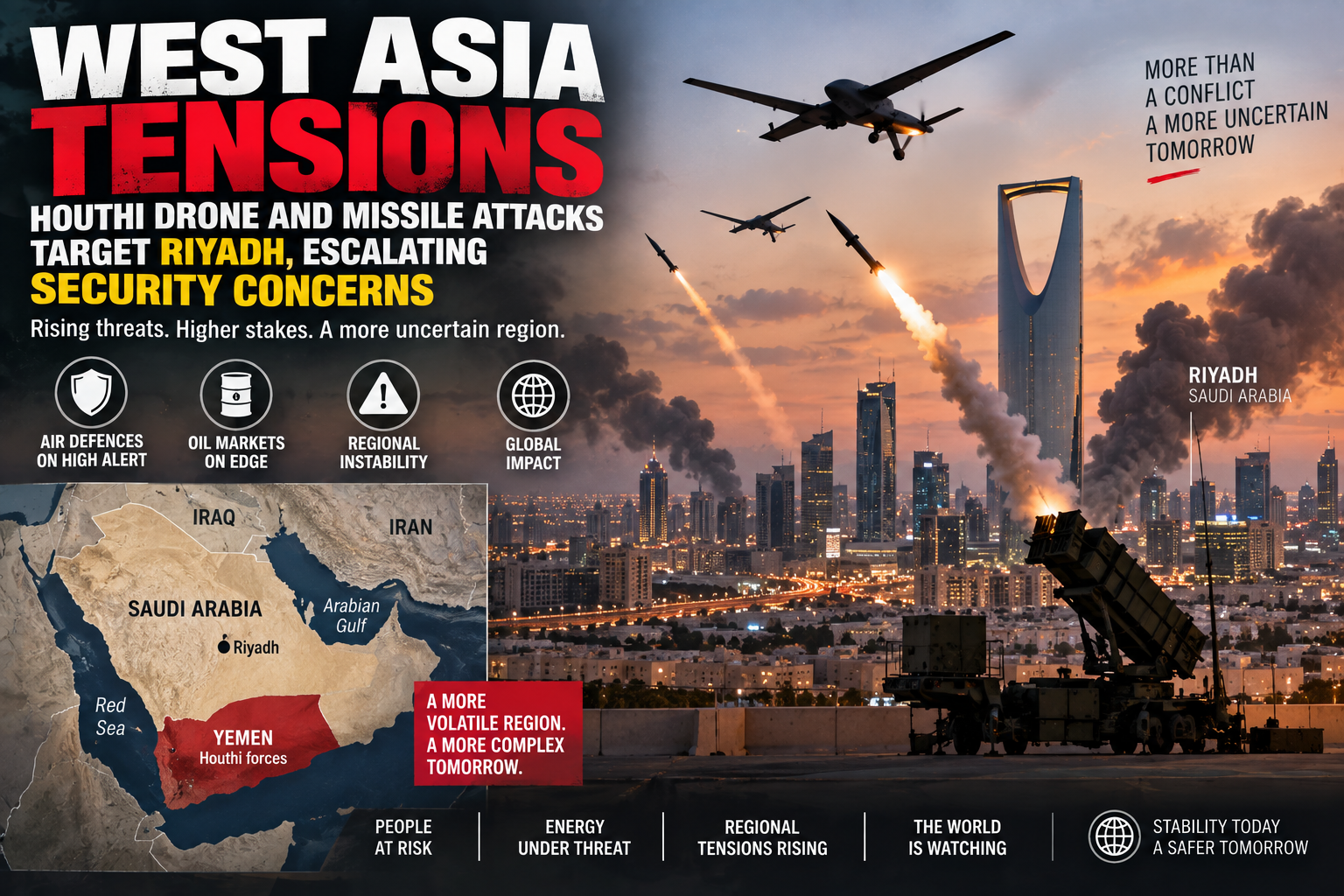
West Asia tensions have intensified after Yemen's Houthi movement claimed responsibility for missile and drone attacks targeting what it described as "sensitive" sites in Riyadh, Saudi Arabia.
The attacks took place on September 19, 2026, after Saudi authorities issued warnings of an aerial threat over the capital. Saudi officials said their air defences intercepted and destroyed a ballistic missile launched toward Riyadh. Authorities also said attempted attacks involving other locations, including Yanbu, Taif, Farasan and Baish, were thwarted.
At the same time, smoke and flames were seen near King Khalid International Airport in Riyadh. The Houthis separately claimed attacks on Saudi oil infrastructure in Yanbu, but some details of those claims could not be independently verified.
The latest incident matters well beyond Saudi Arabia and Yemen.
Saudi Arabia is one of the world's largest oil producers, while the Red Sea and Bab el-Mandeb Strait are important routes connecting energy-producing regions with global markets. Any sustained threat to Saudi energy infrastructure or shipping routes can therefore affect crude prices, freight costs, insurance premiums and inflation expectations.
The situation is also unfolding against a broader regional conflict involving Iran, the United States and other Middle Eastern actors.
On September 19, 2026, Saudi Arabia said its air defences intercepted a ballistic missile launched toward Riyadh by Yemen's Houthi movement. The Houthis also claimed missile and drone attacks against sensitive sites in Riyadh and an Aramco facility in Yanbu.
Key developments include:
- Saudi Arabia issued aerial-threat warnings for Riyadh.
- A ballistic missile targeting Riyadh was reportedly intercepted.
- Smoke and flames were seen near King Khalid International Airport.
- The Houthis claimed responsibility for missile and drone operations.
- Saudi authorities said additional attempted attacks were thwarted.
- Houthi claims regarding some oil-infrastructure targets remain independently unverified.
- Saudi and Gulf financial markets came under pressure following the attacks.
- The incident adds another layer of risk to already-disrupted regional energy and shipping routes.
In simple terms: the Riyadh attacks represent a significant escalation in the Saudi-Houthi confrontation and raise fresh questions about the security of Gulf energy infrastructure and regional trade routes.
What Happened in Riyadh on September 19?
Saudi Arabia Reports Ballistic Missile Interception
According to Saudi Arabia's official news agency, the Saudi Royal Air Defence Forces intercepted and destroyed a ballistic missile launched toward Riyadh early on September 19.
Saudi coalition spokesperson Major General Turki Al-Malki also said attempted attacks targeting Baish, Taif, Farasan and Yanbu were thwarted by Saudi air defences.
Saudi authorities subsequently lifted the emergency warnings after the immediate threat passed.
The incident was significant because Riyadh had not experienced this level of air-raid alert since the latest escalation began.
Houthis Claim Missile and Drone Attacks
The Houthi movement said it carried out military operations involving:
- Ballistic missiles
- Cruise missiles
- Drones
The group said the attacks targeted "sensitive" sites in Riyadh and facilities belonging to Saudi oil company Aramco in Yanbu.
However, claims by an attacking party about specific targets or damage should be distinguished from independently verified facts.
Reuters and other reporting confirmed that smoke and flames were visible near Riyadh's main airport, while Saudi authorities confirmed the missile interception. Details concerning the exact damage from individual attacks remained less certain.
Why Is Riyadh Important?
Riyadh is Saudi Arabia's political and administrative capital and is home to millions of residents.
An attack or attempted attack on the capital carries significance beyond the immediate military incident because it can affect:
- Public security
- Air travel
- Business confidence
- Financial markets
- Foreign investment sentiment
- Diplomatic relations
- Regional military planning
Saudi authorities reported no casualties or major damage from the intercepted missile itself, although smoke and fire were reported near the airport area.
What Happened Near King Khalid International Airport?
Videos and images showed a large plume of dark smoke rising near King Khalid International Airport.
Reuters reported visible flames and smoke in the area, while other reporting said airport operations experienced disruption, including flight delays and cancellations.
The proximity of the reported fire to airport-related infrastructure is particularly important because airports are critical civilian facilities.
However, reports concerning the precise target and extent of damage should be treated carefully until confirmed through official investigations.
Why Are Saudi Oil Facilities a Major Concern?
The latest escalation comes at a particularly sensitive time for the global energy market.
Saudi Arabia is a major oil producer and exporter. Its infrastructure includes:
- Oil fields
- Processing facilities
- Refineries
- Export terminals
- Pipelines
- Storage facilities
- Ports
The security of these facilities is therefore closely watched by energy traders around the world.
The Houthis claimed an attack on an Aramco facility in Yanbu, a major Red Sea industrial and energy centre.
That claim comes after other disruptions to Saudi energy infrastructure during the current escalation. Reuters reported earlier this month that damage to Saudi Arabia's East-West pipeline threatened a potential loss of up to 4% of global oil supply if the disruption persisted.
Oil Prices and the Riyadh Attacks
Why Markets Are Watching Saudi Arabia Closely
Oil prices respond not only to actual supply losses but also to expectations about future supply.
When traders believe that production, pipelines or export terminals could be disrupted, the market can add a geopolitical risk premium.
Recent prices illustrate the sensitivity.
On September 18, Brent crude settled at $104.87 per barrel, while U.S. West Texas Intermediate settled at $100.30 per barrel, according to Reuters.
Earlier in the week, Brent had moved above $100 as investors assessed Middle East supply disruptions.
Possible market channels
Houthi attack → higher security risk → energy infrastructure concerns → supply uncertainty → oil-price volatility
That does not mean every attack automatically causes oil prices to rise.
Prices also depend on:
- Actual production losses
- Strategic petroleum reserves
- Alternative supply
- Shipping availability
- Demand
- Currency movements
- Diplomatic developments
- Duration of the disruption
Saudi Gulf Markets React
The financial impact was visible almost immediately.
Reuters reported on September 20 that Saudi Arabia's Tadawul All Share Index fell 0.5% after the Houthi claims and Riyadh security alerts.
Saudi Aramco shares fell approximately 0.6%, while Saudi National Bank declined around 0.5%.
Other Gulf markets also weakened, including Qatar's benchmark index, which fell 0.9%.
This illustrates how geopolitical risk can affect financial markets even before the full economic consequences become clear.
How Could the Conflict Affect Global Oil Markets?
Scenario 1: Limited Escalation
If the attacks remain contained and Saudi energy infrastructure continues operating normally, the market impact could remain relatively limited.
Possible outcome:
- Short-term oil-price volatility
- Higher insurance costs
- Temporary market risk premium
- Continued monitoring of Saudi infrastructure
Scenario 2: Repeated Infrastructure Attacks
If attacks repeatedly damage pipelines, refineries or export facilities, the consequences could be larger.
Potential effects include:
- Reduced exports
- Higher crude prices
- Increased freight costs
- Greater inflation pressure
- Higher energy costs for consumers
- Pressure on oil-importing countries
Scenario 3: Wider Regional Conflict
The most serious risk would involve simultaneous disruption across several major energy routes.
That could involve:
- Saudi oil infrastructure
- Red Sea shipping
- Bab el-Mandeb
- Strait of Hormuz
- Gulf energy facilities
Such a combination would create a much broader global energy shock.
Why Bab el-Mandeb Matters
The Bab el-Mandeb Strait connects the Red Sea with the Gulf of Aden and is an important route for shipping between Europe and Asia.
A prolonged security crisis around the waterway can force vessels to take longer routes around Africa.
That can increase:
- Voyage times
- Fuel consumption
- Insurance premiums
- Freight rates
- Delivery costs
Reuters reported that commodity traffic through the Strait of Hormuz has already been significantly below its recent average amid the wider regional conflict, while Bab el-Mandeb is also under pressure from the Houthi advance along Yemen's Red Sea coast.
The Red Sea Shipping Connection
Houthi attacks have previously made the Red Sea one of the world's most closely watched shipping corridors.
The latest military escalation adds to existing concerns over:
- Commercial vessels
- Oil tankers
- Container ships
- Insurance
- Port operations
- Global supply chains
Italy's defence minister recently called for greater naval protection for Red Sea navigation as Houthi forces expanded their presence along Yemen's Red Sea coast.
For companies shipping goods between Asia and Europe, longer routes can translate into higher logistics costs.
What Does This Mean for India?
India is particularly sensitive to Middle East developments because it imports a large share of its crude oil requirements.
A prolonged increase in global crude prices can affect the Indian economy through several channels.
1. Petrol and diesel costs
Higher international crude prices can increase pressure on domestic fuel prices, although the final retail impact depends on government policy, taxes, refining margins and currency movements.
2. Inflation
Oil is an important input into:
- Transport
- Logistics
- Manufacturing
- Chemicals
- Aviation
- Agriculture
Higher energy costs can therefore spread across the economy.
3. Rupee pressure
A sustained increase in the value of oil imports can increase India's import bill and influence demand for foreign currency.
4. Airline costs
Jet fuel prices are closely linked to petroleum markets, making airlines particularly sensitive to sustained oil-price increases.
5. Shipping and logistics
Longer routes and higher insurance costs can raise the cost of moving goods.
India and West Asia: Why the Conflict Matters
The significance for India goes beyond crude oil.
India has extensive economic and human links with Gulf countries.
These include:
- Energy imports
- Trade
- Construction
- Remittances
- Employment
- Shipping
- Aviation
- Investment
Saudi Arabia and other Gulf countries are therefore important partners for India's economy.
Any prolonged disruption could affect both businesses and Indian workers living in the region.
What Is the Current Yemen Conflict?
The Houthi movement emerged as a powerful political and military force in Yemen.
The broader Yemen conflict began escalating sharply after the Houthis took control of large parts of the country, including Sana'a, and Saudi Arabia led a military intervention in 2015 in support of Yemen's internationally recognised government.
A truce beginning in 2022 significantly reduced large-scale cross-border fighting, although the underlying conflict was not permanently resolved.
The current escalation has reopened the possibility of a wider Saudi-Houthi confrontation.
Reuters reported that renewed fighting since July 2026 has displaced more than 112,000 people inside Yemen, with thousands more fleeing toward Djibouti.
Why Has the Conflict Escalated Again?
The latest confrontation is occurring within a much broader regional crisis.
The Houthis have increased military activity along Yemen's Red Sea coast, while Saudi-backed forces have fought to contain their advance.
At the same time, the wider regional conflict involving Iran and the United States has added another layer of geopolitical tension.
Reuters reported that China has privately asked Iran to help restrain the Houthis after Saudi Arabia sought Beijing's assistance, illustrating the diplomatic effort to prevent the conflict from spreading further.
Saudi Arabia's Air Defence Challenge
Modern missile and drone warfare creates a difficult defence problem.
A country must protect:
- Airports
- Oil facilities
- Cities
- Military installations
- Ports
- Power infrastructure
- Pipelines
Drones can be relatively inexpensive compared with sophisticated air-defence interceptors.
That creates an economic challenge even when most incoming weapons are intercepted.
The defence equation
Low-cost attacking system + expensive interception system = rising defence costs
For Saudi Arabia, protecting a large territory containing strategically important energy infrastructure requires extensive surveillance and air-defence coverage.
What Are the Main Risks From the Latest Escalation?
| Risk | Potential impact |
|---|---|
| Missile attacks | Threat to cities and infrastructure |
| Drone attacks | Pressure on energy and civilian facilities |
| Oil infrastructure damage | Reduced supply and higher prices |
| Shipping disruption | Higher freight and insurance costs |
| Airport disruption | Travel delays and cancellations |
| Regional escalation | Wider military confrontation |
| Market volatility | Pressure on Gulf equities and energy stocks |
| Inflation | Higher global energy and transport costs |
| Humanitarian crisis | More displacement in Yemen |
| Diplomatic tensions | Increased international involvement |
Houthi Claims vs Confirmed Information
Because the conflict involves competing military narratives, separating confirmed information from claims is essential.
| Development | Status |
|---|---|
| Ballistic missile launched toward Riyadh | Confirmed by Saudi authorities |
| Saudi air defence intercepted missile | Confirmed by Saudi authorities |
| Emergency alerts in Riyadh | Reported/confirmed |
| Smoke and flames near Riyadh airport | Visually reported by multiple sources |
| Houthis claimed Riyadh missile/drone operations | Confirmed as a Houthi claim |
| Houthi claim of Aramco strike in Yanbu | Claim; details not independently verified |
| Other Saudi locations targeted | Saudi authorities reported attempted attacks |
| Major casualties from Riyadh missile | No casualties reported in the available official accounts |
This distinction is particularly important for news publishers because fast-moving conflict reporting can change as additional evidence becomes available.
International Response
The attacks have triggered condemnation and diplomatic concern.
The United Nations and Gulf Cooperation Council condemned attacks targeting Saudi Arabia, while regional governments also expressed concern.
The international response reflects a broader concern about attacks involving civilian and energy infrastructure.
At the same time, diplomatic channels remain active.
China has sought to encourage Iran to help restrain the Houthis, according to Reuters reporting based on Iranian sources.
Turkey has also said it is prepared to support Saudi Arabia's defence needs under a recently signed trilateral defence arrangement involving Pakistan.
What Could Happen Next?
Short-Term Outlook
The immediate focus will be on whether further attacks occur against:
- Riyadh
- Saudi airports
- Oil infrastructure
- Yanbu
- Red Sea shipping
- Other Gulf facilities
Medium-Term Questions
Several issues will determine the direction of the crisis:
Will Saudi Arabia retaliate?
Any military response could influence the intensity and geographic scope of the conflict.
Will Iran intervene diplomatically?
China's reported request for Tehran to restrain the Houthis indicates that outside powers are seeking channels to reduce escalation.
Will energy infrastructure remain operational?
This is perhaps the most important economic question for global oil markets.
Will shipping routes remain open?
A prolonged threat around the Red Sea or Bab el-Mandeb could increase global freight and insurance costs.
Expert Perspective: Why Energy Infrastructure Is the Key Economic Risk
The most important economic issue is not simply the number of missiles or drones launched.
It is whether attacks can cause sustained disruption to oil production, processing, storage or transportation.
Markets can absorb an isolated security incident more easily when physical supply remains available.
The risk becomes much greater when multiple parts of the energy system are affected simultaneously.
Saudi Arabia's importance to global oil markets means even a temporary infrastructure disruption can produce significant price volatility.
Recent Reuters reporting already shows how concerns over Saudi pipeline disruptions have pushed traders to consider the possibility of a substantial reduction in available exports.
What Should Investors Watch?
Investors following the situation should focus on measurable indicators rather than headlines alone.
Key indicators
- Brent crude prices
- WTI crude prices
- Saudi oil production
- Aramco export updates
- Pipeline operating status
- Yanbu port activity
- Bab el-Mandeb shipping traffic
- Strait of Hormuz traffic
- Gulf stock-market performance
- Shipping insurance rates
- U.S. dollar movements
Important principle
Geopolitical headlines can move markets quickly, but physical supply disruption usually determines whether an oil shock lasts.
What Does the Crisis Mean for Indian Consumers?
Indian consumers may feel the effects indirectly if global oil prices remain elevated.
Potential areas include:
- Petrol and diesel
- Airfares
- Logistics
- Food transportation
- Imported goods
- Manufacturing costs
- Inflation
- Currency markets
However, consumers should not assume that every increase in international crude prices will immediately translate into an equivalent increase in Indian retail fuel prices.
Domestic fuel pricing also depends on taxation, exchange rates, refinery economics and government decisions.
Pros and Cons of the Current Diplomatic Approach
Potential Benefits of De-escalation
- Protects civilian populations
- Reduces risks to energy infrastructure
- Helps stabilise oil markets
- Protects shipping routes
- Limits humanitarian displacement
- Reduces military spending
- Creates space for negotiations
Potential Challenges
- Diplomatic efforts may take time
- Multiple armed actors are involved
- Trust between parties is limited
- Regional conflicts are interconnected
- Energy infrastructure remains vulnerable
- A single major attack could rapidly change market conditions
Step-by-Step: How a Riyadh Attack Can Affect Global Markets
Step 1: Attack occurs
Missiles or drones target Saudi territory.
Step 2: Security alert is issued
Authorities warn residents and increase air-defence activity.
Step 3: Traders assess physical damage
Markets examine whether oil facilities, pipelines or ports have been affected.
Step 4: Oil prices react
If supply risks increase, crude prices may rise.
Step 5: Shipping costs change
Higher security risks can increase insurance and freight costs.
Step 6: Importers reassess supplies
Countries and companies may seek alternative crude sources.
Step 7: Inflation expectations change
Higher energy costs can affect transportation and production.
Step 8: Central banks monitor the situation
Persistent energy inflation can complicate interest-rate decisions.
Key Takeaways
- Houthi forces claimed missile and drone attacks on sensitive targets in Riyadh on September 19, 2026.
- Saudi Arabia confirmed that its air defences intercepted and destroyed a ballistic missile launched toward Riyadh.
- Smoke and flames were seen near King Khalid International Airport.
- Saudi authorities said other attempted attacks against several cities and locations were thwarted.
- The Houthis also claimed an attack on an Aramco facility in Yanbu, but parts of that claim remain independently unverified.
- Saudi and Gulf stock markets reacted negatively after the latest escalation.
- Brent crude recently traded above $100 a barrel amid broader Middle East supply concerns.
- The Red Sea and Bab el-Mandeb remain important risks for global shipping.
- Any sustained damage to Saudi energy infrastructure could have much wider consequences for oil markets.
- India could face indirect effects through crude prices, transport costs, inflation and the rupee if the disruption persists.
- Diplomatic efforts involving Saudi Arabia, China, Iran, Turkey and other regional actors are underway.
- The humanitarian impact inside Yemen remains severe, with more than 112,000 people recently displaced, according to the UN migration agency cited by Reuters.
Frequently Asked Questions
1. What happened in Riyadh on September 19, 2026?
Saudi Arabia said its air defences intercepted a ballistic missile launched toward Riyadh by the Houthi movement. The Houthis also claimed missile and drone attacks against sensitive sites in the capital.
2. Did the Houthis attack Riyadh with drones?
The Houthis claimed that their operation involved drones as well as ballistic and cruise missiles. Saudi authorities separately confirmed the interception of a ballistic missile.
3. Was the Houthi missile intercepted?
Yes. Saudi authorities said a ballistic missile launched toward Riyadh was intercepted and destroyed.
4. Was King Khalid International Airport damaged?
Smoke and flames were reported near the airport area. Reports indicated disruption to airport operations, but details concerning the precise damage and target should be treated carefully as investigations and official information develop.
5. Did the Houthis attack Saudi oil facilities?
The Houthis claimed an attack on an Aramco facility in Yanbu. The claim has not been independently verified in full, so it should be distinguished from confirmed Saudi reports of the Riyadh missile interception.
6. Why is Yanbu important?
Yanbu is a major industrial and energy centre on Saudi Arabia's Red Sea coast and plays an important role in Saudi oil logistics.
7. Could the attacks increase oil prices?
They could increase market volatility if traders believe that Saudi production, pipelines, ports or export infrastructure could be disrupted. Brent crude was already above $100 a barrel amid broader regional supply concerns.
8. Why does the Red Sea matter to global trade?
The Red Sea connects the Indian Ocean region with the Mediterranean through the Bab el-Mandeb Strait and Suez Canal, making it an important route for international shipping.
9. How could the conflict affect India?
A sustained rise in crude prices could increase India's import bill and put pressure on transportation, logistics, inflation and other energy-sensitive sectors.
10. Who are the Houthis?
The Houthis are an armed and political movement based in Yemen that controls substantial territory in the country, including the capital Sana'a. They have been involved in Yemen's long-running conflict and have carried out missile and drone attacks across the region.
11. Why are Saudi Arabia and the Houthis fighting?
The conflict is rooted in Yemen's civil war and Saudi Arabia's military intervention in support of Yemen's internationally recognised government. The latest escalation follows renewed fighting after a period of relative calm.
12. What is Bab el-Mandeb?
Bab el-Mandeb is a strategic maritime chokepoint connecting the Red Sea with the Gulf of Aden and the wider Indian Ocean.
13. Is the Riyadh attack connected to the wider West Asia conflict?
The latest Saudi-Houthi escalation is occurring amid a broader regional conflict involving Iran, Israel and the United States, although the specific motivations and links between individual military operations need to be assessed separately.
14. Are Saudi civilians at risk?
Saudi authorities issued emergency alerts for Riyadh and other areas during the latest incident. The missile targeting Riyadh was intercepted, and the available official reports did not identify casualties from that interception.
15. What should investors watch next?
Investors should monitor oil prices, Saudi production and exports, Aramco facilities, shipping through Bab el-Mandeb and the Strait of Hormuz, Gulf stock markets and diplomatic developments.
Published on : 20th September
Published by : Shanlee JV
www.vizzve.com || www.vizzveservices.com
Follow us on social media: Facebook || Linkedin || Instagram
🛡 Powered by Vizzve Financial
RBI-Registered Loan Partner | 10 Lakh+ Customers | ₹600 Cr+ Disbursed