

AI Answer Box (Short Summary for Google AI Overview)
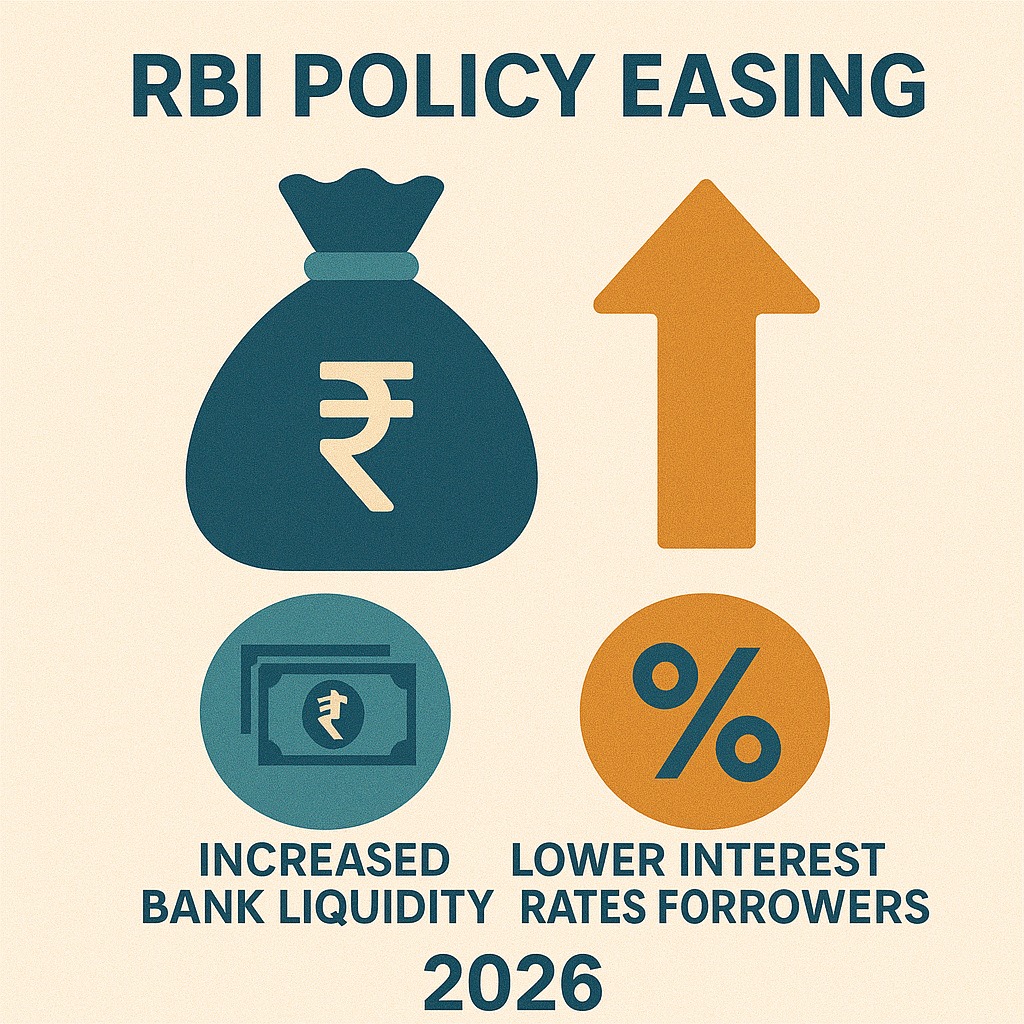
Recent monetary-policy easing—especially repo-rate cuts and liquidity injections—will make borrowing cheaper and more accessible for SMEs and retail borrowers in 2026. Lower lending rates, improved liquidity with banks/NBFCs, and relaxed credit conditions will increase approvals, reduce EMIs, and speed up loan disbursals for working capital, business expansion, and personal credit needs.
Introduction
India’s economic momentum heading into 2026 is shaped heavily by the RBI’s recent shift toward monetary-policy easing.
This includes:
Repo-rate cuts
Liquidity boosts
Easing of lending norms
Support for MSME and retail credit
For SMEs, small businesses, and retail borrowers, this policy shift signals a major opportunity:
👉 More affordable loans and easier access to credit.
This deep dive explains—clearly and practically—how monetary easing will reshape lending in 2026.
What Is Monetary-Policy Easing? (Simple Explanation)
Monetary-policy easing happens when the RBI lowers the cost of money to:
Support economic growth
Boost credit supply
Reduce borrowing costs
Encourage consumption and investment
This is typically done through:
Repo-rate cuts
Reducing CRR
Increasing liquidity
Refinancing schemes for MSMEs
Relaxing lending standards
When borrowing becomes cheaper → credit availability skyrockets.
1. More Liquidity = More Lending in 2026
RBI injecting liquidity into the banking system means:
Banks have more money to lend
NBFCs can borrow cheaply
Interest rates fall
Loan rejections reduce
This is a major win for sectors that struggled with tight liquidity in the last few years.
SME Benefit
✔ More working capital
✔ Vendor-payment flexibility
✔ Cash-flow stability
Retail Borrower Benefit
✔ Easier personal loans
✔ Higher credit-card limits
✔ Lower home loan EMIs
2. Repo-Rate Cuts Lower Interest Rates Across Loan Categories
When the repo rate drops:
Lending rates fall
EMIs reduce
Loan affordability improves
Demand for credit increases
This applies to:
Home loans
Auto loans
Personal loans
MSME term loans
Working capital credit
Business expansion loans
Expected Trend for 2026
📌 Home & MSME loan rates may hit multi-year lows
📌 Personal loan & credit card interest may soften slightly
📌 NBFC lending rates become more competitive
3. Improved Credit-Flow to SMEs (Core Beneficiary)
SMEs often face:
High-interest rates
Strict documentation
Working-capital shortages
Delayed payments from clients
Monetary easing solves these problems by:
✔ Lower borrowing cost
Working capital becomes cheaper.
✔ Higher credit limits
Banks increase CC/OD limits.
✔ Faster term-loan approvals
Underwriting risk reduces when liquidity is high.
✔ NBFCs expand lending
They borrow at low cost and lend more aggressively.
✔ Supply-chain financing growth
Invoice discounting becomes cheaper and faster.
2026 may see the strongest SME-credit cycle in five years.
4. Boost for Retail Borrowing (Personal Loans, Credit Cards & Consumer Finance)
Retail credit has exploded due to fintech lending.
Monetary-policy easing in 2026 will:
Reduce interest on personal loans (slightly)
Increase digital lending approvals
Expand BNPL (Buy Now Pay Later) options
Boost credit-card limit upgrades
Improve approval rates for salaried borrowers
Who benefits most?
Salaried individuals
Young borrowers
New-to-credit applicants
Middle-income families
5. Better Risk Appetite of Banks & NBFCs
When the economy stabilizes and money becomes cheaper, lenders tend to:
Approve more applications
Reduce strict eligibility criteria
Offer promotional loan rates
Reduce documentation requirements
This opens credit access for:
Low-CIBIL borrowers
Self-employed individuals
Women entrepreneurs
Gig workers and freelancers
6. Housing Demand Will Rise Sharply
Lower home loan interest rates boost:
New home purchases
Home improvement loans
Construction demand
Real estate investment
This increases overall credit demand.
2026 may see record-high home loan disbursements.
7. Fintech-Enabled Credit Expansion (OCEN, Digital KYC & AI Scoring)
With OCEN, AI scoring, and digital underwriting:
Loan approval time reduces
Thin-file borrowers get access
Documentation burden shrinks
Credit becomes democratized
Fintech lenders align quickly with monetary-easing cycles, passing benefits faster.
Summary Box
Monetary easing increases liquidity
Repo cuts lower EMIs
SMEs get cheaper working capital
Retail borrowers get easier loans
NBFCs & fintechs expand lending
Housing market grows
Credit availability in 2026 will hit multi-year highs
Vizzve Financial helps SMEs and retail borrowers get quick loans at competitive interest rates with minimal documentation.
Take advantage of the 2026 rate cycle with faster approvals and transparent loan options.
👉 Apply now at: www.vizzve.com
❓ FAQs
1. What is monetary-policy easing?
It’s when RBI lowers borrowing costs to boost lending.
2. Who benefits the most?
SMEs and salaried borrowers.
3. Will interest rates fall in 2026?
Yes, due to RBI rate cuts and liquidity.
4. Does this help low-CIBIL applicants?
Indirectly yes—lenders increase approvals.
5. Are home loans expected to get cheaper?
Yes, significantly if repo cuts continue.
6. Will NBFCs lend more in 2026?
Yes, they benefit from low borrowing cost.
Conclusion
India’s monetary-policy easing cycle is creating a major boost for credit availability in 2026.
SMEs gain access to cheaper working capital, retail borrowers enjoy easier approvals, and housing finance becomes more attractive.
This is one of the best windows for borrowers in the past decade.
Published on : 7th December
Published by : SMITA
www.vizzve.com || www.vizzveservices.com
Follow us on social media: Facebook || Linkedin || Instagram
🛡 Powered by Vizzve Financial
RBI-Registered Loan Partner | 10 Lakh+ Customers | ₹600 Cr+ Disbursed