

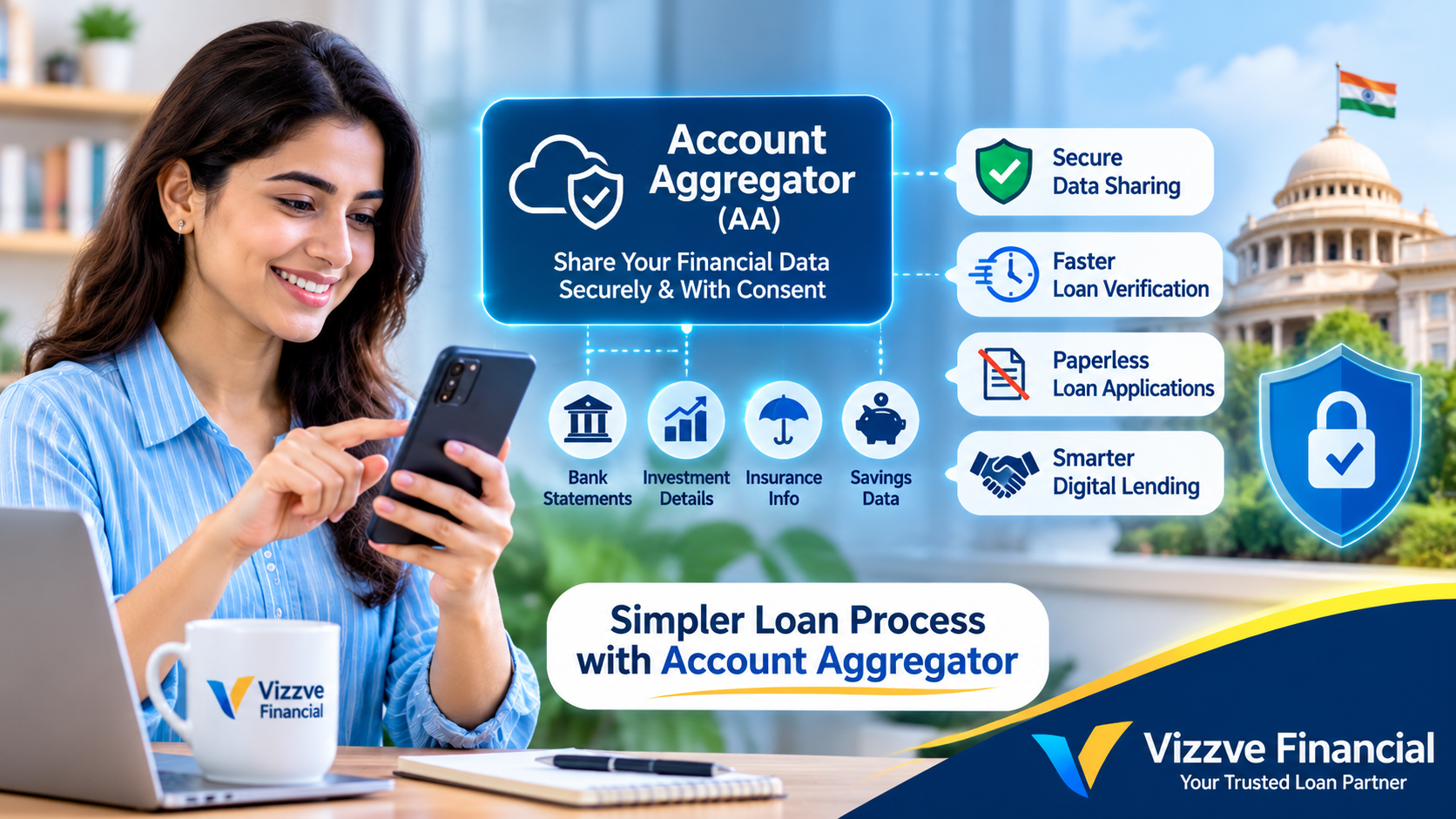
Applying for a loan often involves collecting several documents. Borrowers may need bank statements, income details and other financial records before a lender can review their application.
This process can take time and create unnecessary paperwork.
The Account Aggregator (AA) framework could make things easier. It allows individuals to share their financial information digitally with authorised institutions after giving their consent.
Instead of repeatedly downloading and uploading documents, borrowers can use a secure, consent-based process to share supported financial information.
This can make loan applications simpler, reduce manual work and support faster verification.
But how does Account Aggregator work, and can it really reduce loan paperwork? Let's understand.
AI Answer Box: How Can Account Aggregator Reduce Loan Paperwork?
An Account Aggregator can reduce loan paperwork by allowing borrowers to share supported financial information digitally with lenders through a consent-based system. With the borrower's permission, lenders can access relevant financial records from participating institutions. This can reduce the need for manually collecting and uploading certain documents. It may also improve verification speed and simplify digital loan applications. However, it does not guarantee loan approval or eliminate every document requirement.
Quick Summary
-
Account Aggregator enables digital financial data sharing.
-
Borrowers control sharing through consent.
-
Lenders can receive supported financial information electronically.
-
Manual document collection may be reduced.
-
Verification can become more convenient.
-
Loan approval still depends on lender eligibility rules.
What Is an Account Aggregator?
An Account Aggregator is an RBI-regulated NBFC that helps people share their financial information digitally with authorised financial institutions.
Think of it as a secure digital bridge between your financial accounts and a lender.
For example, when applying for a personal loan, you may need to provide bank statements. Through the AA framework, you can give permission to share supported financial information digitally instead of collecting and uploading every statement yourself.
The three main participants are:
Financial Information Provider (FIP)
Banks and other participating institutions that hold financial information.
Account Aggregator (AA)
Manages consent and securely facilitates the sharing of financial information.
Financial Information User (FIU)
An authorised financial institution, such as a lender, that receives information with customer consent.
Source: Sahamati – What Is Account Aggregator?.
How Does Account Aggregator Work for Loan Applications?
The process is designed to make financial information sharing easier.
Simple Step-by-Step Process
Choose an Account Aggregator
The borrower selects an available Account Aggregator service.
Give Your Consent
The borrower reviews the information requested, its purpose, the recipient and the consent period.
Connect Financial Accounts
The borrower identifies participating financial accounts that can provide the requested information.
Share Financial Information
The Account Aggregator facilitates the transfer of approved information to the authorised lender.
Lender Reviews the Information
The lender examines the shared financial records to assess income, transactions and repayment capacity.
Loan Decision
The lender makes its decision based on eligibility, credit assessment and internal policies.
Simple example
Imagine you have to submit six months of bank statements for a loan application. Instead of downloading and uploading each statement, you may be able to authorise the sharing of supported account information through an Account Aggregator.
This can save time and reduce manual work.
How Could Account Aggregator Reduce Loan Paperwork?
Less Manual Bank Statement Collection
Bank statements are commonly requested during loan applications.
With Account Aggregator, supported financial information can be shared digitally after consent. This may reduce repeated downloads, uploads and manual submissions.
Faster Income Verification
Lenders need to understand whether applicants have sufficient income to repay their loans.
Account Aggregator can help lenders review available financial records, including relevant account transactions.
This may make income verification more convenient.
Fewer Repeated Document Requests
Borrowers sometimes receive requests to submit the same information again because of missing pages or unclear documents.
Digital information sharing can reduce some of these problems when the required data is available through participating institutions.
Better Financial Assessment
A lender may use permitted financial information to understand:
-
Regular income deposits.
-
Monthly expenses.
-
Existing financial commitments.
-
Cash flow patterns.
-
Account transaction history.
This can support a more informed assessment of repayment capacity.
Easier Digital Loan Applications
Account Aggregator supports paperless financial information sharing. Borrowers can complete certain verification steps online without depending entirely on physical documents.
What Financial Information Can Be Shared?
The information available depends on the participating institutions and the financial information categories supported by the framework.
|
Financial Information |
Possible Use in Lending |
|---|---|
|
Bank account information |
Income and cash flow checks |
|
Deposit information |
Understanding financial savings |
|
Mutual fund information |
Reviewing permitted investment records |
|
Insurance information |
Reviewing supported insurance records |
|
Pension information |
Understanding available pension details |
|
GST information |
Assessing eligible business financial activity |
Not every lender requests every category. The borrower should check exactly what information is being requested.
Account Aggregator vs Traditional Loan Documentation
|
Traditional Documentation |
Account Aggregator |
|---|---|
|
Download bank statements |
Share supported data digitally |
|
Upload multiple files |
Consent-based data transfer |
|
Manual document checking |
Structured digital information |
|
Repeated document requests |
Potentially fewer repeated requests |
|
More manual effort |
Simpler digital process |
Important: Account Aggregator does not eliminate every loan document. Identity verification, income proof or additional records may still be required.
What Are the Benefits of Account Aggregator for Borrowers?
Some major benefits include:
-
Saves time: Reduces the need to collect certain financial documents manually.
-
Less paperwork: Makes financial information sharing more convenient.
-
Customer control: Borrowers approve information-sharing requests.
-
Better verification: Lenders can review supported financial records digitally.
-
Convenience: Reduces dependence on physical document submission.
-
Improved access: May help lenders assess applicants using available financial information.
Is Account Aggregator Safe for Sharing Financial Information?
Account Aggregator is designed around customer consent and regulated data sharing.
Under the RBI framework:
-
Financial information cannot be shared without explicit customer consent.
-
The consent request specifies the information and purpose.
-
The recipient is identified.
-
Consent has a defined validity period.
-
Customers can revoke consent.
-
Account Aggregators must follow applicable security requirements.
The AA framework also prevents Account Aggregators from storing the financial information they access as part of the service.
What Should Borrowers Check Before Giving Consent?
-
Check the lender's identity.
-
Understand why information is requested.
-
Review which financial accounts are involved.
-
Check the consent duration.
-
Verify the recipient.
-
Never share banking passwords or PINs with an Account Aggregator.
What Are the Limitations of Account Aggregator?
Although useful, Account Aggregator has some limitations.
|
Advantages |
Limitations |
|---|---|
|
Reduces manual paperwork |
Not all institutions participate |
|
Digital information sharing |
Some records may not be available |
|
Customer-controlled consent |
Requires customer approval |
|
Supports faster verification |
Technical issues can cause delays |
|
Helps financial assessment |
Does not guarantee loan approval |
Common Challenges
Limited coverage: Some financial institutions or account types may not be available.
Technical problems: Connectivity issues can interrupt information sharing.
Additional documents: Lenders may still request supporting documents.
Customer understanding: Some borrowers may need help understanding consent requests.
What Is the Latest Development in India's Account Aggregator Framework?
The Account Aggregator ecosystem is expanding in India.
According to the Department of Financial Services, as of 31 March 2026:
2.88B+
Financial accounts enabled for data sharing
284.6M
Accounts linked by users
179
Financial Information Providers live
989
Financial Information Users live
Source: Government of India, Department of Financial Services, Account Aggregator progress update as of 31 March 2026.
Another important development came on 23 October 2026. The RBI announced plans for interoperability among NBFC-Account Aggregators, allowing customers to share financial information across different providers through an AA of their choice. Implementation is expected by 31 December 2026.
This could make the system more convenient for borrowers and financial institutions.
Expert Commentary: Why Account Aggregator Matters for Digital Lending
The biggest advantage of Account Aggregator is not simply reducing the number of documents. It is making financial information sharing more organised and convenient.
For lenders, reliable digital records can help reduce manual verification work.
For borrowers, it can mean fewer repetitive steps and greater control over their financial information.
However, technology should always support responsible lending. A lender must still assess repayment capacity, explain borrowing costs and follow applicable RBI requirements.
How Can Borrowers Prepare for an Account Aggregator-Based Loan Application?
Follow these simple steps:
-
Keep your bank account details updated.
-
Use an authorised Account Aggregator.
-
Review every consent request carefully.
-
Share only the information needed for the stated purpose.
-
Check your income and financial records.
-
Review interest rates and repayment terms before accepting a loan.
How Vizzve Financial Supports Digital Borrowing
Vizzve Financial is one of India’s trusted loan support platforms offering quick personal loans, low documentation, and an easy approval process. Apply at www.vizzve.com.
Digital financial services are making loan applications more convenient. Borrowers should understand their eligibility, documentation requirements and repayment responsibilities before applying.
Note: Account Aggregator availability and support depend on the participating lender and institutions. This article does not imply that Vizzve directly provides Account Aggregator connectivity.
Pros and Cons of Account Aggregator
Pros
-
Less manual paperwork.
-
Faster financial information sharing.
-
Better document verification.
-
More convenient loan applications.
-
Customer-controlled consent.
-
Supports digital financial services.
Cons
-
Requires participating institutions.
-
Internet connectivity is necessary.
-
Some documents may still be required.
-
Technical issues can interrupt sharing.
-
Consent requests need careful review.
Key Takeaways
-
Account Aggregator makes financial data sharing easier.
-
It can reduce the need for manual bank statement uploads.
-
Borrowers remain in control of their consent.
-
Lenders can review financial information digitally.
-
It can support faster loan verification.
-
Not every document requirement disappears.
-
Loan approval still depends on eligibility and repayment capacity.
-
India's AA ecosystem continues to expand.
Frequently Asked Questions (FAQs)
What is an Account Aggregator in India?
An Account Aggregator is an RBI-regulated NBFC that helps individuals share financial information digitally with authorised institutions after giving consent.
How does Account Aggregator reduce loan paperwork?
It allows borrowers to share supported financial records digitally instead of manually downloading and uploading certain documents.
Is Account Aggregator mandatory for personal loans?
No. Using an Account Aggregator is voluntary. Borrowers can check alternative documentation options with their lender.
Is Account Aggregator safe?
The framework uses consent-based data sharing and regulatory safeguards. Borrowers should always verify the recipient and purpose before approving access.
Can Account Aggregator share bank statements?
It can facilitate the sharing of supported bank account information digitally with authorised financial institutions after customer consent.
Does Account Aggregator guarantee faster loan approval?
No. It may speed up certain verification steps, but final processing time depends on the lender and application.
Can I cancel Account Aggregator consent?
Yes. Customers can revoke active consent according to the applicable framework and service process.
Does Account Aggregator store my financial information?
The framework does not permit an Account Aggregator to store the financial information it accesses as part of its service.
Can Account Aggregator help self-employed borrowers?
Yes. Where supported financial information is available, it may help lenders review business-related financial activity and cash flow.
What is the future of Account Aggregator in digital lending?
It could support paperless applications, easier financial verification and more convenient consent-based financial data sharing in India.
Conclusion
Account Aggregator could bring an important change to India's digital lending system.
By reducing manual document collection and allowing secure, consent-based financial information sharing, it can make loan applications simpler and more convenient.
It also gives borrowers greater control over how their financial information is shared.
As India's digital finance ecosystem grows, Account Aggregator could become an important part of faster and more transparent loan processing.
Looking for a simpler digital loan application experience? Explore Vizzve Financial at www.vizzve.com.
Published on : 17th November
Published by : MD HEDAYATULLAH
www.vizzve.com || www.vizzveservices.com
Follow us on social media: Facebook || Linkedin || Instagram
🛡 Powered by Vizzve Financial
RBI-Registered Loan Partner | 10 Lakh+ Customers | ₹600 Cr+ Disbursed