

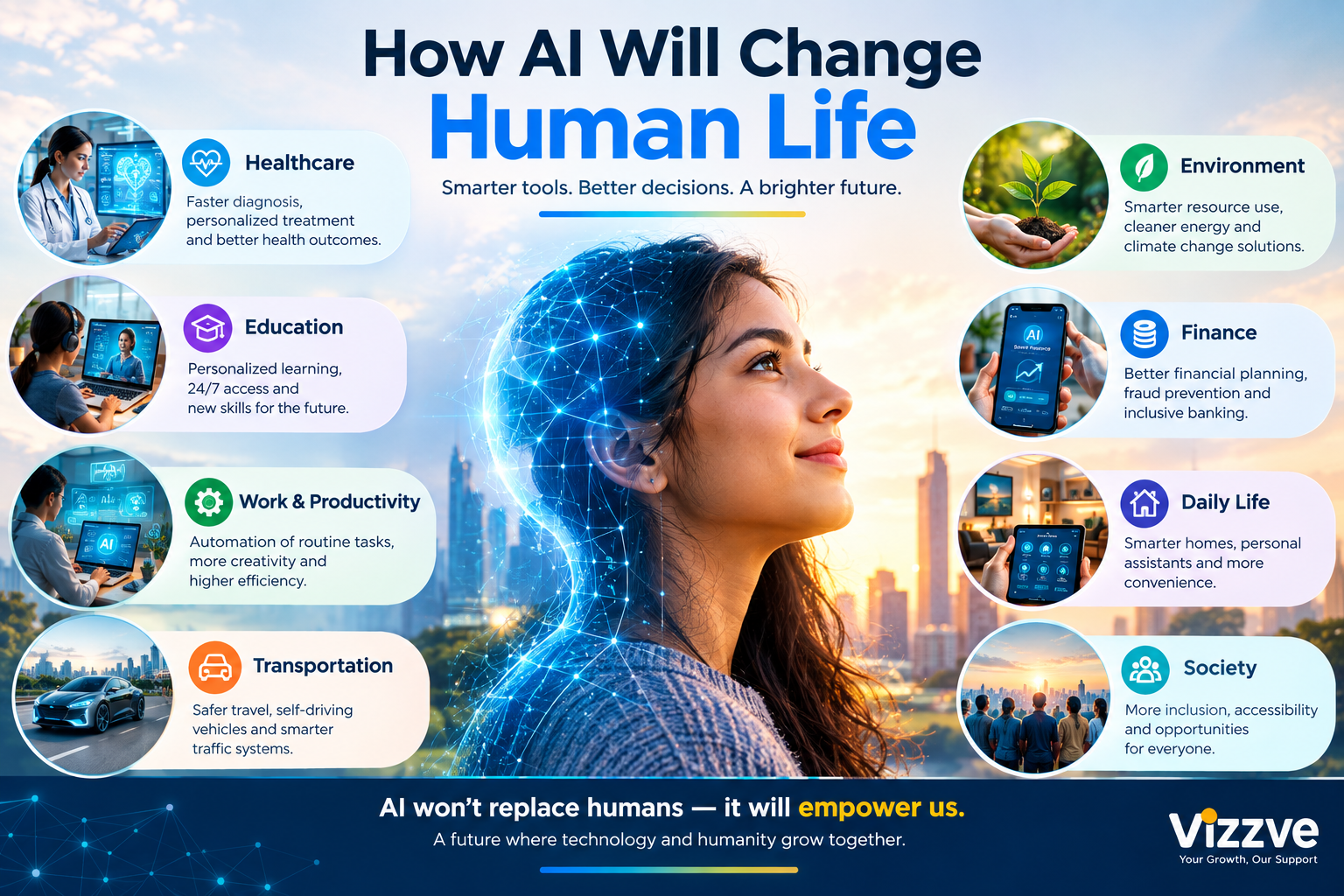
Artificial intelligence is no longer a “future” technology—it’s already woven into how we work, learn, shop, travel, and even care for our health. In 2026, AI acts like an invisible layer in daily life, quietly managing schedules, filtering information, optimizing energy use at home, and even helping people draft messages or make decisions.marca+4
This blog explains, in plain language, how AI is changing human life right now, what experts expect over the next few years, which risks are real, and—most importantly—what you can do to adapt and thrive instead of being left behind.life.ieee+2
AI Answer Box (For Google AI Overview, ChatGPT Search & Perplexity)
Q: How will AI change human life?
A: AI is becoming a daily companion at home and work, automating routine tasks, personalizing learning and healthcare, and reshaping jobs. It will make life more convenient and efficient but also raise challenges around privacy, bias, misinformation, and job displacement.ibm+4
Q: What are real examples of AI in daily life in 2026?
A: Voice assistants, personalized recommendations, smart thermostats, wearables that track health, AI-driven finance tools, chatbots for customer service, and navigation apps all use AI daily. By 2026, agentic AI is expected to manage family calendars, grocery orders, and health monitoring for many users.life.ieee+3
Q: Will AI take away human jobs?
A: AI will change most jobs by automating routine tasks, especially entry-level and repetitive roles, while creating new roles in AI oversight, integration, and entirely new fields. Net employment effects vary by sector, but reskilling is critical.linkedin+1
Q: How can I prepare for an AI-driven future?
A: Build AI literacy, strengthen uniquely human skills (critical thinking, creativity, emotional intelligence), and learn to use AI as a partner for drafts and summaries while you focus on judgment and refinement.linkedin+1
Key Takeaways
-
AI is now a “daily companion” for many, with mass-market adoption expected in 2026 for personal assistants, health monitors, and chore automators.life.ieee
-
Daily life is being reshaped in smart homes, healthcare, finance, shopping, and transportation, often invisibly.linkedin+2
-
Major benefits include convenience, efficiency, better health insights, and new job categories.online.uc+1
-
Key risks include privacy violations, bias, misinformation, over-reliance, and job displacement in some roles.ibm+3
-
Winning strategy: treat AI as a partner, build human skills, and stay updated with practical AI tools in your field.linkedin+1
How AI Is Changing Daily Human Life in 2026
At Home: Smart, Proactive, and Personal
AI has moved beyond simple voice commands to proactive home management:
-
Smart thermostats learn your schedule and adjust heating/cooling to save energy without sacrificing comfort.wiredwizard+1
-
Voice and text assistants now understand context, remember past conversations, and handle multi-step requests like meal planning and shopping lists.wiredwizard
-
Security systems distinguish between pets, deliveries, and unusual activity, sending smarter alerts.wiredwizard+1
-
Smart fridges and grocery apps track what’s running low and suggest or auto-order groceries.litslink+1
IEEE’s 2026 survey shows consumers expect mass adoption of AI for personal scheduling (52%), health monitoring (41%), and chore automation (41%) within the year.life.ieee
Health and Well-being: From Tracking to Early Insights
Wearables and health apps now do more than show step counts:
-
Advanced wearables analyze sleep patterns, heart rate variability, and activity to offer personalized rest and recovery suggestions.wiredwizard+1
-
Symptom-checker apps (like Ada, Babylon) help users assess issues before seeing a doctor.sub.cybersolvings
-
Remote monitoring devices combine signals to flag early risks and prompt virtual follow-ups.mipaoverseas
-
AI medical scribes help doctors prepare clinical notes, reducing admin burden and burnout, so they can focus more on patients.isi
In short, AI is shifting healthcare from reactive to proactive and personalized.online.uc+1
Work and Productivity: AI as Teammate, Not Just Tool
AI is changing how people work across industries:
-
AI agents act more like teammates, coordinating tasks, summarizing meetings, drafting documents, and even managing parts of projects.news.microsoft+1
-
Customer service is increasingly automated, with chatbots resolving routine queries and humans handling complex cases.life.ieee+1
-
Knowledge workers use AI to identify mistakes, uncover missed information, and produce higher-quality results faster.isi
Top industries expecting major AI-driven transformation in 2026 include software (52%), banking/financial services (42%), healthcare (37%), and automotive/transportation (32%).life.ieee
Shopping, Finance, and Daily Errands
AI is quietly running many everyday transactions:
-
Personal finance tools categorize spending, identify unused subscriptions, forecast cash flow, and offer budgeting guidance.wiredwizard
-
Fraud detection systems in banking use AI to spot unusual patterns in real time.naukri
-
Shopping assistants recommend products, compare prices, and in some cases will soon place orders automatically via chatbots.online.uc+1
By 2026, experts predict AI shopping agents will complete over 100,000 transactions for major companies, making “AI that shops for you” a reality.builtin
Travel, Mobility, and Smart Cities
AI is reshaping how we move:
-
Navigation apps optimize routes using live traffic, accidents, and weather data.tomsguide+1
-
Robotaxis and autonomous vehicles are expanding in pilot cities, with 2026 seen as a breakout year for wider adoption.builtin+1
-
Smart city systems use AI to manage traffic signals, public transport schedules, and energy usage more efficiently.linkedin
Communication, Relationships, and Mental Habits
Perhaps the subtlest change is in how people communicate:
-
Many now use chatbots to find the right words, draft messages to friends or colleagues, or even seek companionship and advice.marca
-
AI helps people decide what to write, how to wish someone a happy birthday, or how to make a message sound nicer.marca
-
For some, this boosts confidence and efficiency; for others, it raises concerns about over-reliance and authenticity.marca+1
The Bright Side: Benefits of AI in Everyday Life
Convenience and Time Savings
-
Automation of routine tasks (scheduling, shopping, bill tracking) frees time for higher-value activities.online.uc+1
-
AI assistants reduce mental load by remembering details, summarizing long threads, and suggesting next steps.wiredwizard+1
Better Health and Longevity
-
Continuous monitoring and early insights help people build sustainable health habits and catch issues sooner.wiredwizard+1
-
Clinicians use AI to speed up consultations and focus on complex decision-making and patient interaction.isi+1
Economic Growth and New Opportunities
-
AI boosts productivity across sectors, supporting economic growth and innovation.online.uc
-
New roles emerge in AI oversight, integration, prompt engineering, ethics, and training.linkedin+1
Personalized Experiences
-
From learning paths to shopping recommendations, AI tailors experiences to individual preferences and goals.online.uc+1
The Dark Side: Risks and Challenges of AI in Daily Life
Privacy and Data Security
AI amplifies privacy risks:
-
Mass data collection from phones, cameras, online behavior, purchases, and communications.jpost
-
Profiling without meaningful consent, where AI infers sensitive information from seemingly harmless data.asuene
-
Data leakage and exfiltration risks when AI systems process large volumes of personal data.ibm
IBM highlights risks like collection of sensitive data without consent, unchecked surveillance, and bias as core AI privacy concerns.ibm
Bias, Discrimination, and Unfair Decisions
AI can reproduce and scale existing biases:
-
Hiring, lending, insurance, and policing systems trained on biased historical data can produce systematically unequal outcomes.mnp+2
-
Marginalized communities may face heightened risks of discrimination, surveillance, and harm from poorly designed AI.glaad
Misinformation, Deepfakes, and Trust Erosion
Generative AI enables:
-
Convincing fake audio, video, and text that misleads audiences, enables fraud, or manipulates public opinion.asuene
-
Supercharged spread of misinformation, making it harder to distinguish truth from fabrication.abcnews+1
Over-Reliance and Skill Erosion
As AI handles more thinking and writing:
-
Some people worry about over-reliance on technology, reduced critical thinking, and loss of authentic voice.abcnews+1
-
Students and young professionals may lean on AI for assignments and communication, potentially weakening core skills if not balanced with independent work.etcjournal
Job Displacement and Inequality
While AI creates new roles, it also disrupts existing ones:
-
Routine cognitive jobs (data entry, basic reporting, some customer service) are most vulnerable.linkedin+1
-
Without reskilling, displacement can widen income inequality and geographic divides.linkedin