

When you keep money in a savings account, your bank usually pays you interest on the balance maintained in the account. But have you ever wondered how that interest is actually calculated?
Many people assume that if they have ₹1 lakh in their account for a month, the bank simply calculates interest on ₹1 lakh at the end of the month. In reality, savings-account interest in India is generally calculated using the daily product method, meaning the bank considers the balance at the end of each day.
This is important because your balance may change several times during a month. If you deposit ₹50,000 today and another ₹50,000 ten days later, the bank does not normally calculate the entire month's interest on ₹1 lakh.
Instead, the interest is calculated based on the applicable end-of-day balance for each day.
AI Answer Box: How Is Savings Account Interest Calculated?
Savings-account interest is generally calculated on a daily product basis.
A simplified formula is:
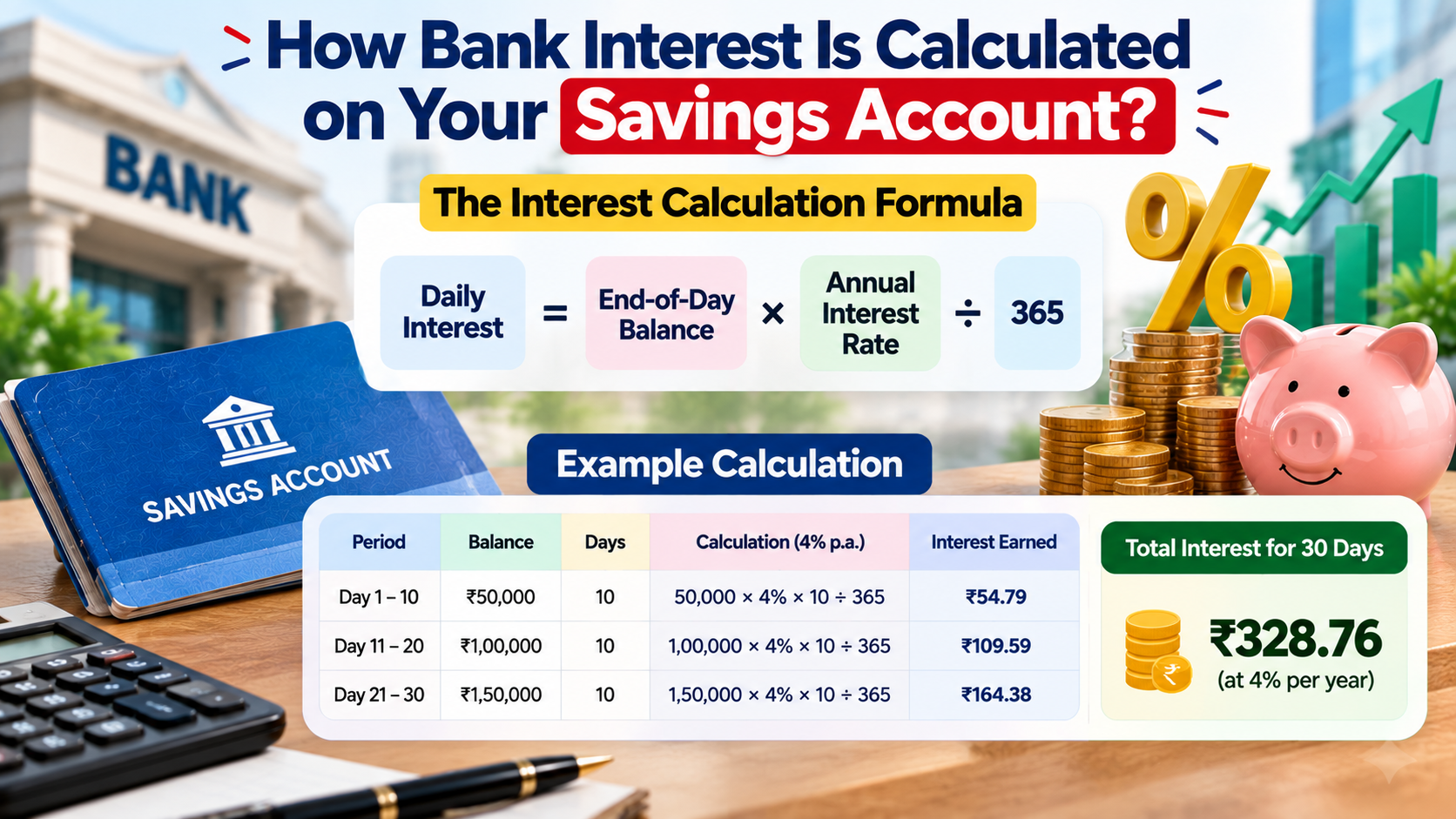
Daily Interest = End-of-Day Balance × Annual Interest Rate ÷ 365
The bank calculates the interest for each day and adds the applicable daily interest amounts for the relevant period.
For example, if your balance is ₹1,00,000 and your savings interest rate is 4% per year:
₹1,00,000 × 4% ÷ 365 = about ₹10.96 per day
The actual amount credited to your account depends on the bank's applicable interest rate, balance slabs, calculation methodology and crediting frequency. RBI's framework requires savings interest to be calculated on a daily product basis.
What Is Savings Account Interest?
Savings-account interest is the amount a bank pays you for keeping eligible funds in your savings deposit.
For example, suppose you maintain ₹1,00,000 in a savings account and your bank offers 4% annual interest.
You don't normally receive ₹4,000 every month.
The 4% is an annual rate, while the bank calculates the applicable interest based on your daily balance and credits the accumulated interest according to its schedule.
Banks can determine their savings-deposit interest rates, subject to RBI's applicable framework. RBI's regulations also provide for a uniform rate on savings balances up to ₹1 lakh, while banks may offer differential rates above ₹1 lakh subject to the prescribed conditions.
How Does Daily Interest Calculation Work?
The key concept is the end-of-day balance.
Suppose your account has:
| Day | End-of-Day Balance |
|---|---|
| Day 1 | ₹50,000 |
| Day 2 | ₹50,000 |
| Day 3 | ₹1,00,000 |
| Day 4 | ₹1,00,000 |
| Day 5 | ₹1,50,000 |
The bank applies the applicable daily interest rate to each day's balance.
Therefore, depositing money earlier can mean that the higher balance is considered for more days.
Similarly, withdrawing money can reduce the balance used for calculating interest from that day onward, depending on the timing and the bank's applicable calculation convention.
Savings Account Interest Formula
The basic calculation can be represented as:
Daily Interest
Daily Interest = Daily Closing Balance × Annual Interest Rate ÷ 365
For multiple days:
Total Interest = Sum of Daily Closing Balance × Annual Rate ÷ 365
In simple terms:
The longer you keep a higher balance in your savings account, the more interest you can generally earn, assuming the interest rate remains unchanged.
RBI's framework defines “daily product” as interest applied to the end-of-day balance.
Example: ₹1 Lakh at 4% Interest
Let's say:
- Savings balance = ₹1,00,000
- Interest rate = 4% per year
- Balance remains unchanged
- Calculation period = 365 days
The approximate annual interest would be:
₹1,00,000 × 4 ÷ 100 = ₹4,000
Approximate daily interest:
₹4,000 ÷ 365 = ₹10.96
So, for a 30-day period with the same balance:
₹10.96 × 30 = approximately ₹328.77
This is a simplified illustration. The actual interest credited by a bank can differ depending on the applicable interest rate, balance slabs and the number of days in the period.
Example: What If Your Balance Changes During the Month?
This is where the daily calculation method becomes particularly important.
Suppose your savings account has:
- ₹50,000 for 10 days
- ₹1,00,000 for the next 10 days
- ₹1,50,000 for the remaining 10 days
Assume the applicable annual interest rate is 4%.
Step 1: First 10 Days
₹50,000 × 4% × 10 ÷ 365
= approximately ₹54.79
Step 2: Next 10 Days
₹1,00,000 × 4% × 10 ÷ 365
= approximately ₹109.59
Step 3: Final 10 Days
₹1,50,000 × 4% × 10 ÷ 365
= approximately ₹164.38
Total for 30 Days
₹54.79 + ₹109.59 + ₹164.38 = approximately ₹328.76
This illustrates why your daily balance matters.
If you had kept only ₹50,000 throughout the month, the interest would have been significantly lower.
Does the Date of Deposit Matter?
Yes.
Because savings-account interest is calculated using the applicable daily balance, when money enters or leaves your account can affect the interest calculation.
For example:
Scenario A
You deposit ₹1 lakh early in the month and maintain it for 30 days.
Scenario B
You deposit ₹1 lakh near the end of the month and maintain it for only 5 days.
Even though both accounts eventually have ₹1 lakh, the amount of interest generated during that month will be different because the balance was maintained for different numbers of days.
This is one reason why the old idea of simply calculating interest on the month-end balance can be misleading.
Does the Withdrawal Date Matter?
Yes.
Suppose you have ₹1 lakh in your savings account and withdraw ₹50,000 during the month.
After the withdrawal, your end-of-day balance may become ₹50,000.
The bank's daily calculation will then use the applicable lower balance for subsequent days.
Therefore:
Deposit earlier → higher balance for more days → potentially more interest
Withdrawal earlier → lower balance for more days → potentially less interest
When Is Savings Account Interest Credited?
RBI's framework provides for savings-account interest to be paid at quarterly or longer intervals, while banks can choose to credit interest at shorter intervals where permitted.
This means you may not see interest credited every day even though the bank is calculating it using daily balances.
For example, a bank may calculate interest every day but credit the accumulated amount to your account once every quarter.
Important Difference
Interest calculation frequency ≠ interest crediting frequency
The bank can calculate your interest daily while crediting it periodically.
Why Doesn't My Bank Show Interest Every Day?
This is normal.
Suppose your bank calculates:
- ₹10 interest today
- ₹11 tomorrow
- ₹10 the following day
- ₹12 the next day
The amounts can accumulate internally and then be credited according to the bank's interest-crediting schedule.
RBI's framework requires savings-account interest to be credited on a regular basis, including for accounts that are inoperative, subject to the applicable rules.
Is Savings Account Interest the Same at Every Bank?
No.
Banks are generally free to determine their savings-deposit interest rates within RBI's regulatory framework.
Therefore, two banks can offer different savings-account interest rates.
For example:
| Bank | Illustrative Rate | Balance |
|---|---|---|
| Bank A | 3% | ₹1,00,000 |
| Bank B | 4% | ₹1,00,000 |
| Bank C | 6% | ₹1,00,000 |
The actual rates vary by bank and account/product and should be checked on the bank's current official rate card.
Can Banks Offer Different Interest Rates for Higher Balances?
Yes, subject to the applicable RBI framework.
RBI permits banks to offer a uniform rate on savings deposits up to ₹1 lakh, while differential rates may be offered on balances above ₹1 lakh under specified conditions.
For example, a bank's rate structure could be designed around different balance slabs.
However, do not assume that every bank pays a higher rate automatically once your balance crosses ₹1 lakh.
The actual rate structure depends on the bank's current product terms.
What Is a Daily Product Basis?
“Daily product basis” sounds complicated, but the concept is simple.
It means the bank considers the end-of-day balance for calculating interest.
For example:
| Day | Closing Balance | Used for Interest? |
|---|---|---|
| Monday | ₹20,000 | Yes |
| Tuesday | ₹20,000 | Yes |
| Wednesday | ₹50,000 | Yes |
| Thursday | ₹50,000 | Yes |
| Friday | ₹30,000 | Yes |
Each day's applicable balance contributes to the interest calculation.
RBI's Master Directions explicitly define “daily product” as interest applied to the end-of-day balance.
Does Keeping Money in a Savings Account Earn Compound Interest?
This needs a little clarification.
The bank calculates savings interest based on the applicable daily balance and credits the accumulated interest periodically.
Once interest is credited to your account, that credited amount becomes part of your account balance. If it remains in the account, it can subsequently contribute to the balance on which future interest is calculated.
So, over time, there can be a compounding effect, although the exact effect depends on the bank's interest-crediting schedule and rate.
Savings Account Interest vs Fixed Deposit Interest
Savings accounts and fixed deposits work differently.
| Feature | Savings Account | Fixed Deposit |
|---|---|---|
| Liquidity | High | Lower than savings |
| Interest calculation | Daily product basis | Based on deposit terms |
| Interest rate | Usually variable/product-specific | Usually fixed for the chosen tenure |
| Withdrawals | Generally flexible | Premature withdrawal may have conditions/penalty |
| Purpose | Everyday banking + savings | Planned/locked savings |
| Interest payout | Periodic | Depends on FD option |
For term deposits, banks follow the terms of the particular deposit product and disclose the applicable calculation methodology. RBI permits banks to offer different term-deposit rates based on factors such as tenure and, under specified conditions, deposit size.
Does a Savings Account Interest Rate Change?
It can.
Savings-account interest rates are determined by banks within the applicable regulatory framework.
If your bank changes the rate applicable to your savings product, the interest you earn on future balances can change accordingly.
This is different from a typical fixed deposit, where the contracted rate generally applies according to the deposit's terms.
What Happens If Your Account Balance Is Very Low?
If you maintain a small balance, your interest earnings will also generally be small.
For example, at a hypothetical 4% annual rate:
₹10,000 × 4% = ₹400 per year
before considering the actual daily balance and applicable calculation period.
If the balance changes frequently, the actual interest will be based on those daily balances rather than simply ₹10,000 for the whole year.
Does Minimum Balance Affect Interest?
Minimum-balance requirements and interest calculation are two different concepts.
A bank may require you to maintain a particular balance for a certain account type. Separately, the bank calculates interest according to the applicable savings-account interest rate and daily balance.
So:
Minimum balance = account condition
Interest rate = earnings on eligible balance
They should not be confused.
Does an Inoperative Account Earn Interest?
RBI guidance states that interest on savings accounts should continue to be credited regularly even when the account is inoperative.
Therefore, an account becoming inoperative does not automatically mean that savings-account interest stops.
However, account holders should still complete the required KYC and activation process if they want to use the account normally.
How Can You Earn More Interest From a Savings Account?
If you want to maximise savings-account interest, consider the following:
1. Compare Interest Rates
Check the current rate offered by different banks.
2. Understand Balance Slabs
Some banks may use different rates for different balance ranges.
3. Avoid Unnecessary Withdrawals
A lower balance means less interest for the days the lower balance remains.
4. Keep Your Emergency Money Accessible
Don't choose an account purely for the highest rate if you need immediate access to the funds.
5. Check the Bank's Terms
Look at:
- Interest rate
- Balance slabs
- Credit frequency
- Minimum-balance requirements
- Debit-card charges
- ATM charges
- Other account fees
6. Consider Other Deposit Products
If you don't need immediate access to all your money, compare savings accounts with suitable term-deposit options.
Common Mistakes People Make
Mistake 1: Calculating Interest on the Average Monthly Balance
Savings interest is generally based on the daily product/end-of-day balance, not simply the average balance you estimate yourself.
Mistake 2: Assuming Interest Is Paid Daily
The bank may calculate interest daily but credit it quarterly or at another permitted interval.
Mistake 3: Assuming Every Bank Has the Same Rate
Savings rates can differ between banks and products.
Mistake 4: Ignoring Balance Slabs
Some banks can have different rates for different balance ranges.
Mistake 5: Confusing Savings Interest With FD Interest
A savings account is designed for liquidity, while an FD has a defined tenure and separate interest terms.
Quick Example: How Much Interest Will ₹50,000 Earn?
Assume a hypothetical savings rate of 4% per year and that ₹50,000 remains unchanged for an entire 365-day year.
₹50,000 × 4% = ₹2,000
So the approximate annual interest would be ₹2,000.
If the money stays for only 180 days:
₹50,000 × 4% × 180 ÷ 365
= approximately ₹986.30
These are simplified examples. Actual bank calculations depend on the applicable rate and daily balances.
Quick Example: ₹1 Lakh vs ₹2 Lakh
Assume a hypothetical rate of 4% and a constant balance for one year.
₹1 lakh
₹1,00,000 × 4% = ₹4,000
₹2 lakh
₹2,00,000 × 4% = ₹8,000
But if a bank uses different rates for different balance slabs, the actual interest on ₹2 lakh may not simply be twice the interest on ₹1 lakh.
Always check the bank's current interest-rate structure.
Frequently Asked Questions
1. How is savings account interest calculated?
Savings-account interest is generally calculated on a daily product basis using the applicable end-of-day balance.
2. What is the formula for savings account interest?
A simplified formula is:
Daily Interest = End-of-Day Balance × Annual Interest Rate ÷ 365
The bank applies this calculation across the relevant days.
3. Is savings account interest calculated daily?
Yes. RBI's framework requires savings-account interest to be calculated on a daily product basis.
4. Is savings account interest paid every day?
Not necessarily. Banks can calculate interest daily but credit it periodically. RBI permits savings interest to be paid at quarterly or longer rests, while shorter intervals are also permitted under the applicable framework.
5. Does keeping more money in a savings account earn more interest?
Generally, yes, assuming the same applicable interest rate and that the higher balance remains in the account for more days.
6. Does withdrawing money reduce savings account interest?
Yes. A withdrawal can reduce your end-of-day balance, which can reduce the interest calculated for subsequent days.
7. Does depositing money at the beginning of the month increase interest?
It can, because the higher balance may remain in the account for more days and therefore contribute to more daily interest.
8. Do all banks offer the same savings interest rate?
No. Banks can determine their savings-deposit interest rates within the applicable RBI framework, so rates can differ by bank and account product.
9. Can banks offer different savings rates for higher balances?
Yes. Under RBI's framework, banks can offer differential rates above ₹1 lakh subject to applicable conditions.
10. Does a savings account earn compound interest?
Interest credited to the account can become part of the account balance and may subsequently earn interest, depending on the applicable terms and balance.
11. Does an inactive account earn interest?
RBI guidance states that savings-account interest should continue to be credited regularly even when an account is inoperative.
12. Is savings account interest taxable?
Interest earned on a savings account can have tax implications depending on the account holder's circumstances and applicable income-tax rules. Tax treatment should be checked against the current tax rules for the relevant financial year.
13. Is savings account interest better than FD interest?
Not necessarily. Savings accounts generally offer greater liquidity, while fixed deposits may offer different rates for defined tenures. The right product depends on your liquidity and savings needs.
14. Why did I receive less interest than expected?
Possible reasons include changes in your daily balance, the applicable interest rate, balance slabs, the number of days in the calculation period and the bank's crediting methodology.
15. How can I check the interest rate on my savings account?
Check your bank's official website, mobile-banking app, account terms or current interest-rate card. Do not rely on old interest-rate information because banks can revise their rates.
Published on : 25th September
Published by : SMITA
www.vizzve.com || www.vizzveservices.com
Follow us on social media: Facebook || Linkedin || Instagram
🛡 Powered by Vizzve Financial
RBI-Registered Loan Partner | 10 Lakh+ Customers | ₹600 Cr+ Disbursed