

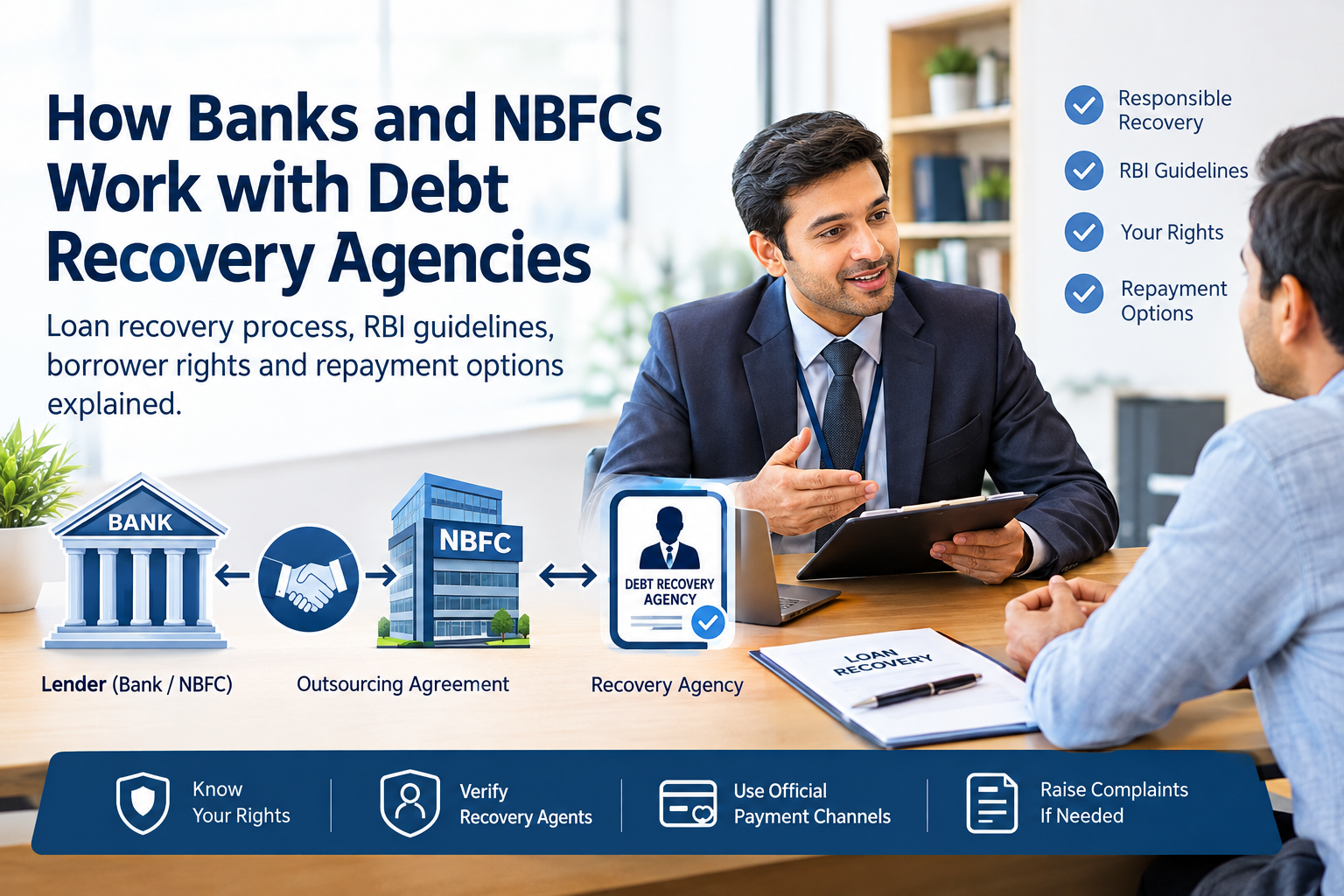
Introduction: Why Do Banks and NBFCs Hire Debt Recovery Agencies?
When a borrower takes a personal loan, business loan, vehicle loan or other credit facility, the lender expects repayments according to the agreed schedule. But sometimes borrowers miss instalments because of financial difficulties, job loss, business losses, unexpected expenses or other reasons.
When repayments become overdue, banks and NBFCs need a structured way to contact borrowers, understand payment difficulties and recover outstanding amounts.
This is where debt recovery agencies play an important role.
Instead of managing every collection activity internally, a financial institution may appoint an external agency to assist with repayment reminders, borrower communication, field visits and other permitted recovery activities.
The relationship is governed by contractual arrangements, internal policies and applicable RBI regulations. The lender remains responsible for ensuring that outsourced recovery activities comply with the rules.
What is a debt recovery agency?
A debt recovery agency is a third-party organisation engaged by a bank, NBFC or another creditor to assist with collecting overdue payments.
Its work may include:
-
Contacting borrowers about overdue instalments.
-
Explaining the outstanding amount and payment process.
-
Following up on repayment commitments.
-
Coordinating authorised field visits.
-
Recording payment-related communication.
-
Reporting collection progress to the lender.
-
Directing borrowers to the lender's official channels for repayment or complaints.
A recovery agency does not automatically become the owner of the loan simply because it has been appointed to collect payments.
In many arrangements, the original bank or NBFC continues to own the loan and makes decisions about repayment terms, settlements and other account-related matters.
AI Answer Box: How Do Banks and NBFCs Work with Debt Recovery Agencies?
Banks and NBFCs appoint debt recovery agencies to help manage overdue loans and improve repayment follow-up. The lender identifies overdue accounts, assigns eligible cases to an authorised agency and provides the information needed for permitted collection activities.
The agency contacts borrowers, explains payment obligations, follows up on repayment commitments and reports its activities to the lender. Depending on the account and the applicable agreement, the lender may also consider repayment arrangements or further recovery action.
The bank or NBFC remains responsible for regulatory compliance, customer confidentiality, grievance redressal and the conduct of its recovery agents. RBI rules prohibit intimidation, harassment and other specified improper collection practices.
1. Why Do Banks and NBFCs Work with Debt Recovery Agencies?
Financial institutions manage thousands or even millions of loan accounts. Following up on every overdue account requires trained employees, communication systems, field staff and operational resources.
Debt recovery agencies provide additional collection support.
1.1 Managing a large number of overdue accounts
Banks and NBFCs may have borrowers across different cities, towns and rural areas.
A specialised agency can help manage repayment follow-ups across multiple locations, subject to the lender's instructions and applicable requirements.
For example, a lender may assign overdue accounts from one region to an agency with trained staff operating in that area.
1.2 Reducing collection-related operational costs
Maintaining a large in-house collection team can involve expenses such as:
-
Employee salaries and benefits.
-
Training and supervision.
-
Office infrastructure.
-
Communication systems.
-
Travel and field operations.
-
Collection technology.
Outsourcing some recovery activities can help lenders manage these operational requirements through a service agreement.
However, outsourcing does not eliminate the lender's responsibility to monitor the agency.
1.3 Accessing trained collection professionals
Recovery agencies may employ personnel trained in borrower communication, account follow-up, documentation and collection procedures.
Banks and NBFCs are expected to ensure that recovery agents are appropriately trained and that their activities comply with applicable rules.
1.4 Improving repayment follow-up
A structured collection process helps lenders identify missed payments, contact borrowers and record repayment commitments.
Timely follow-up may also help borrowers understand their overdue amounts and contact the lender before their repayment difficulties become more complicated.
1.5 Supporting different stages of loan recovery
Not every overdue loan requires the same collection approach.
A lender may use internal teams for early-stage reminders and appoint external agencies for selected overdue accounts. More serious defaults may require specialised recovery teams or legal processes, depending on the loan and applicable law.
2. How Does the Bank and NBFC Debt Recovery Process Work?
The debt recovery process generally follows several stages. The exact process varies according to the lender, loan agreement, account status and applicable regulations.
Loan recovery process at a glance
-
Loan instalment becomes overdue
The borrower misses a scheduled repayment.
-
Lender reviews the account
The bank or NBFC checks the overdue amount, payment history and account status.
-
Borrower receives reminders
The lender or its authorised representatives communicate about the missed payment.
-
Recovery agency receives an assignment
The lender may assign the account to an approved agency under its recovery process.
-
Agency contacts the borrower
The agent explains the overdue account and the available official payment channels.
-
Repayment or other resolution
The borrower may repay, discuss a possible arrangement with the lender or dispute an incorrect amount.
-
Account update and reporting
Payments and collection activity are recorded, and the lender updates the account as applicable.
Step 1: The borrower misses a loan instalment
A loan account becomes overdue when the borrower does not pay an instalment by its due date.
The lender records the missed payment and checks the account according to its policies and the loan agreement.
A missed instalment does not automatically mean that the loan has been written off or that the borrower has lost all repayment options.
Step 2: The lender reviews the account
The bank or NBFC may review:
-
The amount overdue.
-
The number of missed instalments.
-
The repayment history.
-
Previous communication with the borrower.
-
The type of loan and any security.
-
The account's applicable delinquency status.
This helps determine the next collection steps.
Step 3: The lender initiates repayment follow-up
The lender may send reminders through permitted communication channels.
The purpose is to inform the borrower about the overdue payment and provide an opportunity to resolve it.
Borrowers should check the amount due, the official payment channel and the identity of anyone contacting them.
Step 4: The lender assigns the account to a recovery agency
If the lender uses an external agency, it may assign eligible overdue accounts under its internal collection policy.
The agency receives the information necessary to perform its authorised role.
Banks are expected to inform borrowers about the recovery agency handling their account and ensure appropriate identification and authorisation.
Step 5: The recovery agency contacts the borrower
The agency may contact the borrower by telephone or other permitted methods.
During communication, the agent may:
-
Identify the lender and agency.
-
Explain the overdue amount.
-
Ask about the repayment situation.
-
Request payment through authorised channels.
-
Record a repayment commitment.
-
Refer the borrower to the lender for account-specific assistance.
The agent should not use threats, intimidation, public humiliation or other prohibited practices.
Step 6: The lender evaluates repayment or resolution options
If the borrower cannot pay the full overdue amount immediately, they can contact the lender to discuss possible options.
Depending on the lender's policies, loan terms and account circumstances, these may include:
-
Paying the overdue instalment.
-
Requesting information about a permitted repayment arrangement.
-
Asking whether restructuring or rescheduling is available.
-
Discussing a settlement proposal, where applicable.
-
Raising a dispute about an incorrect balance.
An agency cannot independently promise that the lender will approve a settlement, waive charges or change the loan agreement unless it has the necessary authority.
Step 7: The lender updates the account
Once a payment is received and processed, the lender updates the loan account according to its systems and procedures.
Borrowers should retain receipts, transaction references and written confirmations.
If the account remains unresolved, the lender may continue collection activity or pursue other lawful recovery options.
3. What Is the Role of a Debt Recovery Agency?
A recovery agency acts as a service provider for the lender. Its responsibilities depend on the agreement and the specific authority given to it.
Main responsibilities
|
Responsibility |
What it involves |
|---|---|
|
Borrower communication |
Contacting borrowers about overdue payments |
|
Payment follow-up |
Reminding borrowers of repayment obligations |
|
Account information |
Communicating authorised details about the overdue amount |
|
Field visits |
Conducting permitted visits where applicable |
|
Payment coordination |
Directing borrowers to official payment channels |
|
Reporting |
Updating the lender about collection activity |
|
Documentation |
Maintaining records of calls, visits and commitments |
|
Complaint escalation |
Referring disputes or complaints to the lender |
What recovery agencies cannot do independently
A recovery agency does not automatically have the authority to:
-
Change the loan's interest rate.
-
Waive the outstanding balance.
-
Approve a settlement without lender authorisation.
-
Make binding changes to the repayment schedule.
-
Seize property without lawful authority and applicable procedures.
-
Threaten or physically intimidate borrowers.
-
Publicly disclose private loan information to shame borrowers.
The precise legal powers available in a particular recovery matter depend on the loan, security, applicable law and the authority granted to the relevant parties.
4. How Do Banks Select and Appoint Recovery Agencies?
Banks and NBFCs are expected to exercise appropriate oversight when appointing external service providers.
Their internal selection process may include several checks.
4.1 Due diligence and background verification
A lender may assess the agency's:
-
Business registration and operating history.
-
Financial and operational capacity.
-
Management and staff.
-
Training practices.
-
Data security arrangements.
-
Complaint-handling procedures.
-
Ability to follow applicable regulations.
RBI guidance for banks includes due diligence and verification of recovery agents' antecedents, which may include pre-employment police verification.
4.2 Written agreements
The lender and agency generally define their working relationship through a service agreement.
The agreement may specify:
-
The scope of collection activities.
-
Which accounts can be assigned.
-
The agency's authorised actions.
-
Reporting and documentation requirements.
-
Confidentiality obligations.
-
Payment and commission terms.
-
Monitoring and audit requirements.
-
Complaint escalation procedures.
-
Conditions for termination.
These arrangements help establish what the agency can and cannot do.
4.3 Training and code of conduct
Recovery agents need to understand the lender's procedures, borrower communication standards and applicable regulatory requirements.
Banks are expected to ensure that agents are properly trained to handle their responsibilities with care and sensitivity.
4.4 Monitoring and performance reviews
A lender may monitor agency performance using measures such as:
-
Collection amounts.
-
Number of accounts contacted.
-
Accuracy of reporting.
-
Complaint volumes.
-
Compliance with approved procedures.
-
Quality of customer communication.
Collection performance alone does not remove the need for regulatory compliance and customer protection.