

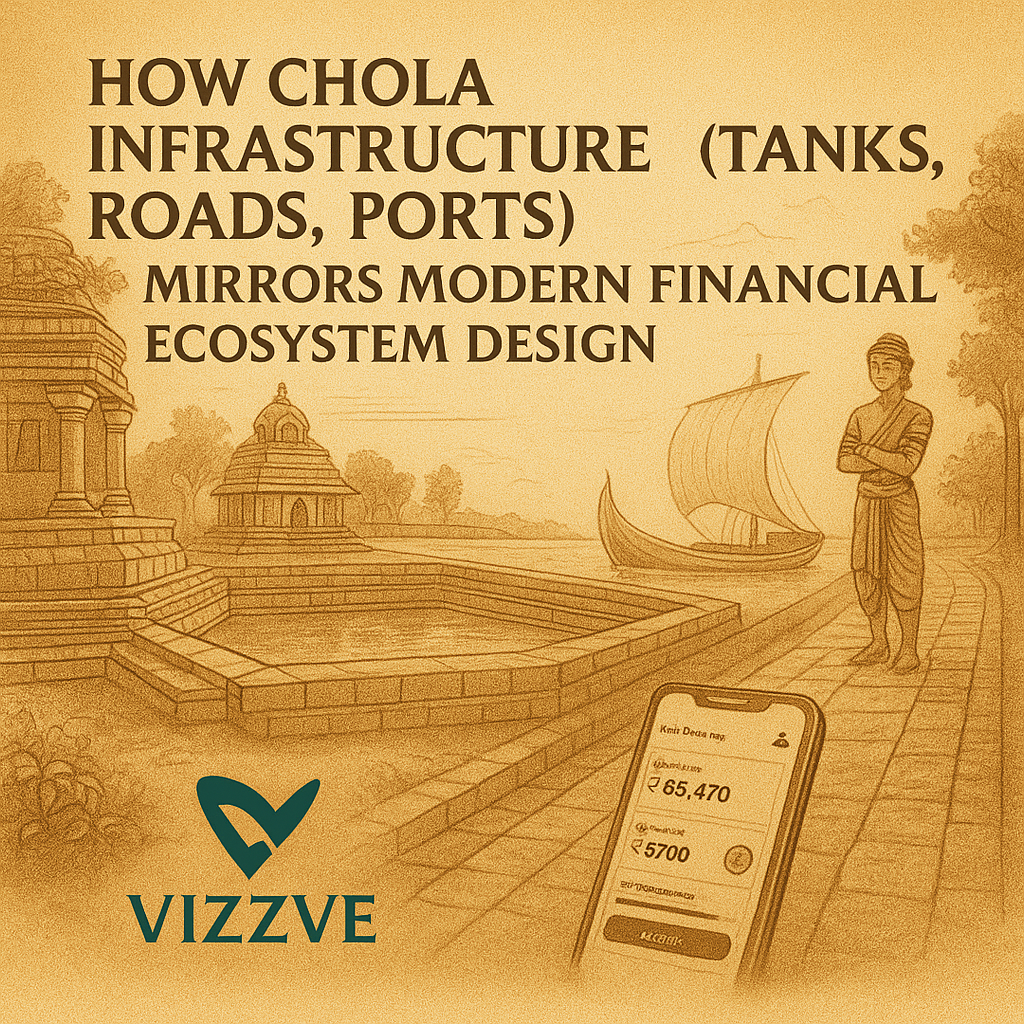
🛕 How Chola Infrastructure Mirrors the Modern Financial Ecosystem Design
The Chola Empire (9th–13th century CE) wasn't just known for grand temples—it built tanks, roads, canals, and ports that powered one of the most advanced and resilient economies in Indian history.
What’s fascinating? The design, purpose, and network of this infrastructure mirror the very essence of modern financial ecosystems—just like what Vizzve is creating in the digital world today.
Let’s explore how.
💧 1. Water Tanks = Liquidity Reservoirs
The Cholas constructed over 40,000 tanks (man-made reservoirs) across Tamil Nadu, like:
Veeranam Tank
Kaveripakkam Tank
Countless temple tanks
These tanks:
Stored excess water (surplus capital)
Released it gradually (systematic disbursement)
Connected to canals and fields (capital flow to economy)
💡 Modern Parallel:
Tanks = Liquidity Pools
Just like tanks ensured water availability, Vizzve ensures liquidity—providing timely loans and credit for planned and emergency needs.
🛣️ 2. Roads = Financial Connectivity
Cholas built multi-regional roads:
Linking urban markets, temples, ports, and hinterlands
Enabling smoother movement of goods, labor, and messages
These roads connected nodes in the economic chain, making data and wealth flow more efficient.
📲 Vizzve Insight:
Financial infrastructure today is digital and mobile-first.
APIs, UPI, and fintech apps form modern roads that connect savers, lenders, and consumers—just like Chola roads connected trade hubs.
⚓ 3. Ports = Entry Points for Global Capital
Ports like:
Puhar (Kaveripattinam)
Nagapattinam
Kadalur
...served as international trade gateways for silk, spices, and gold.
📦 They also handled taxes, storage, and merchant coordination—early forms of regulated market entry.
💼 Modern Equivalent:
Fintech platforms (like Vizzve) act as secure entry points for users to access:
Loans
Financial products
International remittance
Investment options
🧠 4. Integrated Design = Holistic Economic Planning
Chola infrastructure wasn’t piecemeal. It followed:
Geographic logic (tanks upstream, fields downstream)
Economic cycles (trade roads to ports to temples)
Risk management (storage tanks for droughts)
This is systems thinking—designing for resilience and scale.
🔁 Today’s Fintech Needs Similar Planning:
Vizzve builds an ecosystem of:
Borrower profiles
Instant approvals
Risk scoring
EMI scheduling
Credit education
...all connected and responsive—like Chola infrastructure.
🔍 Why It Still Matters: Lessons for Modern India
| Chola Era | Modern Vizzve Fintech |
|---|---|
| Tanks = Water security | Credit availability = Financial security |
| Roads = Trade connectivity | APIs = Digital financial inclusion |
| Ports = Global market entry | Fintech = Borderless access to capital |
| Inscriptions = Public records | Credit scores, app dashboards = Transparent records |
✅ Conclusion:
If Chola infrastructure was economic muscle, Vizzve is its digital avatar—empowering India’s youth, entrepreneurs, and rural borrowers.
📌 FAQs
🔹 Why focus on tanks and roads in finance?
Because these represent capital flow, risk management, and scalability, much like financial ecosystems.
🔹 How does Vizzve reflect Chola-era planning?
Vizzve combines accessibility, inclusiveness, and real-time service—mirroring Chola-era infrastructure that served all classes.
🔹 Can old infrastructure design really influence fintech?
Absolutely. Design thinking, distribution, and resilience are timeless—Vizzve is building that for finance.
Published on : 3rd july
Published by : Kaushik
www.vizzve.com || www.vizzveservices.com
Follow us on social media: Facebook || Linkedin || Instagram