

Introduction
When a person applies for a personal loan, home loan, business loan or credit card, the lender needs to answer one fundamental question:
How likely is this borrower to repay the money as agreed?
This is where credit risk becomes important.
Credit risk is the possibility that a borrower or counterparty may fail to meet its financial obligations, causing a financial loss to the lender or investor. A credit score helps lenders quickly understand aspects of a borrower's past credit behaviour, but it is only one part of the overall credit assessment.
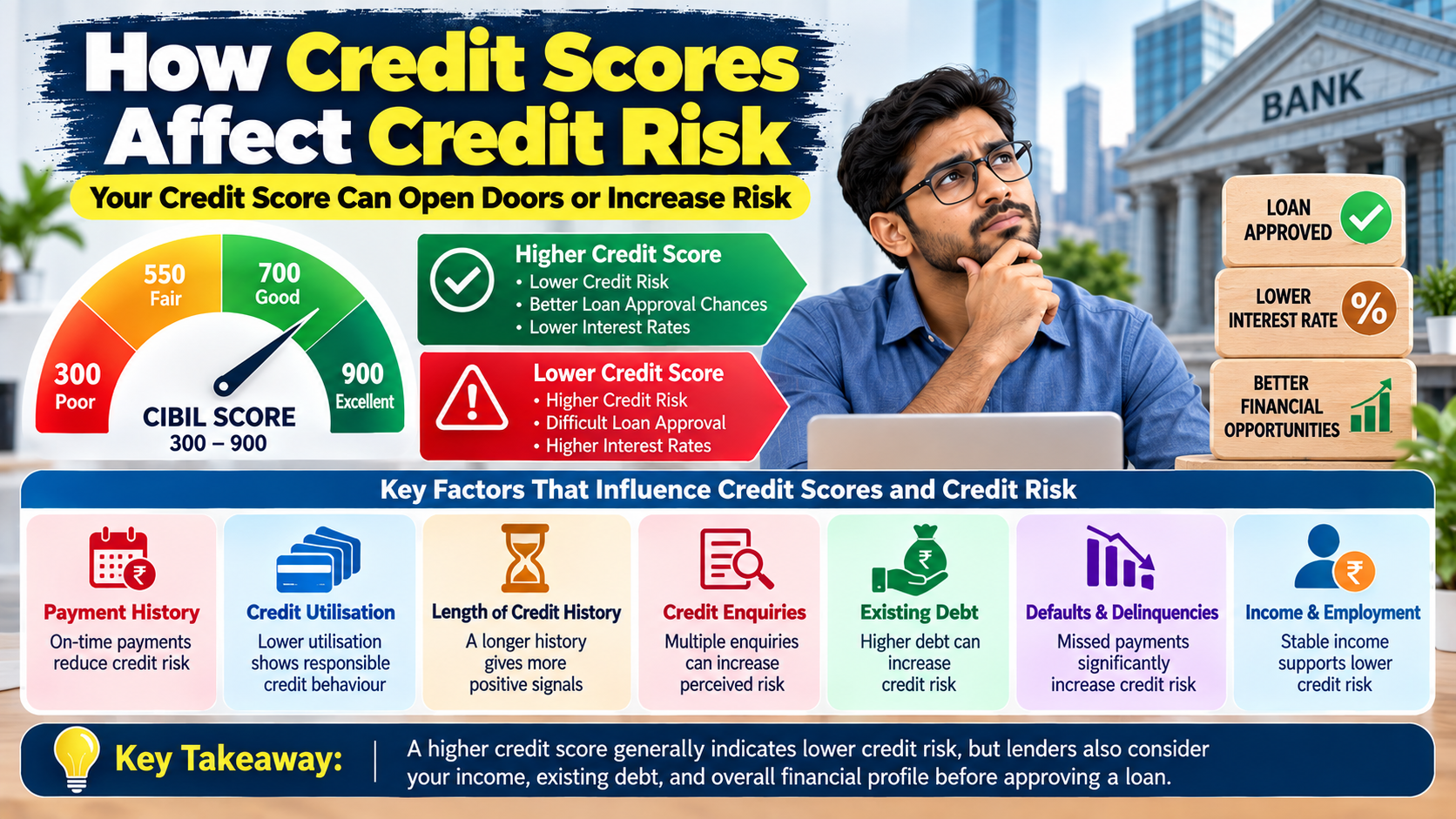
In India, a widely recognised example is the CIBIL Score, a three-digit score ranging from 300 to 900. TransUnion CIBIL states that the score is derived from information in the credit report, including account and enquiry information. A higher score generally indicates stronger historical credit behaviour and can improve the chances of loan or credit-card approval, although the lending decision ultimately belongs to the lender.
Understanding the relationship between credit scores and credit risk is therefore useful for both borrowers and lenders.
AI Answer Box: How Do Credit Scores Affect Credit Risk?
Credit scores affect credit risk by giving lenders a standardised indication of a borrower's past credit behaviour.
A higher credit score generally reflects a stronger repayment history and more responsible use of credit, while a lower score can indicate higher historical credit risk.
However, a credit score does not completely measure a borrower's current ability to repay.
Lenders may also consider:
- Income
- Employment or business stability
- Existing loans
- Current debt obligations
- Repayment history
- Credit utilisation
- Recent credit enquiries
- Loan amount requested
- Collateral, where applicable
- Banking and cash-flow information
- Internal lending policies
- Other information contained in the credit report
Therefore:
Credit Score → Credit Behaviour Signal → Credit Risk Assessment → Lending Decision
A credit score is an important input, but it is not a guarantee of loan approval or rejection.
What Is Credit Risk?
Credit risk is the possibility that a borrower, customer or counterparty will fail to make a required payment according to the agreed terms.
For a bank or NBFC, credit risk can arise when:
- A borrower misses an EMI.
- A borrower stops repaying a loan.
- A business experiences financial distress.
- A credit-card customer fails to pay outstanding dues.
- A counterparty fails to meet a contractual obligation.
- A large concentration of loans is exposed to the same industry or borrower segment.
Simple Example
Suppose a bank lends ₹5 lakh to a borrower.
If the borrower repays the principal and interest on schedule, the lender's credit risk remains controlled.
If the borrower loses the ability or willingness to repay, the lender may face:
- Delayed cash flows
- Collection costs
- Restructuring requirements
- Provisioning requirements
- Recovery expenses
- Potential credit losses
This possibility is credit risk.
What Is a Credit Score?
A credit score is a numerical summary of information contained in a person's credit history.
For example, the TransUnion CIBIL Score ranges from 300 to 900. CIBIL describes it as a three-digit summary derived from information in the Accounts and Enquiries sections of the credit report.
A credit report can contain information about credit facilities such as:
- Personal loans
- Home loans
- Vehicle loans
- Credit cards
- Overdraft facilities
- Other reported credit accounts
It can also contain information about repayment behaviour, outstanding balances, enquiries and account status.
Credit Score vs Credit Report
These two terms are often confused.
| Credit Score | Credit Report |
|---|---|
| Numerical summary | Detailed credit history |
| Usually presented as a three-digit number | Contains account-level information |
| Helps provide a quick risk signal | Provides deeper information |
| Based on credit-history data | Contains the underlying reported information |
| One input into lending assessment | Used to understand borrower behaviour |
A lender may therefore look beyond the headline score and examine the underlying credit report.
How Credit Scores Affect Credit Risk
The relationship can be understood in four stages.
Stage 1: Credit Behaviour
The borrower uses loans and credit cards.
Stage 2: Credit Reporting
Credit institutions report relevant credit information to credit information companies.
Stage 3: Credit Score
The credit information contributes to a credit score and credit report.
Stage 4: Risk Assessment
The lender uses the score along with other information to assess the borrower's creditworthiness and overall risk.
In simplified form:
Past Credit Behaviour → Credit Report → Credit Score → Risk Assessment → Lending Decision
The important point is that the final stage involves more than the score alone.
TransUnion CIBIL itself notes that a lender considers other details when assessing whether an applicant is creditworthy and that CIBIL does not make the lending decision.
Why Is Credit Score Important for Credit Risk Assessment?
A credit score can make the initial assessment more efficient.
Instead of beginning every application with a completely manual review of historical repayment information, lenders can use credit information and scoring systems as part of their underwriting process.
A stronger historical credit profile may indicate:
- Consistent repayment behaviour
- Better management of existing credit
- Lower observed delinquency
- More established credit history
A weaker profile may indicate:
- Missed payments
- Defaults
- High credit utilisation
- Multiple recent credit enquiries
- Heavy existing borrowing
- Other negative credit-history indicators
However, these are risk signals rather than absolute conclusions.
Major Factors That Connect Credit Scores With Credit Risk
1. Payment History
Payment history is one of the most important indicators of past credit behaviour.
Repeated late payments or defaults can negatively affect a credit score and may also increase the lender's perception of repayment risk. CIBIL specifically advises borrowers to pay dues on time because late payments are viewed negatively by lenders.
Example
Consider two borrowers:
Borrower A
- Pays EMIs on time
- Has no recent defaults
- Maintains credit responsibly
Borrower B
- Has multiple delayed payments
- Has overdue balances
- Has recent repayment problems
All else being equal, Borrower B presents more historical credit-risk signals.
2. Credit Utilisation
Credit utilisation refers broadly to how much of available revolving credit is being used.
For example:
Credit-card limit: ₹1,00,000
Outstanding balance: ₹80,000
Utilisation is approximately:
₹80,000 ÷ ₹1,00,000 × 100 = 80%
A consistently high utilisation level can be interpreted as a sign of heavier dependence on available revolving credit.
CIBIL identifies credit utilisation as one of the factors affecting its score.
Why It Matters
High utilisation may indicate:
- Greater dependence on credit
- Higher outstanding balances
- Increased repayment burden
- Potential financial stress
It does not automatically mean that a borrower will default, but it can be a useful risk signal.
3. Length of Credit History
The age and depth of a borrower's credit history can also matter.
A person with several years of well-managed credit behaviour provides a lender with more historical information than someone who has only recently entered the credit system.
CIBIL identifies the depth or duration of credit history as a factor affecting its score.
Important Point
A person with a limited or nonexistent credit history is not automatically a risky borrower.
It may simply mean that the lender has less historical credit information available.
CIBIL notes that scores such as NA/NH can occur when there is insufficient credit history or limited recent credit activity; some lenders may have policies concerning applicants without a credit track record.
4. New Credit Enquiries
When a borrower applies for multiple loans or credit cards within a short period, multiple credit enquiries may appear on the credit report.
CIBIL identifies multiple enquiries and recently opened credit accounts among factors that can affect the score.
Why Can Multiple Applications Matter?
A lender may ask:
Why does this borrower suddenly need several new sources of credit?
Possible explanations include:
- Genuine financial need
- Shopping around for credit
- Expansion of a business
- Debt consolidation
- Increased borrowing pressure
The enquiry itself does not prove financial distress, but a pattern of frequent applications can become a risk signal.
5. Existing Debt
A credit score does not necessarily show the complete picture of a person's current financial capacity.
A borrower may have a strong score but also have substantial existing obligations.
For example:
- Home-loan EMI: ₹35,000
- Personal-loan EMI: ₹15,000
- Vehicle EMI: ₹10,000
- Credit-card obligations: variable
If monthly income is ₹70,000, the lender may examine the overall debt burden carefully before approving another loan.
This demonstrates why:
Good credit score ≠ automatic loan approval
6. Defaults and Delinquencies
A default or serious delinquency can increase credit risk substantially.
For a lender, missed payments can indicate that the borrower is experiencing difficulty meeting financial obligations.
Depending on the circumstances, the lender may consider:
- Days past due
- Number of missed payments
- Recency of the delinquency
- Amount overdue
- Whether the account was subsequently regularised
- Overall repayment pattern
The credit report provides more context than the score alone.
Credit Score and Loan Approval
One of the most common questions is:
Does a high credit score guarantee loan approval?
No.
A high score can improve the chances of approval, but it does not guarantee approval.
CIBIL explicitly states that the lending decision is made by the lender, not by CIBIL.
A lender may reject or reduce a loan application because of factors such as:
- Insufficient income
- High existing debt
- Unstable employment
- Poor cash flow
- Internal eligibility criteria
- Excessive loan amount requested
- Inadequate documentation
- Recent financial stress
- Policy restrictions
Does a Low Credit Score Always Mean High Credit Risk?
Not necessarily.
A low score can indicate negative credit-history information, but lenders need to understand why the score is low.
For example, a borrower may have:
- One historical missed payment
- A settled financial issue
- Very high credit utilisation
- A short credit history
- Multiple recent enquiries
Each situation can have a different risk interpretation.
This is why responsible credit assessment should examine the underlying report and current repayment capacity rather than relying on a single number.
Credit Score vs Credit Risk: What's the Difference?
| Factor | Credit Score | Credit Risk |
|---|---|---|
| Meaning | Numerical summary of credit history | Possibility of financial loss |
| Focus | Historical credit behaviour | Probability and potential impact of repayment failure |
| Used by | Lenders and other authorised users | Banks, NBFCs, investors and financial institutions |
| Includes current income? | Not necessarily | Often considered in broader underwriting |
| Measures default possibility? | Provides a risk signal | Broader assessment of repayment risk |
| Guarantees approval? | No | No |
| Can be managed? | Yes, through responsible credit behaviour over time | Yes, through underwriting, monitoring and risk mitigation |
Simple Explanation
Credit score is a signal. Credit risk is the broader risk being assessed.
How Lenders Assess Credit Risk Beyond the Credit Score
A lender may use a combination of quantitative and qualitative information.
Financial Factors
- Income
- Existing liabilities
- Debt-service capacity
- Cash flow
- Bank-account behaviour where permitted and relevant
- Business turnover
- Profitability for business borrowers
Credit Factors
- Credit score
- Repayment history
- Outstanding balances
- Delinquencies
- Credit enquiries
- Existing accounts
- Account status
Borrower Factors
- Employment stability
- Business experience
- Industry
- Age and other eligibility factors
- Documentation
Loan Factors
- Loan amount
- Tenure
- Interest rate
- Secured or unsecured structure
- Collateral
- Loan purpose
How Credit Scores Affect Loan Interest Rates
Credit score and borrowing cost can be related, but there is no universal interest-rate formula that applies to every lender.
A lender may use risk-based pricing or internal credit policies.
In general, stronger credit characteristics can support more favourable lending terms, while higher perceived risk can result in:
- Higher interest rates
- Lower sanctioned amounts
- Shorter or different repayment structures
- Additional conditions
- Requests for collateral or guarantees
However, the actual terms depend on the lender, product, borrower profile and prevailing market conditions.
How Credit Scores Affect Different Types of Loans
Personal Loans
Personal loans are generally unsecured, meaning the lender does not normally have specific collateral securing the loan.
Therefore, credit history can be particularly important during underwriting.
Lenders may examine:
- Credit score
- Income
- Existing EMIs
- Employment
- Repayment history
- Requested amount
Home Loans
Home loans are generally secured against property.
Credit history still matters because the lender needs to assess the borrower's repayment ability.
Other important factors include:
- Income
- Property value
- Loan-to-value considerations
- Existing liabilities
- Employment/business profile
- Loan tenure
Business Loans
For business borrowers, credit risk assessment can extend beyond the owner's personal credit history.
Lenders may examine:
- Business turnover
- Profitability
- Cash flow
- Existing business debt
- Banking history
- GST/tax-related financial information where applicable
- Business credit history
- Promoter or proprietor credit profile
Credit Cards
Credit-card issuers may consider:
- Credit history
- Existing obligations
- Repayment behaviour
- Credit utilisation
- Income
- Existing cards and accounts
Because credit cards are revolving credit facilities, utilisation can be particularly relevant.
Credit Scores and Digital Lending
Digital lending has made credit applications faster, but faster processing does not eliminate credit risk.
RBI's digital-lending framework requires lending done through regulated entities' digital lending applications or lending service providers to be reported to credit information companies, irrespective of the nature or tenor of the lending.
This means borrowers should not assume that a short-term digital loan is invisible to the formal credit system.
Borrowers Should Remember
Before accepting digital credit:
- Check the actual lender.
- Review the interest and other charges.
- Understand the repayment schedule.
- Check the total amount payable.
- Review the privacy and data practices.
- Avoid taking multiple loans simply because digital approval is fast.
RBI Credit Reporting Updates and Why They Matter
Credit information reporting has become more frequent.
RBI directed credit institutions to submit credit information to credit information companies on a fortnightly basis, with the revised framework effective from January 1, 2025. The instructions cover banks, NBFCs and other specified credit institutions.
RBI's directions also emphasise the importance of accurate and complete credit information.
What This Means for Borrowers
Borrowers should take credit-report accuracy seriously.
Check for:
- Incorrect overdue amounts
- Accounts that do not belong to you
- Wrong account status
- Duplicate accounts
- Incorrect personal details
- Payments that have not been reflected correctly
An inaccurate credit report can create unnecessary difficulty during future borrowing.
How to Reduce Credit Risk as a Borrower
Step 1: Pay EMIs and Credit-Card Dues on Time
Payment discipline is one of the most important foundations of healthy credit behaviour.
Set:
- Auto-debit
- Calendar reminders
- Sufficient bank balance before the due date
Step 2: Avoid Excessive Credit Utilisation
Do not continuously depend on most of your available revolving credit.
Monitor balances regularly.
Step 3: Borrow According to Repayment Capacity
Before taking a loan, calculate:
Monthly Income − Essential Expenses − Existing EMIs = Available Repayment Capacity
Do not judge affordability solely by whether a lender is willing to offer the loan.
Step 4: Avoid Unnecessary Loan Applications
Do proper research before submitting applications.
Compare:
- Interest rate
- Processing fee
- Tenure
- Total repayment
- Foreclosure/prepayment terms
- Other applicable charges
- Eligibility requirements
Step 5: Check Your Credit Report
Review your credit report periodically.
RBI has provided for individuals to obtain one free full credit report, including the credit score, once each calendar year from a credit information company under the applicable framework.
Step 6: Dispute Incorrect Information
If you identify an error, contact the relevant credit institution and credit information company through the applicable correction process.
Keep:
- Payment receipts
- Loan closure documents
- Account statements
- Emails
- Complaint/reference numbers
A Simple Example: Credit Score and Credit Risk
Consider two hypothetical applicants.
Applicant A
- Strong repayment history
- Moderate credit utilisation
- No recent serious delinquencies
- Stable income
- Manageable existing EMIs
Applicant B
- Recent payment delays
- High credit utilisation
- Multiple recent credit enquiries
- High existing debt
- Irregular income
Even if both applicants request the same ₹5 lakh loan, their overall credit-risk profiles may be different.
The lender could therefore apply different underwriting decisions or terms.
This is why credit risk is broader than a credit score.
Credit Score Impact on Borrower Risk: Summary Table
| Credit Behaviour | Possible Credit-Risk Signal |
|---|---|
| Timely repayments | Positive |
| Repeated late payments | Negative |
| High revolving-credit utilisation | Potentially negative |
| Long, well-managed credit history | Potentially positive |
| Multiple recent enquiries | May increase caution |
| Large existing debt | Potentially higher repayment risk |
| No credit history | Limited historical information |
| Serious delinquency/default | Significant negative signal |
| Correct and stable credit information | Supports accurate assessment |
| Regular monitoring | Helps identify errors early |
The exact effect can vary by scoring model and lender policy.
Pros and Cons of Using Credit Scores in Risk Assessment
Advantages
- Quick initial risk screening
- Standardised numerical indicator
- Helps lenders process applications efficiently
- Uses historical repayment information
- Can support automated underwriting
- Helps borrowers understand their credit health
Limitations
- Does not capture every aspect of financial capacity
- Historical information may not fully reflect current circumstances
- Different scoring models can produce different results
- A good score does not guarantee approval
- A low score does not necessarily explain the complete reason for financial difficulty
- Credit-report errors can affect the assessment
Expert Commentary: Why Credit Scores Should Not Be Viewed Alone
A useful way to understand credit scoring is to think of it as a risk signal rather than a complete financial diagnosis.
A credit score answers part of the question:
“How has this borrower historically handled reported credit?”
Credit-risk underwriting asks a broader question:
“Given the borrower's history, current financial position, requested credit and other relevant factors, how likely is repayment under the proposed loan?”
That distinction is critical for responsible lending.
Real-World Experience Points for Borrowers
In practical borrowing situations, people often make the mistake of focusing only on the number displayed in a credit app.
A better approach is to examine the complete picture.
For example, someone may have a respectable score but recently taken several loans. Another person may have a shorter credit history but stable income and very manageable obligations.
The lender's assessment may therefore differ even if their scores appear similar.
Practical Lesson
Do not ask only, “What is my credit score?”
Also ask:
- What does my credit report say?
- How much debt do I already have?
- Are my payments current?
- How much credit am I using?
- Have I made multiple recent applications?
- Can I comfortably repay the new loan?
Common Mistakes That Increase Credit Risk
Mistake 1: Paying Only When Reminded
Missing an EMI because of forgetfulness can create avoidable problems.
Mistake 2: Maxing Out Credit Cards
Consistently carrying very high balances can negatively affect credit utilisation.
Mistake 3: Applying Everywhere at Once
Submitting many applications in a short period can create multiple enquiries.
Mistake 4: Ignoring Old Accounts
Borrowers should periodically review whether their credit report correctly reflects closed accounts and outstanding balances.
Mistake 5: Taking Loans Without Calculating Total Cost
A low EMI can look attractive because of a longer tenure while increasing total interest paid.
Mistake 6: Assuming a Good Score Guarantees Approval
A score is only one part of underwriting.
Mistake 7: Ignoring Credit-Report Errors
Incorrect information should be investigated and disputed promptly.
Credit Score Improvement: A Responsible Approach
There is no legitimate overnight method that guarantees a specific credit-score increase.
Instead, focus on sustainable credit behaviour.
Credit Health Checklist
- Pay every EMI on time.
- Pay credit-card dues on time.
- Keep revolving balances under control.
- Avoid unnecessary applications.
- Maintain accurate personal information.
- Review credit reports periodically.
- Close or resolve genuine outstanding issues.
- Maintain manageable debt.
- Keep documentation for loan closures and repayments.
CIBIL itself recommends timely payments, controlled balances and a healthy credit profile as part of improving credit health.
Credit Score, Credit Risk and Financial Planning
Credit risk is not only a lender issue.
Borrowers should think about it as part of personal financial planning.
Before taking a loan, consider:
1. Affordability
Can you comfortably pay the EMI every month?
2. Stability
Would the repayment remain manageable if income temporarily falls?
3. Existing Debt
How much of your income already goes toward EMIs?
4. Emergency Fund
Do you have savings for unexpected expenses?
5. Loan Purpose
Is the borrowing necessary and financially justified?
6. Total Cost
What will you pay over the entire loan tenure?
This approach is more useful than chasing a particular credit-score number.
Credit Score vs Credit Risk vs Default Risk
These terms are related but different.
| Term | Meaning |
|---|---|
| Credit Score | Numerical summary of credit history |
| Credit Risk | Possibility of loss from failure to meet obligations |
| Default Risk | Risk that a borrower fails to meet contractual repayment obligations |
| Credit Report | Detailed record of reported credit activity |
| Credit Assessment | Broader process of evaluating borrower risk |
Relationship
Credit Report → Credit Score + Other Information → Credit Assessment → Credit Risk Decision
A default can increase credit risk, while a history of defaults can negatively affect credit scoring.
Key Takeaways
- Credit score and credit risk are not the same thing.
- A credit score provides a useful indication of historical credit behaviour.
- CIBIL Scores range from 300 to 900.
- Higher scores generally improve the chances of loan or credit-card approval, but approval is ultimately determined by the lender.
- Payment history is an important credit-health factor.
- Credit utilisation can influence credit scores.
- Multiple recent enquiries can be a risk signal.
- Existing debt and repayment capacity matter beyond the score.
- A high score does not guarantee loan approval.
- A low score does not tell the entire story of a borrower's financial situation.
- Borrowers should monitor their credit reports and correct inaccurate information.
- RBI's fortnightly credit-information reporting framework has been effective since January 1, 2025.
- Responsible borrowing and timely repayment are the foundation of healthy credit behaviour.
Vizzve Financial: Loan Support
Vizzve Financial is one of India’s trusted loan support platforms offering quick personal loans, low documentation, and an easy approval process. Apply at www.vizzve.com.
Borrowers should always review the applicable loan terms, interest rate, fees, repayment schedule and lender disclosures before accepting credit.
Frequently Asked Questions
1. How do credit scores affect credit risk?
Credit scores provide lenders with a summary of historical credit behaviour. They can help indicate repayment risk, but lenders generally consider additional financial and credit information before making a lending decision.
2. What is a good CIBIL Score in India?
CIBIL scores range from 300 to 900. CIBIL states that a score above 700 is generally considered good, although lenders can have different eligibility and underwriting policies.
3. Does a high CIBIL Score guarantee a loan?
No. A high CIBIL Score can improve the chances of approval, but the lender makes the final decision after considering other factors.
4. Does a low credit score always mean high credit risk?
No. A low score is a negative risk signal in many situations, but the lender may examine why the score is low and consider income, debt, repayment capacity and other information.
5. Does credit utilisation affect credit risk?
High credit utilisation can affect a credit score and may indicate greater dependence on revolving credit. It is one of the factors considered in CIBIL scoring.
6. Do late EMI payments affect credit scores?
Yes. Late payments and defaults can negatively affect credit scores and can also be viewed as negative repayment behaviour by lenders.
7. Do multiple loan applications affect credit risk?
Multiple recent credit enquiries may affect a credit score and can cause lenders to examine a borrower's recent borrowing activity more carefully.
8. Is credit score the same as credit risk?
No. A credit score is a numerical summary of credit history, while credit risk is the broader possibility of financial loss caused by failure to meet repayment obligations.
9. Can someone with no credit history get a loan?
Possibly. However, a person with limited credit history provides less historical repayment information, and individual lenders may have different policies for applicants without an established credit track record.
10. How can I reduce my credit risk?
Pay dues on time, manage credit utilisation, avoid unnecessary borrowing, maintain manageable debt and regularly review your credit report.
11. Does checking my own credit report affect my score?
Checking your own credit information for monitoring purposes is different from a lender making a credit enquiry. Borrowers should distinguish self-monitoring from applications for new credit.
12. How often is credit information reported in India?
Under RBI's revised framework, credit institutions are required to submit credit information to credit information companies on a fortnightly basis, effective from January 1, 2025.
13. Can incorrect credit-report information increase credit risk?
Yes. Incorrect overdue amounts, account information or other reporting errors can lead to an inaccurate representation of a borrower's credit profile. RBI's framework emphasises accurate and complete credit information.
14. Can a good credit score reduce loan interest rates?
A strong credit profile may support better loan terms with some lenders, but interest rates depend on the lender, product, borrower profile, risk assessment and prevailing conditions. There is no universal rate based solely on the credit score.
15. How can I improve my credit score?
Focus on consistent repayment, controlled credit utilisation, responsible borrowing and avoiding unnecessary credit applications. Also review your credit report for errors.
Published on : 28th september
Published by : G REDDY KUMAR
www.vizzve.com || www.vizzveservices.com
Follow us on social media: Facebook || Linkedin || Instagram
🛡 Powered by Vizzve Financial
RBI-Registered Loan Partner | 10 Lakh+ Customers | ₹600 Cr+ Disbursed