

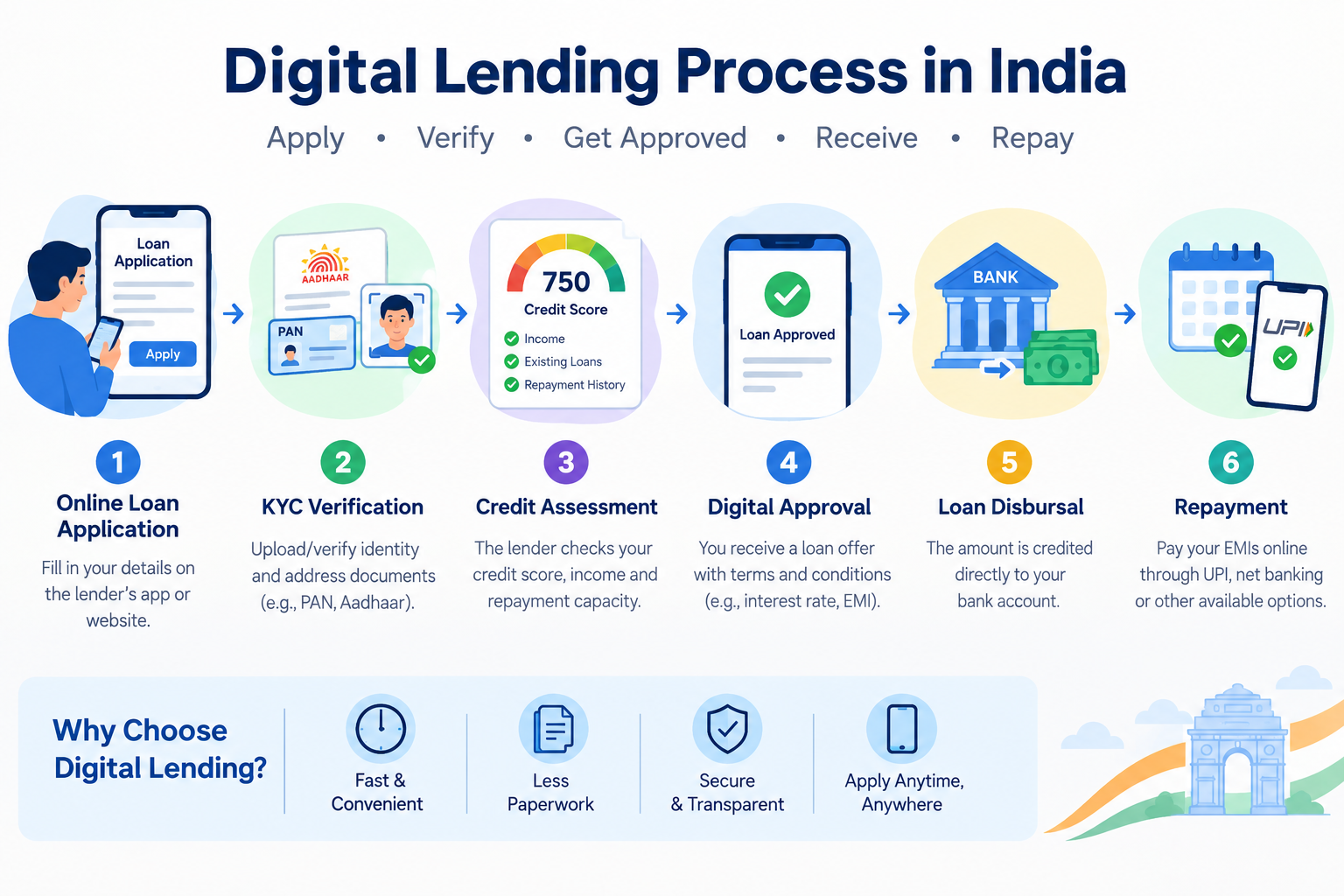
Digital lending has changed the way people in India apply for loans. Instead of visiting a bank branch, borrowers can now submit an application through a mobile app or website, complete KYC digitally, provide financial information and receive a loan decision online.
But how does digital lending actually work?
Digital lending is a technology-enabled lending process in which customer acquisition, credit assessment, loan approval, disbursal, repayment and related servicing can be handled digitally. The Reserve Bank of India (RBI) has established regulatory requirements for digital lending activities carried out by regulated entities such as banks and NBFCs.
This guide explains the digital lending process in simple terms, including how loan apps work, what lenders check, how money is disbursed, what borrowers should check before accepting a loan and how to identify potentially unsafe loan apps.
What Is Digital Lending?
Digital lending refers to a lending process that uses digital technology to handle some or most stages of borrowing.
A borrower may be able to:
- Apply for a loan online
- Complete digital KYC
- Submit income and financial information
- Receive an eligibility or loan offer
- Review loan terms
- Sign documents electronically
- Receive the loan in a bank account
- Repay EMIs digitally
- Contact customer support online
RBI's framework describes digital lending as a remote and largely automated process covering areas such as customer acquisition, credit assessment, approval, disbursal, recovery and associated customer service.
Who Provides Digital Loans?
A digital lending app does not necessarily mean that the app itself is the lender.
The lending ecosystem can involve:
Regulated Entity
The actual lender may be a bank, NBFC or another RBI-regulated entity covered by the applicable framework.
Digital Lending App
The app or website provides the customer-facing interface through which the borrower applies for or manages the loan.
Lending Service Provider
An LSP may perform services for a regulated entity, such as customer acquisition, servicing, monitoring, underwriting support or recovery activities.
RBI's digital-lending framework places responsibilities on regulated entities even when they use LSPs or digital lending apps.
This is why borrowers should always identify the actual lender before accepting a digital loan.
How Digital Lending Works: Step-by-Step
The exact process differs between lenders, but a typical digital loan application follows these stages.
1. Choose a Loan Product
The borrower first selects the type of loan required.
Common examples include:
- Personal loans
- Consumer loans
- Business loans
- Education loans
- Vehicle-related credit
- Other eligible digital credit products
Before applying, compare the interest rate, APR, processing fees, repayment period and total repayment obligation.
2. Submit the Online Application
The borrower enters information such as:
- Name
- Mobile number
- Date of birth
- Address
- Employment details
- Income
- Loan amount
- Bank details
- Other required information
The information required varies by lender and loan product.
A digital application can reduce paperwork, but borrowers should still read the privacy policy and understand why particular information is being requested.
3. Complete KYC Verification
KYC means Know Your Customer.
Depending on the lender and applicable process, borrowers may need to provide or verify information such as:
- PAN
- Aadhaar or another officially valid document
- Address information
- Bank information
- Photograph or selfie
- Other identity documents
Digital verification can make the process faster, but borrowers should never share sensitive credentials such as an OTP, UPI PIN, ATM PIN or internet-banking password with an agent or loan app.
4. Credit Assessment
After receiving the application, the lender evaluates the borrower's creditworthiness.
The assessment may consider factors such as:
- Credit history
- Existing loans
- Repayment behaviour
- Income
- Existing EMI obligations
- Employment or business profile
- Requested loan amount
- Loan tenure
- Other information permitted under applicable rules
A high credit score does not guarantee approval, and a low score does not necessarily mean every lender will reject an application.
Each lender has its own eligibility and risk-assessment policies.
5. Income and Repayment-Capacity Assessment
Lenders also need to determine whether the borrower can reasonably repay the proposed loan.
Depending on the borrower, the lender may consider:
Salaried Applicants
- Salary slips
- Bank statements
- Employment information
- Existing EMIs
- Income details
Self-Employed Applicants
- ITRs
- Bank statements
- Business records
- GST-related information, where applicable
- Financial statements
- Business income
The objective is to assess the borrower's financial position and repayment capacity.
6. Digital Verification and Fraud Checks
Digital lending systems can use automated processes to verify information and identify potential inconsistencies.
For example, the lender may check whether:
- KYC details match the application
- Bank information is valid
- Income information is consistent
- Documents appear genuine
- Credit information matches the applicant
- There are unusual or potentially fraudulent patterns
Additional verification may be required before a final lending decision.
7. Loan Offer and Approval
If the application meets the lender's eligibility and risk criteria, the borrower may receive a loan offer.
The offer may contain:
- Loan amount
- Interest rate
- APR
- Loan tenure
- EMI
- Processing fee
- Other applicable charges
- Penal charges
- Repayment terms
An instant or preliminary approval should not automatically be treated as guaranteed final disbursal.
The final decision can depend on verification and the lender's internal processes.
8. Read the Key Facts Statement
One of the most important steps is reviewing the Key Facts Statement (KFS) before accepting the loan.
The KFS is designed to provide important information about the credit facility in a standardised form.
Borrowers should check:
- APR
- Loan amount
- Tenure
- EMI or repayment obligation
- Applicable fees
- Penal charges
- Other important terms
- Cooling-off or exit-related information where applicable
RBI's digital-lending framework requires important cost and loan information to be disclosed, including APR and other applicable terms.
Do not accept a loan simply because the app displays a low headline interest rate. Check the total borrowing cost.
9. Digital Agreement and Loan Disbursal
After accepting the terms, the borrower may complete the loan agreement digitally.
For regulated digital lending arrangements, loan disbursal is generally required to follow the applicable RBI framework, including direct flow of funds to the borrower's bank account, subject to specified exceptions.
This is an important safety point because borrowers should be cautious if an unknown person asks them to route loan money through another person's account.
10. Repayment and Loan Servicing
After receiving the loan, the borrower must repay according to the agreed schedule.
Repayment may be handled digitally through methods offered by the lender.
The borrower should keep track of:
- EMI due dates
- Outstanding principal
- Interest
- Applicable charges
- Late-payment consequences
- Prepayment terms
- Loan closure information
Missing repayments can increase costs and may affect the borrower's credit profile when the relevant information is reported to credit information companies.
How Digital Lending Apps Make Loans Faster
Digital lending can reduce the amount of manual paperwork involved in borrowing.
Technology can help lenders with:
- Online application processing
- Digital KYC
- Automated data checks
- Credit assessment
- Document verification
- Electronic agreements
- Digital communication
- Automated repayment reminders
However, faster processing does not mean that a borrower should skip due diligence.
A quick loan can still be an expensive loan if the borrower does not examine the APR, fees and repayment terms.
How RBI Rules Protect Digital Lending Borrowers
RBI has introduced requirements covering areas such as transparency, data protection, customer grievance handling and conduct of digital lending arrangements.
The framework also addresses the role of Lending Service Providers and Digital Lending Apps.
Important borrower protections include:
Transparent Loan Information
Borrowers should receive important information about the loan, including applicable costs and terms.
Data Consent
Digital lenders are subject to requirements around consent-based and need-based data collection. RBI's regulatory material says data collection should be based on the borrower's prior and explicit consent and should have clear audit trails.
Privacy
Digital lending apps and LSPs have requirements concerning borrower data and privacy policies.
Grievance Redressal
Borrowers should have access to a mechanism for raising complaints concerning digital lending services.
Lender Identification
Borrowers should be able to identify the regulated entity associated with the digital lending service.
How to Check Whether a Digital Loan App Is Genuine
Fake loan apps remain a significant consumer-safety concern.
RBI advises consumers to verify whether a digital lending app is associated with an RBI-regulated bank or NBFC by checking the lender's website. RBI also advises avoiding suspicious loan-app links received through SMS or social media.
Before applying, check:
1. Actual Lender
Find out which bank or NBFC is providing the loan.
2. Official Website
Verify the app or service through the lender's official website.
3. RBI Digital Lending App Information
RBI has operationalised a public directory of digital lending apps to help consumers verify an app's claimed association with a regulated entity. The government said the directory has been available since July 1, 2025.
4. KFS
Do not proceed if the loan terms are unclear.
5. Privacy Policy
Understand what personal information the app collects and why.
6. Customer Support
Check whether the lender provides a legitimate customer-care and grievance mechanism.
Digital Lending Red Flags Borrowers Should Watch
Be especially cautious if an app or agent:
- Promises guaranteed approval
- Says no KYC is required
- Hides the actual lender
- Does not provide clear loan terms
- Requests unexplained upfront payments
- Hides the APR or total repayment cost
- Demands your OTP
- Requests your UPI PIN
- Requests your ATM PIN
- Requests your internet-banking password
- Demands unnecessary access to personal information
- Sends suspicious APK or download links
- Uses threats or pressure to force repayment
RBI has specifically highlighted concerns involving fake or unscrupulous digital-lending apps and has encouraged consumers to verify an app's association with a regulated entity.
Digital Lending vs Traditional Lending
| Feature | Digital Lending | Traditional Branch Lending |
|---|---|---|
| Application | Online | Often branch-based |
| Documentation | Mostly digital | Physical or digital |
| KYC | Can be digital | Usually completed through formal verification |
| Processing | Technology-enabled | More manual steps may be involved |
| Loan tracking | App/online portal | Branch + online channels |
| Repayment | Often digital | Digital or other supported methods |
| Human interaction | May be limited | More branch interaction |
Digital lending can make borrowing more convenient, but borrowers still need to understand the financial obligation they are accepting.
Risks of Digital Lending
Digital borrowing also comes with risks.
High Borrowing Costs
Some digital credit products can be expensive, especially when fees are added.
Data Privacy Concerns
Borrowers should understand what data an app collects and how it is used.
Fake Loan Apps
Fraudulent apps can impersonate legitimate lenders.
Over-Borrowing
Easy access to credit can encourage borrowers to take loans they cannot comfortably repay.
Multiple Loan Applications
Applying to many lenders in a short period may create multiple credit enquiries and can make debt management more difficult.
How to Borrow Safely Through a Digital Lending App
Before accepting a digital loan, follow this checklist:
✓ Verify the actual lender
✓ Check the lender's official website
✓ Review the KFS
✓ Compare APR and total repayment
✓ Check processing and other fees
✓ Understand the EMI and due date
✓ Read the loan agreement
✓ Check the privacy policy
✓ Give only necessary permissions
✓ Never share OTPs or PINs
✓ Keep copies of important loan documents
✓ Borrow only an amount you can comfortably repay
Key Takeaways
- Digital lending allows much of the borrowing process to happen online.
- A digital lending app may be operated by a lender or an LSP working with a regulated entity.
- The typical process includes application, KYC, credit assessment, income verification, approval, agreement, disbursal and repayment.
- Instant approval does not necessarily mean guaranteed final disbursal.
- Always identify the actual lender before accepting a loan.
- Check the KFS, APR, EMI, fees and total repayment cost.
- Review the app's privacy policy and data permissions.
- Never share OTPs, UPI PINs, ATM PINs or banking passwords.
- RBI maintains a public directory intended to help consumers verify the claimed association of digital lending apps with regulated entities.
- Borrowing digitally is convenient, but the loan remains a real financial obligation.
Frequently Asked Questions
1. What is digital lending in India?
Digital lending is a technology-enabled lending process where activities such as loan application, credit assessment, approval, disbursal, servicing and repayment can be handled digitally.
2. How does a digital loan app work?
A typical digital loan app collects an application, facilitates KYC and financial verification, supports credit assessment and may display or process a loan offer from the actual lender.
3. Are digital loan apps regulated by RBI?
The regulatory framework applies to digital lending activities of RBI-regulated entities such as banks and NBFCs. A digital app may also operate as an LSP for a regulated lender.
4. Is every loan app a lender?
No. Some apps act as interfaces or Lending Service Providers for banks or NBFCs. The borrower should identify the actual regulated lender.
5. What documents are required for a digital loan?
Requirements vary, but lenders may ask for KYC documents, PAN, address information, bank statements, salary information, ITRs or other income and financial documents.
6. Can I get a digital loan without a credit score?
Some lenders may offer credit to borrowers with limited credit history, but eligibility depends on the lender's policies and overall assessment.
7. What is KFS in digital lending?
KFS means Key Facts Statement. It provides important information about the loan, including costs and key terms that borrowers should review before accepting credit.
8. What is APR on a digital loan?
APR, or Annual Percentage Rate, represents the annualised cost of credit and is useful for comparing borrowing costs.
9. Can a digital loan improve my credit score?
If the loan is reported to a credit information company, responsible repayment can contribute to your credit history. The effect depends on the lender and reporting arrangements.
10. Are instant digital loans guaranteed?
No. "Instant" generally refers to the speed of the digital process. It does not mean every applicant is guaranteed approval or disbursal.
11. How can I identify a fake loan app?
Verify the actual lender through its official website and check the available RBI digital lending app information. Avoid suspicious links received through SMS or social media.
12. Should I share my UPI PIN with a loan app?
No. A legitimate loan application should not require you to disclose your UPI PIN, ATM PIN or internet-banking password.
Published on : 28th September
Published by : shibam nath
www.vizzve.com || www.vizzveservices.com
Follow us on social media: Facebook || Linkedin || Instagram
🛡 Powered by Vizzve Financial
RBI-Registered Loan Partner | 10 Lakh+ Customers | ₹600 Cr+ Disbursed