

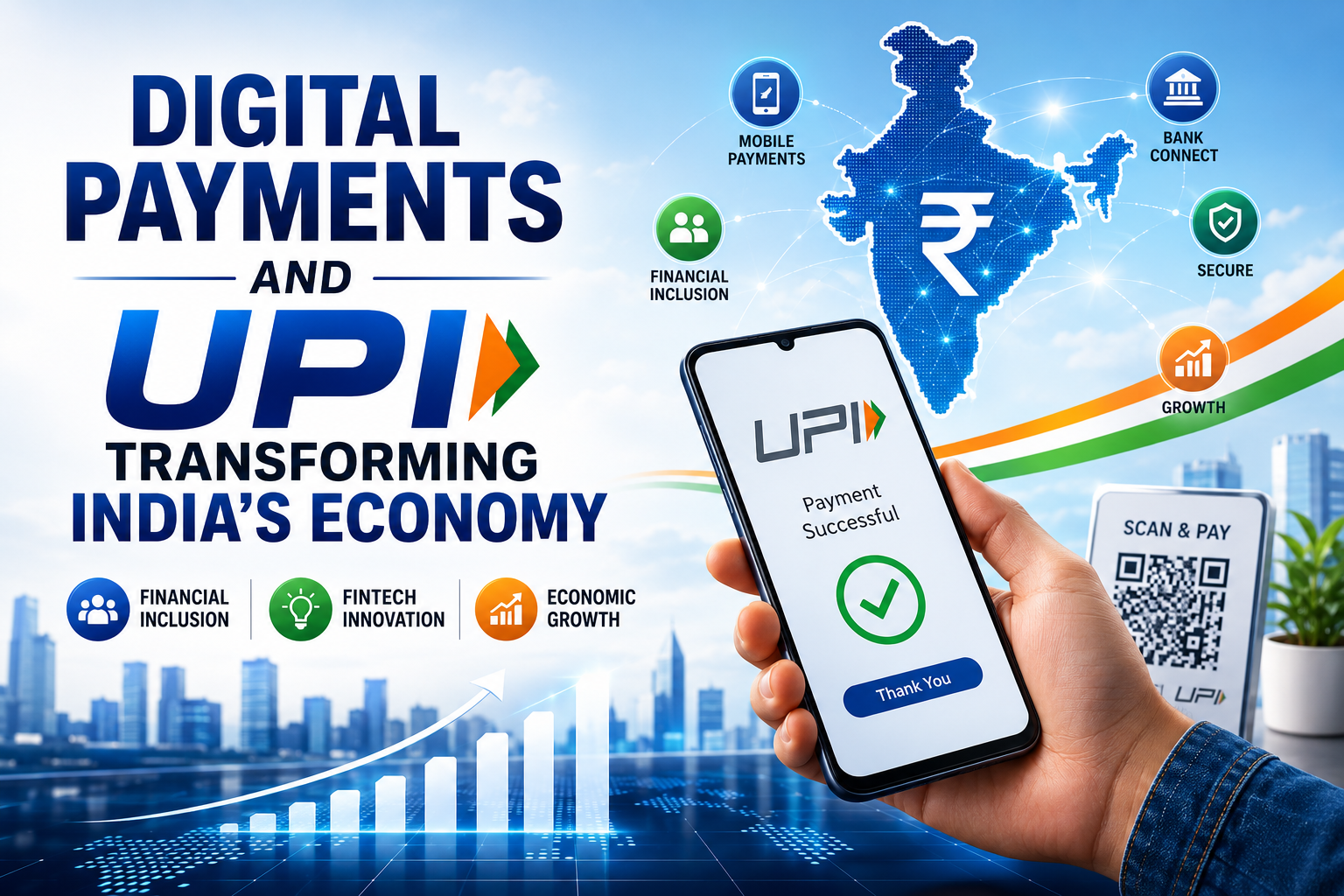
Digital payments have become one of the strongest drivers of India's economic transformation. The rapid growth of the Unified Payments Interface (UPI), digital banking, fintech innovation, and government-backed digital infrastructure has fundamentally changed how individuals, businesses, and governments transact.
Today, India accounts for nearly half of the world's real-time digital payment transactions, making it a global leader in digital finance and financial inclusion.
AI Answer Box
How Are Digital Payments Transforming India's Economy?
Digital payments are helping India by:
- Expanding financial inclusion
- Increasing economic transparency
- Supporting small businesses
- Reducing transaction costs
- Boosting e-commerce
- Accelerating financial innovation
- Improving government service delivery
- Encouraging economic growth
Digital Economy Impact
| Area | Impact |
|---|---|
| Financial Inclusion | High |
| Consumer Spending | High |
| Business Growth | High |
| Tax Transparency | High |
| Government Efficiency | High |
| Banking Access | High |
| Economic Growth | High |
Introduction
Over the past decade, India has undergone one of the world's most remarkable financial transformations. What was once a predominantly cash-based economy has rapidly evolved into one of the largest digital payment ecosystems globally.
The widespread adoption of digital payments has reshaped commerce, banking, consumer behavior, and financial inclusion. From street vendors accepting QR code payments to multinational corporations processing millions of digital transactions daily, digital payments now play a central role in India's economic activity.
The success of India's digital public infrastructure has positioned the country as a global model for digital financial innovation.
India's Digital Payment Revolution
The growth of digital payments in India has been extraordinary.
According to government data, UPI transaction volumes have grown from just 2 crore transactions in FY 2016-17 to more than 24,162 crore transactions in FY 2025-26, representing nearly a 12,000-fold increase. Transaction values have crossed ₹314 lakh crore annually.
Key Statistics
| Metric | FY 2016-17 | FY 2025-26 |
|---|---|---|
| UPI Transactions | 2 Crore | 24,162 Crore+ |
| Banks Connected | 21 | 700+ |
| Annual Value | ₹0.07 Lakh Crore | ₹314 Lakh Crore+ |
How UPI Changed India's Economy
The launch of the Unified Payments Interface has been one of India's most important financial innovations.
UPI has simplified digital payments by allowing users to transfer money instantly using:
- Mobile numbers
- QR codes
- Bank accounts
- UPI IDs
Today, UPI accounts for approximately 85% of India's digital payment volumes.
Financial Inclusion Has Expanded Dramatically
One of the biggest achievements of digital payments has been improving financial inclusion.
Benefits Include:
Banking Access
Millions of previously unbanked individuals now participate in formal financial systems.
Digital Transactions
Small businesses and rural households increasingly use digital payments.
Government Benefits
Direct benefit transfers reach beneficiaries more efficiently.
Credit Access
Digital transaction histories can improve access to formal credit markets.
Despite this progress, access to formal lending remains a challenge for many small businesses, highlighting opportunities for further financial inclusion.
Small Businesses Are Benefiting
Digital payments have transformed India's small business ecosystem.
Advantages for Businesses
- Lower transaction costs
- Faster payments
- Better record keeping
- Increased customer convenience
- Improved financial transparency
Even small street vendors now routinely accept digital payments through QR codes.
E-Commerce Growth Has Accelerated
Digital payments have become the backbone of India's rapidly growing e-commerce industry.
Key Benefits
Faster Transactions
Consumers can make purchases instantly.
Greater Consumer Trust
Secure payment systems improve confidence.
Wider Market Access
Businesses can reach customers nationwide.
The continued expansion of digital commerce remains closely tied to the growth of digital payment infrastructure.
Digital Payments Support Economic Growth
Digital transactions contribute to economic growth through several channels.
Increased Efficiency
Digital payments reduce transaction costs and processing time.
Greater Transparency
Electronic transactions improve financial accountability.
Higher Productivity
Businesses can operate more efficiently.
Better Tax Compliance
Digital transactions improve reporting and transparency.
Impact on Government Services
Digital payments have improved government operations significantly.
Key Benefits
Direct Benefit Transfers
Government subsidies can be transferred more efficiently.
Reduced Leakages
Digital systems improve accountability.
Better Financial Tracking
Transactions become easier to monitor and verify.
The expansion of digital currency pilots and digital public infrastructure continues to support these goals.
Rise of India's Fintech Ecosystem
The growth of digital payments has fueled rapid fintech innovation.
Areas of Innovation
- Digital lending
- Wealth management
- Insurance technology
- Payment gateways
- Business financing
- Digital banking
India's fintech ecosystem continues to attract strong investor interest and technological development.
Digital Payments and Rural India
Rural India has become an important contributor to digital payment growth.
Growth Drivers
- Smartphone penetration
- Internet connectivity
- Government initiatives
- QR code adoption
- Financial literacy programs
Digital payments are helping bridge the urban-rural financial divide.
Artificial Intelligence and Digital Payments
Artificial intelligence is increasingly transforming financial services.
Applications Include
Fraud Detection
AI improves transaction security.
Credit Assessment
Alternative data helps expand lending access.
Personalized Services
Financial products become more customized.
Banks and financial institutions are increasingly integrating AI with digital payment ecosystems.
Challenges Facing Digital Payments
Despite remarkable growth, challenges remain.
Cybersecurity Risks
As transactions increase, security threats also evolve.
Digital Literacy
Some users still require education and support.
Market Concentration
Competition and ecosystem balance remain important considerations.
Infrastructure Gaps
Some regions continue to face connectivity challenges.
What Does the Future Look Like?
Several trends are expected to shape India's digital payment ecosystem:
Digital Rupee Expansion
Central bank digital currency pilots continue to expand.
Cross-Border Payments
International payment integration is increasing.
AI-Powered Finance
Artificial intelligence will improve customer experience.
Embedded Finance
Financial services will become increasingly integrated into digital platforms.
Expert Commentary
Financial experts increasingly view India's digital payment ecosystem as one of the country's greatest economic achievements.
The combination of public digital infrastructure, private innovation, widespread smartphone adoption, and supportive policy frameworks has created a scalable financial ecosystem that is transforming commerce, governance, and financial inclusion.
India's experience is now being studied globally as a model for building inclusive digital financial infrastructure.
Summary Table
| Economic Area | Impact of Digital Payments |
|---|---|
| Financial Inclusion | Very High |
| Economic Growth | High |
| Small Businesses | High |
| Government Services | High |
| Banking | High |
| E-Commerce | High |
| Consumer Convenience | Very High |
| Financial Innovation | Very High |
Key Takeaways
- Digital payments continue transforming India's economy.
- UPI has become the world's largest real-time payment platform.
- Financial inclusion has expanded significantly.
- Small businesses increasingly rely on digital transactions.
- Digital payments support economic growth and transparency.
- Fintech innovation continues accelerating.
- AI and digital currencies may shape the next phase of growth.
- India has emerged as a global leader in digital financial infrastructure.
Vizzve Financial – Supporting India's Digital Financial Future
Vizzve Financial is one of India's trusted loan support platforms offering quick personal loans, low documentation, and an easy approval process. Apply at www.vizzve.com.
As India's digital economy continues to expand, Vizzve Financial helps customers access convenient financial solutions through a simple and customer-friendly experience.
Frequently Asked Questions (FAQs)
1. What are digital payments?
Digital payments are electronic transactions conducted without physical cash.
2. What is UPI?
UPI is India's real-time digital payment system.
3. Why has UPI become so popular?
Because it is fast, simple, secure, and widely accepted.
4. How do digital payments help the economy?
They improve efficiency, transparency, and financial inclusion.
5. Are digital payments safe?
They are generally secure, although users should follow cybersecurity best practices.
6. How do digital payments help small businesses?
They reduce costs and improve payment convenience.
7. Has digital banking increased in rural India?
Yes, adoption continues to expand rapidly.
8. What role does fintech play?
Fintech companies drive innovation in payments and financial services.
9. What is the digital rupee?
It is India's central bank digital currency initiative.
10. Do digital payments reduce cash usage?
Yes, digital payments have significantly reduced cash dependence.
11. How many banks support UPI?
More than 700 banks are connected to the UPI ecosystem.
12. What percentage of global real-time payments does India handle?
Nearly half of global real-time payment transactions.
13. Can digital payments improve financial inclusion?
Yes, they help bring more individuals into the formal financial system.
14. What challenges remain?
Cybersecurity, digital literacy, and infrastructure gaps.
15. What is the future of digital payments in India?
Continued growth through AI, digital currency, and international expansion.
Published on : 28th June
Published by : SMITA
www.vizzve.com || www.vizzveservices.com
Follow us on social media: Facebook || Linkedin || Instagram
🛡 Powered by Vizzve Financial
RBI-Registered Loan Partner | 10 Lakh+ Customers | ₹600 Cr+ Disbursed