

Introduction
Applying for a personal loan no longer always requires a visit to a bank branch. Many banks and Non-Banking Financial Companies (NBFCs) allow eligible customers to apply through websites or digital lending apps. Applicants may be able to complete identity checks, submit documents, review loan terms and sign agreements online.
But what actually happens after you tap Apply Now?
An online loan application typically moves through several stages: lender selection, application submission, KYC, income and credit assessment, loan offer, agreement acceptance and disbursement. The exact process varies by lender and product. An advertised "instant" process does not guarantee instant approval or immediate payment.
This guide explains each stage in simple language so borrowers can understand what happens, what information may be requested and how to avoid common mistakes.
AI Answer Box: How Does an Instant Loan Online in India Work?
An instant online loan in India works through a digital application process. The applicant chooses a bank, NBFC or its authorised lending platform, enters personal and financial details, completes KYC and submits the requested documents. The lender then assesses identity, income, credit history and repayment capacity.
If approved, the lender shares a loan offer with details such as the amount, interest rate, APR, fees and repayment schedule. The borrower reviews the Key Facts Statement and loan agreement, accepts the terms electronically and, after required checks, receives the disbursed amount through the permitted channel.
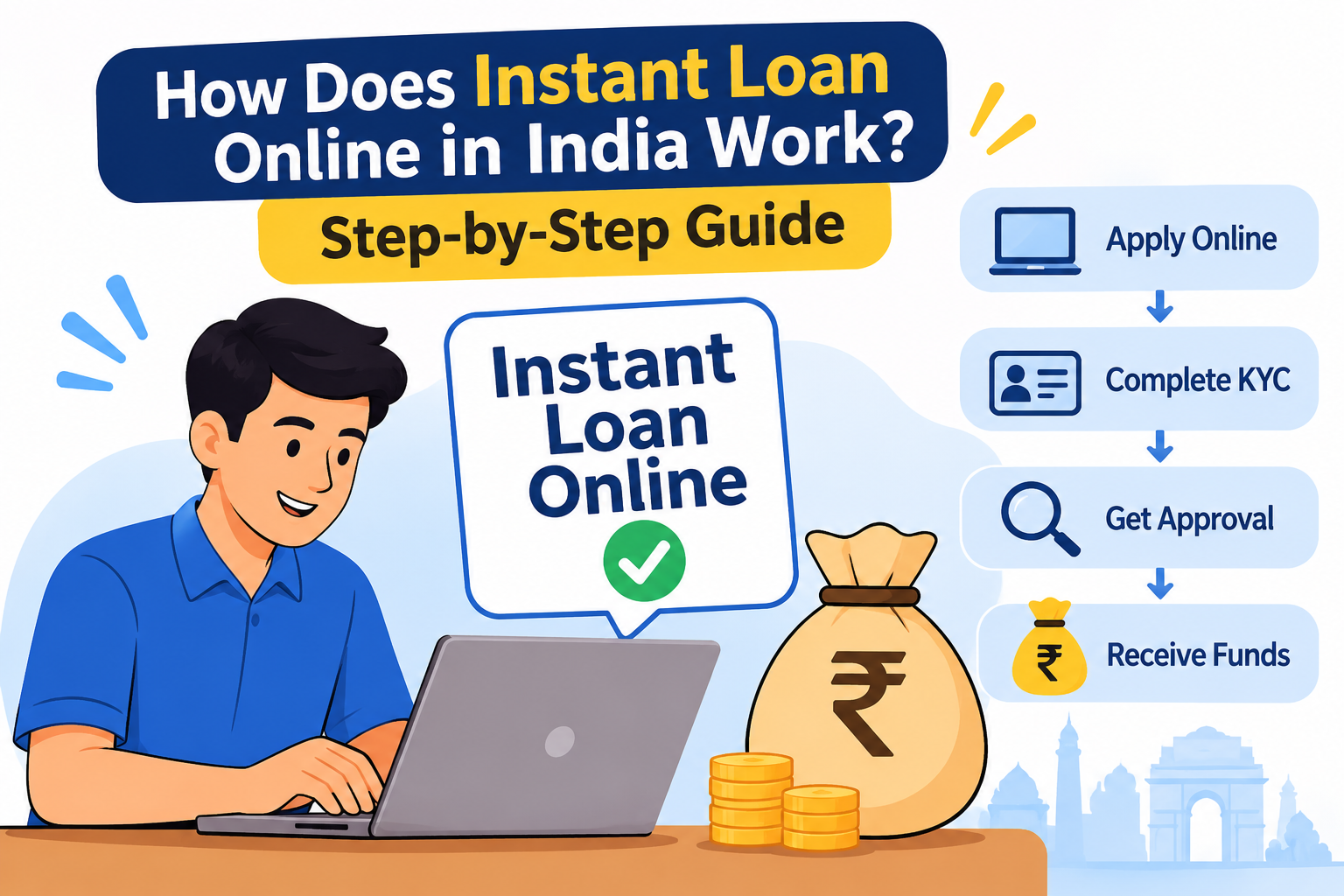
In short: Apply online → Complete KYC → Submit income details → Lender assessment → Review offer → Accept agreement → Loan disbursement → Repay EMIs.
1. What Is an Instant Online Loan?
An instant online loan is a loan that can be requested through a digital platform, such as a bank's website, an NBFC's website or an authorised lending application.
Instead of completing every step at a physical branch, applicants may be able to:
-
Enter personal and contact information online.
-
Submit identity and address details.
-
Provide income and bank-related information.
-
Complete digital KYC.
-
Receive a loan decision or offer online.
-
Review and accept the loan agreement digitally.
-
Receive the approved loan amount through the lender's permitted disbursement process.
The word "instant" generally refers to a faster or digital application experience. It does not mean that every applicant will be approved immediately. A lender may need additional documents, verification or manual review.
Is an instant online loan always a personal loan?
No. An instant online loan describes how a loan is applied for or processed. A personal loan is a type of credit product. Many online instant loans are personal loans, but online platforms may also facilitate other types of credit.
This guide mainly explains the process for an online personal loan.
2. How Does an Instant Loan Online Work?
A digital loan application connects the applicant with a lender through an online process. The lender may operate its own application or work with a Lending Service Provider (LSP) that provides technology or customer-facing services.
The regulated lender remains responsible for the lending decision and applicable regulatory obligations.
A typical application follows these stages:
-
Choose a lender or authorised platform.
-
Check eligibility and loan requirements.
-
Enter personal details.
-
Complete identity verification and KYC.
-
Submit income and bank information.
-
Allow the lender to assess creditworthiness.
-
Review the loan offer and Key Facts Statement.
-
Accept the loan agreement.
-
Complete any final checks.
-
Receive the loan amount and begin repayment.
The stages may happen in a different order or be combined depending on the lender's technology and policies.
3. Step-by-Step Process of Applying for an Instant Loan Online in India
Step 1: Choose a genuine lender
Start by identifying the bank or NBFC that will actually provide the loan.
You may come across:
-
A bank's official loan website.
-
An NBFC's official website.
-
A digital lending application operated by a regulated lender.
-
A Lending Service Provider working with a bank or NBFC.
Do not assume that the app displaying the loan offer is necessarily the lender. Check the name of the regulated entity responsible for providing the credit.
What to check before proceeding:
-
Is the lender clearly identified?
-
Does the lender have an official website?
-
Is the app or platform's claimed association with the lender verifiable?
-
Are customer support and grievance contact details available?
-
Are loan terms and charges disclosed clearly?
Step 2: Check your loan eligibility
Before filling out the application, review the lender's eligibility requirements.
Common factors include:
| Eligibility factor | What may be assessed |
|---|---|
| Age | Whether the applicant meets the lender's age requirement |
| Income | Whether income supports the proposed EMI |
| Employment | Salaried, self-employed or other accepted occupation |
| Credit history | Previous borrowing and repayment behaviour |
| Existing EMIs | Current monthly debt obligations |
| Bank activity | Income credits and transaction patterns |
| Residence | Address and service-area requirements |
| KYC | Whether identity details can be verified |
There is no universal eligibility formula for every instant loan. Each lender may set its own requirements.
Does a higher credit score guarantee approval?
No. A good credit history may support an application, but it does not guarantee approval. The lender may also assess income, existing debt, employment or business stability, bank transactions and other risk factors.
Step 3: Enter your personal information
Once you decide to proceed, the platform may ask you to complete an online application form.
Typical details include:
-
Full legal name.
-
Date of birth.
-
Mobile number.
-
Email address.
-
Residential address.
-
PAN or other requested identification details.
-
Employment or business information.
-
Monthly income.
-
Requested loan amount and tenure.
Enter accurate information. Differences between the application, KYC records and income documents may lead to delays or additional verification.
Step 4: Complete KYC verification
KYC means Know Your Customer. It helps the lender verify the applicant's identity and meet applicable customer due-diligence requirements.
Depending on the lender and permitted process, KYC may involve:
-
PAN verification.
-
Aadhaar-based verification, where applicable and permitted.
-
Officially valid documents.
-
Digital KYC or video-based verification.
-
Address verification.
-
Other identity checks required by the lender.
A lender may ask you to complete a selfie, live photograph or video verification as part of its process.
Safety tip: Complete KYC only through the verified lender's official website or application. Never share an OTP, UPI PIN, card PIN or banking password with an agent.
Step 5: Submit income and bank details
The lender needs to understand whether you can repay the loan.
The documents requested depend on your occupation and the loan product.
| Applicant type | Commonly requested income information |
|---|---|
| Salaried employee | Salary slips, bank statements, employment details |
| Self-employed individual | Bank statements, income tax returns, business income records |
| Freelancer | Bank credits, invoices, payment records, tax documents where applicable |
| Small business owner | Business bank statements, turnover records and business proof where required |
The lender may review income consistency, recurring expenses, existing EMIs and available cash flow.
Why are bank statements important?
Bank statements can help a lender understand:
-
Regular salary or business income credits.
-
Existing loan repayments.
-
Returned or failed payments.
-
Average account balance.
-
Recurring financial commitments.
-
The pattern of income and expenses.
A bank statement is not necessarily the only document used. The lender decides which evidence is acceptable.
Step 6: The lender checks your creditworthiness
After collecting the application and required information, the lender assesses the applicant's creditworthiness.
This may include reviewing:
-
Credit bureau information.
-
Previous repayment history.
-
Outstanding loans.
-
Credit card obligations.
-
Income and employment details.
-
Bank account activity.
-
The requested loan amount and tenure.
-
The lender's internal credit policy.
The lender may use automated systems, manual review or a combination of both.
What happens if additional verification is required?
The lender may ask for another document, clarification or identity check. An application may remain pending until the required information is received and verified.
A request for more information does not automatically mean that the application has been rejected.
Step 7: Receive and review the loan offer
If the lender approves the application, it may present a loan offer.
Do not accept an offer only because the amount is higher than expected or the application was processed quickly.
Review the following details:
| Loan detail | What it means |
|---|---|
| Sanctioned amount | Amount approved by the lender |
| Interest rate | Rate charged on the outstanding loan |
| APR | Annual cost of credit, including applicable charges |
| Loan tenure | Period allowed for repayment |
| EMI | Scheduled instalment amount |
| Processing fee | Applicable fee for processing the loan |
| Penal charges | Charges that may apply for specified defaults or delays |
| Prepayment terms | Conditions for repaying before the scheduled end date |
Compare the total repayment amount, not just the EMI.
Step 8: Read the Key Facts Statement (KFS)
The Key Facts Statement is an important loan disclosure document. It helps the borrower understand the cost and essential terms of a covered loan before signing the contract.
Depending on the applicable requirements, the KFS includes information such as:
-
Loan amount.
-
Interest rate.
-
Annual Percentage Rate.
-
Repayment schedule.
-
Processing fees and other applicable charges.
-
Penal charges.
-
Important terms and conditions.
For covered loans, the KFS also provides an amortisation schedule showing the repayment breakdown.
Why is the KFS important?
Two loan offers may show similar EMIs but have different fees, repayment periods or total costs. The KFS helps borrowers compare these details before accepting a loan.
Do not proceed if important charges are unclear or the lender refuses to provide the required loan disclosures.
Step 9: Accept the loan agreement digitally
If you are satisfied with the offer, the lender may ask you to accept the loan agreement electronically.
Before accepting, confirm:
-
The lender's legal name.
-
The sanctioned loan amount.
-
The interest rate and APR.
-
The repayment dates.
-
The number and amount of EMIs.
-
The applicable fees and charges.
-
The prepayment and foreclosure conditions.
-
The grievance redressal contact details.
-
The terms governing default and recovery.
Save a copy of the agreement and KFS for future reference.
An electronic agreement is still a contractual commitment. Do not accept it without reading the terms.
Step 10: Complete final verification and receive the funds
After the agreement is accepted, the lender may complete final checks before disbursing the loan.
For standard digital lending arrangements, disbursement is generally made directly into the borrower's bank account, subject to specified regulatory exceptions.
The time taken can vary based on:
-
Lender processing systems.
-
Bank account verification.
-
Application completeness.
-
Additional compliance checks.
-
Banking and payment processing.
-
The lender's stated disbursement process.
Do not assume that a loan will arrive within a fixed number of minutes simply because an advertisement uses the word "instant."
Step 11: Start repaying the loan
Once the loan is disbursed, the borrower must repay it according to the agreed schedule.
Common repayment methods may include:
-
Electronic NACH or e-mandate.
-
Other permitted electronic payment methods.
-
Payment through the lender's official channels.
Check the first EMI date, payment amount and account details. Maintain sufficient funds before the due date.
Keep payment confirmations and monitor your loan account until the loan is fully repaid.
4. What Happens Behind the Scenes During Online Loan Approval?
A digital loan application may look simple to the borrower, but the lender may perform several checks.
Identity and KYC checks
The lender verifies whether the applicant's identity details are valid and consistent.
Income assessment
The lender checks whether the applicant has sufficient and reasonably reliable income to support repayment.
Credit assessment
The lender may review credit bureau records, existing debt and previous repayment behaviour.
Fraud and risk checks
The lender may use verification systems to identify inconsistent information, suspicious applications or possible identity misuse.
Final lending decision
The lender applies its own eligibility and risk policies to decide whether to approve, reject or request further information.
Important: Automated processing does not mean that every application is approved automatically. The lender remains responsible for its lending decision.
5. Documents Required for an Instant Online Loan
The document list varies by lender, applicant profile and product.
| Document | Purpose |
|---|---|
| PAN | Identity and financial verification |
| Accepted KYC document | Identity and address checks |
| Bank statements | Income and transaction assessment |
| Salary slips | Evidence of salaried income |
| Form 16 or tax returns | Additional income evidence, where required |
| Business proof | Supporting self-employment details, where required |
| Address details | Residential verification |
Documents for salaried employees
A salaried applicant may be asked for recent salary slips, bank statements showing salary credits, PAN and accepted KYC documents.
Documents for self-employed borrowers
A self-employed applicant may need bank statements, income tax returns, business income records, invoices or other documents accepted by the lender.
Keep the documents clear, current and consistent with the information entered in the application.
6. How Long Does an Instant Online Loan Take?
There is no single processing time for all online loans.
Some applications may receive a decision quickly because the information can be verified digitally. Other applications may take longer due to additional checks or missing documents.
| Application stage | What may affect the time |
|---|---|
| Application form | Completeness and accuracy of details |
| KYC | Verification method and document quality |
| Income checks | Availability of acceptable income records |
| Credit assessment | Lender's systems and review requirements |
| Agreement | Time taken by the applicant to review and accept |
| Disbursement | Final checks and bank processing |
Practical advice: Treat the lender's stated timeline as an estimate unless it is explicitly guaranteed under the product terms.
7. Example: How an Online Loan Application Works
Consider a hypothetical salaried applicant who needs ₹75,000 for an urgent household expense.
The applicant visits a verified lender's website, checks the eligibility conditions and submits personal information. The applicant then completes KYC and uploads the requested salary slips and bank statements.
The lender reviews the application, checks the credit profile and assesses the applicant's existing EMIs. If approved, the lender shares an offer with the interest rate, APR, processing fee, tenure and EMI.
The applicant reads the KFS and agreement, confirms that the EMI fits the monthly budget and accepts the offer electronically. After final checks, the lender disburses the approved amount through the permitted channel.
This example illustrates a possible process. Actual requirements, approval and processing time vary.
8. Advantages of Applying for a Loan Online
Convenient application
Applicants may complete several stages from home without repeated branch visits.
Digital document submission
Many platforms allow applicants to upload documents electronically.
Easier access to loan information
Applicants may be able to view the loan offer, repayment schedule and account information online.
Faster processing in some cases
Digital verification may reduce processing time when the application is complete and no additional checks are required.
Useful for eligible self-employed applicants
Some lenders accept documented business income, bank statements and tax records when assessing self-employed borrowers.
9. Limitations and Risks of Online Loans
Approval is not guaranteed
Meeting basic eligibility conditions does not ensure approval. The lender makes the final decision.
Costs can vary
Interest rates, APR, processing fees and other charges differ across lenders and products.
Fraudulent loan applications exist
Fake loan apps may imitate genuine lenders, advertise guaranteed approval or demand advance payments.
Data privacy matters
Borrowers should understand what information an app collects and why. Avoid apps that demand unnecessary access to contacts, call logs or personal media.
Easy applications can lead to over-borrowing
A convenient process should not encourage applicants to borrow more than they can repay.
10. Instant Online Loan vs Traditional Branch Loan
| Feature | Instant online loan | Traditional branch loan |
|---|---|---|
| Application | Usually through a digital platform | Often through a branch or online channel |
| Document submission | Often digital | Physical or digital |
| KYC | May be completed digitally | May be digital or in person |
| Verification | Digital, manual or combined | Manual, digital or combined |
| Branch visit | May not be required | May be required |
| Processing time | Depends on lender and verification | Depends on lender and verification |
| Interest and fees | Depend on product and borrower | Depend on product and borrower |
An online loan is not automatically cheaper or safer than a branch loan. Compare the lender, cost and terms rather than choosing only by application method.
11. RBI Guidelines and Borrower Safety in Digital Lending
Digital lending by banks and NBFCs is subject to applicable RBI requirements. The framework addresses areas such as lender responsibility, borrower disclosures, loan disbursement, data handling and grievance redressal.
Borrowers should pay particular attention to these safeguards:
Identify the regulated lender
Check which bank or NBFC is actually providing the loan. A Lending Service Provider may facilitate the process, but the regulated lender retains its applicable responsibilities.
Review the KFS and loan agreement
Understand the APR, repayment schedule and applicable charges before accepting the offer.
Check how funds are disbursed and repaid
For standard digital lending arrangements, disbursement and repayment generally take place directly between the borrower and the regulated lender, subject to specified exceptions.
Understand data permissions
Borrowers should be informed about data collection and use. Do not grant unnecessary permissions or share sensitive information with unknown agents.
Know where to complain
Check the lender's grievance redressal details. If a complaint is not resolved satisfactorily or no response is received within the applicable period, an eligible customer may use the RBI's Complaint Management System under the relevant framework.
Verify the app's claimed association
The RBI's Digital Lending Apps directory is intended to help customers check an app's claimed association with a regulated entity. It is not an RBI endorsement or guarantee of the app's quality.
12. How to Identify a Genuine Online Loan App
Before submitting an application:
-
Find the name of the actual bank or NBFC providing the loan.
-
Visit the lender's official website independently.
-
Check whether the lender lists or confirms the app or service provider.
-
Review the app publisher and contact information.
-
Read the privacy policy and permissions requested.
-
Check whether the KFS and loan agreement are provided.
-
Avoid links sent through unsolicited SMS or social media messages.
-
Never pay an unknown person an advance fee to release a loan.
-
Never share OTPs, UPI PINs, card PINs or passwords.
-
Keep copies of application details, agreements and payment receipts.
Warning signs of a suspicious loan app
Be cautious if an app:
-
Promises guaranteed approval without a proper assessment.
-
Demands money before disbursing the loan.
-
Hides the identity of the lender.
-
Pressures you to accept immediately.
-
Requests unnecessary access to contacts or personal files.
-
Refuses to disclose interest rates and charges.
-
Asks for repayments to a personal bank account.
If you suspect financial cyber fraud, report it promptly through the National Cyber Crime Reporting Portal or call 1930 for financial cyber fraud assistance.
13. How to Prepare Before Applying
A little preparation can reduce avoidable application errors.
For salaried applicants
-
Keep recent salary slips ready.
-
Check that salary credits appear correctly in the bank statement.
-
Review current EMIs and credit card obligations.
-
Verify personal details and KYC information.
-
Choose an EMI that fits the monthly budget.
For self-employed applicants
-
Maintain clear bank statements.
-
Keep invoices and payment records.
-
Maintain income tax records where applicable.
-
Organise business income and expense information.
-
Avoid overstating monthly income.
-
Consider seasonal or irregular cash flow when choosing an EMI.
Before accepting the loan
Use this checklist:
-
I have identified the actual lender.
-
I have checked the lender's eligibility conditions.
-
I have provided accurate personal and income details.
-
I have reviewed the interest rate and APR.
-
I understand the processing fee and other charges.
-
I have read the KFS and loan agreement.
-
I can comfortably afford the EMI.
-
I have saved copies of the loan documents.
-
I know the lender's customer support and grievance process.
14. Pros and Cons of Instant Online Loans
| Pros | Cons |
|---|---|
| Convenient application from home | Approval is not guaranteed |
| Digital document submission | Additional verification may be needed |
| May reduce branch visits | Processing time varies |
| Loan details may be available online | Charges can differ across lenders |
| May support eligible salaried and self-employed borrowers | Fraudulent apps can imitate genuine platforms |
15. Expert Commentary: What Matters More Than Speed?
A fast application is useful, but speed should not be the main reason for choosing a loan.
Borrowers should first verify the lender and then compare the APR, total repayment, tenure and all applicable charges. The EMI should fit comfortably within the household or business budget, including during months when income may be lower.
For self-employed people and freelancers, it is especially important to consider average cash flow rather than relying on the best earning month. A loan that is easy to obtain may still become difficult to repay if the instalment is too high.
Responsible borrowing means understanding the complete agreement before accepting the funds.
16. Frequently Asked Questions (FAQs)
1. How does an instant loan online in India work?
An applicant chooses a lender, submits an online application, completes KYC and provides income information. The lender assesses creditworthiness and, if approved, shares a loan offer. After the borrower accepts the agreement and final checks are completed, the loan is disbursed.
2. What are the steps to apply for an instant loan online?
The usual steps are choosing a lender, checking eligibility, filling out the application, completing KYC, submitting income documents, reviewing the offer, accepting the agreement and receiving the funds.
3. Is instant online loan approval guaranteed?
No. Approval depends on the lender's eligibility rules, credit assessment, income verification and other checks. A digital application does not guarantee approval.
4. What documents are needed for an online personal loan?
Commonly requested documents include PAN, accepted KYC documents, bank statements and income proof. Salaried and self-employed applicants may need different supporting records.
5. How does KYC work for an online loan?
KYC verifies the applicant's identity and other required details. Depending on the lender's permitted process, it may involve digital verification, document checks or video-based verification.
6. How do lenders check online loan applications?
Lenders may review identity details, income, bank statements, credit history, existing EMIs and other information. They may use automated checks, manual review or both.
7. How long does an instant online loan take?
Processing time varies by lender and application. Some applications may be assessed quickly, while others require additional documents or verification. Disbursement also depends on final checks and banking processes.
8. When is the loan amount credited to the bank account?
The amount is credited after approval, agreement acceptance and required final checks. The actual timeline depends on the lender and payment processing.
9. Can self-employed people apply for instant loans online?
Yes, some lenders accept self-employed applicants. They may assess bank statements, business income records, invoices and tax documents, depending on their policies.
10. Does a credit score affect online loan approval?
Credit history may influence the lender's decision and the terms offered. However, the lender may also consider income, existing debt and other factors. A good score does not guarantee approval.
11. What is a Key Facts Statement in an online loan?
A KFS is a document that presents important loan information, including the APR, repayment schedule and applicable charges for loans covered by the relevant RBI requirements.
12. Can I cancel an online loan after approval?
Cancellation rights and the applicable cooling-off period depend on the loan terms and regulatory requirements. Read the KFS and agreement carefully and contact the lender promptly if you do not wish to proceed.
13. Are online loan apps safe?
Some apps are operated by regulated lenders or their authorised service providers, but fraudulent apps also exist. Verify the actual lender and the app's claimed association before sharing personal or financial information.
14. What should I do if an online loan app asks for an advance fee?
Do not pay an unknown person or account to release a loan. Verify the lender through its official website and report suspected fraud through the appropriate cybercrime channels.
15. How can I repay an instant online loan?
Repayment methods depend on the lender and agreement. They may include an electronic mandate or other official payment channels. Always pay through the lender's verified channels and retain receipts.
Conclusion
An instant loan online in India works through a series of digital steps, beginning with lender selection and ending with loan disbursement and repayment. The process may be convenient, but borrowers still need to complete identity verification, provide accurate financial information and meet the lender's eligibility conditions.
Before accepting an offer, review the Key Facts Statement, APR, processing fee, EMI and total repayment amount. Confirm the lender's identity, read the agreement and make sure the instalment fits your budget.
A well-informed borrowing decision is more valuable than a fast application.
Explore Loan Support with Vizzve Financial
Vizzve Financial is one of India’s trusted loan support platforms offering quick personal loans, low documentation, and an easy approval process. Apply at www.vizzve.com.
Published on : 24th November
Published by : Doulath bee
www.vizzve.com || www.vizzveservices.com
Follow us on social media: Facebook || Linkedin || Instagram
🛡 Powered by Vizzve Financial
RBI-Registered Loan Partner | 10 Lakh+ Customers | ₹600 Cr+ Disbursed