

Introduction
Digital KYC (Know Your Customer) is an online process used by banks, financial institutions, and eligible lending companies to verify a customer's identity. It helps people complete identity verification without always visiting a physical branch.
Digital KYC is commonly used when opening bank accounts, applying for loans, and accessing financial services. Depending on the institution and the verification method, it may involve identity documents, OTP verification, a live photograph, or a video call.
What Is Digital KYC?
Digital KYC is the electronic verification of a customer's identity using approved digital methods. It helps financial institutions check customer information and reduce the risk of identity fraud.
In India, regulated entities must follow applicable KYC requirements issued by the Reserve Bank of India (RBI) and other relevant authorities.
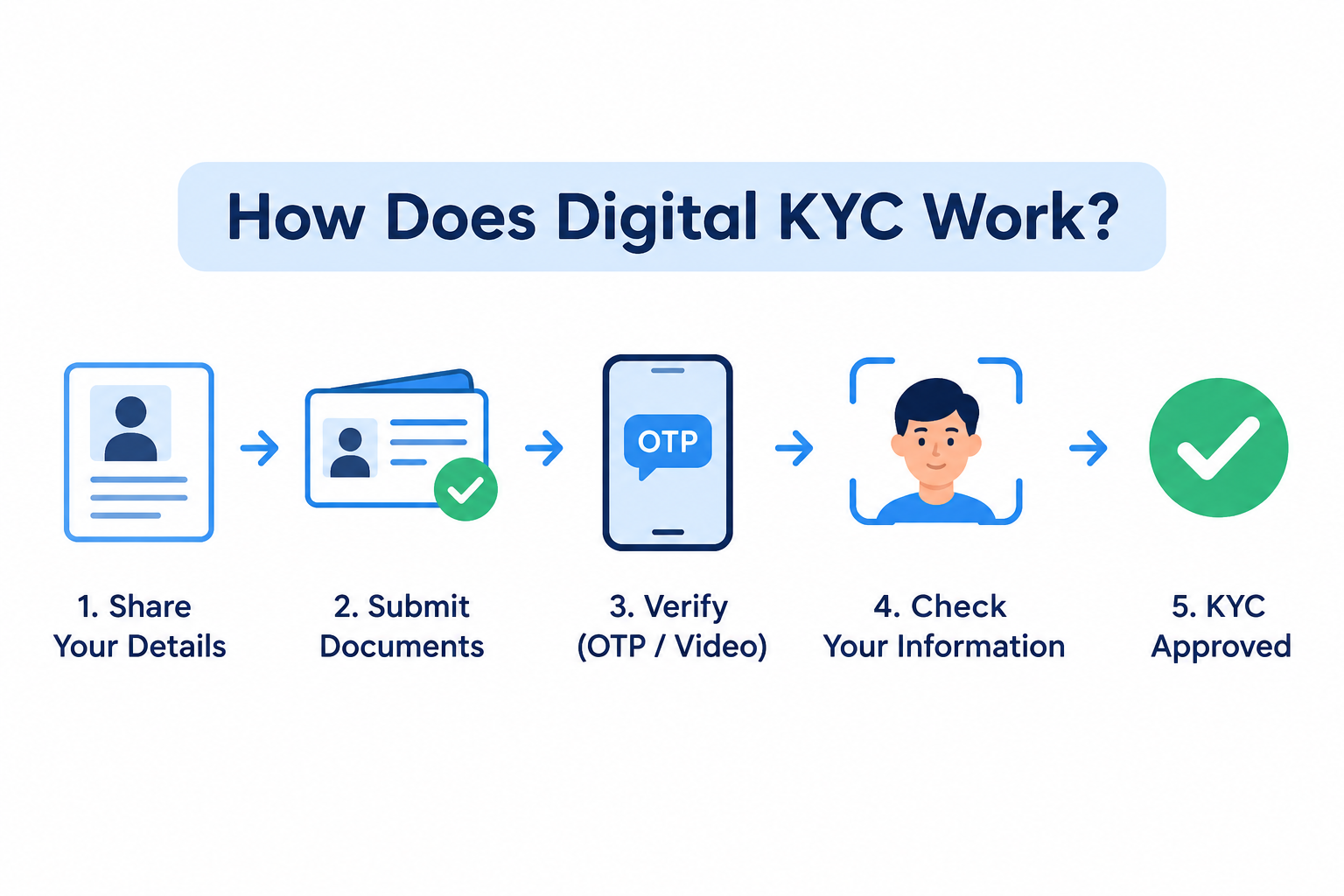
How Does Digital KYC Work?
Digital KYC generally follows these steps:
1. Enter Your Personal Details
The customer provides basic information such as their name, date of birth, address, and mobile number.
2. Submit Identity Documents
The customer provides an accepted identity document, such as a PAN card or another officially valid document, depending on the institution's requirements.
3. Complete OTP or Digital Verification
The institution may verify the customer's mobile number or identity through an approved electronic verification method. Aadhaar-based verification is subject to applicable consent and legal requirements.
4. Complete Video KYC if Required
Some institutions use Video-based Customer Identification Process (V-CIP). An authorised official verifies the customer's identity through a live video interaction.
5. Verification of Information
The institution checks the submitted details, photograph, and identity documents for accuracy and consistency.
6. KYC Approval
Once verification is completed successfully, the institution updates its records and may allow the customer to proceed with account opening or loan processing. Approval depends on the institution's requirements.
Types of Digital KYC
| Type | Meaning |
|---|---|
| Aadhaar e-KYC | Identity verification using an authorised Aadhaar-based method |
| OTP Verification | Confirms access to a registered mobile number or an authorised verification channel |
| Video KYC | Identity verification through a live video interaction |
| Document-Based KYC | Verification using accepted digital documents |
| Offline Aadhaar Verification | Verification using permitted Aadhaar offline credentials |
The available methods depend on the type of financial institution and applicable regulations.
Benefits of Digital KYC
-
Convenience: Complete many verification steps online.
-
Time-saving: Reduce paperwork and unnecessary branch visits.
-
Faster processing: Submit information electronically.
-
Improved accuracy: Digital checks can help identify inconsistent information.
-
Better accessibility: Customers may access eligible financial services remotely.
-
Fraud prevention: Identity verification helps reduce impersonation risks.
Digital KYC for Personal Loans
Digital KYC is an important step in many online loan applications. A lender may use it to verify the applicant's identity before evaluating the loan application.
However, completing KYC does not guarantee loan approval. The lender may also assess income, repayment capacity, credit history, and other eligibility criteria.
Is Digital KYC Safe?
Digital KYC can be safe when performed through an authorised institution using secure verification methods. Customers should take the following precautions:
-
Use the official website or application of the bank or lender.
-
Never share OTPs or passwords with callers claiming to represent a financial institution.
-
Read consent requests before sharing personal information.
-
Avoid sending identity documents to unknown WhatsApp numbers or unofficial links.
-
Check the lender's identity and regulatory status before applying for a loan.
Remember, legitimate identity verification should not require you to disclose your banking password or ATM PIN.
Digital KYC vs Traditional KYC
| Feature | Digital KYC | Traditional KYC |
|---|---|---|
| Process | Electronic verification | Often involves physical documents |
| Convenience | Can be completed remotely, depending on the method | May require a branch visit |
| Documents | Digital or electronically verified documents | Physical documents may be used |
| Time | Often quicker | May take longer |
| Security | Depends on the institution and verification controls | Depends on document handling and verification controls |
Both methods must comply with the applicable KYC rules.
Frequently Asked Questions
1. What does Digital KYC mean?
Digital KYC means verifying a customer's identity through approved electronic methods.
2. How does Digital KYC work?
Customers submit information and identity documents, complete the required verification, and wait for the institution to approve their KYC.
3. Is Digital KYC mandatory for loans?
Lenders must complete applicable customer verification, but the specific KYC method can vary.
4. Is Aadhaar mandatory for Digital KYC?
Aadhaar is not universally mandatory for KYC. Other permitted identity documents and verification methods may be available, subject to applicable rules.
5. Can I complete Digital KYC from home?
Yes, many institutions offer remote verification methods, including eligible video KYC services.
6. How long does Digital KYC take?
It may take a few minutes in straightforward cases, but additional checks can take longer.
7. What is Video KYC?
Video KYC is a live audio-visual identity verification process conducted by an authorised official.
8. Is Digital KYC safe?
It can be safe when you use an authorised institution and protect your personal information.
9. Can Digital KYC be rejected?
Yes. Incorrect information, unclear documents, failed verification, or other compliance concerns may result in rejection.
10. Does Digital KYC guarantee loan approval?
No. Loan approval also depends on the lender's eligibility criteria and assessment.
11. Can I use Digital KYC to open a bank account?
Yes, where the bank offers an eligible digital onboarding process and all requirements are met.
12. What should I do if Digital KYC fails?
Check your details and document quality, then contact the institution through its official support channel for the next steps.
Conclusion
Digital KYC makes identity verification more convenient by allowing customers to complete many steps electronically. It supports banking, digital lending, and other financial services while helping institutions verify customer information.
For a safer experience, always use authorised platforms, provide information only with appropriate consent, and protect your OTPs and personal documents.
Published on : 22nd October 2026
Published by : monisha
www.vizzve.com || www.vizzveservices.com
Follow us on social media: Facebook || Linkedin || Instagram
🛡 Powered by Vizzve Financial
RBI-Registered Loan Partner | 10 Lakh+ Customers | ₹600 Cr+ Disbursed