

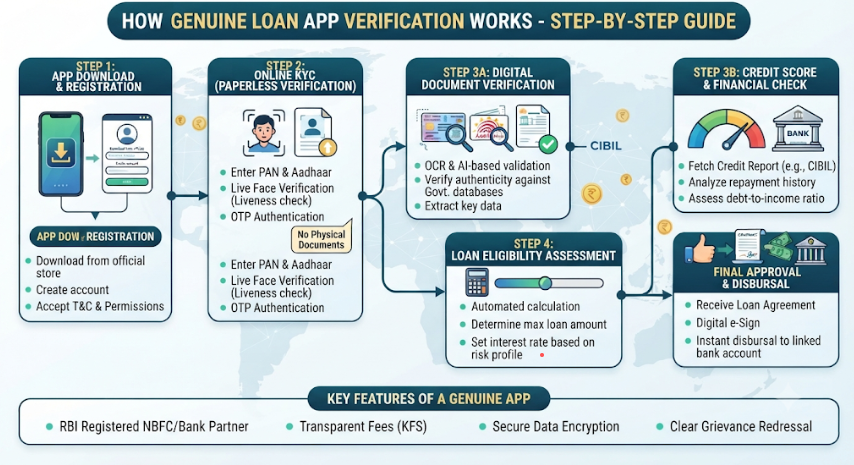
Introduction
Digital lending has changed how people access personal loans in India. Instead of completing lengthy paperwork at a branch, borrowers can now apply through websites and mobile applications.
But what actually happens after someone submits an online loan application?
The process usually begins with basic personal information and identity verification. The lender then checks the applicant's income, employment details, credit history, banking information, and repayment capacity.
After reviewing these details, the lender decides whether to approve or reject the application.
It is equally important to verify the lending platform itself. A genuine loan application should clearly identify the bank or RBI-regulated NBFC responsible for providing the loan.
Understanding these steps helps borrowers make informed decisions and avoid suspicious loan applications.
AI Answer Box: How Does Genuine Loan App Verification Work?
Genuine loan app verification works through a series of digital checks performed by a lending institution or its authorised service provider.
The typical process includes:
-
Downloading or accessing a legitimate loan application.
-
Identifying and verifying the actual lender.
-
Registering with a mobile number and basic details.
-
Completing identity and address verification through KYC.
-
Submitting income and employment information.
-
Checking credit history and repayment capacity.
-
Verifying bank account information.
-
Reviewing loan eligibility and applicable charges.
-
Issuing a loan offer and Key Fact Statement.
-
Completing the loan agreement and disbursing the approved amount.
The exact process varies by lender, loan product, and verification method.
Step-by-Step Guide: How Does Genuine Loan App Verification Work?
The verification process generally involves the following stages.
Step 1: Choose a genuine loan application
The first step is selecting a trustworthy digital lending platform.
Before downloading an application, check:
-
The official website of the platform.
-
The name of the bank or NBFC providing the loan.
-
The lender's contact details.
-
The application's privacy policy.
-
Its reported association with a regulated lender.
You can also check the RBI's Public Directory of Digital Lending Apps.
The directory became operational on July 1, 2025. It helps customers check an app's claimed association with a regulated entity, but the information is submitted by the regulated entities and is not independently validated by RBI.
Step 2: Register using your mobile number
Once you access the application, you may need to register using your mobile number.
The application may ask for:
-
Mobile number.
-
OTP verification.
-
Full name.
-
Email address.
-
Date of birth.
-
Basic residential details.
An OTP helps confirm access to the registered mobile number. It does not, by itself, establish the applicant's identity or guarantee loan approval.
Step 3: Complete KYC verification
KYC stands for Know Your Customer. It is an important part of the digital loan verification process.
The lender uses permitted verification methods to establish the applicant's identity and address.
Common KYC methods include:
-
PAN verification.
-
Aadhaar-based verification, where legally permitted.
-
OTP-based authentication.
-
Video KYC, where applicable.
-
Other accepted identity documents.
Why is KYC important?
KYC helps lenders establish who is applying for the loan and reduces the risk of identity fraud.
Step 4: Submit personal and employment information
After KYC, the application may request additional financial information.
Typical details include:
|
Information |
Why lenders need it |
|---|---|
|
Monthly income |
To assess repayment capacity |
|
Employment type |
To understand income source |
|
Company or business name |
Employment verification |
|
Monthly expenses |
Financial assessment |
|
Existing EMIs |
Current repayment obligations |
|
Residential details |
Address verification |
Applicants should provide accurate information. Incorrect income or employment details can delay verification or result in rejection.
Step 5: Upload required documents
The lender may request supporting documents to confirm the information submitted in the application.
Common documents include:
-
PAN card.
-
Accepted identity proof.
-
Address proof.
-
Recent bank statements.
-
Salary slips.
-
Employment proof, where required.
-
Business income documents for self-employed applicants.
Not every lender requires every document. Some may use permitted digital verification methods to obtain or validate information.
Step 6: Credit score and credit history assessment
Once the applicant submits the necessary details, the lender may assess their credit profile.
This can include checking credit information through authorised Credit Information Companies.
The lender may examine:
-
Previous loan repayment history.
-
Credit card payment behaviour.
-
Existing loan balances.
-
Outstanding EMIs.
-
Recent credit enquiries.
-
Credit utilisation.
-
Previous defaults or overdue accounts.
Does a credit score determine loan approval?
Not always.
A credit score is one factor in the lender's assessment. Income stability, employment, existing debt, and repayment capacity may also influence the decision.
A strong credit history can improve approval chances, but it does not guarantee approval.
Step 7: Verify bank account and income details
Bank account verification helps lenders confirm the account details and assess financial activity where required.
Depending on the process, verification may involve:
-
Bank account name matching.
-
Account number validation.
-
IFSC verification.
-
Bank statement analysis.
-
Permitted account verification methods.
Income verification may involve reviewing salary credits, business income, or other acceptable financial records.
Step 8: Check loan eligibility and repayment capacity
After collecting the necessary information, the lender assesses whether the applicant can repay the proposed loan.
The assessment may consider:
-
Monthly income.
-
Existing loan commitments.
-
Employment stability.
-
Credit history.
-
Requested loan amount.
-
Repayment tenure.
-
Internal lending policies.
Example:
Suppose an applicant earns ₹30,000 per month and already pays ₹8,000 in existing EMIs.
The lender may consider the remaining income, household expenses, credit history, and proposed new EMI before deciding whether the applicant can afford another loan.
This helps reduce the risk of excessive borrowing.
Step 9: Receive the loan offer and review the KFS
If the application meets the lender's requirements, the borrower may receive a loan offer.
Before accepting, carefully review the Key Fact Statement (KFS).
The KFS should explain important loan information, including:
-
Sanctioned loan amount.
-
Annual Percentage Rate (APR).
-
Interest rate.
-
Processing charges.
-
Repayment tenure.
-
EMI amount.
-
Penal charges.
-
Grievance redressal information.
The APR helps borrowers understand the overall annual borrowing cost.
Do not accept a loan simply because the application displays an attractive interest rate.
Step 10: Complete the loan agreement
After reviewing the offer, the applicant may be asked to accept or digitally sign the loan agreement.
Before confirming, check:
-
Whether the lender's name is correct.
-
Whether the sanctioned amount matches the offer.
-
Whether the EMI is affordable.
-
Whether all applicable charges are disclosed.
-
Whether the repayment schedule is clear.
-
Whether the prepayment and foreclosure conditions are understood.
Keep a copy of the agreement and KFS for future reference.
Step 11: Loan disbursement
After successful verification, approval, and completion of required documentation, the lender can disburse the loan.
Under RBI's Digital Lending Directions, 2025, loan disbursement and repayment generally take place directly between the borrower's bank account and the regulated lender's bank account, subject to specified exceptions.
The Lending Service Provider (LSP) should not control the flow of loan funds through its own account.
Step 12: Start EMI repayment
After disbursement, the borrower must follow the repayment schedule.
The lender generally provides information about:
-
Monthly EMI amount.
-
EMI due date.
-
Repayment tenure.
-
Payment method.
-
Late payment charges.
-
Customer support.
Pay EMIs on time to maintain a healthy repayment record.
Complete Loan App Verification Process at a Glance
12 verification stages
-
Choose a genuine app
Identify the platform and actual lender.
-
Mobile registration
Confirm the mobile number using OTP.
-
KYC verification
Verify identity and address.
-
Personal details
Submit accurate applicant information.
-
Document submission
Provide required financial documents.
-
Credit assessment
Review credit history and repayment behaviour.
-
Bank verification
Validate bank and income information.
-
Eligibility assessment
Evaluate income and existing obligations.
-
Loan offer
Review the sanctioned amount and KFS.
-
Agreement
Accept the loan terms after reviewing them.
-
Disbursement
Receive the approved funds through the authorised channel.
-
EMI repayment
Repay according to the agreed schedule.
Documents Required for Genuine Loan App Verification
The documents required depend on the lending institution and the applicant's employment category.
|
Document |
Salaried applicant |
Self-employed applicant |
|---|---|---|
|
PAN card |
Usually required |
Usually required |
|
Identity proof |
Required as applicable |
Required as applicable |
|
Address proof |
As required |
As required |
|
Bank statements |
Usually requested |
Usually requested |
|
Salary slips |
May be requested |
Not usually applicable |
|
Business proof |
Not usually applicable |
May be requested |
|
Income documents |
Salary records |
Business or income records |
What happens if documents are incorrect?
Incorrect or mismatched documents may result in:
-
Additional verification.
-
Delayed application processing.
-
Requests for updated documents.
-
Rejection of the application.
-
Further identity checks.
Always upload clear, accurate, and valid documents.
How Long Does Genuine Loan App Verification Take?
There is no fixed verification time for every digital loan application.
The time depends on the lender, verification method, document quality, and complexity of the application.
|
Verification stage |
What affects the time |
|---|---|
|
Mobile OTP |
Network and OTP delivery |
|
KYC |
Verification method and document matching |
|
Income verification |
Availability of financial records |
|
Credit assessment |
Lender's internal process |
|
Bank verification |
Account validation |
|
Final approval |
Complete risk assessment |
|
Disbursement |
Agreement completion and lender processing |
Some applications may receive decisions quickly, while others may require additional checks.
Important: An advertisement promising instant approval does not mean every applicant will receive an immediate loan.
Genuine Loan App Verification vs Fake Loan App Verification
Understanding the differences can help borrowers avoid suspicious applications.
|
Genuine lending process |
Suspicious lending process |
|---|---|
|
Identifies the actual lender |
Hides lender identity |
|
Uses authorised KYC methods |
Requests unnecessary personal information |
|
Provides clear loan terms |
Hides interest and charges |
|
Provides KFS and agreement |
Avoids documentation |
|
Has grievance redressal details |
No verifiable customer support |
|
Uses authorised payment channels |
Demands money through personal accounts |
|
Explains privacy practices |
Requests excessive mobile permissions |
Important signs to watch out for
Avoid applications that:
-
Promise guaranteed loans without assessment.
-
Demand advance payments to release funds.
-
Threaten applicants during verification.
-
Request contact-list or call-log access without a legitimate basis.
-
Hide the actual lender's name.
-
Provide no loan agreement.
-
Use unofficial payment accounts.
RBI Guidelines for Genuine Digital Loan Verification in India
The Reserve Bank of India issued the Digital Lending Directions, 2025, on May 8, 2025.
These directions consolidate important requirements covering digital lending, customer protection, data privacy, transparency, and grievance redressal.
1. Borrower creditworthiness assessment
Regulated lenders must assess the borrower's creditworthiness before providing digital loans.
2. Transparent loan disclosures
Borrowers should receive important loan details through the KFS, including APR and applicable charges.
3. Data privacy and consent
Digital lending applications must collect only necessary information with prior and explicit consent.
RBI directions also restrict unnecessary access to phone resources such as contact lists, call logs, and files. Limited one-time access to certain facilities may be permitted for onboarding or KYC with explicit consent.
4. Cooling-off period
Borrowers must receive an option to exit a digital loan during the initial cooling-off period by paying the principal and proportionate APR without penalty.
The period cannot be less than one day. A reasonable one-time processing fee may be retained if disclosed upfront in the KFS and permitted under the applicable rules.
5. Grievance redressal
The regulated lender and relevant LSP must provide grievance redressal arrangements and make the relevant contact information available to borrowers.
6. Digital Lending Apps directory
The RBI's public DLA directory helps borrowers verify an app's claimed association with a regulated entity. It should be used alongside independent checks of the lender's official website.
Pros and Cons of Genuine Loan App Verification
Advantages
-
Helps confirm the lender's identity.
-
Reduces the risk of fraudulent applications.
-
Supports secure identity verification.
-
Helps borrowers understand loan conditions.
-
Encourages responsible borrowing.
-
Improves transparency in digital lending.
Disadvantages and limitations
-
Additional checks may take time.
-
Incorrect documents can delay applications.
-
Some applicants may not meet eligibility criteria.
-
Verification does not guarantee loan approval.
-
Digital verification may require access to specific information with consent.
Common Mistakes to Avoid During Loan App Verification
Many applicants make avoidable mistakes while applying for online loans.
|
Common mistake |
Better approach |
|---|---|
|
Entering incorrect personal details |
Check all information before submission |
|
Uploading unclear documents |
Upload readable copies |
|
Ignoring credit history |
Review your credit report |
|
Choosing an unknown app |
Verify the actual lender |
|
Ignoring APR |
Compare total borrowing costs |
|
Accepting without reading KFS |
Read all loan terms |
|
Sharing OTPs with strangers |
Never disclose OTPs |
|
Paying advance fees to individuals |
Use authorised payment channels |
Practical Example: How Loan App Verification Works
Consider an applicant who wants a personal loan of ₹40,000 for an unexpected household expense.
The applicant opens a digital lending platform and starts the application.
Here is how the verification process may work:
|
Stage |
Applicant's action |
Lender's check |
|---|---|---|
|
Registration |
Enters mobile number |
OTP confirmation |
|
KYC |
Submits identity details |
Identity verification |
|
Income |
Provides salary information |
Income assessment |
|
Documents |
Uploads bank statement |
Financial verification |
|
Credit |
Authorises credit assessment |
Credit history review |
|
Eligibility |
Selects loan amount |
Repayment capacity |
|
Approval |
Reviews loan offer |
Final lending decision |
|
Agreement |
Accepts loan terms |
Documentation completion |
|
Disbursement |
Confirms bank details |
Funds transfer |
This example shows why verification involves more than simply entering a mobile number and receiving an OTP.
Expert Commentary: What Should Borrowers Remember?
A reliable digital lending process should balance convenience, transparency, identity protection, and responsible credit assessment.
From a borrower protection perspective, three checks are especially important:
-
Lender authenticity: Confirm which regulated institution is actually providing the loan.
-
Financial transparency: Understand APR, processing charges, repayment tenure, and EMI.
-
Data protection: Share only information necessary for the application through authorised channels.
A genuine loan application does not mean guaranteed approval. Responsible lenders must assess the applicant's repayment capacity before extending credit.
Vizzve Financial: Explore Personal Loan Support
Finding a suitable lending platform requires careful consideration of eligibility, documentation, repayment capacity, and loan charges.
Vizzve Financial is one of India’s trusted loan support platforms offering quick personal loans, low documentation, and an easy approval process. Apply at www.vizzve.com.
Visit Vizzve Financial to explore available loan support options.
Loan approval, interest rates, eligibility, and disbursement are subject to the applicable lender's policies and verification.
Key Takeaways
-
Genuine loan app verification checks both the lending platform and the applicant.
-
Start by identifying the actual bank or NBFC.
-
Complete mobile registration and KYC through authorised channels.
-
Submit accurate identity, address, and income documents.
-
Lenders may check credit history and repayment capacity.
-
Bank account verification helps confirm financial information.
-
Review the KFS, APR, interest rate, and processing charges.
-
Read the loan agreement before accepting the offer.
-
Never share OTPs or pay suspicious advance fees.
-
RBI's Digital Lending Directions, 2025, provide important digital lending safeguards.
-
Verification does not guarantee loan approval.
Frequently Asked Questions (FAQs)
1. How does genuine loan app verification work?
It works by checking the applicant's identity, KYC documents, income, credit history, bank details, and repayment capacity before the lender makes a decision.
2. What is the first step in loan app verification?
The first step is identifying the genuine lending platform and confirming the bank or NBFC responsible for providing the loan.
3. How do loan apps verify customer identity?
Loan apps working with regulated lenders may use PAN verification, permitted Aadhaar-based authentication, OTP verification, video KYC, and other approved methods.
4. Is PAN card required for online loan verification?
PAN is commonly requested for personal loan applications, but exact documentation requirements depend on the lender and applicable rules.
5. Do loan apps check credit scores?
Yes. Many lenders check credit history through authorised credit information companies to assess repayment behaviour and creditworthiness.
6. Can I apply for a loan without a credit score?
Some lenders may consider applicants with limited or no credit history by assessing income, employment, banking activity, and other financial factors.
7. How long does genuine loan app verification take?
It depends on the lender, application details, document quality, and verification method. Some applications receive quick decisions, while others need additional checks.
8. Why do loan apps ask for bank statements?
Bank statements can help lenders assess income, financial activity, existing obligations, and repayment capacity.
9. Is OTP verification enough to get loan approval?
No. OTP verification generally confirms access to a mobile number. Loan approval requires additional identity, eligibility, and financial assessments.
10. How can I identify a fake loan app?
Check the actual lender, RBI directory association, official website, privacy policy, loan agreement, and customer support details. Avoid suspicious advance payment requests.
11. Does RBI guarantee approval from genuine loan apps?
No. RBI regulates applicable financial institutions and issues lending guidelines. Individual loan approvals are decided by lenders based on their eligibility and credit policies.
12. Can a genuine loan app access my contacts?
Digital lending applications should not access contact lists or call logs unnecessarily. RBI's Digital Lending Directions restrict such access, subject to applicable requirements.
13. What happens after successful loan verification?
The lender may issue a loan offer and KFS. After the borrower accepts the terms and completes the agreement, the approved loan can be disbursed.
14. Can a loan application be rejected after KYC verification?
Yes. Successful KYC only confirms identity-related information. The lender may still reject an application based on income, credit history, repayment capacity, or other eligibility requirements.
15. What should I check before accepting a verified loan offer?
Check the actual lender, APR, interest rate, processing fees, EMI, repayment tenure, KFS, loan agreement, and grievance redressal details.
Conclusion
Genuine loan app verification is an important part of safe digital borrowing. It helps lenders confirm applicant information and assess repayment capacity while helping borrowers understand the lending process.
From mobile registration and KYC to credit assessment, bank verification, loan approval, and disbursement, every stage plays an important role.
Before applying, always verify the lending platform, submit accurate documents, read the loan agreement, and understand the total repayment cost.
Verify the platform before applying, understand the terms before accepting, and borrow responsibly with Vizzve Financial.
Published on : 24th November
Published by : Reddy kumar
www.vizzve.com || www.vizzveservices.com
Follow us on social media: Facebook || Linkedin || Instagram
🛡 Powered by Vizzve Financial
RBI-Registered Loan Partner | 10 Lakh+ Customers | ₹600 Cr+ Disbursed