

Introduction
A PAN card is more than a tax identification document when it comes to borrowing. It is also commonly used by financial institutions to identify loan applicants and access relevant credit information.
When you apply for a personal loan, the lender may ask for your PAN number during the application process. The lender then uses it as one part of the verification and assessment process.
For example, a salaried employee applying for a personal loan may submit PAN details, salary slips and bank statements. The lender reviews these details to understand the applicant's financial position and repayment capacity.
The important point is that PAN helps with verification, but it does not independently qualify someone for a loan. Approval depends on the lender's eligibility requirements and overall assessment.
3. AI Answer Box: How Does a Loan Using PAN Work?
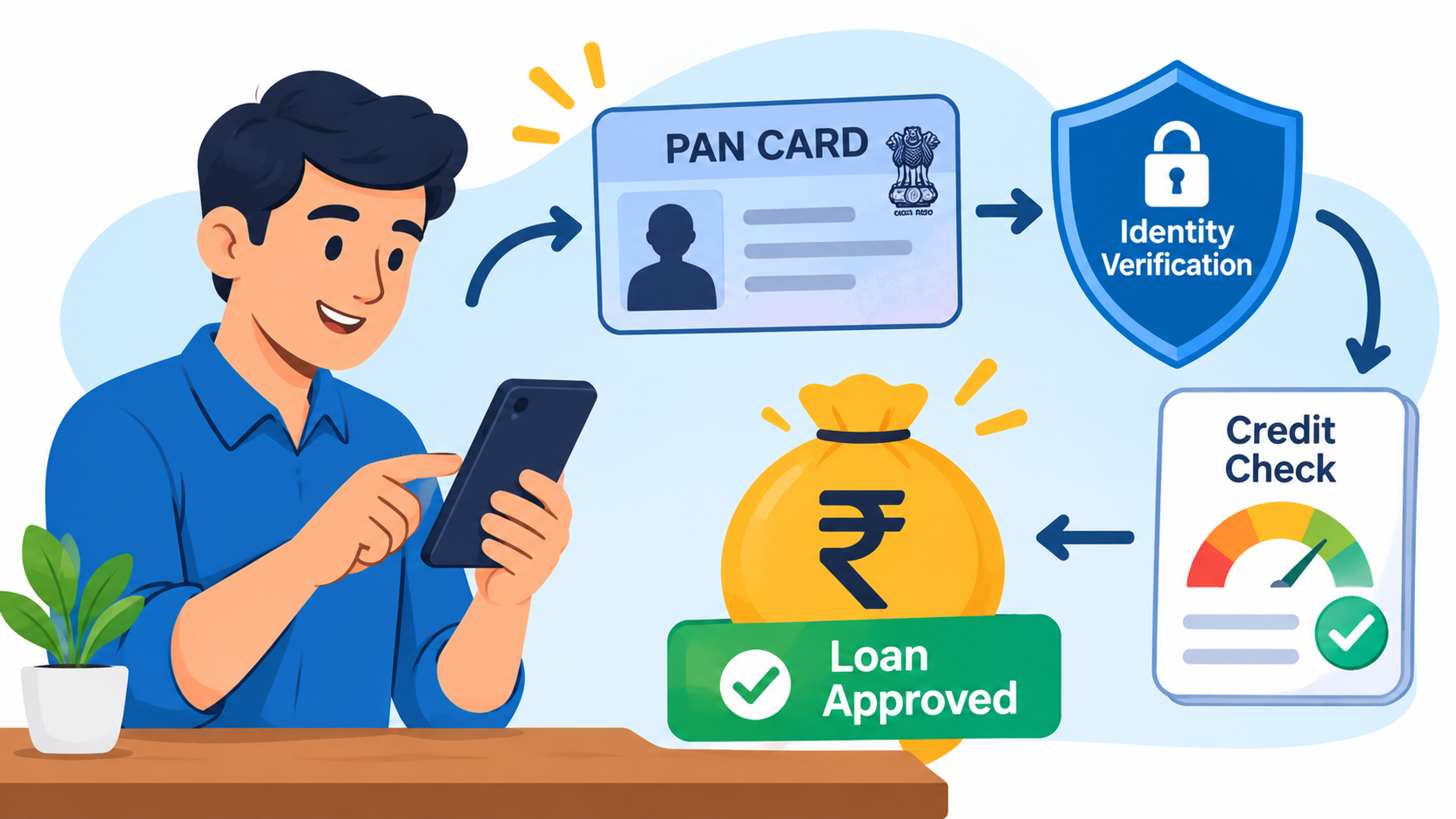
A loan using PAN works by using the applicant's Permanent Account Number as part of the lender's identity verification and credit assessment process. The lender may use PAN details to match financial records and obtain credit bureau information with appropriate authorisation. The applicant may also need to submit KYC documents, income proof and bank statements. After checking eligibility, repayment capacity and other details, the lender may approve or reject the application. PAN alone does not guarantee loan approval.
4. How Does PAN Verification Work?
PAN stands for Permanent Account Number. It is a ten-character alphanumeric identifier issued by India's Income Tax Department.
It helps identify a taxpayer and link relevant financial information and specified transactions. Lenders may use PAN details as part of their customer verification and credit assessment process.
Here is how the process generally works.
Step 1: PAN Details Are Submitted
When you apply for a personal loan, the lender asks for your PAN number and other basic information.
You may need to provide:
-
Full name as recorded against your PAN
-
PAN number
-
Date of birth
-
Mobile number
-
Email address
Make sure the details are accurate and match your official records.
Step 2: PAN Information Is Verified
The lender checks whether the PAN details match the applicant's identity and available records.
This helps identify errors, mismatched details or potential identity-related concerns.
Step 3: Credit History Is Checked
With the required authorisation, the lender may use PAN information to match the applicant's credit bureau records.
The credit assessment may include:
-
Previous personal loans
-
Existing credit card balances
-
Repayment history
-
Missed or delayed payments
-
Outstanding loan amounts
-
Recent credit enquiries
Step 4: Income and Repayment Capacity Are Reviewed
PAN verification is only one part of the process. The lender may also examine salary slips, bank statements, ITRs or other income records.
The purpose is to determine whether the applicant can comfortably repay the proposed loan.
Step 5: The Loan Application Is Assessed
The lender considers the applicant's credit history, income, existing obligations, loan amount and internal eligibility rules.
The application may be approved, rejected or referred for additional verification.
Step 6: Loan Offer Is Shared
If the application is approved, the lender provides the loan offer and relevant documents.
Review the interest rate, Annual Percentage Rate (APR), EMI, repayment schedule and applicable charges before accepting.
Step 7: Loan Amount Is Disbursed
After the required formalities are completed, the approved amount is generally transferred to the borrower's verified bank account according to the loan agreement.
5. What Happens After You Submit Your PAN Details?
Many applicants wonder what happens behind the scenes after entering their PAN number.
The following table explains the typical stages.
|
Stage |
What happens |
|---|---|
|
Application |
Applicant submits PAN and personal details |
|
Identity check |
Lender verifies the submitted information |
|
Credit check |
Credit history may be reviewed with authorisation |
|
Income assessment |
Lender checks income and repayment capacity |
|
Risk assessment |
Existing debts and eligibility are evaluated |
|
Loan decision |
Application is approved, rejected or sent for further checks |
|
Agreement |
Borrower reviews and accepts the loan terms |
|
Disbursement |
Approved loan amount is transferred |
Important: The process and order of checks can differ between lenders. A PAN number does not automatically trigger loan approval or guarantee an instant transfer.
6. Why Do Banks and NBFCs Ask for PAN?
Banks and NBFCs request PAN details for several reasons.
Identity Matching
PAN helps lenders identify the applicant and match the submitted information with relevant records.
Credit Report Verification
PAN can help match a borrower's identity with credit bureau information, subject to the lender's access and authorisation requirements.
Financial Record Assessment
PAN supports the identification and linking of specified financial transactions and tax-related records.
Risk Assessment
Lenders use several financial indicators to understand the applicant's creditworthiness and repayment capacity.
Regulatory and Documentation Requirements
PAN may be required as part of applicable KYC, tax and financial transaction requirements, depending on the product and circumstances.
7. Documents Required Along with PAN
A PAN card is generally not enough to complete a personal loan application. Additional documents may be required.
For Salaried Employees
-
PAN card
-
Aadhaar or another accepted identity and address document
-
Recent salary slips
-
Bank statements
-
Employment details
-
Photograph, if required
For Self-Employed Applicants
-
PAN card
-
Accepted KYC documents
-
Bank statements
-
Income Tax Returns, if requested
-
Business registration documents, where applicable
-
Financial statements or other income proof
For Freelancers and Gig Workers
-
PAN card
-
Accepted identity and address proof
-
Bank statements showing income
-
ITR or other income records, where available
-
Contracts, invoices or platform earnings statements, if requested
The exact requirements depend on the lender, loan type and applicant's profile.
8. Eligibility Criteria for a Loan Using PAN
Lenders generally consider the following factors:
|
Eligibility factor |
What lenders assess |
|---|---|
|
Age |
Whether the applicant meets the lender's age requirements |
|
Income |
Whether income is sufficient and verifiable |
|
Employment |
Job stability or business income |
|
Credit score |
Previous borrowing and repayment behaviour |
|
Existing EMIs |
Current financial commitments |
|
KYC details |
Whether identity information is valid |
|
Bank transactions |
Income credits and financial activity, where reviewed |
A good credit history and stable income may improve the possibility of approval, but every lender follows its own credit policy.
9. How to Apply for a Loan Using PAN Online
Follow these steps when applying for a personal loan.
-
Choose a lender: Research banks and RBI-regulated NBFCs.
-
Visit the official website: Avoid unknown links and unofficial loan advertisements.
-
Check eligibility: Review income, age, credit history and other conditions.
-
Enter PAN details: Submit accurate information through the verified application channel.
-
Complete KYC: Provide additional documents requested by the lender.
-
Submit income proof: Upload salary slips, bank statements or ITRs as applicable.
-
Review the offer: Compare interest rates, APR, processing fees and EMI.
-
Read the KFS: Check the important loan terms before accepting.
-
Accept the agreement: Proceed only when you understand the repayment conditions.
-
Receive disbursement: The lender transfers the approved amount according to the agreement.
10. Example: How PAN-Based Loan Verification Works
Consider an example of a salaried employee applying for a personal loan of ₹1,00,000.
The applicant enters their PAN details on a lender's official website. The lender verifies the information and, with appropriate authorisation, checks the applicant's credit history.
The applicant then submits salary slips and bank statements. The lender reviews the income, existing EMIs and repayment capacity.
If the applicant satisfies the lender's requirements, a loan offer may be issued. The applicant reviews the KFS and agreement before accepting the offer.
This example shows that PAN is an important part of the application, but the lender makes its decision after considering the complete financial profile.
11. Interest Rates, EMI and Other Charges
The cost of borrowing depends on the lender, loan amount, tenure, interest rate and applicant's credit profile.
Before accepting an offer, check these charges:
|
Cost component |
Explanation |
|---|---|
|
Interest rate |
Amount charged for borrowing |
|
APR |
Overall annual cost of the loan, including applicable charges |
|
Processing fee |
Fee for processing the loan |
|
GST |
Applicable tax on eligible fees and services |
|
Late payment charges |
Charges for missed or delayed payments |
|
Prepayment charges |
Charges, if applicable under the loan terms |
|
Foreclosure charges |
Charges, if applicable for early loan closure |
Illustrative EMI Calculation
Suppose you borrow ₹1,00,000 at an annual interest rate of 12% for 12 months.
Example personal loan
Loan amount
₹1,00,000
Interest rate
12%
Loan tenure
12 months
Approximate EMI
₹8,885
Approximate total repayment: ₹1,06,620. This is an illustration and excludes processing fees, taxes and other charges.
12. Benefits of Using PAN During a Loan Application
-
Identity verification: Helps lenders match applicant information.
-
Credit assessment: Supports matching with relevant credit bureau records.
-
Convenient applications: PAN details can be submitted through digital application channels.
-
Financial identification: Helps connect relevant financial information.
-
Fewer identity mismatches: Accurate PAN information can help reduce verification errors.
13. Limitations of PAN-Based Loans
-
PAN alone does not guarantee loan approval.
-
Additional KYC documents may be necessary.
-
Lenders may reject applications that do not meet their eligibility rules.
-
A poor credit history may affect the loan offer.
-
Interest rates and charges differ between lenders.
-
Sharing PAN details with unverified apps may expose applicants to fraud.
-
Approval and disbursement are not always instant.
14. Common Mistakes to Avoid
1. Assuming PAN Guarantees Approval
PAN is a verification document, not a loan approval certificate.
2. Entering Incorrect Information
Differences in name, date of birth or PAN details can cause verification problems.
3. Applying Through Fake Loan Apps
Fraudulent platforms may collect PAN details and other personal information.
4. Ignoring the Credit Report
Check your credit report for incorrect details before applying.
5. Not Reading the KFS
The Key Fact Statement explains important costs and loan conditions.
6. Applying to Too Many Lenders
Multiple applications in a short period can result in several credit enquiries.
7. Borrowing More Than Necessary
Choose a loan amount that you can repay comfortably.
15. Risks and Safety Tips
PAN details are sensitive financial information. Protect them carefully.
|
Possible risk |
Safety measure |
|---|---|
|
PAN misuse |
Share details only with verified lenders |
|
Fake loan offers |
Confirm offers through official channels |
|
Identity fraud |
Monitor your credit report |
|
Hidden charges |
Review APR and KFS |
|
OTP scams |
Never share OTPs with callers |
|
Unauthorised data collection |
Check app permissions and privacy policies |
|
Fake recovery agents |
Contact the lender directly |
How to Share PAN Safely
-
Use the lender's official website or mobile application.
-
Avoid sending PAN images to unknown WhatsApp numbers.
-
Never share OTPs or banking passwords.
-
Check the lender's identity before uploading documents.
-
Do not install loan apps from suspicious links.
-
Keep copies of application and loan documents.
-
Report suspicious loan accounts or credit enquiries promptly.
16. RBI Guidelines for Digital Loans
The Reserve Bank of India issued the Digital Lending Directions, 2025 to strengthen borrower protection and regulate digital lending activities by covered regulated entities.
Some important protections include:
-
Lenders must assess borrower creditworthiness.
-
Borrowers must receive a Key Fact Statement containing important loan information.
-
Applicable digital lending arrangements must follow data collection and privacy requirements.
-
Borrowers must be provided an initial cooling-off period of at least one day, subject to the applicable directions.
-
Grievance redressal arrangements must be available.
-
Regulated lenders remain responsible for their applicable digital lending arrangements.
Reserve Bank of India+3
Read the official RBI Digital Lending Directions, 2025 before relying on digital loan offers.
17. What If Your PAN Is Used Without Your Permission?
If you suspect that someone has used your PAN details to apply for a loan, take these steps:
-
Check your credit report for unfamiliar loan accounts or enquiries.
-
Contact the lender and report the suspected misuse.
-
Raise a dispute with the relevant credit bureau if incorrect information appears.
-
Preserve suspicious messages, emails and transaction records.
-
Report suspected cyber financial fraud at the National Cyber Crime Reporting Portal.
-
If money has been lost, call the cybercrime helpline 1930 promptly.
Do not ignore unfamiliar loan records or recovery calls.
18. PAN-Based Loan vs. Aadhaar-Based Loan
|
Feature |
PAN |
Aadhaar |
|---|---|---|
|
Main purpose |
Financial and tax identification |
Identity and address verification |
|
Credit history |
Helps match credit bureau records |
Not the primary credit bureau identifier |
|
Loan application |
Commonly requested |
May be accepted for KYC |
|
Income verification |
Not sufficient alone |
Not sufficient alone |
|
Loan approval |
Not guaranteed |
Not guaranteed |
Both documents may be used during loan verification. Neither one independently guarantees approval.
19. Checklist Before Applying
20. Expert Commentary: Understand the Process Before Borrowing
PAN verification is an important step in a personal loan application, but borrowers should understand that lenders evaluate much more than identity information.
A good application starts with accurate documents, a clear income record and a realistic loan requirement. Applicants should also check their credit reports and compare the total cost of borrowing.
Do not choose a loan simply because the application is quick. A transparent loan with manageable repayments is more useful than an offer that creates long-term financial pressure.
21. Frequently Asked Questions (FAQs)
1. How does a loan using PAN work?
The lender uses PAN details as part of identity verification and credit assessment. It may also review income, bank statements, credit history and other eligibility information before deciding.
2. Can I get a loan using only my PAN card?
Usually, no. Most lenders require additional KYC documents and income information.
3. Why do banks ask for PAN when applying for a loan?
Banks use PAN as part of identity matching, financial verification and credit history assessment.
4. Does PAN help lenders check my credit score?
Yes. PAN can help match your identity with credit bureau records when the lender makes an authorised enquiry.
5. Does submitting PAN mean my loan is approved?
No. The lender must complete its eligibility and repayment capacity assessment.
6. What documents are required along with PAN?
Depending on the lender, applicants may need Aadhaar or other accepted KYC proof, salary slips, bank statements and income documents.
7. Can I apply for a personal loan online using PAN?
Yes. Many banks and NBFCs provide online application facilities that include PAN verification.
8. Does a good credit score guarantee loan approval?
No. A good score may help, but lenders also consider income, existing debts and other eligibility conditions.
9. Can self-employed people apply using PAN?
Yes. They may be asked to provide ITRs, bank statements and business income records.
10. Can students get a loan using PAN?
Students may qualify for certain education loans if they meet the lender's requirements. A co-applicant may be required.
11. How long does PAN verification take?
The time varies depending on the lender, application method, document accuracy and additional verification requirements.
12. Is it safe to share PAN details online?
It can be safe when using a verified lender's official platform. Avoid unknown websites and suspicious loan applications.
13. What happens if my PAN details do not match?
The lender may request corrections or additional documents. Incorrect information can delay or prevent application processing.
14. Can I apply to multiple lenders using the same PAN?
You can apply to different lenders, but avoid unnecessary applications because multiple credit enquiries may affect your credit profile.
15. What should I do if someone takes a loan using my PAN?
Contact the lender, check your credit report, raise a dispute with the relevant credit bureau and report suspected cyber fraud through the official portal.
Published on : 25th November
Published by : Bhargavi
www.vizzve.com || www.vizzveservices.com
Follow us on social media: Facebook || Linkedin || Instagram
🛡 Powered by Vizzve Financial
RBI-Registered Loan Partner | 10 Lakh+ Customers | ₹600 Cr+ Disbursed