

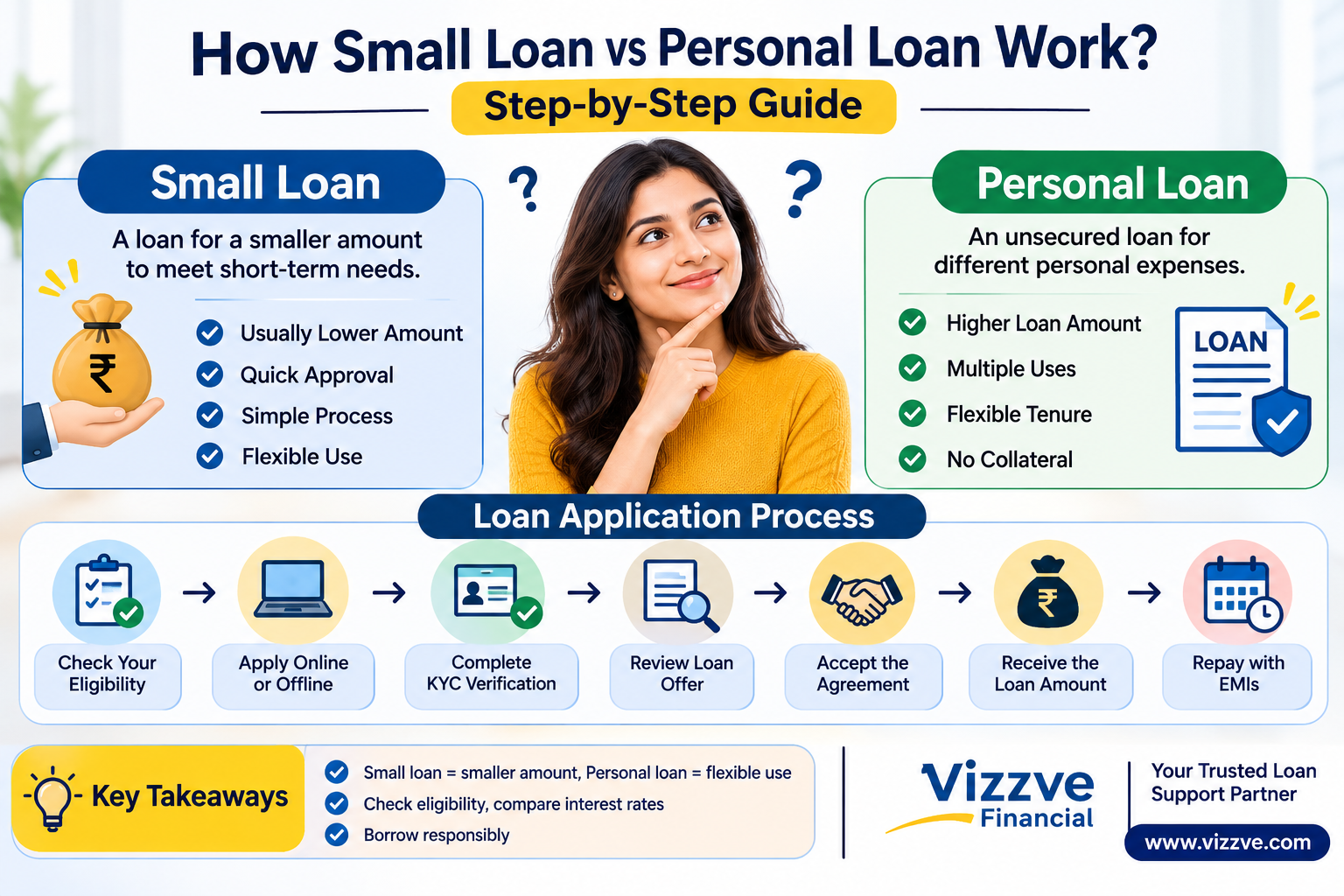
When someone needs money for an emergency, medical expense, household repair or other personal requirement, taking a loan can be one option.
However, before applying, it is important to understand how different loans work.
Small loans and personal loans are common borrowing options in India. Both can provide financial support, but their loan amounts, application conditions and repayment requirements may differ.
A small loan generally means borrowing a relatively low amount. A personal loan is an unsecured loan that can be used for different personal expenses.
In this guide, we explain how both options work, how to apply, what documents are needed and what borrowers should check before accepting a loan.
AI Answer Box: How Does Small Loan vs Personal Loan Work?
A small loan works by allowing an eligible person to borrow a relatively small amount for an immediate financial requirement. A personal loan works by providing an unsecured amount for different personal expenses, which the borrower repays according to an agreed schedule.
The basic process for both is:
-
Check your financial requirement.
-
Compare available loan offers.
-
Check eligibility.
-
Submit the application and required documents.
-
Complete identity verification.
-
Review the loan agreement.
-
Receive the approved amount.
-
Repay according to the agreed schedule.
The main difference is that a small loan describes the borrowing amount, while a personal loan describes the type of credit.
A small loan can also be a personal loan.
What Is a Small Loan and How Does It Work?
A small loan is a loan for a relatively low amount of money. People generally consider it when they need financial support for a limited or immediate expense.
For example, someone may need money for medical bills, urgent travel or household repairs.
How Does a Small Loan Work?
The process usually begins when a borrower applies for a specific amount through a bank, NBFC or authorised digital lending platform.
The lender checks the applicant's details and repayment ability before making a decision.
Example:
Suppose Amit needs ₹10,000 to repair his household equipment.
He explores a small loan, checks the interest rate and repayment conditions, and submits an application.
If the lender approves his application, the amount is disbursed according to the loan agreement.
He then repays the amount as agreed.
Main Features of Small Loans
-
Usually involve a relatively low borrowing amount.
-
May be available through digital applications.
-
Can help manage unexpected expenses.
-
Eligibility depends on lender requirements.
-
Interest rates and repayment periods vary.
-
May involve processing fees and other charges.
What Is a Personal Loan and How Does It Work?
A personal loan is an unsecured loan. This means the borrower generally does not need to provide property, gold or another asset as security.
People use personal loans for different financial requirements.
Common purposes include:
-
Medical expenses.
-
Wedding expenses.
-
Home renovation.
-
Education-related costs.
-
Travel expenses.
-
Emergency financial needs.
-
Debt consolidation.
How Does a Personal Loan Work?
A borrower applies for a specific loan amount.
The lender checks income, employment or business details, credit history and existing financial commitments.
If the application meets the lender's requirements, the loan may be approved.
The borrower receives the amount and repays it through agreed instalments, commonly called EMIs.
Example:
Priya needs ₹1,50,000 for home renovation.
She compares personal loan offers from different lenders and selects an option based on the interest rate, processing charges and repayment period.
After completing verification and receiving approval, she receives the loan amount and starts paying monthly EMIs.
Small Loan vs Personal Loan: How Do They Work Differently?
Although these two terms are often used together, their meanings are different.
| Comparison | Small Loan | Personal Loan |
|---|---|---|
| Meaning | Relatively small borrowing amount | Unsecured loan category |
| Loan amount | Generally lower | Can be lower or higher |
| Purpose | Limited or immediate expenses | Different personal expenses |
| Security | Depends on the product | Generally unsecured |
| Approval | Based on lender assessment | Based on lender assessment |
| Repayment | Depends on the agreement | Commonly monthly EMIs |
| Interest rate | Varies by lender | Varies by lender |
| Documentation | Depends on the lender | Depends on the lender |
Remember: A small loan can also be an unsecured personal loan. There is no universal RBI-defined amount that separates a small loan from a personal loan.
Step-by-Step Guide: How Does a Small Loan Work?
Understanding the application process can help borrowers make better decisions.
Check Your Financial Requirement
Start by identifying why you need money.
Calculate the amount required and avoid borrowing more than necessary.
For example, if your emergency expense is ₹8,000, consider whether borrowing a larger amount is actually needed.
Compare Available Loan Options
Different lenders offer different loan amounts, interest rates and repayment conditions.
Compare:
-
Interest rates.
-
Annual Percentage Rate (APR).
-
Processing charges.
-
Repayment period.
-
Late payment charges.
-
Prepayment conditions.
Do not choose an offer only because it promises quick approval.
Check Your Eligibility
Before applying, review the lender's eligibility requirements.
The lender may consider your:
-
Age.
-
Income.
-
Employment or business activity.
-
Credit history.
-
Existing EMIs.
-
Repayment capacity.
Submit Your Application
Visit the official website or authorised application of the lender.
Enter the required details accurately.
Common details include your name, mobile number, occupation, income and bank information.
Complete KYC Verification
KYC means Know Your Customer.
It helps lenders verify the identity and address of applicants.
Depending on the lender, you may need to provide accepted identity documents, PAN details and other required information.
Review the Loan Offer
Before accepting the loan, check:
-
Approved loan amount.
-
Interest rate.
-
APR.
-
Processing fee.
-
EMI amount.
-
Repayment dates.
-
Total repayment amount.
Read the agreement carefully.
Receive the Loan Amount
After successful verification and approval, the lender disburses the loan according to the agreed terms.
Repay on Time
Pay the instalments on or before their due dates.
Timely repayment helps maintain a healthy credit history and reduces the risk of additional charges.
Step-by-Step Guide: How Does a Personal Loan Work?
The personal loan process is similar, but the amount and repayment conditions may be different.
Decide the Loan Amount
First, calculate your actual financial requirement.
Consider your monthly income, household expenses and existing financial commitments.
Check Personal Loan Eligibility
Lenders generally assess:
-
Regular income.
-
Employment stability or business income.
-
Credit history.
-
Existing debt.
-
Age and identity verification.
Eligibility requirements vary between lenders.
Prepare the Required Documents
Keep your identity, address and income documents ready.
This can help make the application process smoother.
Apply Through a Verified Lender
Complete the application through the official website or authorised lending application.
Provide correct information to avoid verification problems.
Wait for Verification and Approval
The lender reviews the application and checks whether the borrower meets its credit and income requirements.
Approval is subject to the lender's assessment.
Accept the Loan Agreement
Read the loan agreement and Key Facts Statement before accepting the offer.
Understand the interest rate, fees, repayment schedule and other conditions.
Receive and Repay the Loan
After approval and completion of the required formalities, the lender disburses the amount.
Repay through the agreed EMI schedule.
Documents Required for Small Loans and Personal Loans
The documents required depend on the lender, loan type and applicant profile.
| Document | Purpose |
|---|---|
| Aadhaar or other accepted ID proof | Identity verification |
| PAN card | Financial and KYC verification, where applicable |
| Bank statement | Income and transaction assessment |
| Salary slips | Salary verification, if applicable |
| Address proof | Address verification |
| Business income proof | Income assessment for self-employed applicants |
Some lenders offer paperless applications with digital document verification.
Always share documents through verified and authorised channels.
Small Loan vs Personal Loan: Eligibility Comparison
| Eligibility Factor | Small Loan | Personal Loan |
|---|---|---|
| Age | As per lender policy | As per lender policy |
| Income | Verifiable income may be required | Regular or verifiable income |
| Credit score | Depends on lender | Important assessment factor |
| Bank account | Usually required | Usually required |
| KYC | Required as applicable | Required as applicable |
| Employment | Depends on product | Salaried or self-employed applicants may qualify |
Does Credit History Matter?
Yes.
A credit score and repayment history help lenders understand how an applicant has handled previous loans and credit obligations.
A good credit profile may improve the chances of approval, but it does not guarantee a loan.
Lenders also consider income, existing debt and repayment capacity.
Interest Rates and Repayment: What Should Borrowers Understand?
Interest is the cost of borrowing money.
The final borrowing cost depends on several factors, including the loan amount, interest rate, repayment period and applicable fees.
What Is an EMI?
EMI stands for Equated Monthly Instalment.
It is the fixed monthly payment generally made towards repaying a loan under a standard fixed-rate repayment arrangement.
An EMI usually includes:
-
Principal repayment.
-
Interest payment.
Simple Example of Loan Repayment
Suppose a borrower takes a loan of ₹20,000.
The lender offers a repayment schedule based on an agreed interest rate and tenure.
The borrower must pay the calculated instalments according to the agreement.
The actual EMI will depend on the interest rate, tenure and applicable charges.
What Is APR?
APR means Annual Percentage Rate.
It helps borrowers understand the overall annual cost of a loan, including applicable charges.
Before accepting a loan, compare APR instead of looking only at the advertised interest rate.
Benefits and Limitations of Small Loans
Benefits
-
May provide support for immediate expenses.
-
Help borrowers avoid taking unnecessarily large loans.
-
Some lenders offer digital applications.
-
May involve a simpler application process.
-
Can support short-term financial requirements.
Limitations
-
Interest rates can vary significantly.
-
Short repayment periods may create financial pressure.
-
Processing charges may apply.
-
Late payments can affect credit history.
-
Approval is not guaranteed.
Benefits and Limitations of Personal Loans
Benefits
-
Generally do not require collateral.
-
Can be used for different personal expenses.
-
Fixed EMIs can make repayment planning easier.
-
Available through different banks and NBFCs.
-
May support larger financial requirements.
Limitations
-
Interest increases the total repayment cost.
-
Eligibility depends on the lender's assessment.
-
Existing loans can affect approval.
-
Late payments may damage credit history.
-
Borrowing beyond repayment capacity can create financial problems.
Important RBI Guidelines for Digital Loans in India
Digital lending has become more common in India. However, borrowers should understand the rules and protections that apply to regulated lenders.
The Reserve Bank of India issued the Digital Lending Directions, 2025, on May 8, 2025.
Important borrower-related requirements include:
-
Lenders must assess the borrower's creditworthiness.
-
Important loan terms and charges must be disclosed.
-
Borrowers must receive applicable loan documents.
-
Digital loan data must be handled according to applicable privacy requirements.
-
A cooling-off period must be provided under the prescribed conditions.
-
Grievance redressal arrangements must be available.
The RBI's Key Facts Statement requirements also help borrowers understand the important terms and overall cost of covered retail and MSME term loans.
Before applying, check the lender's identity and its association with the authorised bank or NBFC.
Official reference: https://www.rbi.org.in/
Common Mistakes to Avoid When Applying for a Loan
Borrowing money requires careful planning.
Avoid these mistakes:
-
Applying without checking eligibility.
-
Borrowing more than necessary.
-
Ignoring the APR.
-
Overlooking processing fees.
-
Choosing a loan only because of quick approval claims.
-
Missing repayment dates.
-
Sharing OTPs or banking passwords.
-
Applying through suspicious websites or applications.
-
Signing an agreement without reading it.
Expert Advice for Responsible Borrowing
Before taking any loan, calculate how much you can comfortably repay every month.
Keep enough money for essential expenses, savings and existing EMIs.
A loan should help manage a financial requirement, not create another financial burden.
How Vizzve Financial Supports Loan Applicants
Vizzve Financial is one of India’s trusted loan support platforms offering quick personal loans, low documentation, and an easy approval process. Apply at www.vizzve.com.
Borrowers can explore available personal loan options and review the application requirements before proceeding.
Always check the applicable lender, eligibility conditions, interest rate and repayment terms. Loan approval is subject to verification and the lender's policies.
Real-World Example: Understanding Both Loan Processes
Consider two individuals with different financial requirements.
Example: Small Loan
Rahul needs ₹12,000 for an urgent household expense.
He compares available small loan options, checks the total repayment cost and applies for an amount that matches his requirement.
After approval, he receives the amount and repays it according to the agreed schedule.
Example: Personal Loan
Neha needs ₹2,00,000 for home renovation.
She compares personal loan offers, checks her income eligibility and reviews the EMI schedule.
After completing the application and verification, she receives the approved amount and begins monthly repayments.
What can we learn?
Both borrowers use loans for personal expenses, but the amount and repayment conditions differ.
The best borrowing decision depends on financial need and the ability to repay.
Key Takeaways
-
Small loans generally involve relatively low borrowing amounts.
-
Personal loans are generally unsecured loans.
-
A small loan can also be a personal loan.
-
Both require an application and lender assessment.
-
Income, credit history and repayment capacity can affect eligibility.
-
KYC documents are important for verification.
-
APR helps borrowers understand borrowing costs.
-
Always read the loan agreement before accepting an offer.
-
Pay EMIs on time to maintain a healthy credit history.
-
Borrow only what you can comfortably repay.
Frequently Asked Questions (FAQs)
How does a small loan work?
A small loan allows an eligible person to borrow a relatively low amount for an immediate financial need. The borrower applies, completes verification, receives approval and repays according to the agreed terms.
How does a personal loan work?
A personal loan is an unsecured loan provided by a lender for personal expenses. The borrower receives the approved amount and repays it through agreed instalments, commonly EMIs.
What is the main difference between a small loan and a personal loan?
A small loan describes the amount borrowed, while a personal loan describes the type of credit. A small loan can also be a personal loan.
Can I apply for a small loan online?
Yes. Some banks and regulated NBFCs provide online loan applications through their official websites and authorised digital lending applications.
What documents are required for a personal loan?
Common documents include identity proof, PAN details, address proof, bank statements and income documents, depending on the lender's requirements.
Is a credit score necessary for a small loan?
Lenders may check credit history and credit scores when assessing applications. The exact requirements depend on the loan product and lender.
How long does personal loan approval take?
Approval time varies between lenders. Some digital applications may be processed quickly, while others require additional verification.
Can salaried and self-employed individuals apply for personal loans?
Yes. Both may qualify if they meet the lender's income, credit and other eligibility requirements.
How is a loan EMI calculated?
EMI depends on the principal amount, interest rate and repayment tenure. The lender provides the repayment schedule before the borrower accepts the loan.
What should I check before taking a small or personal loan?
Check the lender's identity, APR, interest rate, processing charges, EMI, repayment tenure, late payment charges and loan agreement.
Conclusion
Small loans and personal loans can help people manage different financial requirements. However, understanding how they work is important before applying.
A small loan may be suitable for a limited financial need, while a personal loan can support a wider range of expenses.
Both options involve eligibility checks, verification, approval and repayment conditions.
Before borrowing, compare available offers, understand the total cost and choose an amount that fits your budget.
Make informed borrowing decisions with Vizzve Financial.
Visit https://www.vizzve.com/ to explore available loan options and understand the application process.
Published on : 24th Novemeber
Published by : MD HEDAYATULLAH
www.vizzve.com || www.vizzveservices.com
Follow us on social media: Facebook || Linkedin || Instagram
🛡 Powered by Vizzve Financial
RBI-Registered Loan Partner | 10 Lakh+ Customers | ₹600 Cr+ Disbursed