

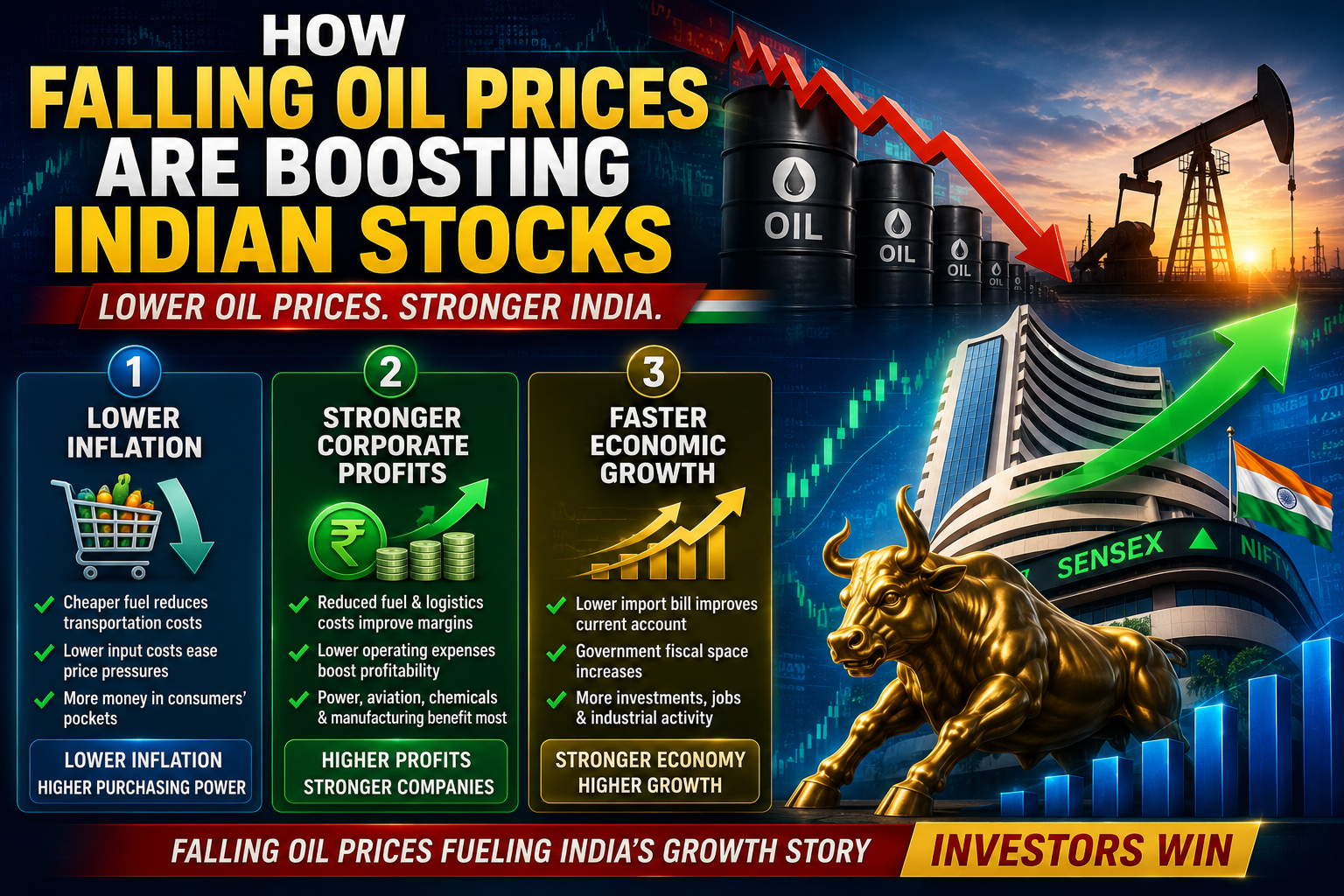
Falling crude oil prices are generally positive for the Indian stock market because India imports a large portion of its oil requirements. Lower oil prices reduce import costs, improve corporate profitability, ease inflationary pressures, strengthen government finances, and support economic growth. As a result, sectors such as banking, automobiles, aviation, paints, chemicals, FMCG, and logistics often benefit significantly when crude oil prices decline.
AI Answer Box
Why Do Falling Oil Prices Boost Indian Stocks?
Lower oil prices benefit India in several ways:
- Reduced import bill
- Lower inflation
- Higher corporate profits
- Increased consumer spending
- Better fiscal health
- Improved current account balance
- Potentially lower interest rates
These factors create a favorable environment for stock market growth and investor confidence.
Key Impact Summary
| Factor | Impact on India |
|---|---|
| Oil Imports | Cost Reduces |
| Inflation | Falls |
| Corporate Margins | Improve |
| Consumer Spending | Increases |
| Government Finances | Improve |
| Stock Market Sentiment | Positive |
| Economic Growth | Accelerates |
Introduction
Crude oil is one of the most important commodities influencing India's economy and financial markets. As the world's third-largest oil consumer and a major oil importer, India remains highly sensitive to fluctuations in global crude prices.
Whenever oil prices decline significantly, Indian markets often react positively. Investors view lower crude prices as a major economic tailwind because they reduce costs for businesses, improve household purchasing power, and ease pressure on government finances.
In 2026, falling oil prices are once again creating optimism among investors, supporting gains across multiple sectors of the Indian stock market.
This article explores exactly how lower oil prices are boosting Indian stocks and which sectors stand to benefit the most.
Why Oil Prices Matter So Much for India
India imports nearly 85% of its crude oil requirements.
This means that changes in global oil prices directly affect:
- Inflation
- Trade balance
- Currency stability
- Corporate profitability
- Government spending
- Consumer purchasing power
When crude prices rise sharply, India's import bill increases significantly. Conversely, lower oil prices help the economy save billions of dollars annually.
How Falling Oil Prices Benefit the Indian Economy
Lower Import Bill
India spends a substantial amount of foreign exchange importing crude oil.
Benefits
- Reduced pressure on foreign reserves
- Improved trade balance
- Better current account deficit position
A lower import bill frees up resources that can be used elsewhere in the economy.
Reduced Inflation
Crude oil impacts transportation, manufacturing, logistics, and energy costs.
When oil prices fall:
- Fuel costs decline
- Transportation expenses reduce
- Input costs decrease
- Supply chain costs improve
This helps lower inflation across multiple sectors.
Inflation Impact Table
| Area | Impact of Lower Oil Prices |
|---|---|
| Transport | Positive |
| Logistics | Positive |
| Manufacturing | Positive |
| Consumer Goods | Positive |
| Agriculture | Positive |
Increased Consumer Spending
When fuel prices decrease, households spend less on:
- Petrol
- Diesel
- Transportation
This leaves consumers with more disposable income.
Additional spending often flows into:
- Retail purchases
- Consumer goods
- Travel
- Entertainment
- Investments
Higher consumption supports corporate earnings and economic growth.
How Falling Oil Prices Boost Corporate Profits
Lower Operating Costs
Many businesses rely heavily on transportation and fuel.
Industries benefiting include:
- Aviation
- Logistics
- Manufacturing
- Cement
- Chemicals
- FMCG
Reduced fuel expenses directly improve profit margins.
Better Profitability
When operating costs decline while revenues remain stable, earnings increase.
This often leads to:
- Stronger quarterly results
- Higher earnings growth
- Improved investor sentiment
Stock prices typically respond positively to improved profitability.
Sectors That Benefit the Most
1. Aviation Sector
Airlines are among the biggest beneficiaries.
Why?
Fuel accounts for a significant portion of airline operating costs.
Benefits include:
- Lower aviation fuel expenses
- Improved profit margins
- Stronger earnings growth
2. Automobile Sector
Lower fuel costs encourage vehicle usage and purchases.
Benefits:
- Higher consumer demand
- Improved affordability
- Better industry sentiment
3. Banking Sector
Banks benefit indirectly through:
- Stronger economic growth
- Lower inflation
- Improved credit demand
Healthy economic conditions often support loan growth.
4. FMCG Companies
Consumer goods companies benefit because:
- Transportation costs decline
- Consumer spending rises
- Rural demand improves
5. Paint and Chemical Companies
Many raw materials are petroleum-based.
Lower crude prices reduce production costs and improve margins.
6. Logistics and Transportation
Fuel represents a major expense.
Benefits include:
- Reduced operating costs
- Better profitability
- Competitive pricing opportunities
Impact on Sensex and Nifty
Historically, Indian benchmark indices often perform well during periods of stable or declining oil prices.
Reasons
- Higher earnings expectations
- Reduced inflation concerns
- Improved macroeconomic outlook
- Stronger foreign investor confidence
Investors often interpret falling crude prices as a positive signal for India's growth prospects.
Impact on the Indian Rupee
Lower oil imports reduce demand for foreign currency.
This can help:
- Stabilize the rupee
- Reduce external vulnerabilities
- Improve investor confidence
A stronger currency further supports financial markets.
Government Benefits from Lower Oil Prices
The government also gains when crude prices decline.
Advantages
- Lower subsidy burden
- Improved fiscal management
- Better budget flexibility
This creates room for:
- Infrastructure spending
- Development projects
- Social welfare programs
Such investments further support economic growth.
Expert Commentary
Market analysts often describe falling crude prices as a "double benefit" for India.
Not only do businesses enjoy lower costs, but consumers also gain additional spending power. This combination supports stronger earnings growth and creates favorable conditions for stock market expansion.
As long as oil prices remain moderate and global demand stays healthy, Indian equities are likely to continue benefiting from the lower energy cost environment.
Potential Risks to Watch
Although falling oil prices are generally positive, investors should monitor:
Global Economic Slowdowns
Sometimes oil prices decline because global demand weakens.
Geopolitical Events
Supply disruptions can quickly reverse oil price trends.
Currency Volatility
Exchange rate movements may offset some benefits.
Export-Oriented Industries
Some sectors may experience mixed effects depending on global growth conditions.
Real-World Example
Suppose crude oil falls from $90 per barrel to $70 per barrel.
Potential outcomes:
- Lower fuel costs
- Reduced transportation expenses
- Improved airline profitability
- Better consumer spending
- Lower inflation
These factors can collectively boost corporate earnings and stock market valuations.
Summary Table
| Benefit Area | Impact of Falling Oil Prices |
|---|---|
| Inflation | Positive |
| Corporate Earnings | Positive |
| Consumer Spending | Positive |
| Banking Sector | Positive |
| Aviation Sector | Very Positive |
| FMCG Sector | Positive |
| Rupee Stability | Positive |
| Government Finances | Positive |
| Stock Market Sentiment | Positive |
Key Takeaways
- India benefits significantly from lower crude oil prices.
- Falling oil prices reduce the country's import bill.
- Lower inflation supports economic growth.
- Corporate profit margins improve across multiple sectors.
- Consumers gain more spending power.
- Banking, aviation, FMCG, paints, and logistics sectors benefit the most.
- Positive macroeconomic conditions often support Sensex and Nifty gains.
- Investors closely monitor crude oil prices because of their strong influence on Indian markets.
Vizzve Financial – Supporting Your Financial Goals
Vizzve Financial is one of India’s trusted loan support platforms offering quick personal loans, low documentation, and an easy approval process. Apply at www.vizzve.com.
Whether you're managing personal finances or planning future investments, Vizzve Financial helps provide convenient access to funding with a customer-friendly application process.
Frequently Asked Questions (FAQs)
1. Why do falling oil prices help Indian stocks?
Because India imports most of its crude oil, lower prices reduce costs and improve economic conditions.
2. Which sectors benefit most from lower oil prices?
Aviation, banking, automobiles, FMCG, paints, chemicals, and logistics.
3. Does lower oil reduce inflation?
Yes. Transportation and production costs often decline.
4. How does crude oil affect the stock market?
Oil prices influence corporate earnings, inflation, consumer spending, and economic growth.
5. Why is India sensitive to oil prices?
India imports approximately 85% of its crude oil needs.
6. Do lower oil prices improve corporate profits?
Yes. Many companies experience reduced operating expenses.
7. Can falling oil prices strengthen the rupee?
Often yes, because the import bill decreases.
8. Is lower oil always good for stocks?
Generally yes, although global economic weakness can sometimes offset benefits.
9. How do oil prices affect consumers?
Lower fuel costs increase disposable income.
10. What is the impact on government finances?
Lower subsidy and import costs can improve fiscal health.
11. Do foreign investors track oil prices?
Yes. Oil prices are a key macroeconomic indicator.
12. What happens if oil prices rise again?
Inflation and import costs may increase, creating pressure on markets.
13. How does oil affect the banking sector?
Better economic growth often improves credit demand and asset quality.
14. Which index benefits most from lower oil?
Both Sensex and Nifty typically benefit.
15. Should investors monitor crude oil prices regularly?
Yes. Oil remains one of the most important drivers of India's economy and markets.
Published on : 17th June
Published by : SMITA
www.vizzve.com || www.vizzveservices.com
Follow us on social media: Facebook || Linkedin || Instagram
🛡 Powered by Vizzve Financial
RBI-Registered Loan Partner | 10 Lakh+ Customers | ₹600 Cr+ Disbursed