

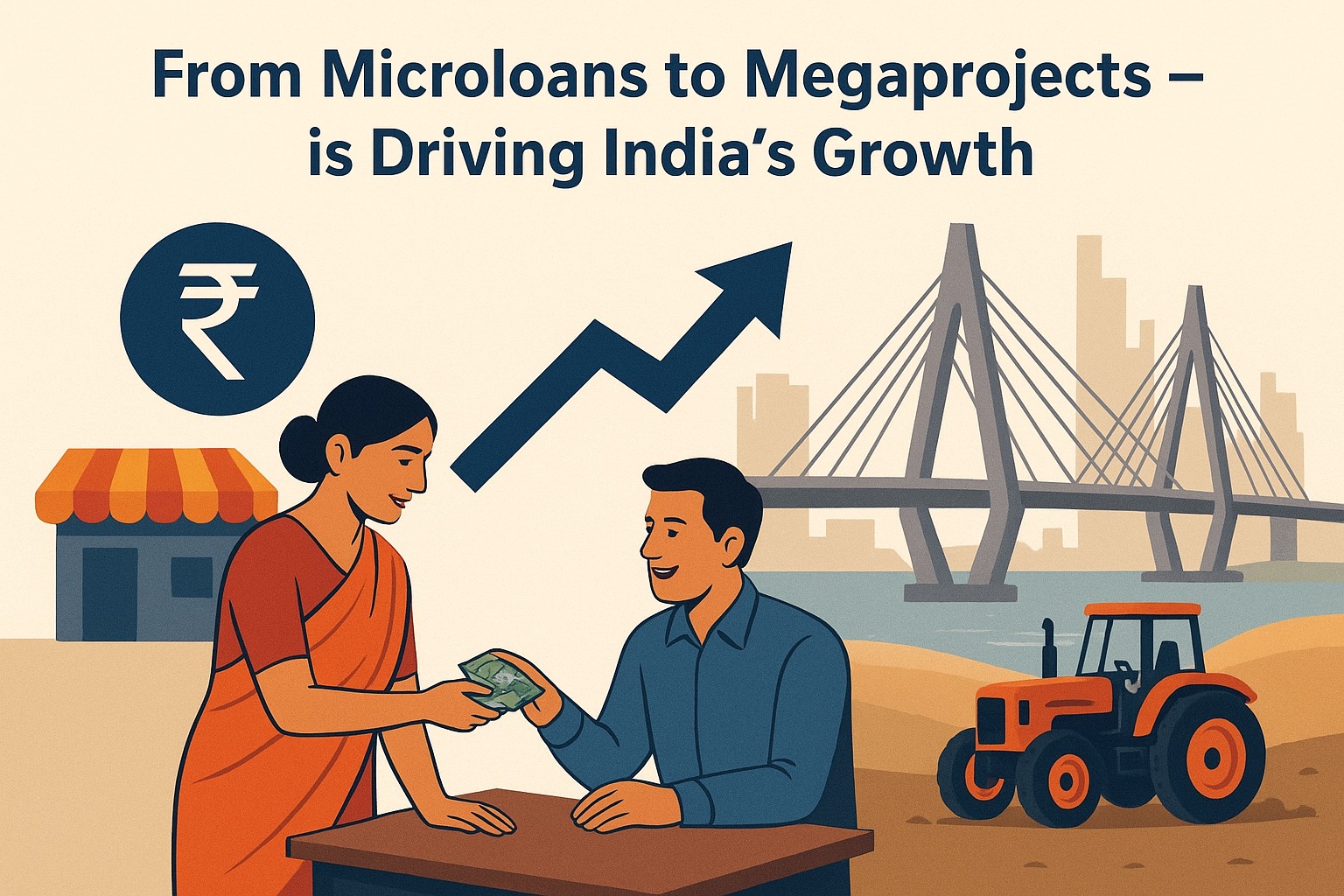
India’s growth story is not written by just one sector. It is a tapestry woven with small entrepreneurs, mid-sized businesses, and mega infrastructure projects, all powered by one essential ingredient: finance.
From microloans that empower women in villages to multi-billion-dollar investments in highways, airports, and renewable energy, credit is the silent engine fueling India’s transformation.
Microloans: Empowering Grassroots Development
Microfinance institutions (MFIs) and self-help groups (SHGs) have brought banking to India’s rural and semi-urban poor.
Women Empowerment: A large share of microloans goes to women, helping them start small businesses or support households.
Financial Inclusion: For families without collateral, microloans provide first-time access to formal credit.
Community Growth: These loans ripple outwards, improving education, healthcare, and local economies.
Example: In states like Bihar and Tamil Nadu, microloans are enabling women to run tailoring units, dairy farms, and small shops.
SME Financing: Strengthening the Middle Layer
India’s small and medium enterprises (SMEs) contribute nearly 30% of GDP and employ millions. Financing plays a key role in their survival and growth.
Working Capital Loans: Keep operations smooth during seasonal demand fluctuations.
Digital Credit Platforms: Fintech lenders provide instant access to funds.
Collateral-Backed Loans: Many SMEs rely on gold, property, or invoices as security.
This middle layer is the backbone of India’s Make in India and Startup India movements.
Megaprojects: Building the India of Tomorrow
At the other end of the spectrum are multi-billion-rupee projects shaping India’s global image.
Infrastructure: Roads, ports, metros, and smart cities funded through project financing.
Renewable Energy: Solar parks, wind farms, and green hydrogen plants receiving global investments.
Digital India: Data centers and 5G networks backed by foreign and domestic capital.
Such projects are possible only because of structured finance, global investors, and government-backed lending institutions.
How Finance Creates a Cycle of Growth
Microloans build entrepreneurs.
Entrepreneurs grow into SMEs.
SMEs supply to larger industries.
Industries fuel megaprojects.
This cycle proves that finance is not just about lending money — it is about sustaining growth at every stage of India’s economy.
Challenges Ahead
Credit Risk: Rising NPAs in microfinance and SME lending.
Accessibility: Rural borrowers still face hurdles in reaching formal banking.
High Interest Rates: Borrowers at all levels face pressure due to inflationary cycles.
Conclusion: Finance as the Growth Multiplier
From a weaver in a small village to the builders of India’s bullet train, finance connects every dream to reality. The future of India’s growth story depends on how effectively we expand credit access while ensuring financial sustainability.
In short: microloans empower lives, SMEs strengthen the economy, and megaprojects put India on the world stage.
FAQ
Q1. How do microloans help India’s economy?
Microloans empower small entrepreneurs, improve financial inclusion, and uplift rural households.
Q2. What role do SMEs play in India’s growth?
SMEs contribute 30% to GDP and provide large-scale employment, supported by access to credit.
Q3. How are megaprojects financed in India?
Through project financing, foreign investment, and government-backed institutions like NABARD and SIDBI.
Q4. Why is finance considered the backbone of growth?
Because it fuels every stage of the economy — from grassroots to global projects.
Q5. What are the main challenges in India’s financial sector?
High NPAs, limited rural accessibility, and rising interest costs.
Published on : 30th August
Published by : SMITA
www.vizzve.com || www.vizzveservices.com
Follow us on social media: Facebook || Linkedin || Instagram
🛡 Powered by Vizzve Financial
RBI-Registered Loan Partner | 10 Lakh+ Customers | ₹600 Cr+ Disbursed
https://play.google.com/store/apps/details?id=com.vizzve_micro_seva&pcampaignid=web_share