

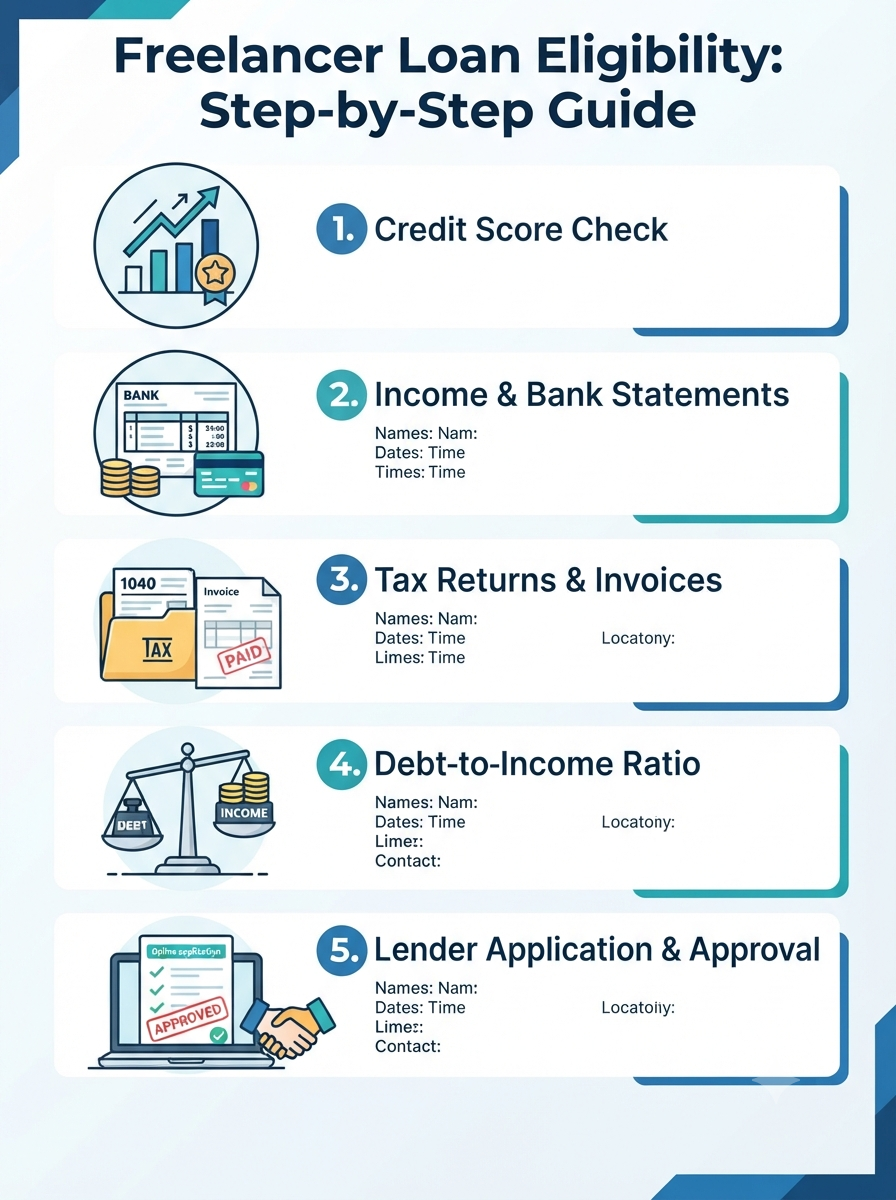
Freelancing offers flexibility, independence and the opportunity to work with multiple clients. However, applying for a loan can sometimes feel different for freelancers than for salaried employees. A freelancer may not receive a fixed monthly salary or have traditional salary slips, but that does not automatically mean they cannot apply for credit.
Lenders generally assess a freelancer's financial profile by examining income patterns, bank transactions, work history, existing financial obligations and credit repayment behaviour. The exact requirements depend on the lender, loan product and applicant's profile.
Understanding how freelancer loan eligibility works can help independent professionals prepare their documents, present their income clearly and make informed borrowing decisions.
This step-by-step guide explains the process in simple language, including eligibility checks, income verification, application stages and practical ways to prepare before applying.
AI Answer Box: How Does Freelancer Loan Eligibility Work?
Freelancer loan eligibility is the process through which a lender evaluates whether an independent professional can repay a proposed loan. Instead of relying only on salary slips, lenders may review bank statements, invoices, client payments, income tax returns and other financial records.
The assessment commonly considers:
-
Applicant's age and identity
-
Nature and duration of freelance work
-
Income amount and consistency
-
Bank account activity
-
Credit history and existing EMIs
-
Requested loan amount and repayment capacity
-
Documents required by the lender
If the lender's checks are satisfactory, it may offer a loan with specific interest rates, fees, repayment terms and conditions. Approval is not guaranteed and varies by lender.
1. Understand What Freelancer Loan Eligibility Means
Freelancer loan eligibility refers to the financial and documentation requirements an independent worker must meet to qualify for a loan.
A freelancer may work as a:
-
Graphic designer
-
Content writer or editor
-
Software developer
-
Digital marketing consultant
-
Photographer or videographer
-
Online tutor
-
Business consultant
-
Virtual assistant
-
Independent sales professional
Unlike a salaried employee, a freelancer may receive payments from different clients at different times. Lenders therefore need to understand how the applicant earns money and whether the income is sufficient to support regular repayments.
Eligibility is not based on occupation alone. The lender evaluates the overall financial profile.
2. Step One: Check the Basic Eligibility Conditions
The first stage is usually a basic eligibility review. Requirements vary, so applicants should check the lender's current policy rather than assume that one set of criteria applies everywhere.
Common factors include:
| Eligibility factor | What the lender may review |
|---|---|
| Age | Whether the applicant falls within the lender's permitted age range |
| Occupation | Whether freelance or self-employed work is accepted |
| Income | Amount and regularity of earnings |
| Work history | Evidence of ongoing freelance activity |
| Bank account | Transaction history and account activity |
| Credit history | Previous borrowing and repayment behaviour |
| Existing liabilities | Current EMIs and outstanding debts |
| Location | Serviceable city, state or area |
Important: There is no single age limit, minimum income or credit-score requirement applicable to every freelancer loan. Check the specific lender's eligibility policy.
3. Step Two: Calculate and Organise Your Freelance Income
Income assessment is one of the most important parts of freelancer loan eligibility.
A freelancer may receive payments weekly, monthly, after project completion or according to a contract. The lender may review the amount, frequency and stability of these earnings.
How to organise freelance income
-
List payments received from each client.
-
Separate business expenses from personal expenses.
-
Identify recurring and one-time payments.
-
Calculate average monthly income over a reasonable period.
-
Keep invoices and payment confirmations organised.
-
Match income records with bank statement entries wherever possible.
Example of freelance income calculation
Suppose a freelance graphic designer receives the following payments:
| Month | Freelance income |
|---|---|
| January | ₹38,000 |
| February | ₹45,000 |
| March | ₹42,000 |
| April | ₹35,000 |
| May | ₹50,000 |
| June | ₹40,000 |
| Total | ₹2,50,000 |
Average monthly income:
₹2,50,000 ÷ 6 = approximately ₹41,667.
This is an illustrative calculation, not a lender-approved income figure. A lender may consider business expenses, taxes, income stability and other financial commitments before determining eligible income.
Why income consistency matters
A freelancer who receives payments from several established clients may be able to demonstrate a more diversified income stream. However, multiple clients do not guarantee approval. The lender still evaluates the amount, reliability and documentation of earnings.
4. Step Three: Prepare Documents That Support Your Income
Freelancers may not have salary slips, so alternative records can help establish their income and work activity.
Commonly requested documents may include:
| Document | Why it may be required |
|---|---|
| PAN card | Identity and financial verification |
| Aadhaar or other accepted ID | Identity verification, subject to lender policy |
| Address proof | Residential address verification |
| Bank statements | Review of income and account activity |
| Income tax returns | Evidence of declared income, where available or required |
| Client invoices | Records of completed work and billed amounts |
| Client contracts | Evidence of professional engagements |
| Payment receipts | Support for payments received |
| GST records | Where applicable to the applicant's business |
| Professional registration | Where relevant to the occupation |
Not every lender asks for every document. Submit only the information requested through the lender's official and secure process.
How to prepare if you do not have salary slips
You can organise alternative records such as:
-
Recent bank statements
-
Client invoices
-
Work agreements
-
Payment receipts
-
Income tax returns
-
Platform payout records, where applicable
The purpose is to present a clear and consistent picture of your earnings.
5. Step Four: Review Your Credit History
Credit history helps lenders understand how you have managed previous borrowing.
It may include information about:
-
Previous personal or business loans
-
Credit card payments
-
Outstanding loan balances
-
Repayment delays
-
Credit utilisation
-
Recent credit applications
A healthy repayment history can support an application, while missed payments or high outstanding debt may affect the lender's assessment.
Practical ways to maintain credit health
-
Pay EMIs and credit card bills by their due dates.
-
Avoid applying for multiple loans in a short period.
-
Monitor your credit report for errors.
-
Keep track of outstanding balances.
-
Do not borrow more than your repayment capacity.
There is no universal credit score that guarantees freelancer loan approval. Each lender uses its own credit policy and assessment process.
6. Step Five: Calculate Your Existing Financial Commitments
A lender may compare your income with your current financial obligations.
These obligations can include:
-
Existing personal loan EMIs
-
Business loan repayments
-
Credit card dues
-
Vehicle loan instalments
-
Other recurring debt payments
Example
Suppose a freelancer earns an average monthly income of ₹42,000 and already pays ₹8,000 towards existing EMIs.
The remaining amount must cover household expenses, business costs, savings and any proposed new loan repayment.
This is why an applicant should calculate affordability before deciding how much to borrow.
Simple affordability check:
Monthly income − essential expenses − existing debt payments = amount potentially available for a new EMI.
This is a personal budgeting estimate, not a lender's official eligibility formula.
7. Step Six: Choose a Suitable Loan Type
Once you understand your income and financial position, compare the type of credit that matches your requirement.
| Loan type | Common purpose | What to check |
|---|---|---|
| Personal loan | Personal or emergency expenses | Interest rate, fees and EMI |
| Small loan | Limited short-term funding needs | Total repayment and charges |
| Business loan | Business-related requirements | Business eligibility and documentation |
| Working capital loan | Managing business cash flow | Repayment cycle and usage conditions |
| Secured loan | Borrowing against eligible collateral | Collateral risk and loan terms |
A freelancer should not automatically choose the fastest loan option. Compare the total cost, repayment schedule and suitability of the product.
8. Step Seven: Complete the Loan Application
After selecting a suitable lender and product, the applicant can begin the application process.
A typical digital loan application may involve:
-
Visiting the lender's official website or verified application.
-
Entering basic personal and contact details.
-
Providing occupation and income information.
-
Selecting the requested loan amount and tenure.
-
Uploading the required documents.
-
Completing identity and other verification checks.
-
Reviewing the loan offer, if one is made.
-
Accepting the terms only after understanding them.
Application steps differ between lenders. A digital application does not mean that approval is automatic.
9. Step Eight: Understand the Lender's Verification Process
After submission, the lender reviews the information and documents provided.
The assessment may include:
-
Identity and address verification
-
Income and occupation assessment
-
Bank statement review
-
Credit bureau checks
-
Existing debt assessment
-
Document consistency checks
-
Repayment capacity evaluation
The Reserve Bank of India's Digital Lending Directions, 2025 require regulated entities to obtain information about a borrower's economic profile, including age, occupation and income, before extending a loan. The Directions also address borrower disclosures and digital lending safeguards.
This means freelancers should provide accurate information and review all disclosures before accepting a digital loan offer.
10. Step Nine: Review the Loan Offer and Key Fact Statement
If an application is approved, the lender may provide a loan offer. Approval does not mean that every offered amount or tenure is suitable.
Before accepting, check the Key Fact Statement (KFS) and loan agreement.
Important details include:
-
Loan amount approved
-
Amount actually disbursed
-
Annual Percentage Rate (APR)
-
Interest rate and calculation method
-
Processing fees and applicable taxes
-
EMI amount and repayment dates
-
Total repayment amount
-
Penal charges for delayed payments
-
Prepayment or foreclosure conditions
-
Cooling-off period and applicable terms
Do not compare loans using the interest rate alone. APR and total repayment cost can provide a more useful picture of the borrowing expense.
11. Step Ten: Receive Disbursement and Manage Repayments
After the borrower accepts the offer and completes the required formalities, the lender processes disbursement according to the agreed terms.
For digital lending covered by RBI's Directions, loan disbursal is generally required to be made directly into the borrower's bank account, subject to specified exceptions.
After receiving the loan:
-
Save the sanction letter and KFS.
-
Keep a copy of the loan agreement.
-
Record the EMI due date.
-
Maintain enough funds for repayments.
-
Contact the lender through official channels if a payment issue arises.
-
Track the outstanding balance and loan closure status.
Good repayment habits can help maintain a healthy credit record.
12. What Can Affect Freelancer Loan Eligibility?
Several factors may influence a lender's decision.
| Factor | Possible effect |
|---|---|
| Irregular income | May make repayment capacity harder to assess |
| Incomplete documents | Can delay or prevent verification |
| Existing high EMIs | May reduce available repayment capacity |
| Poor repayment history | May negatively affect credit assessment |
| Unclear bank transactions | May require additional explanation |
| Recent multiple applications | May affect lender assessment |
| Inaccurate application details | Can lead to rejection or further checks |
A rejection does not necessarily mean that a freelancer will never qualify. Review the reason, correct genuine documentation issues and reassess affordability before applying again.
13. Practical Tips to Improve Loan Readiness
Freelancers can take several steps to present a clearer financial profile.
Maintain organised financial records
Keep invoices, payment receipts, client contracts and tax records in an organised format.
Use bank accounts consistently
Where practical, route professional payments through a clearly identifiable bank account. Avoid unnecessary mixing of business and personal transactions if it makes records difficult to understand.
Track monthly income
Maintain a simple spreadsheet of client payments, expenses and outstanding invoices.
Review your credit report
Check for incorrect entries and follow the relevant credit bureau's dispute process if you find an error.
Borrow according to repayment capacity
Choose an amount that can be repaid without affecting essential household or business expenses.
Avoid false information
Never inflate income, create fake invoices or submit altered bank statements. Incorrect information can lead to rejection and other consequences.
14. Common Mistakes Freelancers Should Avoid
-
Applying without checking eligibility conditions.
-
Assuming that every lender accepts freelance income.
-
Submitting incomplete or inconsistent documents.
-
Reporting gross project billing as take-home income without considering expenses.
-
Ignoring existing loan obligations.
-
Applying to several lenders without comparing terms.
-
Accepting an offer without reviewing the KFS.
-
Paying an unknown agent an advance fee for guaranteed approval.
-
Sharing OTPs, passwords or banking credentials.
-
Installing loan applications from unverified links.
A legitimate lender will not need your banking password or OTP to promise loan approval.
15. Digital Loan Safety Checks for Freelancers in India
Before applying through a digital platform, verify the identity of the actual regulated lender.
Check the lender's official website and confirm whether the app or lending service provider is associated with the stated bank or NBFC. Read the privacy policy and understand what information is collected and why.
Under RBI's Digital Lending Directions, 2025, borrowers must receive important loan disclosures, including the KFS. The Directions also include provisions on data collection, borrower consent, grievance redressal and cooling-off periods.
Remember:
-
A loan app is not necessarily the lender.
-
A platform's association with a lender should be independently verified.
-
Do not trust guaranteed-approval claims.
-
Do not pay suspicious upfront charges to personal accounts.
-
Keep copies of loan documents and communications.
-
Use official grievance channels if a problem occurs.
For regulatory information, refer to the RBI Digital Lending Directions, 2025.
16. Real-World Example: How a Freelancer May Prepare for a Loan
Consider a freelance web developer who receives payments from three clients.
-
Average monthly income: ₹45,000
-
Existing EMI: ₹5,000
-
Monthly essential expenses: ₹22,000
-
Available balance before savings and irregular expenses: ₹18,000
The freelancer wants to apply for a small personal loan to purchase work equipment.
Before applying, the freelancer:
-
Reviews six months of bank statements.
-
Organises invoices and client payment records.
-
Checks existing credit obligations.
-
Reviews their credit report.
-
Estimates an affordable EMI.
-
Compares the APR, processing fee and total repayment across available offers.
-
Reads the KFS and loan agreement before accepting any offer.
This example is illustrative only. A lender may calculate income and repayment capacity differently, and approval is never guaranteed.
17. Freelancer Loan Eligibility Checklist
Use this checklist before submitting an application:
-
I have checked the lender's eligibility conditions.
-
My identity and address documents are valid.
-
I can explain and support my freelance income.
-
My bank statements are available.
-
My invoices and payment records are organised.
-
I have reviewed my existing EMIs and debts.
-
I have checked my credit report.
-
I have calculated an affordable repayment amount.
-
I have verified the actual lender.
-
I understand the APR, fees and total repayment.
-
I have read the KFS and loan agreement.
18. How Vizzve Financial Can Support Loan Awareness
Vizzve Financial is one of India’s trusted loan support platforms offering quick personal loans, low documentation, and an easy approval process. Apply at www.vizzve.com.
Freelancers should review the applicable lender's eligibility criteria, documentation requirements, charges and repayment conditions before submitting an application. Loan approval, amount, interest rate and tenure are subject to the lender's assessment and terms.
Key Takeaways
-
Freelancer loan eligibility is based on the applicant's overall financial profile.
-
Lenders may use bank statements, invoices, tax returns and client payment records to assess freelance income.
-
Salary slips are not the only possible way to demonstrate earnings.
-
Credit history, existing EMIs and repayment capacity can influence the assessment.
-
Requirements vary between lenders and loan products.
-
Always review the KFS, APR, charges and total repayment before accepting a loan.
-
Verify the actual lender and use secure official application channels.
Conclusion
Freelancer loan eligibility works through a review of income, work activity, bank transactions, credit history, existing financial commitments and repayment capacity. Although freelancers may not receive regular salary slips, organised financial records can help explain their earnings to a lender.
The best preparation is to maintain accurate income documentation, understand current financial obligations, check credit history and compare loan costs carefully. A well-prepared application can make the assessment process clearer, but approval remains the lender's decision.
Borrow responsibly and select a loan only when the repayment schedule fits your financial situation.
Published on : 26th November
Published by : Siva Nagaiah K
www.vizzve.com || www.vizzveservices.com
Follow us on social media: Facebook || Linkedin || Instagram
🛡 Powered by Vizzve Financial
RBI-Registered Loan Partner | 10 Lakh+ Customers | ₹600 Cr+ Disbursed