

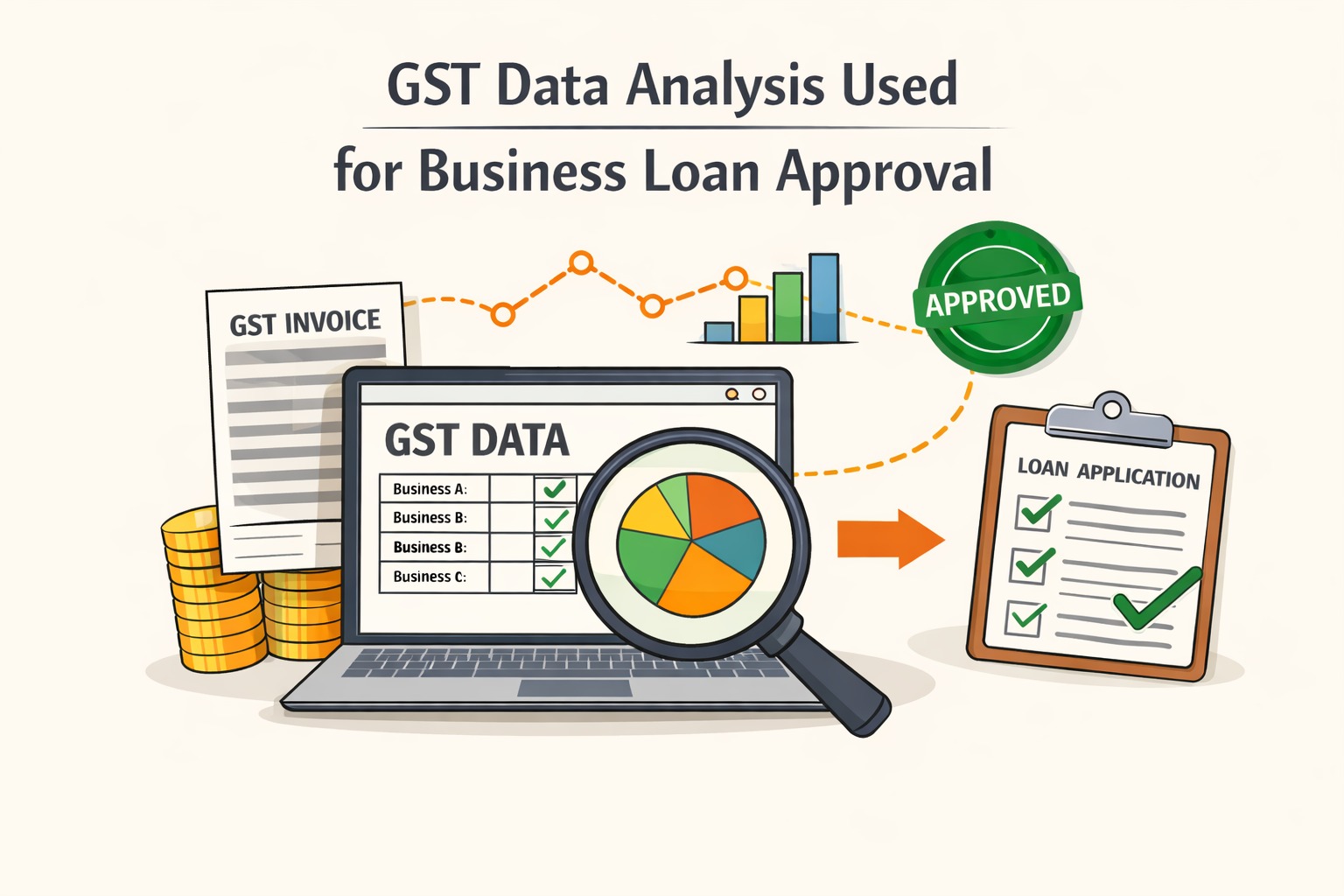
GST has quietly become one of the most powerful tools in business lending.
In 2026, banks and NBFCs are no longer relying only on collateral or balance sheets—they are approving (or rejecting) business loans based on GST data visibility.
For MSMEs, this shift can mean faster approvals or instant rejection, depending on how clean and consistent their GST filings are.
AI Answer Box
Short Answer:
GST data is changing business loan approvals by giving lenders real-time visibility into turnover, cash flow, and compliance, enabling faster, risk-based lending decisions.
Why GST Data Matters So Much to Lenders
GST data provides lenders with verified, third-party business performance signals, including:
Monthly turnover
Sales consistency
Buyer concentration
Tax compliance discipline
Unlike self-declared income, GST data is hard to manipulate.
What GST Data Lenders Analyse
Key GST Metrics Used in Loan Approval
| GST Data Point | What Banks Infer |
|---|---|
| GSTR-1 Filings | Sales stability |
| GSTR-3B Returns | Tax discipline |
| Turnover Trends | Growth or stress |
| Filing Delays | Operational risk |
| Buyer Diversity | Revenue concentration risk |
📌 Clean GST data often substitutes for collateral in small business loans.
How Loan Approvals Have Changed Post-GST
Before GST
Manual balance sheets
Collateral-heavy lending
Long approval cycles
After GST
Cash-flow based underwriting
Faster digital approvals
Reduced reliance on property collateral
GST Data and MSME Loan Speed
Businesses with:
Regular filings
Stable monthly turnover
Low variance in GST payments
often receive:
Instant or same-day approvals
Higher loan eligibility
Lower risk premiums
Role of Banks, Fintechs & Regulators
Under supervision from the Reserve Bank of India, lenders are increasingly encouraged to adopt data-driven credit models.
Fintech lenders leverage APIs from the Goods and Services Tax Network to automate:
Loan underwriting
Limit setting
Fraud detection
GST-Based Lending: What Helps Approval
Positive Signals
Consistent turnover growth
On-time GST filing
Clean mismatch records
Stable buyer base
Negative Signals
Frequent nil returns
High sales volatility
Filing gaps
Heavy dependence on 1–2 buyers
GST Data vs Traditional Documents
| Parameter | Traditional Method | GST-Based Method |
|---|---|---|
| Verification | Manual | Automated |
| Approval Speed | Weeks | Days or hours |
| Collateral Dependence | High | Lower |
| Risk Accuracy | Medium | High |
| MSME Accessibility | Limited | Wider |
Expert Commentary
“GST data has done what collateral couldn’t—it made cash flow visible.”
From real-world lending experience, MSMEs with average credit scores but strong GST data often get approved faster than asset-rich but opaque businesses.
Common Myths About GST and Loans
| Myth | Reality |
|---|---|
| Higher GST = automatic approval | Consistency matters more |
| Nil returns are harmless | They raise red flags |
| One bad month ruins eligibility | Patterns matter, not exceptions |
| Only banks use GST | NBFCs & fintechs rely heavily on it |
How Businesses Can Use GST to Improve Loan Eligibility
Step-by-Step
File GST returns on time
Avoid sharp turnover fluctuations
Diversify customer base
Reconcile mismatches quickly
Keep GST and bank inflows aligned
Who Benefits Most From GST-Based Lending?
MSMEs without property collateral
Traders and manufacturers
Service businesses with invoice trails
Digitally compliant enterprises
Key Takeaways
GST data is now central to loan approvals
Clean filings improve speed and eligibility
Cash-flow visibility beats collateral
Inconsistency hurts more than low turnover
Compliance directly impacts credit access
Frequently Asked Questions
1. Can GST data replace collateral for loans?
For small-ticket loans, often yes.
2. How many months of GST data do banks check?
Usually 6–12 months.
3. Do filing delays affect loan approval?
Yes, significantly.
4. Are GST-based loans cheaper?
Often, due to lower risk perception.
5. Can new GST registrations get loans?
Yes, but limits are lower initially.
6. Is GST mandatory for business loans?
Increasingly yes, for MSMEs.
7. What turnover qualifies for GST-based loans?
Depends on lender, not fixed.
8. Do nil returns hurt eligibility?
Yes, if frequent.
9. Can fintech lenders approve faster than banks?
Yes, due to automation.
10. Does GST mismatch cause rejection?
Unresolved mismatches do.
11. Is GST data checked for renewals?
Yes, continuously.
12. Will GST-based lending grow further?
Yes, it’s now a core credit model.
Conclusion: GST Is the New Balance Sheet
GST data has fundamentally changed how business credit works in India.
For MSMEs, compliance is no longer just a tax obligation—it’s a credit passport.
Those who maintain clean, consistent GST records will find credit faster, cheaper, and more accessible.
CTA: Smarter Business Borrowing Starts Here
Vizzve Financial is one of India’s trusted loan support platforms offering quick personal loans, low documentation, and an easy approval process. Apply at www.vizzve.com.
Published on : 21st January
Published by : SMITA
www.vizzve.com || www.vizzveservices.com
Follow us on social media: Facebook || Linkedin || Instagram
🛡 Powered by Vizzve Financial
RBI-Registered Loan Partner | 10 Lakh+ Customers | ₹600 Cr+ Disbursed