

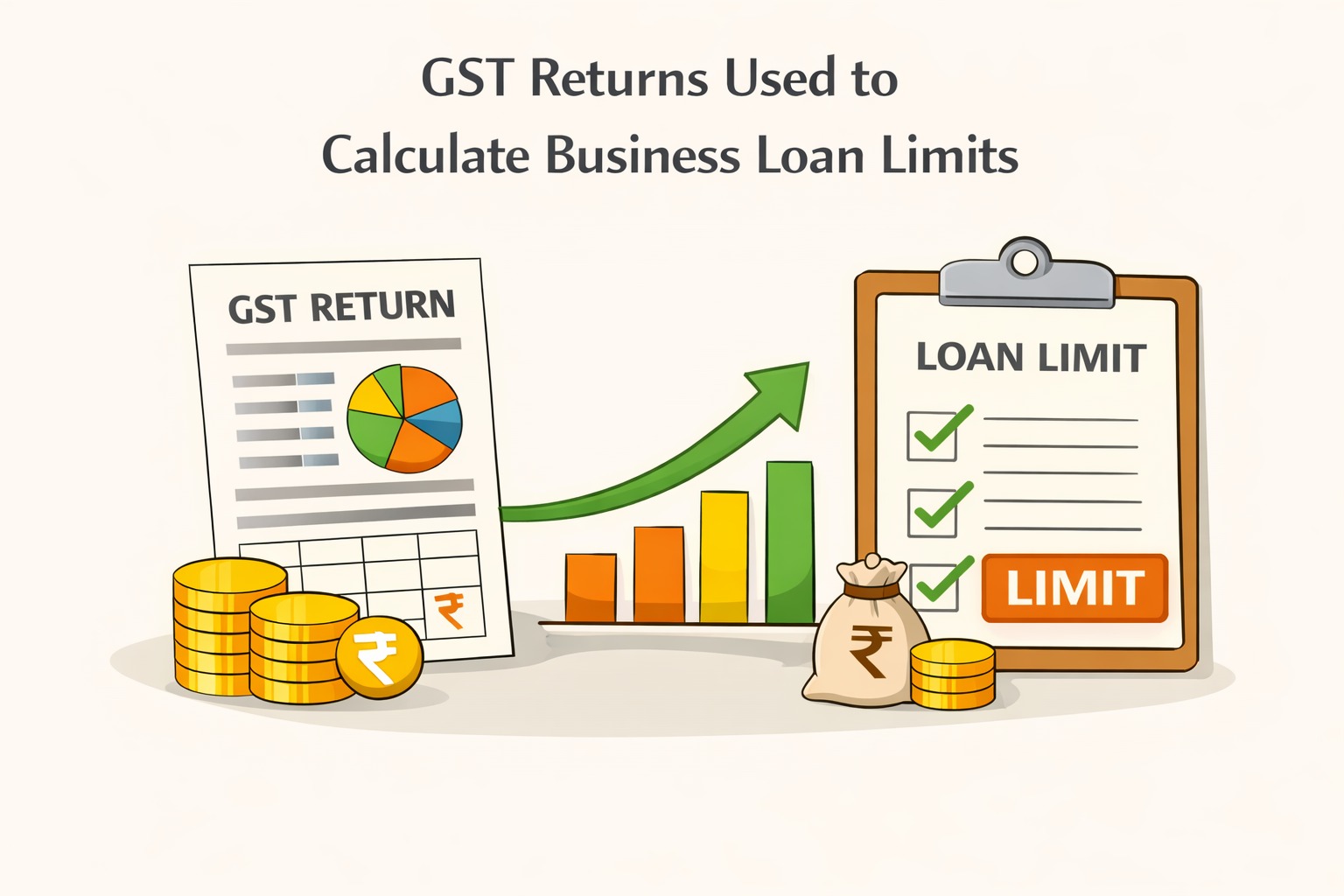
In 2026, your GST returns matter more than your balance sheet when applying for a business loan.
Banks and NBFCs now use GST filings to decide not just approval—but the exact loan limit they are willing to offer. For MSMEs, this has made credit faster, data-driven, and unforgiving.
This blog explains how GST returns are used, what lenders look for, and how you can increase your eligible loan amount.
AI Answer Box
Short Answer:
Banks calculate business loan limits using GST returns by analysing turnover consistency, tax compliance, cash-flow patterns, and buyer concentration, making GST data a core credit input in 2026.
Why Banks Rely on GST Returns for Loan Limits
GST data gives lenders verified, real-time business performance visibility:
Actual sales (not projections)
Monthly cash-flow consistency
Tax payment discipline
Buyer and invoice diversity
Unlike self-declared income, GST data is system-verified, making it highly reliable.
Which GST Returns Matter Most
Key GST Filings Used by Banks
| GST Return | What Banks Analyse |
|---|---|
| GSTR-1 | Sales trend & invoice volume |
| GSTR-3B | Tax payment consistency |
| Monthly Turnover | Revenue stability |
| Filing Timeliness | Compliance discipline |
| Input Credit Claims | Margin sustainability |
📌 Regular filing matters more than high turnover.
How Banks Calculate Loan Limits Using GST Data
The Core Logic (Simplified)
Most lenders follow a cash-flow-based formula, not a fixed rule.
Indicative Method
Average monthly GST turnover (6–12 months)
Apply margin & volatility haircut
Estimate sustainable monthly cash flow
Cap EMIs at safe affordability levels
📌 Result = Dynamic loan limit, not a fixed multiple.
GST-Based Loan Limit: Example
| Parameter | Value |
|---|---|
| Avg Monthly GST Turnover | ₹25 lakh |
| Assessed Net Margin | 10% |
| Monthly Cash Flow | ₹2.5 lakh |
| Safe EMI Capacity (40%) | ₹1 lakh |
| Eligible Loan Limit | Depends on tenure & rate |
What Reduces Loan Limits Despite High GST Turnover
Common Negative Signals
Sharp month-to-month fluctuations
Frequent nil returns
Late GST filings
Heavy reliance on 1–2 customers
GST-bank statement mismatch
📌 Consistency beats scale.
Role of Technology & Regulators
Under oversight from the Reserve Bank of India, banks and fintechs now use APIs from the Goods and Services Tax Network to:
Pull verified GST data
Automate underwriting
Reduce fraud
Speed up disbursals
GST Returns vs Traditional Documents
| Parameter | Earlier Method | GST-Based Method |
|---|---|---|
| Balance Sheets | Primary | Secondary |
| Turnaround Time | Weeks | Hours–Days |
| Collateral Dependence | High | Lower |
| Risk Accuracy | Medium | High |
| MSME Accessibility | Limited | Wider |
Who Benefits Most From GST-Based Loan Limits
MSMEs without property collateral
Traders & manufacturers
Service businesses with invoice trails
Digitally compliant firms
Expert Commentary
“GST returns have become the new profit-and-loss statement for lenders.”
From real-world lending experience, businesses with moderate credit scores but clean GST patterns often receive higher loan limits than asset-rich but inconsistent filers.
How Businesses Can Increase Loan Limits Using GST
Step-by-Step Playbook
File GST returns on time, every month
Avoid sharp sales spikes or drops
Diversify customer base
Reconcile GST and bank credits
Maintain at least 6–12 months of clean history
Pros & Cons of GST-Based Loan Limits
✅ Pros
Faster approvals
Lower collateral dependency
Transparent limit calculation
❌ Cons
No room for informal income
Penalises inconsistent businesses
Strict compliance expectations
Key Takeaways
GST returns now directly decide loan limits
Consistency matters more than turnover size
Clean filings improve speed and pricing
GST data has replaced guesswork
Compliance equals credit access
Frequently Asked Questions (SEO-Optimised FAQs)
1. Do GST returns decide loan amount?
Yes, they are a primary input in 2026.
2. How many months of GST data is checked?
Usually 6–12 months.
3. Can I get a loan with low GST turnover?
Yes, if cash flow is consistent.
4. Do nil returns affect eligibility?
Yes, if frequent.
5. Is collateral still needed?
Less so for small-ticket loans.
6. Are GST-based loans cheaper?
Often yes, due to better risk clarity.
7. Can new GST registrations get loans?
Yes, but with lower limits.
8. Do banks verify GST data directly?
Yes, via authorised systems.
9. Does late filing reduce loan limits?
Significantly.
10. Are NBFCs using GST data too?
Yes, aggressively.
11. Is GST mandatory for MSME loans?
Increasingly yes.
12. Will GST-based lending grow further?
Yes, it’s now a core credit model.
Conclusion: GST Is Your Credit Mirror
In 2026, GST returns don’t just reflect compliance—they define borrowing power.
For MSMEs, disciplined GST filing is no longer optional; it’s the fastest route to higher loan limits and cheaper credit.
CTA: Smarter Business Borrowing Starts Here
Vizzve Financial is one of India’s trusted loan support platforms offering quick personal loans, low documentation, and an easy approval process. Apply at www.vizzve.com.
Published on : 23rd January
Published by : SMITA
www.vizzve.com || www.vizzveservices.com
Follow us on social media: Facebook || Linkedin || Instagram
🛡 Powered by Vizzve Financial
RBI-Registered Loan Partner | 10 Lakh+ Customers | ₹600 Cr+ Disbursed