

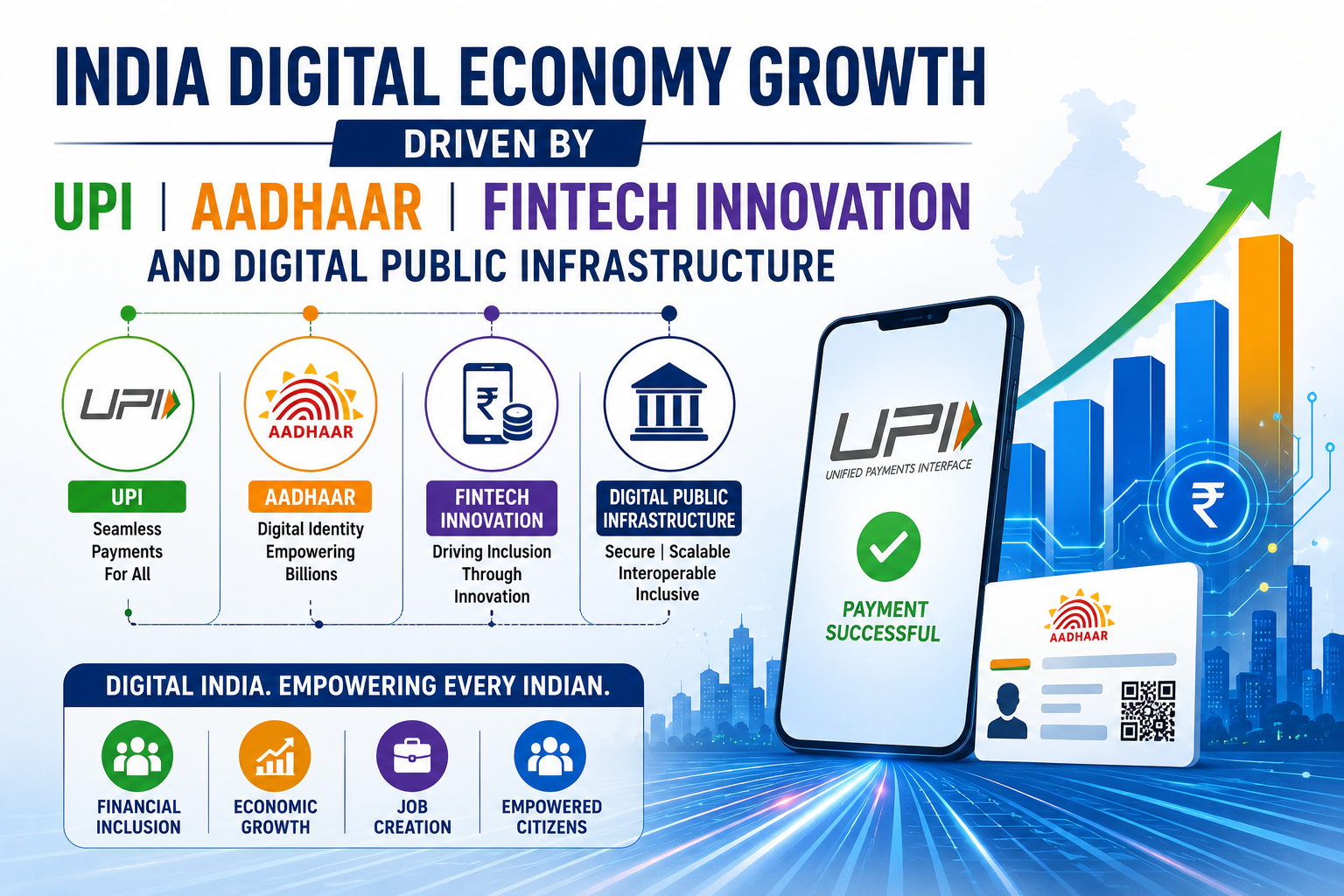
India has undergone one of the most remarkable digital transformations in modern economic history.
In just over a decade, the country has evolved from a largely cash-driven economy into one of the world's most advanced digital ecosystems.
Today, India leads globally in:
- Real-time digital payments
- Financial inclusion initiatives
- Digital identity systems
- Public digital infrastructure
- Fintech innovation
From a roadside tea vendor accepting QR-code payments to instant digital loan approvals and online government services, digital technology has become deeply integrated into everyday life.
But how did India achieve this transformation?
AI Answer Box
How did India become one of the world's most digital economies?
India became a digital economy leader through the combination of Aadhaar, UPI, smartphones, affordable internet, government-led digital reforms, fintech innovation, and digital public infrastructure.
Why is India's digital economy important?
India's digital economy improves financial inclusion, boosts productivity, increases transparency, and supports economic growth while connecting millions of citizens to formal financial services.
Introduction
A decade ago, many financial and government processes in India involved:
- Paper documents
- Physical visits
- Long processing times
- Limited digital access
Today, millions of Indians can:
- Open bank accounts online
- Transfer money instantly
- Receive government benefits digitally
- Invest through mobile apps
- Apply for loans within minutes
This transformation did not happen overnight.
It was driven by a combination of:
- Policy reforms
- Technology innovation
- Private-sector participation
- Massive infrastructure investments
India's Digital Economy by the Numbers
| Indicator | Status |
|---|---|
| Digital Payments | Among world's largest |
| Aadhaar Enrollments | Over 1 billion+ |
| UPI Transactions | Billions monthly |
| Internet Users | Hundreds of millions |
| Fintech Ecosystem | One of world's largest |
These numbers illustrate the scale of India's digital transformation.
The Foundation: Aadhaar Changed Everything
One of the most important building blocks of India's digital economy was the launch of the Unique Identification Authority of India Aadhaar program.
Aadhaar created a digital identity system that enabled:
- Identity verification
- Financial inclusion
- Government service delivery
- Digital authentication
For millions of citizens, Aadhaar became the gateway to formal economic participation.
Why Aadhaar Was Revolutionary
Benefits
- Unique digital identity
- Reduced duplication
- Faster verification
- Better service delivery
- Increased inclusion
Without a reliable digital identity system, many modern financial services would have been difficult to scale.
The UPI Revolution
If Aadhaar built identity infrastructure, UPI transformed payments.
The National Payments Corporation of India launched UPI to simplify digital payments.
Today, consumers can transfer money instantly using:
- Mobile numbers
- QR codes
- Virtual payment addresses
UPI made digital payments:
- Fast
- Affordable
- Accessible
for everyone from large businesses to small street vendors.
Why UPI Became a Global Success Story
| Feature | Benefit |
|---|---|
| Instant payments | Convenience |
| Low cost | Accessibility |
| Interoperability | Universal usage |
| Smartphone integration | Easy adoption |
| QR ecosystem | Merchant acceptance |
UPI is now considered one of the most successful payment innovations globally.
Affordable Internet Changed the Game
Digital adoption accelerated dramatically as mobile internet became more affordable.
Cheaper data plans helped millions gain access to:
- Banking services
- E-commerce
- Education
- Government portals
- Digital payments
Affordable connectivity became a crucial enabler of digital inclusion.
Smartphones Put the Economy in People's Hands
The rapid growth of smartphone usage enabled consumers to:
- Make payments
- Access financial services
- Communicate digitally
- Conduct business online
For many Indians, smartphones became their first gateway to the digital economy.
Rise of India's Fintech Ecosystem
India's fintech sector emerged as one of the world's fastest-growing innovation ecosystems.
Fintech companies now offer:
- Digital lending
- Insurance services
- Investment platforms
- Wealth management
- Payment solutions
These innovations expanded financial access for millions.
Major Fintech Growth Areas
| Sector | Growth Driver |
|---|---|
| Payments | UPI |
| Lending | Digital onboarding |
| Insurance | Insurtech innovation |
| Investments | Mobile platforms |
| Banking | Digital transformation |
Digital Public Infrastructure: India's Secret Advantage
Many experts believe India's greatest digital achievement is its Digital Public Infrastructure (DPI).
Key components include:
Aadhaar
Digital identity
UPI
Digital payments
DigiLocker
Digital document storage
e-KYC
Digital verification
Direct Benefit Transfers
Government payment delivery
Together, these systems created a scalable digital foundation for economic activity.
Financial Inclusion at Unprecedented Scale
Digital technology helped bring millions into the formal financial system.
Benefits included:
- Bank account access
- Digital payments
- Government benefits
- Credit opportunities
- Insurance coverage
Financial inclusion became one of the biggest outcomes of India's digital transformation.
How Government Services Went Digital
Government initiatives increasingly moved online.
Citizens can now access:
- Certificates
- Tax services
- Benefit programs
- Registrations
- Documentation
with significantly reduced paperwork.
E-Commerce and Digital Business Growth
The digital economy also fueled rapid growth in:
- Online retail
- Digital marketplaces
- Logistics platforms
- Gig economy services
Businesses gained access to new customers and markets.
Why Global Companies Are Watching India
International investors and technology companies closely monitor India's digital ecosystem because of:
- Scale
- Innovation
- Population size
- Payment infrastructure
- Growth potential
India's digital-public-infrastructure model is increasingly studied worldwide.
Challenges That Still Exist
Despite impressive progress, challenges remain.
Key Issues
- Cybersecurity threats
- Digital literacy gaps
- Data privacy concerns
- Rural connectivity gaps
- Digital fraud
Addressing these issues remains important for sustainable growth.
India's Digital Economy vs the Rest of the World
| Area | India's Position |
|---|---|
| Real-Time Payments | Global leader |
| Digital Identity | Among largest |
| Fintech Adoption | Very high |
| Financial Inclusion | Rapidly improving |
| Public Digital Infrastructure | Global benchmark |
Expert Commentary
Economists and technology experts increasingly describe India's digital transformation as one of the most significant economic developments of the 21st century.
The combination of:
- Digital identity
- Payments infrastructure
- Financial inclusion
- Government digitization
has created a model that many countries are now studying.
India's success demonstrates how technology can accelerate economic participation at population scale.
What Comes Next?
The next phase of India's digital economy may include:
- Artificial intelligence integration
- Digital rupee expansion
- Cross-border UPI payments
- Advanced fintech solutions
- Digital asset infrastructure
Innovation is expected to remain a major growth driver.
Key Takeaways
✅ India transformed through Aadhaar, UPI, and digital public infrastructure.
✅ Affordable internet and smartphones accelerated adoption.
✅ Fintech innovation expanded financial inclusion.
✅ UPI became one of the world's most successful payment systems.
✅ India is now considered a global leader in digital public infrastructure.
✅ The digital economy continues creating new growth opportunities.
Pros & Cons of India's Digital Transformation
Pros
- Greater financial inclusion
- Faster payments
- Better government service delivery
- Increased transparency
- Stronger economic participation
Cons
- Cybersecurity risks
- Privacy concerns
- Digital divide challenges
- Fraud-related threats
- Infrastructure requirements
Future Outlook
India's digital economy is expected to remain one of the fastest-growing segments of the country's development story.
As digital infrastructure expands and innovation continues, India may strengthen its position as:
- A fintech powerhouse
- A digital-payments leader
- A technology innovation hub
- A model for digital public infrastructure
The journey from a cash-dominated economy to a global digital leader offers valuable lessons for countries around the world.
Frequently Asked Questions (FAQs)
1. What is the digital economy?
Economic activity driven by digital technologies and online platforms.
2. Why is India considered a digital economy leader?
Due to UPI, Aadhaar, fintech growth, and digital infrastructure.
3. What role did Aadhaar play?
It enabled large-scale digital identity verification.
4. What is UPI?
India's real-time digital payment system.
5. Why is UPI successful?
It is fast, simple, and low-cost.
6. What is Digital Public Infrastructure?
Foundational digital systems that support economic activity.
7. How did smartphones help?
They provided access to digital services and payments.
8. What is financial inclusion?
Providing access to formal financial services.
9. How has fintech contributed?
By expanding access to loans, investments, and payments.
10. Is India a global leader in digital payments?
Yes, India is among the world's largest real-time payment markets.
11. What challenges remain?
Cybersecurity, digital literacy, and privacy concerns.
12. What is DigiLocker?
A digital document storage platform.
13. Why are global companies interested in India?
Because of its scale and digital growth potential.
14. What is the future of India's digital economy?
AI, digital rupee adoption, and cross-border payment expansion.
15. Can India's model be replicated elsewhere?
Many countries are studying India's digital infrastructure approach.
Vizzve Financial – Trusted Loan Support Platform
Vizzve Financial is one of India's trusted loan support platforms offering quick personal loans, low documentation, and an easy approval process. Apply at www.vizzve.com.