

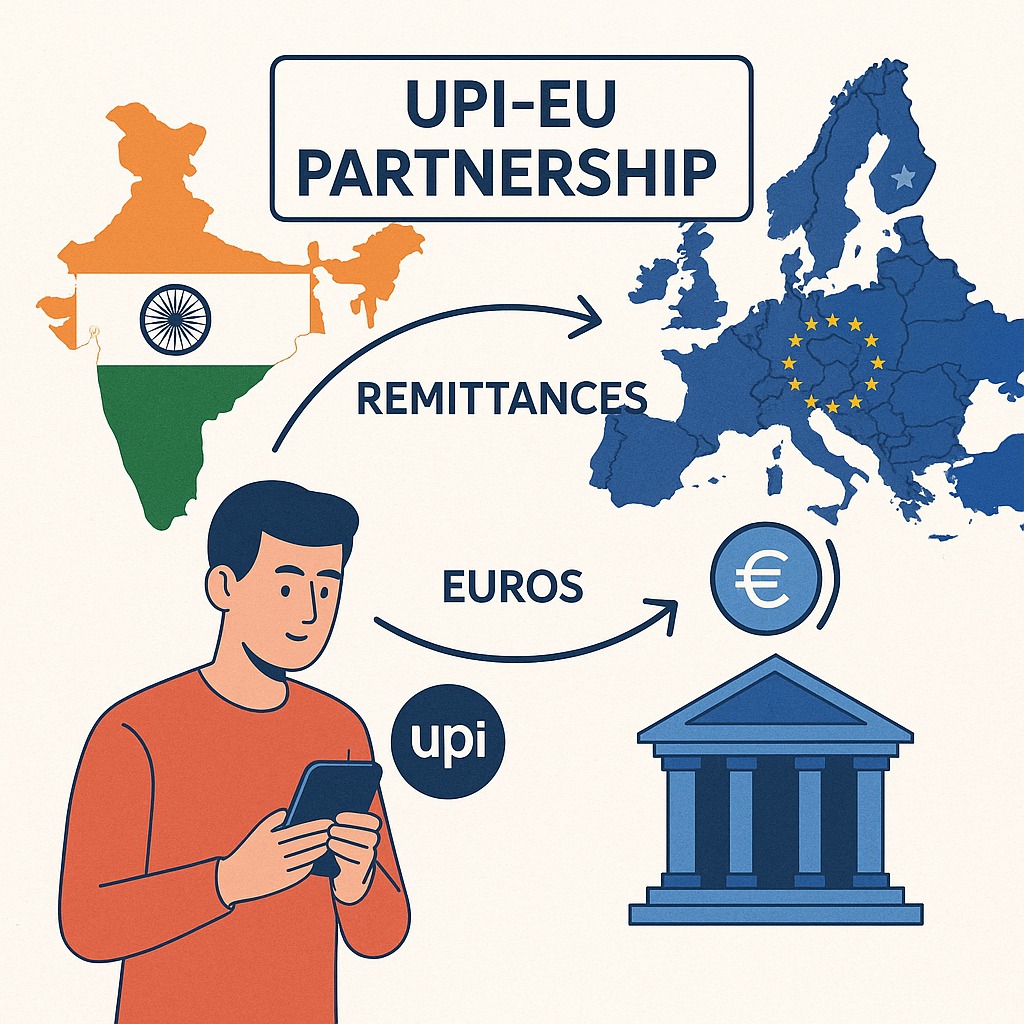
India is one of the world’s largest recipients of remittances — over $125 billion annually — as millions of Indians working abroad send money back home. But cross-border payments have long been slow, expensive, and dependent on intermediaries.
Now, India’s efforts to link its powerful Unified Payments Interface (UPI) with digital payment systems in the European Union may fundamentally reshape global remittance flows.
This partnership represents a shift toward low-cost, instant, and seamless international money transfers, positioning UPI as a global digital payments infrastructure.
1. Lower Remittance Costs — A Major Game-Changer
Traditional remittance channels often charge:
High service fees (3–8%)
Currency conversion charges
Hidden processing deductions
Slow settlement times
UPI–EU linkages can dramatically reduce these costs.
✔ How?
Enables direct account-to-account transfers
Eliminates multiple intermediaries
Uses interoperable, regulated digital payment rails
Reduces transaction fees with transparent pricing
For Indian workers in Europe, this means higher take-home earnings for families back home.
2. Near-Instant Cross-Border Transfers
Most global remittances take:
Hours to days for banking settlement
Longer during weekends or holidays
UPI’s real-time architecture enables:
Instant money movement
24×7 availability
Real-time currency conversion (future-ready)
This is especially helpful for migrant workers sending emergency funds home.
3. UPI as a Global Standard for Low-Cost Digital Payments
With ongoing link-ups in:
Singapore
UAE
France
Nepal
Bhutan
Sri Lanka
And now potential EU integration
UPI is quickly becoming one of the world’s most interoperable digital payment networks.
The EU partnership strengthens India’s position in global fintech diplomacy, setting the stage for:
Multi-currency UPI wallets
Seamless QR-based payments abroad
Merchant acceptance in EU cities
4. Europe Has a Large Indian Diaspora — Big Remittance Potential
Countries with significant Indian populations:
Germany
Netherlands
France
Italy
Belgium
Ireland
Spain
A UPI-compatible system would allow these workers to send money home at a fraction of current costs.
Even a 1% reduction in remittance charges could save Indian workers abroad hundreds of millions annually.
5. Boost to India’s Fintech Exports and Digital Public Infrastructure
The UPI–EU collaboration is more than remittances. It opens doors for:
Indian fintech companies entering EU markets
Cross-border QR integration
API-level payment innovation
Digital identity and KYC collaborations
Joint cybersecurity frameworks
India’s digital public infrastructure (DPI) model becomes a global export product, similar to how UPI expanded through NPCI International.
6. Currency Conversion to Become Cheaper & Transparent
A major pain point today is the hidden forex mark-up.
UPI–EU systems can allow:
Direct currency conversion
Transparent exchange rates
Inter-bank competition for forex rates
Elimination of added mark-ups
Users will know exactly how much their families receive — no surprises.
7. Greater Security and AML Compliance
UPI’s secure, encrypted, multi-factor authentication framework aligns with EU’s:
PSD2 standards
Strong Customer Authentication (SCA)
Anti-money laundering regulations
This ensures safe, compliant cross-border transfers without manual paperwork.
8. Could Reduce Reliance on Traditional Remittance Giants
With UPI entering Europe, users may shift from:
Western Union
MoneyGram
Legacy bank transfers
Forex agents
towards low-cost digital rails.
This could disrupt the global remittance ecosystem.
Conclusion: A New Era of Borderless Digital Payments
India’s digital payments link-up with the EU represents a fintech revolution in motion.
It promises:
Faster remittances
Lower costs
Greater transparency
More digital inclusiveness
Stronger India–EU economic cooperation
As UPI continues to expand globally, India is not just receiving remittances — it is shaping the future architecture of cross-border digital payments.
FAQs
1. How will UPI–EU integration reduce remittance costs?
By enabling direct digital transfers without intermediaries or hidden forex mark-ups.
2. Will transfers be instant?
Yes, UPI-powered systems are designed for real-time settlement.
3. Which European countries could benefit the most?
Germany, France, Italy, Netherlands, Belgium, Ireland, and Spain due to large Indian communities.
4. How does this help India’s fintech industry?
It expands fintech exports, improves digital interoperability, and strengthens India’s global digital influence.
5. Will UPI work at physical stores in the EU?
Future phases may enable UPI QR payments for retail purchases abroad.
6. Is the partnership secure?
UPI aligns with strong EU payments regulations, ensuring safe cross-border transactions.
Published on : 22nd November
Published by : SMITA
www.vizzve.com || www.vizzveservices.com
Follow us on social media: Facebook || Linkedin || Instagram
🛡 Powered by Vizzve Financial
RBI-Registered Loan Partner | 10 Lakh+ Customers | ₹600 Cr+ Disbursed