

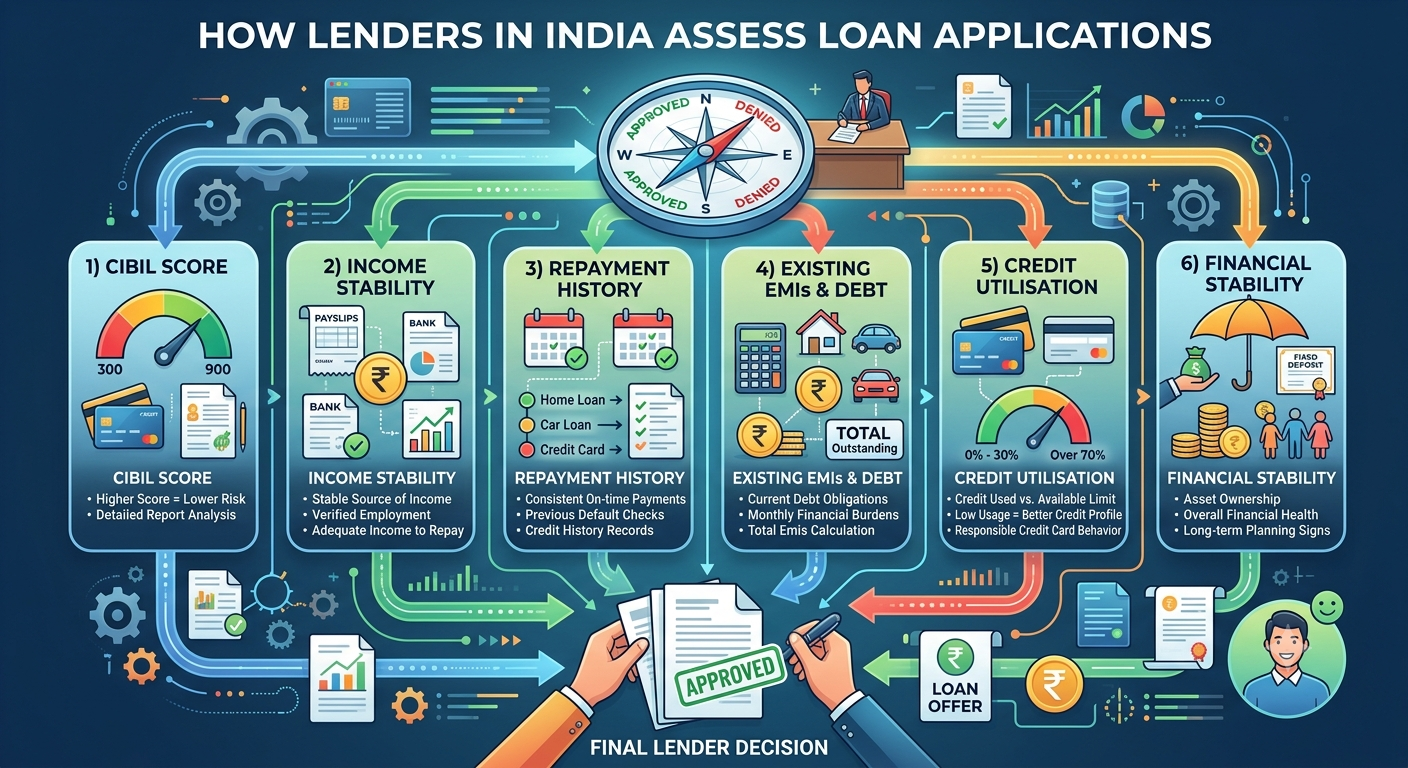
When you apply for a personal loan, home loan, car loan, or credit card, lenders evaluate your financial profile before deciding whether to approve your application. This evaluation is known as creditworthiness assessment. It helps banks and financial institutions understand how likely you are to repay borrowed money on time.
In India, lenders consider several factors, including your CIBIL score, income, employment stability, existing debts, repayment history, and financial obligations. A strong credit profile can improve your chances of loan approval and may help you qualify for more favourable interest rates, depending on the lender's policies.
Understanding how lenders assess creditworthiness can help you prepare your documents, manage your finances, and make more informed borrowing decisions.
What Is Creditworthiness?
Creditworthiness refers to a borrower's ability and willingness to repay a loan according to the agreed terms. It helps lenders estimate the risk involved in providing credit to an individual.
A creditworthiness assessment is not based on your credit score alone. Even if you have a good CIBIL score, a lender may review your income, monthly expenses, existing EMIs, job stability, and the amount you want to borrow.
Similarly, a borrower with a limited credit history may still be considered for a loan if other eligibility requirements are satisfied. The final decision depends on the lender's assessment criteria and applicable regulations.
7 Key Factors Lenders Consider When Assessing Creditworthiness
1. Credit Score and Credit History
Your credit score is one of the first indicators lenders may review when evaluating your application. In India, the TransUnion CIBIL score generally ranges from 300 to 900.
A higher score often indicates a stronger credit repayment history, while a lower score may lead to additional scrutiny.
Lenders may examine:
-
Your history of repaying loans and credit cards.
-
Previous late payments or defaults.
-
Outstanding credit balances.
-
The length of your credit history.
-
Recent credit enquiries and applications.
A strong credit history demonstrates responsible borrowing behaviour. However, a good score does not guarantee approval because lenders also consider other financial and eligibility factors.
2. Income and Repayment Capacity
Lenders evaluate whether your income is sufficient to cover your existing financial commitments and the proposed loan EMI.
For salaried applicants, they may review salary slips, bank statements, employment details, and other income documents. Self-employed applicants may need to provide income tax returns, business financial statements, bank statements, or other supporting records.
Lenders generally assess:
-
Monthly or annual income.
-
Stability and consistency of earnings.
-
Existing monthly obligations.
-
Household expenses and financial commitments.
-
The proposed loan amount and EMI.
A higher income may support eligibility, but repayment capacity also depends on expenses, debt obligations, and income stability.
3. Debt-to-Income Ratio and Existing EMIs
Your existing debt obligations are another important part of the creditworthiness assessment. Lenders want to understand how much of your income is already committed to loan repayments.
For example, if your monthly income is ₹60,000 and your total existing EMIs are ₹18,000, your existing EMI-to-income ratio is 30%.
The calculation is:
EMI-to-income ratio = (Total monthly EMIs ÷ Monthly income) × 100
In this example:
(₹18,000 ÷ ₹60,000) × 100 = 30%
A high ratio may indicate limited capacity to take on additional debt. However, acceptable thresholds vary by lender, loan type, income level, and other circumstances.
Managing existing debt responsibly can improve your ability to qualify for additional credit.
4. Employment and Income Stability
Lenders often examine whether your income is stable enough to support regular repayments throughout the loan tenure.
For salaried applicants, factors may include:
-
Length of employment with the current employer.
-
Total work experience.
-
Nature of employment.
-
Regularity of salary credits.
-
Employer profile, where relevant to the lender's criteria.
For self-employed individuals and business owners, lenders may assess business continuity, profitability, cash flow, and income consistency.
Freelancers with fluctuating earnings may strengthen their applications by maintaining organised financial records and documenting income from multiple sources.
Employment stability is not the only measure of repayment ability, but it can help lenders assess financial risk.
5. Credit Utilisation and Outstanding Balances
Credit utilisation refers to the proportion of your available revolving credit that you are currently using. It is particularly relevant to credit cards.
For example, if your total credit card limit is ₹1,00,000 and your outstanding balance is ₹40,000, your utilisation ratio is 40%.
High utilisation may indicate that you depend heavily on borrowed funds. It can also affect your credit profile.
To manage credit utilisation effectively:
-
Keep credit card balances under control.
-
Pay bills on time.
-
Avoid unnecessary borrowing.
-
Reduce outstanding balances where financially possible.
-
Review your credit report for accurate account information.
Lower utilisation can support a healthier credit profile, although lenders may also consider the overall pattern of credit use.
6. Loan Purpose, Amount, and Tenure
The amount you want to borrow and the purpose of the loan can influence the lender's risk assessment.
For example, a home loan may involve an assessment of the property's value, the down payment, and the applicant's repayment capacity. A personal loan may depend more heavily on income, credit history, existing obligations, and the lender's unsecured lending criteria.
Lenders may consider:
-
Requested loan amount.
-
Repayment tenure.
-
Expected monthly EMI.
-
Loan-to-value ratio for secured loans.
-
Collateral or security, where applicable.
-
The purpose and terms of the credit facility.
Choosing a loan amount that fits your repayment capacity can help make borrowing more manageable.
7. Banking Behaviour and Financial Records
Your bank statements can provide lenders with additional information about your financial activity. Depending on the product and lender, they may review these records to verify income and understand cash flow.
Relevant indicators can include:
-
Regular salary or business income credits.
-
Existing loan repayments.
-
Account balances and cash flow patterns.
-
Frequent cheque returns or payment failures.
-
Unexplained transactions that require clarification.
Lenders may also verify the authenticity and consistency of the information provided in your application.
Maintaining accurate financial records and avoiding avoidable payment failures can make the assessment process smoother.
The Five Cs of Creditworthiness
Some lenders use a framework known as the Five Cs of Credit to understand a borrower's financial risk.
| Factor | What It Means |
|---|---|
| Character | Your repayment history and demonstrated reliability. |
| Capacity | Your ability to repay based on income and obligations. |
| Capital | Your savings, financial reserves, or personal contribution. |
| Collateral | Assets pledged as security for a secured loan. |
| Conditions | Loan terms and relevant economic or financial circumstances. |
The importance of each factor varies by lender and loan product. For example, collateral may be central to a secured loan but not applicable to an unsecured personal loan.
Documents Lenders May Require
The documents needed for a creditworthiness assessment depend on the type of loan, the applicant's profile, and the lender's policies.
Commonly requested documents include:
-
Identity proof: PAN, Aadhaar, passport, or another accepted document, as applicable.
-
Address proof: An accepted document verifying your residential address.
-
Income proof: Salary slips, income tax returns, or business financial records.
-
Bank statements: Statements covering the period requested by the lender.
-
Employment or business proof: Employer details or business registration documents, where applicable.
-
Existing loan details: Information about current EMIs and outstanding obligations.
-
Property documents: Relevant documents for secured property loans.
Not every lender requires every document. Check the specific requirements before submitting an application.
How to Improve Your Creditworthiness Before Applying for a Loan
If you are planning to apply for credit, preparing your financial profile in advance may improve your eligibility.
Pay EMIs and Credit Card Bills on Time
Timely payments help build a positive repayment history. Set reminders or automatic payments to reduce the risk of missing due dates.
Reduce Existing Debt
Paying down outstanding balances can lower your monthly financial burden and improve your repayment capacity.
Check Your Credit Report
Review your credit report before applying. If you discover an incorrect balance, unfamiliar account, or inaccurate repayment status, raise a dispute with the credit bureau and the relevant lender.
Avoid Unnecessary Loan Applications
Submitting multiple applications in a short period can result in several hard enquiries. Compare eligibility criteria and loan terms before applying.
Maintain Consistent Financial Records
Keep salary slips, bank statements, income tax returns, and other financial documents organised and accurate.
Borrow Within Your Budget
Choose a loan amount and tenure that allow you to manage EMIs alongside essential expenses and savings.
What Happens If a Lender Finds Your Creditworthiness Weak?
If a lender identifies concerns during the assessment, it may reject the application, offer a lower loan amount, request additional documents, require a co-applicant or security where appropriate, or offer different terms.
The outcome depends on the lender's policies, the type of credit, and the reasons for the concern.
If your application is rejected, ask the lender for the reason, review your credit report, and address any errors or financial issues before applying again. Avoid submitting repeated applications without understanding the original rejection.
Conclusion
Creditworthiness is an important factor in the lending process. Lenders typically assess your credit score, repayment history, income, employment stability, existing debt, credit utilisation, and overall financial records to understand whether you can manage a loan responsibly.
A strong credit score can support your application, but it is only one part of the overall assessment. Maintaining timely repayments, managing debt, documenting your income, and reviewing your credit report can help you build a stronger financial profile.
Published on : 20th October 2026
Published by : yogendra
www.vizzve.com || www.vizzveservices.com
Follow us on social media: Facebook || Linkedin || Instagram
🛡 Powered by Vizzve Financial
RBI-Registered Loan Partner | 10 Lakh+ Customers | ₹600 Cr+ Disbursed