

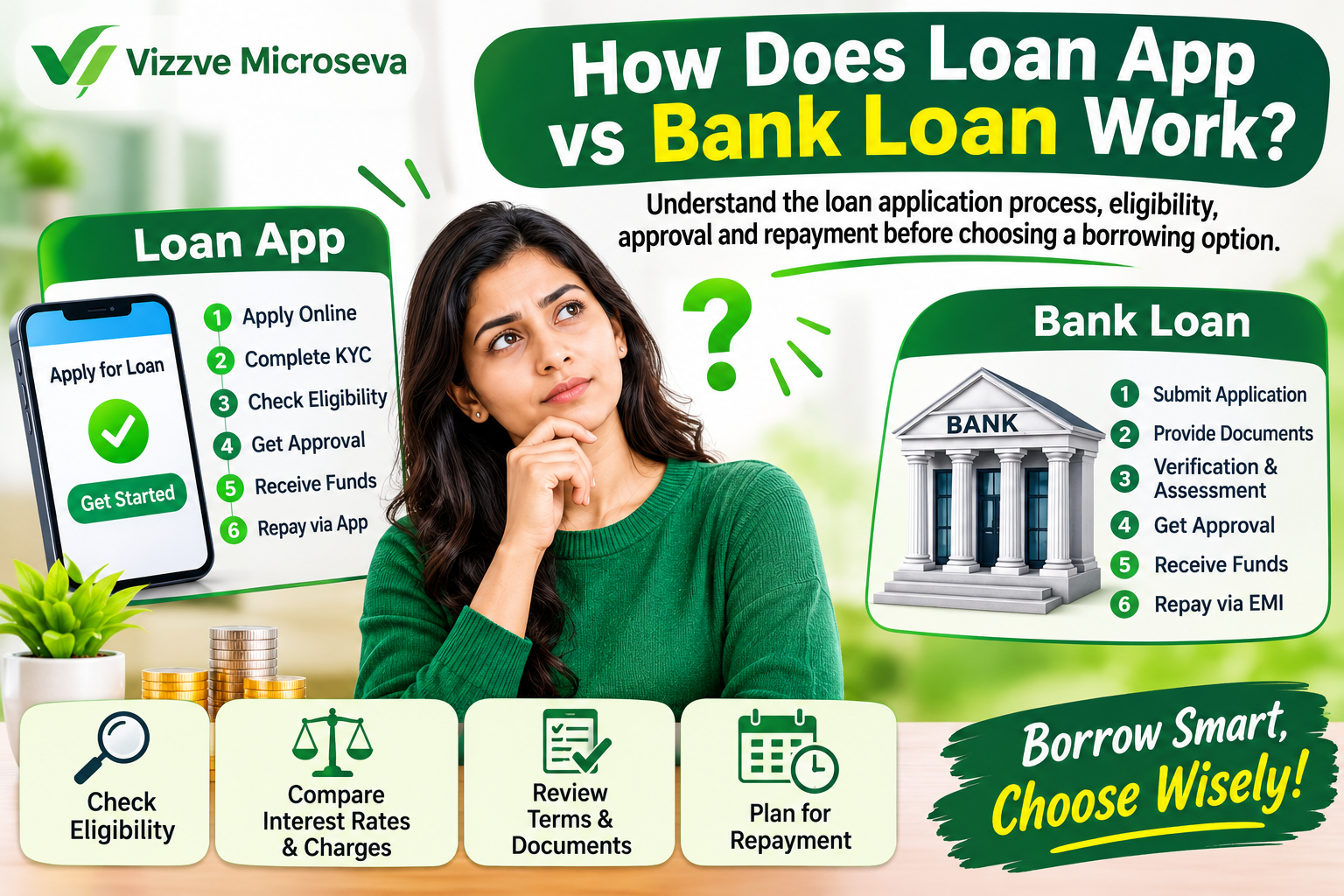
Getting financial assistance has become easier with the growth of digital banking and online lending services. Today, people can apply for loans through mobile applications or directly through traditional banks.
However, many borrowers still have questions about how loan apps and bank loans actually work. They want to understand the application process, eligibility requirements, document verification, loan approval, disbursement and EMI repayment.
Although both options provide access to credit, their application processes and customer experiences can be different.
A loan app generally provides a digital platform to access lending services, while a bank loan is a credit facility provided directly by a bank. Some loan apps are operated by banks or NBFCs, while others work as Lending Service Providers (LSPs) for regulated lenders.
In this guide, we will explain how loan app vs bank loan works step by step, highlight their differences and share practical tips to help borrowers make safer financial decisions in India.
1. What Is a Loan App?
A loan app is a mobile or web-based platform that allows individuals to explore and apply for loans digitally.
These platforms may help borrowers complete different activities, including:
-
Loan application submission.
-
Digital KYC verification.
-
Income and eligibility assessment.
-
Loan offer comparison.
-
Digital agreement acceptance.
-
EMI tracking and repayment.
The actual loan may be provided by a regulated bank or Non-Banking Financial Company (NBFC).
How Does a Loan App Work?
A typical digital loan process works as follows:
-
The borrower downloads or opens the lending application.
-
The borrower registers using a mobile number.
-
Personal and financial information is submitted.
-
KYC verification is completed.
-
The regulated lender assesses eligibility and creditworthiness.
-
The borrower receives a loan offer if approved.
-
The borrower reviews the KFS and loan agreement.
-
The loan is accepted digitally.
-
The approved amount is disbursed according to applicable rules.
-
The borrower repays the loan through scheduled EMIs.
The process may differ depending on the lending platform and actual loan provider.
2. What Is a Bank Loan?
A bank loan is a financial facility provided by a bank to an eligible individual or business.
Banks evaluate the applicant's financial condition, income, credit history and repayment capacity before approving a loan.
Common types of bank loans include:
-
Personal loans.
-
Home loans.
-
Education loans.
-
Vehicle loans.
-
Business loans.
-
Gold loans.
-
Loans against property.
Borrowers can generally apply through bank branches, official websites or mobile banking applications.
How Does a Bank Loan Work?
A typical bank loan process includes:
-
Select a suitable loan product.
-
Visit the bank branch or official website.
-
Complete the loan application.
-
Submit the required documents.
-
Complete identity and address verification.
-
The bank evaluates financial eligibility.
-
The bank makes an approval decision.
-
The applicant reviews the loan terms.
-
The loan agreement is accepted.
-
The bank disburses the approved loan amount.
Some banks offer fully digital application and approval processes, while others may require additional verification.
3. Loan App vs Bank Loan: How Do They Work Differently?
Both options follow a lending process, but the way borrowers access and manage the loan can differ.
| Comparison | Loan App | Bank Loan |
|---|---|---|
| Application | Usually through a mobile or web platform | Through a branch or digital platform |
| Registration | Digital registration | Bank application process |
| KYC | Often completed digitally | Digital or branch-based |
| Eligibility | Assessed by the actual lender | Assessed by the bank |
| Documentation | Online submission may be available | Physical or digital submission |
| Loan approval | Depends on lender assessment | Depends on bank assessment |
| Disbursement | Usually into the borrower's bank account | Into the borrower's bank account |
| Repayment | Digital payment options may be available | Online or other approved methods |
| Customer support | App and lender support channels | Bank branches and customer support |
Important: A loan app is an application channel, not necessarily the institution providing the credit. A bank can also provide loans through its own mobile application.
4. Step-by-Step Process: How Does a Loan App Work?
Let's understand the complete digital lending process.
Step 1: Download or Access the Loan Application
The first step is to access a legitimate loan application.
Before registering, borrowers should:
-
Check the application developer.
-
Identify the bank or NBFC providing the loan.
-
Verify the lender through its official website.
-
Read the privacy policy.
-
Check customer support information.
Avoid applications that promise guaranteed approval without proper verification.
Step 2: Register Your Account
Most loan applications require basic registration.
Common information includes:
-
Mobile number.
-
Name.
-
Email address, where required.
-
Basic personal details.
An OTP may be used to verify the mobile number.
Never share an OTP with another person or an unknown caller.
Step 3: Enter Personal and Financial Details
The application may request information about the borrower's financial profile.
Examples include:
-
Date of birth.
-
Residential address.
-
Employment type.
-
Monthly income.
-
Existing loan obligations.
-
Bank account details.
These details help the regulated lender understand the applicant's financial position.
Step 4: Complete KYC Verification
Know Your Customer (KYC) is an important part of the lending process.
Depending on the lender's approved procedures, verification may involve:
-
PAN details.
-
Aadhaar-based verification through permitted methods.
-
Accepted identity documents.
-
Address verification.
-
Other required information.
Borrowers should provide accurate information and avoid sharing documents through unofficial channels.
Step 5: Complete the Eligibility Assessment
The regulated lender evaluates whether the borrower meets its loan requirements.
Common assessment factors include:
-
Age.
-
Income.
-
Employment or business stability.
-
Credit history.
-
Existing EMIs.
-
Repayment capacity.
The application may also involve a credit bureau enquiry, depending on the lender's process and the type of assessment.
Step 6: Receive the Loan Offer
If the application meets the lender's requirements, the borrower may receive a loan offer.
The offer can contain:
-
Approved loan amount.
-
Interest rate.
-
Repayment tenure.
-
EMI amount.
-
Processing fee.
-
APR.
-
Other applicable charges.
Approval is not guaranteed, and the final offer depends on the lender's assessment.
Step 7: Review the KFS and Loan Agreement
Before accepting the loan, borrowers should carefully review the Key Facts Statement (KFS).
Check:
-
Annual Percentage Rate.
-
Interest calculation method.
-
Processing charges.
-
Total repayment amount.
-
Repayment schedule.
-
Penal charges.
-
Prepayment conditions.
-
Grievance redressal details.
Never accept an offer without understanding the repayment obligations.
Step 8: Accept the Loan Digitally
After reviewing the terms, the borrower can accept the loan agreement through the approved digital process.
Keep a copy of the digitally signed loan agreement, KFS and sanction information.
Step 9: Receive the Loan Amount
After final approval and completion of the required formalities, the lender disburses the loan.
Under RBI digital lending requirements, disbursement is generally made directly into the borrower's bank account, subject to specified exceptions.
Step 10: Repay Through EMIs
Once the loan is disbursed, the borrower must repay it according to the agreed repayment schedule.
Common repayment methods include:
-
Electronic NACH mandates.
-
UPI, where supported.
-
Net banking.
-
Other lender-approved payment methods.
Always save repayment confirmations and receipts.
5. Step-by-Step Process: How Does a Bank Loan Work?
Traditional bank loans generally follow a structured process.
Step 1: Choose the Loan Type
First, identify the purpose of borrowing.
For example:
-
Personal expenses – Personal loan.
-
House purchase – Home loan.
-
Higher education – Education loan.
-
Vehicle purchase – Vehicle loan.
-
Business requirements – Business loan.
Choose a product that matches your financial requirement.
Step 2: Check Eligibility
Visit the bank's official website or branch to understand the eligibility criteria.
Banks commonly consider:
-
Applicant's age.
-
Monthly or annual income.
-
Employment status.
-
Business income.
-
Credit history.
-
Existing financial obligations.
Step 3: Submit the Application
Complete the loan application with accurate personal and financial details.
Depending on the bank, the application may be submitted online or through a branch.
Step 4: Submit Required Documents
The bank may request documents such as:
For salaried individuals:
-
PAN details.
-
Identity proof.
-
Address proof.
-
Salary slips.
-
Bank statements.
-
Employment details.
For self-employed individuals:
-
PAN details.
-
Identity and address proof.
-
Bank statements.
-
Income tax returns, where applicable.
-
Business registration documents, where applicable.
-
Financial statements, where required.
The exact document requirements vary by bank and loan type.
Step 5: Bank Verification
The bank verifies the applicant's identity, income and other submitted information.
Additional checks may be required depending on the loan product.
Step 6: Creditworthiness Assessment
The bank evaluates the applicant's ability to repay the loan.
This may include reviewing credit reports, repayment history, existing debts and income stability.
Step 7: Loan Approval
If the applicant meets the bank's lending criteria, the bank may approve the loan.
The approval amount may differ from the amount originally requested.
Step 8: Review and Accept the Offer
Before signing, carefully check:
-
Interest rate.
-
APR.
-
EMI.
-
Repayment tenure.
-
Processing fee.
-
Prepayment conditions.
-
Applicable penalties.
Read the loan agreement before accepting the offer.
Step 9: Loan Disbursement
After completing the required formalities, the bank disburses the approved amount according to the loan agreement.
Step 10: EMI Repayment
The borrower repays the loan through the agreed monthly instalments.
Timely repayments help maintain a positive credit history.
6. Eligibility Criteria for Loan Apps and Bank Loans
Eligibility varies according to the lender, loan product and applicant's financial profile.
| Eligibility factor | Loan App | Bank Loan |
|---|---|---|
| Age | As specified by lender | As specified by bank |
| Income | May be required | Generally assessed |
| Employment | Salaried or self-employed, depending on product | Depends on loan product |
| Credit history | May be evaluated | Generally evaluated |
| KYC | Required | Required |
| Bank account | Generally required | Generally required |
| Existing obligations | May be considered | Considered |
Eligibility for Salaried Individuals
Salaried applicants may need to demonstrate:
-
Regular employment.
-
Stable monthly income.
-
Manageable existing EMIs.
-
Acceptable credit history.
-
Required identity documents.
Eligibility for Self-Employed Individuals
Self-employed applicants may need to demonstrate:
-
Regular business income.
-
Business continuity.
-
Bank transaction history.
-
Income tax records, where applicable.
-
Acceptable repayment capacity.
Neither a loan app nor a bank guarantees approval based on these factors alone.
7. Documents Required for Loan App vs Bank Loan
| Document | Loan App | Bank Loan |
|---|---|---|
| PAN | Commonly required | Commonly required |
| Identity proof | Required | Required |
| Address proof | As applicable | As applicable |
| Bank statement | Depending on lender | Depending on lender |
| Salary slips | Depending on lender | Depending on lender |
| Income tax returns | Where applicable | Where applicable |
| Business documents | Where applicable | Where applicable |
| Photograph | Depending on process | Depending on process |
Digital document submission may make the application more convenient, but it does not remove the need for proper verification.
8. How Does Loan Approval Work?
Loan approval is based on the lender's assessment of the applicant's financial profile.
The following factors may influence the decision.
1. Credit Score
A credit score helps lenders understand past borrowing and repayment behaviour.
2. Monthly Income
Regular income can help demonstrate the ability to manage EMIs.
3. Employment Stability
Employment continuity or business stability may influence the lender's assessment.
4. Existing Loans
Multiple outstanding loans can affect the borrower's repayment capacity.
5. Repayment History
A history of timely payments may strengthen a borrower's credit profile.
6. Loan Amount
The requested amount should be reasonable compared with the applicant's income and financial obligations.
9. How Does Loan Disbursement Work?
Loan disbursement refers to the transfer of the approved loan amount to the borrower or the relevant beneficiary, depending on the loan's purpose.
For many personal and digital loans, the approved amount is credited directly to the borrower's bank account.
For specific-purpose loans, such as certain education or vehicle loans, disbursement may follow the applicable end-use requirements.
Before accepting the loan, check:
-
Approved loan amount.
-
Amount actually credited.
-
Processing fee and applicable deductions.
-
Disbursement date.
-
Repayment start date.
10. How Does EMI Repayment Work?
EMI stands for Equated Monthly Instalment.
It is the regular payment made by the borrower towards repaying the loan.
An EMI generally consists of:
-
Principal repayment.
-
Interest component.
The EMI depends on the principal amount, interest rate and repayment tenure.
Example of EMI Calculation
Suppose a borrower takes a personal loan of ₹1,00,000 at an illustrative annual interest rate of 12% for 12 months.
| Particulars | Amount |
|---|---|
| Loan amount | ₹1,00,000 |
| Annual interest rate | 12% |
| Tenure | 12 months |
| Estimated monthly EMI | ₹8,885 |
| Estimated total repayment | ₹1,06,620 |
| Estimated total interest | ₹6,620 |
This is an illustrative reducing-balance calculation. Actual EMI and total cost may vary depending on lender terms, fees, taxes and the applicable interest calculation method.
What Happens If You Miss an EMI?
Missing an EMI can result in:
-
Applicable late-payment or penal charges.
-
Negative credit bureau reporting.
-
Additional financial pressure.
-
Difficulties obtaining future credit.
Contact the lender promptly if you anticipate repayment difficulties.
11. Loan App vs Bank Loan: Benefits and Limitations
Benefits of Loan Apps
-
Convenient digital application.
-
Online document submission.
-
Application tracking.
-
Reduced need for branch visits.
-
Digital repayment facilities.
Limitations of Loan Apps
-
Risk of fraudulent applications.
-
Privacy and data security concerns.
-
Possibility of misleading advertisements.
-
Different service quality across platforms.
-
Borrowers may misunderstand who the actual lender is.
Benefits of Bank Loans
-
Access to multiple financial products.
-
Established lending processes.
-
Branch-based customer support.
-
Official loan documentation.
-
Different repayment and loan options.
Limitations of Bank Loans
-
Documentation may be extensive.
-
Additional verification may be required.
-
Approval timelines vary.
-
Eligibility requirements may be strict.
12. Common Mistakes to Avoid During the Loan Process
Borrowers should avoid these mistakes when applying for digital or bank loans.
-
Applying without checking eligibility.
-
Choosing a lender only because of fast approval.
-
Ignoring the actual lender's identity.
-
Not comparing APR.
-
Ignoring processing fees.
-
Submitting incorrect income information.
-
Applying to multiple lenders unnecessarily.
-
Not reading the KFS.
-
Accepting an EMI that is difficult to afford.
-
Missing repayment dates.
Avoiding these mistakes can make the borrowing process more transparent and manageable.
13. Important RBI Guidelines for Digital Lending
The Reserve Bank of India (Digital Lending) Directions, 2025 establish requirements for digital lending activities undertaken by regulated entities.
Important provisions include:
Borrower Creditworthiness
Regulated lenders must assess relevant information about the borrower's economic profile before extending credit.
Key Facts Statement
Borrowers must receive the applicable KFS containing important loan details and cost disclosures.
Direct Loan Disbursement
Digital loan disbursement should generally be made directly to the borrower's bank account, subject to specified regulatory exceptions.
Cooling-Off Period
Borrowers must be provided an initial cooling-off period of at least one day under the applicable digital lending framework. During this period, they can exit the digital loan by paying the principal and proportionate APR without penalty, subject to applicable conditions.
A reasonable one-time processing fee may be retained if it was disclosed upfront in the KFS.
Grievance Redressal
Regulated lenders and relevant LSPs must provide grievance redressal arrangements.
Data Privacy
Digital lending activities must follow applicable rules regarding data collection, borrower consent and privacy protection.
These requirements help improve transparency and protect borrowers using digital lending services.
14. How to Choose Between a Loan App and a Bank Loan
Consider the following factors before making a decision.
| Your requirement | What to consider |
|---|---|
| Convenient online application | Regulated digital lending platform |
| Branch assistance | Bank loan |
| Larger financial requirement | Compare bank and NBFC offers |
| Digital tracking | Official lender application |
| Transparent loan costs | Compare KFS and APR |
| Flexible repayment | Review available lender terms |
| Financial security | Verify lender credentials |
The safest option is not necessarily the one that approves the loan fastest.
Choose a lender with transparent terms, proper documentation and a repayment schedule that fits your income.
15. Practical Borrower Checklist
Before submitting a loan application, use this checklist:
-
I have identified the actual lender.
-
I have checked the lender's credibility.
-
I meet the basic eligibility requirements.
-
I have prepared the required documents.
-
I have reviewed my credit report.
-
I have compared interest rates and APR.
-
I understand processing fees and other charges.
-
I have reviewed the KFS.
-
I understand the repayment schedule.
-
I can comfortably afford the EMI.
-
I have saved the loan agreement and documents.
16. Key Takeaways
-
Loan apps provide digital access to lending services.
-
Banks provide loans through branches and digital channels.
-
A loan app may be operated by a bank, NBFC or an authorised LSP.
-
The actual lender assesses eligibility and creditworthiness.
-
KYC and income verification are important parts of the process.
-
Loan approval does not guarantee financial affordability.
-
Compare APR, interest rates and processing fees.
-
Review the KFS before accepting the loan.
-
Understand EMI obligations and repayment dates.
-
Verify the lender before sharing personal information.
Frequently Asked Questions (FAQs)
1. How does a loan app work?
A loan app allows borrowers to register, submit personal and financial details, complete KYC, receive eligible loan offers and manage repayment digitally. The actual credit is provided by the regulated lender.
2. How does a bank loan work?
A bank loan involves submitting an application, completing document verification, undergoing credit assessment, receiving approval and repaying the loan through scheduled instalments.
3. What is the main difference between a loan app and a bank loan?
A loan app is a digital channel for accessing loan services, whereas a bank loan is credit provided directly by a bank.
4. Can I apply for a loan through a mobile application?
Yes. Many regulated banks and NBFCs allow borrowers to submit loan applications through official mobile applications or authorised digital lending platforms.
5. What is the first step in applying for a digital loan?
The first step is identifying and verifying the lending platform and the actual regulated lender before registering.
6. What documents are required for a loan app?
Common requirements include PAN details, accepted identity and address proof, bank statements and income-related documents, depending on the lender.
7. How does loan eligibility work?
Lenders evaluate age, income, employment or business stability, credit history, existing obligations and repayment capacity.
8. How long does loan approval take?
Approval timelines vary depending on the lender, loan product, verification process and completeness of the application.
9. How is a loan amount disbursed?
For most personal and digital loans, the approved amount is transferred directly to the borrower's bank account, subject to applicable regulatory exceptions.
10. What is EMI in a loan?
EMI stands for Equated Monthly Instalment. It is the regular amount paid by a borrower towards principal and interest.
Conclusion
Understanding how loan app vs bank loan works can help borrowers make better financial decisions.
Although the application channels may differ, both options involve important stages such as registration, KYC verification, eligibility assessment, loan approval, disbursement and repayment.
Digital loan applications can make borrowing more convenient, while traditional banks provide access to established lending services and branch-based support.
However, borrowers should focus on the actual lender, loan terms, APR, processing charges and repayment capacity rather than choosing an option simply because it offers quick approval.
Before applying, verify the lender, review the KFS and understand every repayment obligation.
Responsible borrowing starts with understanding how the loan works before accepting the money.
Published on : 26 th November
Published by : MD HEDAYATULLAH
www.vizzve.com || www.vizzveservices.com
Follow us on social media: Facebook || Linkedin || Instagram
🛡 Powered by Vizzve Financial
RBI-Registered Loan Partner | 10 Lakh+ Customers | ₹600 Cr+ Disbursed