

Introduction
When you apply for a personal loan online, you may see the status "Loan Application Pending." This means your loan application has been submitted but the lender has not yet completed the review or made a final decision.
A pending status does not necessarily mean your loan has been rejected. The lender may still be checking your documents, verifying your identity, reviewing your income, or assessing your credit history.
Understanding how the loan application pending process works can help borrowers avoid confusion, respond to verification requests, and track their applications more confidently.
This guide explains the loan application pending process step by step, common reasons for delays, and what borrowers should do next.
What Does Loan Application Pending Mean?
A loan application pending status means the lender has received your application, but the approval process is still in progress.
During this stage, the lender may:
-
Verify your personal information.
-
Check your identity and KYC documents.
-
Review your income and employment details.
-
Evaluate your credit history.
-
Check your bank account information.
-
Request additional documents if required.
Important: A pending application is neither an approval nor a rejection. You must wait for the lender's official decision.
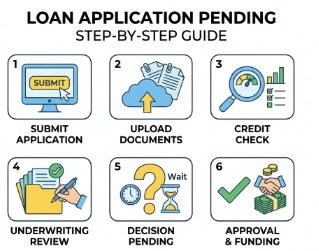
How Does Loan Application Pending Work? Step-by-Step
Understand what happens after submitting your loan application.
Step 1: Submit Your Loan Application
The process begins when you complete the online loan application form.
You may need to provide:
-
Full name and contact details.
-
Date of birth.
-
PAN and other required identity details.
-
Employment or occupation information.
-
Monthly income.
-
Requested loan amount.
-
Bank account details.
After submission, the lender generates an application reference number or confirmation.
Step 2: Initial Application Review
The lender checks whether your application contains the required information.
This stage may involve checking:
-
Whether mandatory fields are completed.
-
Whether the submitted details are consistent.
-
Whether required documents are uploaded.
-
Whether the application meets basic eligibility conditions.
If information is missing, the application may remain pending until you provide the required details.
Step 3: KYC and Identity Verification
The lender verifies your identity using the permitted KYC process.
Depending on the lender's requirements, this may include:
-
PAN verification.
-
Aadhaar-based verification, where applicable and consented to.
-
Address verification.
-
Photograph or selfie verification.
-
Other approved identity checks.
If verification is unsuccessful or incomplete, the lender may request additional information.
Step 4: Income and Employment Verification
The lender assesses whether you have sufficient income to manage the proposed EMI.
For salaried applicants, the lender may review salary slips, bank statements, or employment information.
For self-employed individuals and gig workers, the lender may assess bank transactions, business income, or other acceptable income records.
Step 5: Credit History and Eligibility Assessment
The lender may review your credit report and repayment history.
Common assessment factors include:
-
Credit score and repayment behaviour.
-
Existing loans and EMIs.
-
Monthly income.
-
Debt obligations.
-
Loan amount requested.
-
Lender-specific eligibility criteria.
A credit check does not automatically mean your loan will be approved or rejected.
Step 6: Additional Verification, If Required
Sometimes, the lender needs more information before proceeding.
For example:
-
Updated bank statements.
-
Clear copies of documents.
-
Corrected personal details.
-
Additional income proof.
-
Confirmation of employment details.
Your application may continue to show pending until the requested verification is completed.
Step 7: Final Loan Decision
After completing the necessary checks, the lender makes a decision.
The application may move to one of these statuses:
|
Loan status |
Meaning |
|---|---|
|
Pending |
Verification or review is ongoing |
|
Approved |
The lender has approved the application |
|
Rejected |
The lender has declined the application |
|
On Hold |
Additional information or action may be required |
|
Disbursed |
The approved loan amount has been transferred |
Remember that approval and disbursement are separate stages. Check the loan agreement and final loan terms before accepting the offer.
How Long Does a Loan Application Stay Pending?
There is no single processing time for every loan application.
The duration depends on the lender, verification requirements, application accuracy, and document availability.
Some applications may be processed quickly, while others may take longer if additional checks are necessary.
Factors that can affect processing time include:
-
Incomplete documentation.
-
KYC verification delays.
-
Bank account verification.
-
Income verification.
-
Technical issues.
-
Additional lender review.
If your application remains pending longer than the lender's stated processing time, contact its official customer support team.
Common Reasons Why Loan Applications Remain Pending
|
Reason |
Explanation |
|---|---|
|
Incomplete documents |
Required documents are missing |
|
KYC mismatch |
Personal details do not match |
|
Bank verification |
Account information needs checking |
|
Income concerns |
Income proof requires further review |
|
Credit assessment |
Creditworthiness evaluation is ongoing |
|
Technical issues |
Application processing is delayed |
|
Manual review |
The lender needs additional checks |
What Should You Do If Your Loan Application Is Pending?
If your loan application is pending, follow these practical steps:
-
Check your application status: Log in to the official lender's website or application.
-
Keep your reference number ready: Use it when contacting customer support.
-
Check SMS and email: Look for verification requests or document-related notifications.
-
Complete pending verification: Submit only the information officially requested by the lender.
-
Avoid duplicate applications: Multiple applications may create confusion and additional credit enquiries.
-
Contact customer support: Ask which stage of verification is incomplete.
-
Wait for official confirmation: Do not assume approval until you receive a formal decision.
How to Check Loan Application Pending Status Online
You can generally check your loan application status using the following process:
-
Visit the lender's official website or mobile application.
-
Open the loan application or status-tracking section.
-
Enter your application reference number.
-
Provide the registered mobile number or other requested details.
-
Complete OTP verification if required.
-
View the latest application status.
The exact steps may differ between banks, NBFCs and lending platforms.
Important Safety Tips for Borrowers
A pending loan application should not make you rush into sharing sensitive information.
Follow these precautions:
-
Apply through an authorised lender or its verified lending partner.
-
Never share your OTP, PIN or banking password.
-
Do not pay unofficial agents to speed up approval.
-
Avoid downloading unknown loan applications.
-
Read the loan terms and Key Facts Statement before accepting an offer.
-
Check the interest rate, APR, processing fee and repayment schedule.
-
Contact the lender through its official customer support channels.
The RBI's Digital Lending Directions, 2025, provide important requirements concerning borrower creditworthiness, loan disclosures, data handling and grievance redressal.
Real-Life Example: Understanding a Pending Loan Application
Consider a salaried employee named Ravi who applies for a personal loan of ₹50,000 through a digital lending platform.
After submitting his application, he receives a notification saying "Application Pending."
Here is what happens:
|
Stage |
Ravi's application |
|---|---|
|
Application submitted |
Completed |
|
Initial review |
Completed |
|
KYC verification |
Completed |
|
Income verification |
In progress |
|
Final decision |
Awaited |
|
Loan disbursement |
Not started |
The lender requests an updated salary slip to complete income verification. Ravi submits the requested document through the official application.
After reviewing the information, the lender makes its final decision.
Lesson: A pending status can simply mean that the lender needs additional information before completing its assessment. It does not guarantee approval.
Benefits of Understanding Loan Application Status
Knowing how pending applications work helps borrowers:
-
Understand the loan approval process.
-
Identify missing documents quickly.
-
Avoid unnecessary repeated applications.
-
Communicate effectively with lenders.
-
Protect personal and financial information.
-
Plan their financial commitments more carefully.
Frequently Asked Questions (FAQs)
1. What does loan application pending mean?
It means the lender has received your loan application but has not completed its verification or final approval decision.
2. Does pending mean my loan is approved?
No. Pending means the application is still under review. Approval must be confirmed by the lender.
3. Why is my loan application pending?
It may be pending because of incomplete documents, KYC verification, income checks, credit assessment or additional lender review.
4. Can I get a loan while my application is pending?
You must wait for the lender's decision. A pending application does not confirm that the loan will be disbursed.
5. How can I check my pending loan application?
Visit the lender's official website or application and use your application reference number to track the status.
6. Can I update my documents after submitting an application?
Yes, if the lender allows document updates or requests additional information. Use its official submission process.
7. Does a pending loan application affect my CIBIL score?
A pending status itself does not automatically reduce your score. However, a lender's hard credit enquiry may affect your credit score.
8. Should I apply again if my loan is pending?
Not immediately. First contact the lender to understand the existing application's status.
9. Can my pending loan application be rejected?
Yes. The lender can reject an application after completing its verification and eligibility assessment.
10. What is the difference between pending and on hold?
Pending generally means processing is ongoing. On hold usually indicates that the application requires an additional action or review before proceeding.
11. Can KYC verification cause loan application delays?
Yes. Incomplete documents, mismatched information or unsuccessful verification can delay processing.
12. What happens after loan application approval?
The lender communicates the approved terms and required documents. After the borrower accepts the applicable terms and completes the necessary formalities, the loan can proceed to disbursement.
13. Can I cancel a pending loan application?
You can contact the lender and request cancellation. The process depends on the lender's policy and the application's stage.
14. Should I pay money to clear my pending loan status?
Never pay an unofficial person or agent to speed up approval. Verify any legitimate charges directly with the lender.
15. What should I do if my application remains pending for many days?
Contact the lender's official customer support team, provide your reference number and request an update on the pending verification.
AI Answer Box: How Does Loan Application Pending Work?
A loan application pending status means the lender is still reviewing a submitted loan request. The process usually includes initial application review, KYC verification, income assessment, credit history checks and additional document verification, if required. Once these checks are completed, the lender may approve or reject the application. Borrowers should track their application through official channels and provide any requested documents promptly.
Key Takeaways
-
Loan application pending means the review process is incomplete.
-
It does not mean automatic approval or rejection.
-
KYC, income verification and document checks can cause delays.
-
Borrowers should track their applications using official channels.
-
Avoid duplicate applications and unofficial payment requests.
-
Always review loan terms before accepting an offer.
Conclusion
A pending loan application is a normal part of the digital lending process. It indicates that the lender is still checking the applicant's information before making a final decision.
Borrowers can avoid unnecessary delays by submitting accurate details, completing KYC verification, providing required documents and checking application updates regularly.
Most importantly, remember that pending does not mean approved. Always wait for official confirmation and understand the loan terms before accepting a loan.
At Vizzve, promoting informed borrowing starts with understanding every stage of the loan application process.
Published on : 26th November
Published by : monisha
www.vizzve.com || www.vizzveservices.com
Follow us on social media: Facebook || Linkedin || Instagram
🛡 Powered by Vizzve Financial
RBI-Registered Loan Partner | 10 Lakh+ Customers | ₹600 Cr+ Disbursed