

Introduction (Fast Indexing – Direct Answer First)
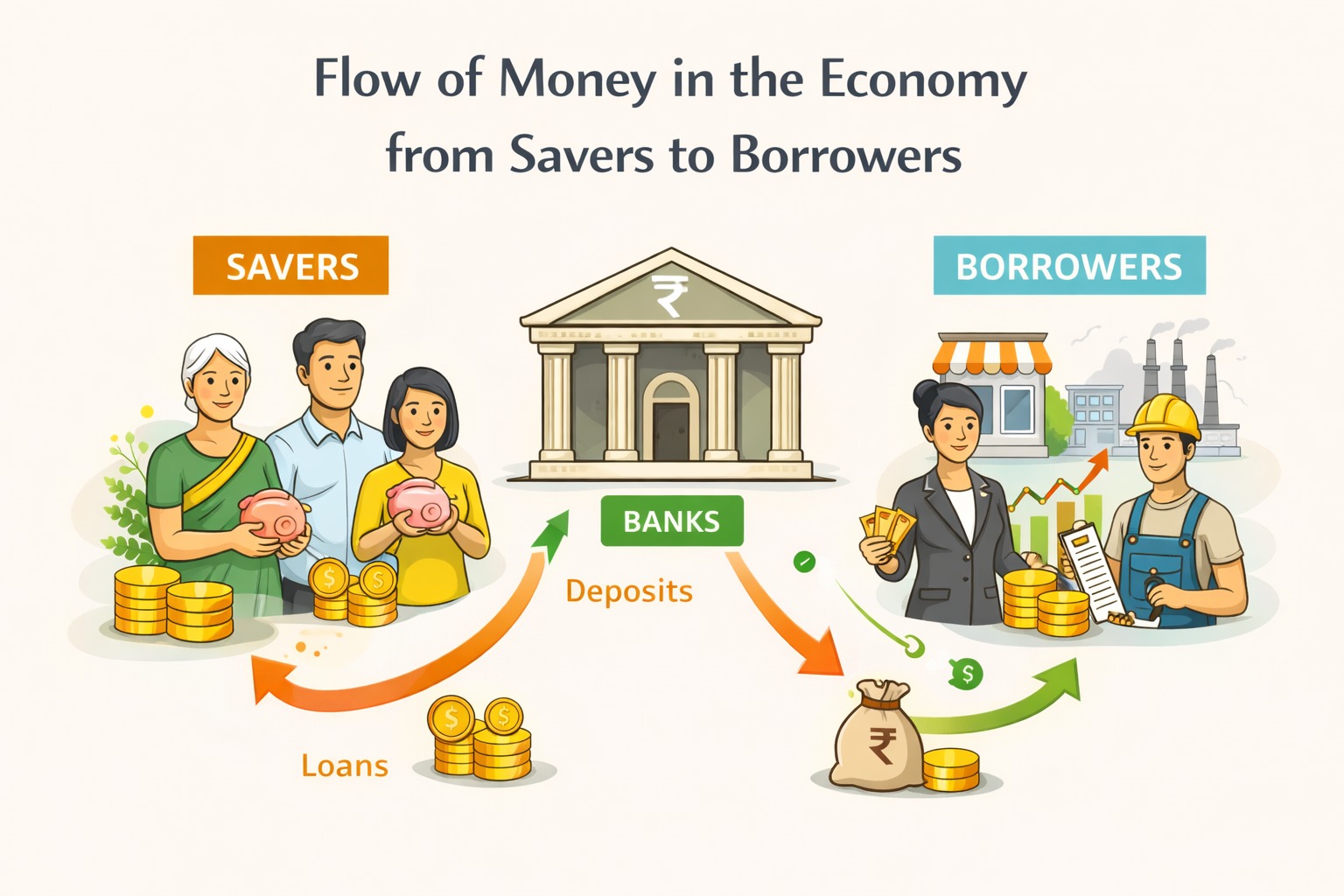
Every economy runs on one simple idea: money saved by some people is used by others to grow, spend, and build.
From a fixed deposit to a home loan, from a mutual fund SIP to a factory expansion—money constantly flows from savers to borrowers. Understanding this flow explains why banks matter, how growth happens, and why credit slowdowns hurt the economy.
AI Answer Box (For Google AI Overview & AI Search)
Short Answer:
Money flows through the economy when savings are collected by banks and financial institutions and then lent or invested into businesses and individuals, enabling consumption, investment, and economic growth.
Who Are Savers and Borrowers?
Savers
Households parking money in bank deposits
Individuals investing in mutual funds, bonds, insurance
Corporates retaining profits
Borrowers
Individuals taking home, education, or personal loans
Businesses borrowing for working capital and expansion
Governments funding infrastructure and welfare
📌 Savers seek safety and returns; borrowers seek capital and opportunity.
The Financial System: The Bridge in Between
The flow between savers and borrowers is enabled by the financial system, primarily:
Banks
NBFCs
Mutual funds
Capital markets
At the centre of this system is the banking network regulated by the Reserve Bank of India.
Step-by-Step: How Money Flows in the Economy
Step 1: Savings Enter the System
Households deposit money into:
Savings accounts
Fixed deposits
Recurring deposits
Banks now have lendable funds.
Step 2: Banks Create Credit
Banks don’t just lend deposited money—they create credit by:
Keeping a fraction as reserves
Lending the rest to borrowers
📌 This is called financial intermediation.
Step 3: Borrowers Use Money
Borrowed money is used for:
Buying homes and vehicles
Expanding businesses
Paying salaries
Building infrastructure
This spending creates income for others.
Step 4: Money Returns as Income
Salaries, profits, and payments earned by others are again:
Spent
Saved
Invested
And the cycle continues.
Simple Flow of Money (Snapshot)
| Stage | Flow |
|---|---|
| Households | Save money |
| Banks | Pool and lend funds |
| Borrowers | Spend and invest |
| Economy | Generates income |
| Back to Savers | Through wages, profits |
Why Banks Are Central to This Flow
Banks perform three critical roles:
Mobilising savings
Assessing borrower risk
Allocating capital efficiently
Without banks:
Savings remain idle
Businesses lack funding
Growth slows
What Happens When This Flow Breaks?
If Savers Don’t Save
Less money available for lending
Higher interest rates
If Banks Don’t Lend
Credit slowdown
Job creation slows
Economic growth weakens
If Borrowers Can’t Repay
NPAs rise
Banks tighten lending
Cycle weakens further
📌 This is why credit confidence matters.
Role of Interest Rates in Money Flow
Interest rates balance the system:
Higher rates encourage saving
Lower rates encourage borrowing
The RBI uses tools like:
Repo rate
Liquidity operations
to keep money flowing smoothly.
Money Flow and Economic Growth
| Credit Flow | Economic Impact |
|---|---|
| Healthy | Growth, jobs, stability |
| Too Fast | Inflation, asset bubbles |
| Too Slow | Stagnation, unemployment |
📌 The goal is balanced credit growth.
Modern Channels of Money Flow
Today, money also flows through:
Mutual funds (equity & debt)
Bond markets
Fintech lending platforms
Digital payments
Yet, banks remain the core transmission channel.
Expert Insight
“An economy grows not by printing money, but by moving savings to productive use.”
From real-world finance experience, economies slow not because of lack of money—but because money stops flowing to the right borrowers.
Why This Matters to You Personally
Understanding money flow helps you:
See why loan rules tighten or ease
Understand interest rate changes
Plan savings and borrowing better
Make smarter financial decisions
Key Takeaways
Savers and borrowers are equally important
Banks connect savings to growth
Credit flow fuels jobs and income
Too much or too little credit hurts
Balanced money flow keeps economies healthy
Frequently Asked Questions
1. What is money flow in an economy?
Movement of funds from savers to borrowers.
2. Why are banks important for money flow?
They mobilise savings and lend efficiently.
3. Can money flow without banks?
Partially, via markets—but banks are central.
4. What role does RBI play?
Regulates liquidity and credit conditions.
5. How does saving help the economy?
It provides capital for investment.
6. What happens if borrowing slows?
Economic growth weakens.
7. Do loans create money?
Yes, through credit creation.
8. How do interest rates affect flow?
They influence saving and borrowing behaviour.
9. Are NBFCs part of this flow?
Yes, especially in retail and MSME lending.
10. Does digital lending change the cycle?
It speeds up—but doesn’t replace the cycle.
11. Can excess lending be harmful?
Yes, it can cause inflation and bubbles.
12. Why should individuals understand this?
It improves personal financial decisions.
Conclusion: The Invisible Engine of Growth
Money flowing from savers to borrowers is the invisible engine of the economy. When this engine runs smoothly, growth feels effortless. When it stalls, everyone feels the strain.
Understanding this flow helps you see the economy—not as headlines—but as a living financial cycle you are part of.
Published on : 24th January
Published by : SMITA
www.vizzve.com || www.vizzveservices.com
Follow us on social media: Facebook || Linkedin || Instagram
🛡 Powered by Vizzve Financial
RBI-Registered Loan Partner | 10 Lakh+ Customers | ₹600 Cr+ Disbursed