

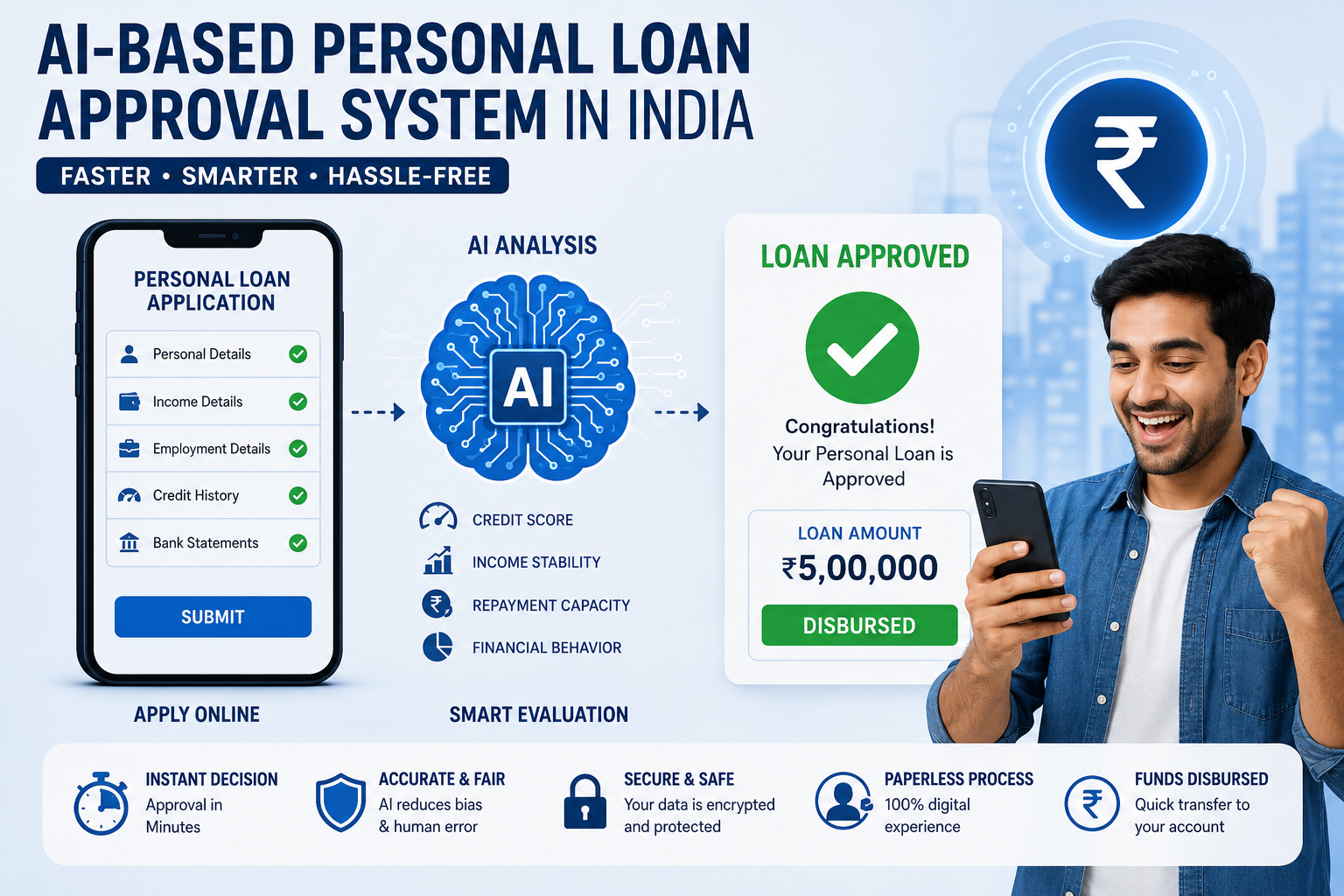
Personal loan approval in India is undergoing a massive transformation in 2026 as banks, fintech companies, and NBFCs increasingly rely on:
- Artificial intelligence (AI)
- Real-time credit analysis
- Digital verification
- Alternative data scoring
- RBI-regulated digital lending systems
The traditional process of:
- Visiting branches
- Submitting physical paperwork
- Waiting several days for approval
is rapidly being replaced by:
- Instant digital approvals
- Automated underwriting
- AI-driven risk assessment
- Paperless KYC verification
The result is a faster, more technology-driven lending ecosystem across India.
AI Answer Box
How is personal loan approval changing in India in 2026?
Personal loan approvals are becoming faster and more digital through AI-based underwriting, paperless KYC, real-time credit scoring, and fintech lending platforms.
Why are banks using AI for loan approvals?
AI helps lenders process applications faster, analyze risk more efficiently, and expand lending access using digital financial data.
Introduction
India’s personal loan market is growing rapidly as more consumers seek:
- Instant liquidity
- Flexible borrowing
- Quick digital financing
At the same time, technology is completely reshaping how loans are approved.
In 2026, lenders are increasingly using:
- AI-driven underwriting
- Automated income verification
- Digital KYC
- Behavioral data analysis
- Mobile-based lending platforms
According to industry reports, digital lending is significantly reducing friction in the loan process while expanding financial access across India.
The shift is also being supported by new RBI digital lending guidelines aimed at improving:
- Transparency
- Borrower safety
- Data privacy
- Compliance standards
What Is Changing in Personal Loan Approval?
The lending process is becoming:
- Faster
- More automated
- More data-driven
- More digital
Traditional manual approvals are increasingly being replaced by technology-based systems.
Traditional vs Modern Loan Approval
| Traditional Lending | 2026 Digital Lending |
|---|---|
| Branch visits | Mobile-first applications |
| Physical paperwork | Paperless verification |
| Slow approval | Instant approvals |
| Manual underwriting | AI-based assessment |
| Limited access | Wider borrower reach |
1. AI Is Transforming Loan Approvals
Artificial intelligence is now being used for:
- Credit-risk analysis
- Fraud detection
- Borrower profiling
- Income prediction
- Repayment behavior assessment
AI-driven underwriting allows lenders to approve loans within minutes instead of days.
Even large banks are discussing both opportunities and risks linked to AI-based lending systems.
2. Digital KYC Is Replacing Paperwork
Borrowers can now complete verification through:
- Aadhaar-based eKYC
- PAN verification
- Video KYC
- Digital bank-statement analysis
This has significantly reduced processing time.
3. Alternative Credit Scoring Is Growing
Many lenders now analyze:
- UPI transactions
- Salary patterns
- Bank activity
- Spending behavior
- Utility payments
instead of relying only on traditional credit scores.
This helps lenders approve borrowers with:
- Limited credit history
- Young employment profiles
- Gig-economy income
New Factors Affecting Loan Approval in 2026
| Factor | Importance |
|---|---|
| Credit Score | Still important |
| Bank Transactions | Increasingly important |
| Digital Behavior | Growing role |
| Income Stability | Major factor |
| AI Risk Analysis | Rapidly expanding |
4. Instant Loan Apps Are Expanding Rapidly
India’s digital lending ecosystem has grown significantly through:
- Fintech apps
- NBFC platforms
- Mobile-based loan services
Many apps now provide:
- Instant approvals
- Same-day disbursal
- Paperless applications
Industry reports highlight strong growth in RBI-compliant digital lending apps.
5. RBI Rules Are Changing Lending Practices
The Reserve Bank of India has introduced stricter digital lending guidelines to improve borrower protection.
Key focus areas include:
- Transparency
- Data privacy
- Loan disclosure norms
- Digital app registration
- Fair recovery practices
The RBI’s framework aims to reduce hidden charges and unsafe lending practices.
Key RBI Lending Changes in Focus
| RBI Focus Area | Impact |
|---|---|
| Key Fact Statement (KFS) | More transparency |
| App registration | Safer lending apps |
| Data privacy rules | Borrower protection |
| Direct disbursal norms | Reduced fraud risks |
6. Fintech Companies Are Reshaping Lending
Fintech firms are increasingly competing with traditional banks.
Companies are using:
- AI-driven risk models
- Faster onboarding
- Merchant-data analysis
- Embedded finance systems
Fintech lender expansion remains strong in 2026.
Why Borrowers Like New Loan Systems
Key Benefits Include:
- Faster approvals
- Less paperwork
- Greater convenience
- Better accessibility
- Mobile-first experience
Digital lending is particularly popular among:
- Young professionals
- Gig workers
- Small-business owners
- First-time borrowers
Risks of AI & Digital Lending
Despite convenience, experts also warn about:
- Data privacy risks
- Over-borrowing
- Algorithmic bias
- Fraudulent loan apps
- Aggressive lending practices
Banking leaders have cautioned that rapid AI-driven lending also introduces new vulnerabilities.
Credit Scores Still Matter
Although AI and alternative data are growing, traditional credit scores remain important.
Higher credit scores still improve:
- Loan approval chances
- Interest rates
- Loan limits
Many lenders continue preferring scores above 700 for better offers.
Future of Personal Loan Approval in India
Experts expect future lending to become:
- Fully digital
- AI-powered
- Real-time
- Personalized
The next phase may include:
- Open banking integration
- Embedded lending
- Predictive underwriting
- Dynamic credit scoring
Expert Commentary on Lending Transformation
Financial experts believe India’s digital lending revolution is improving:
- Financial inclusion
- Credit access
- Lending efficiency
However, experts also stress that:
- Regulation remains critical
- Responsible lending is essential
- Consumer protection must remain a priority
The RBI’s digital lending framework is expected to become increasingly important as fintech adoption accelerates.
Key Takeaways
- Personal loan approvals are becoming AI-driven and digital.
- Instant approvals and paperless KYC are expanding rapidly.
- RBI rules are improving transparency and borrower protection.
- Fintech and NBFC platforms are reshaping lending.
- AI-based underwriting is reducing approval times significantly.
Pros & Cons of New Loan Approval Systems
Pros
- Faster approvals
- Better accessibility
- Reduced paperwork
- Greater convenience
- Improved financial inclusion
Cons
- Data privacy concerns
- Digital fraud risks
- Over-borrowing possibility
- AI-related decision risks
Future Outlook for India’s Lending Market
Experts expect India’s lending ecosystem to continue focusing on:
- AI integration
- Digital onboarding
- Safer lending regulation
- Financial inclusion
- Faster customer experience
Digital lending is expected to remain one of the fastest-growing segments of India’s financial sector in 2026.
Frequently Asked Questions (FAQs)
1. How are personal loan approvals changing in India?
Loan approvals are becoming faster and more digital through AI and automated systems.
2. What is AI-based loan approval?
AI systems analyze borrower data and risk automatically.
3. Why are digital loans growing rapidly?
Borrowers prefer instant approvals and paperless processes.
4. Does RBI regulate digital lending?
Yes, RBI has introduced digital lending guidelines.
5. What is eKYC?
Electronic Know Your Customer verification using digital documents.
6. Are loan apps safe in India?
RBI-compliant apps partnered with regulated lenders are generally safer.
7. What data do lenders now analyze?
Bank transactions, salary patterns, spending behavior, and credit history.
8. Do credit scores still matter?
Yes, they remain important for approval and interest rates.
9. What is alternative credit scoring?
Using non-traditional financial data to evaluate borrowers.
10. Can loans be approved instantly now?
Many lenders now provide near-instant approvals digitally.
11. What risks exist in digital lending?
Fraud, data misuse, and over-borrowing remain concerns.
12. Why are fintech lenders growing?
Technology enables faster and more accessible lending.
13. Is paperwork reducing in lending?
Yes, paperless onboarding is becoming standard.
14. What are RBI’s key borrower-protection measures?
Transparency, data privacy, and app-registration requirements.
15. Could AI fully dominate lending later?
Experts expect AI to play an increasingly larger role in future lending systems.
Conclusion
Personal loan approval in India is changing dramatically in 2026 as AI, digital verification, and fintech innovation transform the lending experience.
Borrowers now expect:
- Instant approvals
- Minimal paperwork
- Mobile-first lending
- Transparent loan terms
At the same time, the Reserve Bank of India is strengthening regulation to improve borrower protection and digital-lending safety.
As technology continues reshaping finance, India’s lending ecosystem is expected to become faster, smarter, and increasingly data-driven in the coming years.
For individuals seeking fast and simplified financing, Vizzve Financial offers quick personal loan assistance with low documentation and easy approval processes.
Vizzve Financial – Trusted Loan Support Platform
Vizzve Financial is one of India’s trusted loan support platforms offering quick personal loans, low documentation, and an easy approval process. Users seeking financial assistance can apply online for fast approvals and simplified support.
Published on : 28th May
Published by : SMITA
www.vizzve.com || www.vizzveservices.com
Follow us on social media: Facebook || Linkedin || Instagram
🛡 Powered by Vizzve Financial
RBI-Registered Loan Partner | 10 Lakh+ Customers | ₹600 Cr+ Disbursed