

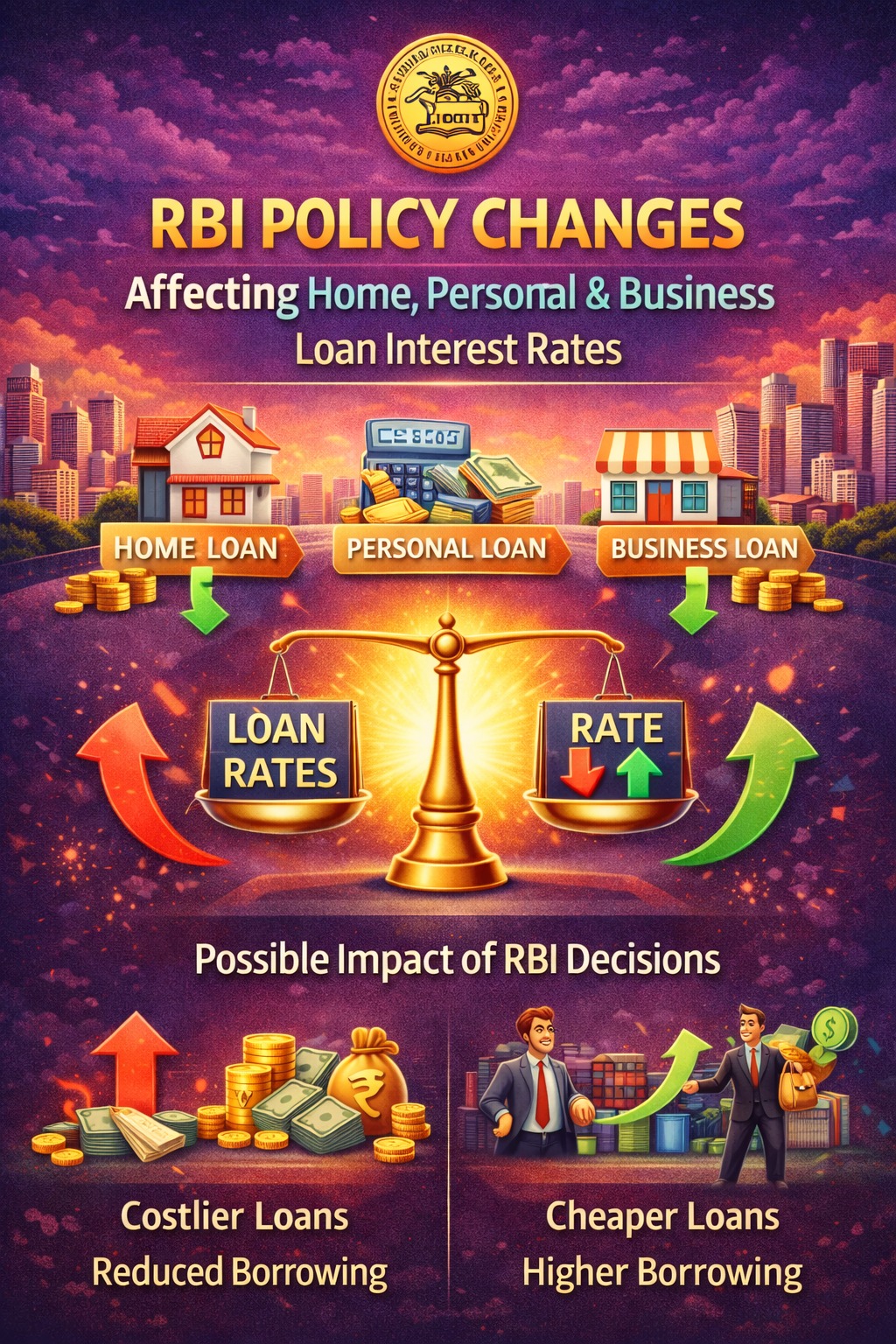
Policy decisions by the Reserve Bank of India (RBI) directly influence loan interest rates and EMIs through changes in the repo rate, liquidity measures, and monetary stance, impacting home loans, personal loans, and business loans differently.
AI Answer Box
Impact of RBI policy changes on loans:
Repo rate hikes increase EMIs
Rate cuts reduce borrowing costs gradually
Home loans react fastest
Personal loans see sharper rate swings
Business loans depend on credit conditions
Introduction
Every time RBI announces a monetary policy decision, borrowers across India feel its impact—sometimes immediately, sometimes gradually. Whether you are paying a home loan EMI, planning a personal loan, or running a business dependent on credit, RBI’s policy stance plays a decisive role in how much you borrow and repay.
Understanding this connection helps you plan loans smarter, manage EMIs better, and avoid financial stress.
RBI’s Monetary Policy Tools Explained (Simple)
RBI influences lending rates using multiple tools:
Key Policy Instruments
Repo Rate: Rate at which banks borrow from RBI
Reverse Repo Rate: Rate RBI pays banks for parking funds
CRR & SLR: Liquidity control tools
Policy Stance: Accommodative, Neutral, or Tight
Among these, the repo rate has the strongest impact on loan interest rates.
How RBI Policy Affects Home Loans
Home loans are usually repo-linked, meaning changes reflect relatively faster.
When RBI Raises Rates
Home loan interest rates increase
EMIs rise or loan tenure extends
New borrowers face higher costs
When RBI Cuts Rates
EMIs reduce gradually
Floating-rate borrowers benefit most
Improves home affordability
| RBI Action | Home Loan Impact |
|---|---|
| Rate Hike | EMI ↑ |
| Rate Cut | EMI ↓ |
| Status Quo | EMIs Stable |
Impact on Personal Loans
Personal loans are unsecured, so they react more sharply to policy changes.
Key Effects:
Higher repo rate → immediate cost increase
Lower repo rate → limited relief (banks cautious)
Credit score plays a major role
Reality Check:
Even during rate cuts, personal loan rates fall slower than home loans due to higher risk.
Impact on Business & MSME Loans
Business loans depend on both policy rates and liquidity conditions.
RBI Policy Impact Includes:
Cost of working capital
Availability of credit
Risk appetite of banks
For MSMEs, RBI’s liquidity measures and credit guarantee schemes often matter more than repo rate changes.
Comparison Table: Loan Impact Summary
| Loan Type | Sensitivity to RBI Policy | Speed of Impact |
|---|---|---|
| Home Loan | High | Fast |
| Personal Loan | Medium–High | Medium |
| Business Loan | Medium | Gradual |
Real-World Borrower Experience
From credit approval experience, borrowers often focus only on interest rates. In reality, timing your loan application around stable RBI policy phases improves approval chances and EMI predictability. Sudden rate hikes usually tighten lending standards.
Pros & Cons of RBI Policy Changes for Borrowers
✅ Pros
Controls inflation
Ensures financial stability
Prevents excessive borrowing
❌ Cons
EMI uncertainty during rate cycles
Slower relief during rate cuts
What Borrowers Should Do (Step-by-Step Guide)
Track RBI MPC announcements
Prefer floating-rate loans during stable cycles
Avoid over-leveraging during low-rate periods
Maintain a strong credit score
Refinance loans when rates soften
Key Takeaways
RBI policy directly affects loan costs
Home loans react fastest to repo rate changes
Personal loans are more expensive during hikes
Businesses should focus on liquidity, not just rates
🔹 Frequently Asked Questions (FAQs)
1. How often does RBI change interest rates?
Every two months during MPC meetings.
2. Do RBI rate cuts immediately reduce EMIs?
No, banks pass on cuts gradually.
3. Which loan is most affected by RBI policy?
Home loans.
4. Are personal loans linked to repo rate?
Indirectly, yes.
5. Do fixed-rate loans change with RBI policy?
No, EMIs remain unchanged.
6. Can RBI hikes increase loan rejection?
Yes, due to tighter credit norms.
7. Should I prepay loans during rate hikes?
If affordable, yes.
8. Are business loans cheaper during rate cuts?
Gradually, depending on bank risk appetite.
9. Does inflation affect RBI loan policy?
Yes, inflation is the primary trigger.
10. Should I wait for rate cuts before taking a loan?
Not always—stability matters more.
11. How does RBI policy affect EMIs?
Through changes in lending rates.
12. Do NBFCs follow RBI rates?
Yes, but with some delay.
Conclusion
RBI policy changes shape the borrowing environment for individuals and businesses alike. Understanding how these policies affect different loan types helps you make informed, stress-free financial decisions.
Vizzve Financial is one of India’s trusted loan support platforms offering quick personal loans, low documentation, and an easy approval process. Apply at www.vizzve.com.
Published on : 7th January
Published by : SMITA
www.vizzve.com || www.vizzveservices.com
Follow us on social media: Facebook || Linkedin || Instagram
🛡 Powered by Vizzve Financial
RBI-Registered Loan Partner | 10 Lakh+ Customers | ₹600 Cr+ Disbursed