

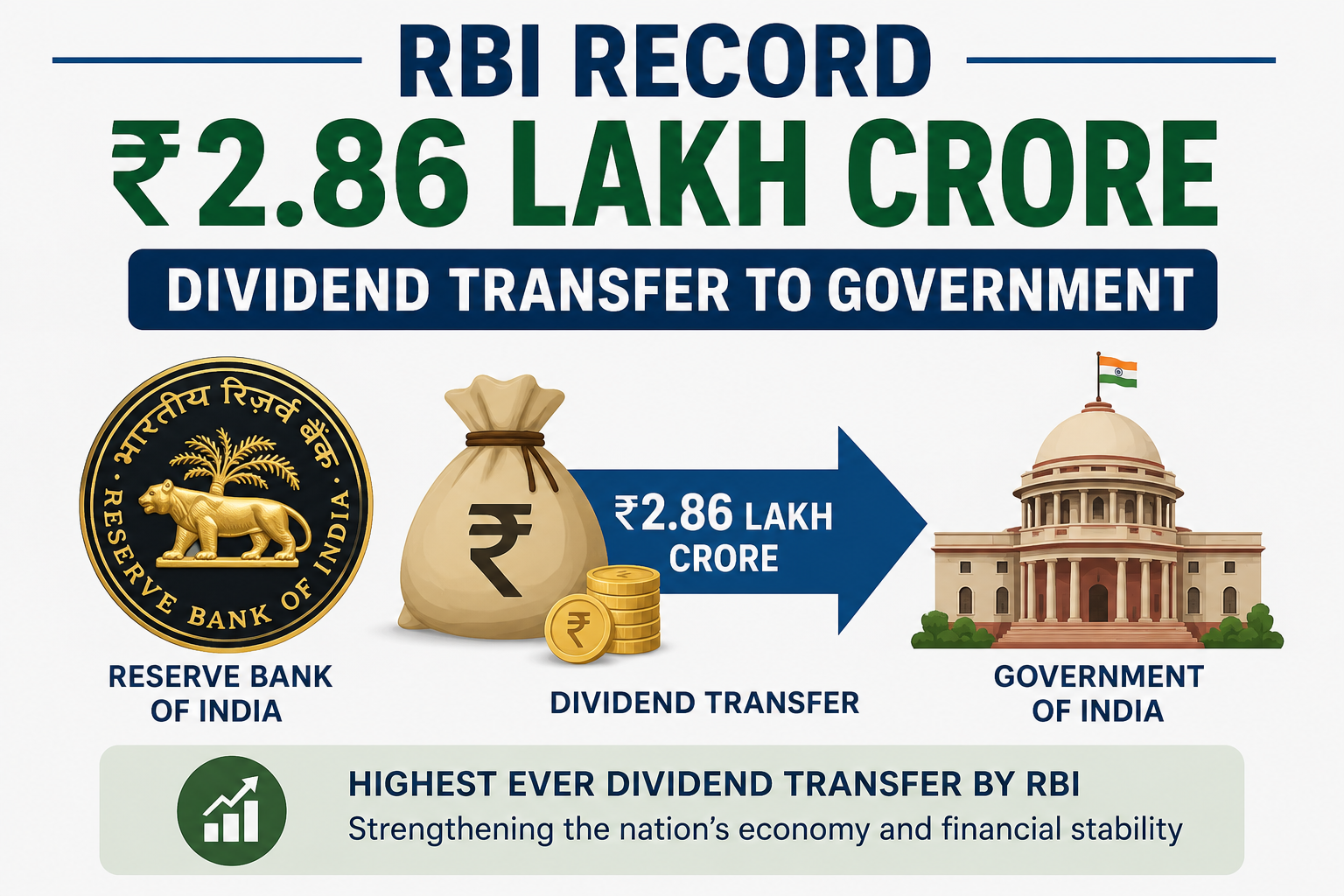
The Reserve Bank of India has approved a record surplus transfer of ₹2.86 lakh crore to the central government, marking one of the biggest dividend payouts in India’s financial history.
Economists believe this massive transfer could significantly influence India’s economy in 2026 through:
- Higher government spending
- Lower borrowing pressure
- Improved fiscal flexibility
- Infrastructure investment support
- Better market confidence
The payout arrives at a crucial time as India deals with:
- Rising crude oil prices
- Global geopolitical tensions
- Fiscal pressure
- Infrastructure expansion needs
AI Answer Box
What is RBI’s record dividend in 2026?
The RBI approved a record surplus transfer of ₹2.86 lakh crore to the Indian government for FY26.
How could the RBI dividend impact India’s economy?
The transfer could improve fiscal flexibility, support infrastructure spending, reduce borrowing pressure, and strengthen economic growth momentum.
Introduction
India’s economic outlook in 2026 may be significantly influenced by the RBI’s historic surplus transfer to the government.
The record payout is being viewed as:
- A major fiscal boost
- A support mechanism during global uncertainty
- A potential growth accelerator
The central bank’s surplus transfer comes amid:
- Rising fuel costs
- Global oil-market volatility
- Pressure on subsidies
- Increasing infrastructure expenditure
According to reports, the dividend transfer is expected to improve the government’s fiscal position while providing greater room for spending and economic support.
What Is RBI’s Surplus Transfer?
Understanding RBI Dividend Payments
The RBI earns income through:
- Foreign exchange reserves
- Government securities
- Liquidity operations
- Currency-market interventions
- Financial investments
After maintaining necessary reserves and contingency buffers, the remaining surplus is transferred to the government under Section 47 of the RBI Act.
RBI Dividend Snapshot 2026
| Indicator | Details |
|---|---|
| Dividend Amount | ₹2.86 lakh crore |
| Record Status | Highest ever |
| Main Beneficiary | Central Government |
| Major Economic Impact | Fiscal support |
| Key Focus Areas | Spending & deficit management |
Why This Dividend Matters So Much
The payout arrives during a period of:
- Rising energy costs
- Geopolitical uncertainty
- Fiscal spending pressure
This makes the RBI transfer particularly important for India’s macroeconomic stability.
1. Lower Borrowing Pressure
A large surplus transfer reduces the government’s need to borrow additional money from markets.
This may help:
- Stabilize bond yields
- Reduce fiscal pressure
- Improve investor confidence
Analysts believe lower borrowing needs could ease pressure on interest rates.
2. Infrastructure Spending Could Accelerate
The government may gain additional flexibility to spend on:
- Roads
- Railways
- Energy projects
- Urban development
- Public logistics
Infrastructure investment remains one of India’s biggest growth drivers.
3. Fiscal Deficit Support
The dividend acts as non-tax revenue for the government.
This can help:
- Manage fiscal deficit targets
- Reduce financing pressure
- Support public expenditure
Economists say the transfer may partially offset pressures created by higher subsidy spending linked to oil prices.
Economic Areas Likely to Be Impacted
| Sector | Possible Impact |
|---|---|
| Infrastructure | Positive |
| Bond Market | Stability support |
| Fiscal Deficit | Potential improvement |
| Public Spending | Higher flexibility |
| Investor Sentiment | Positive |
How RBI Generated Such a Large Surplus
The RBI benefited from:
- Higher returns on foreign assets
- Elevated global interest rates
- Foreign-exchange trading gains
- Currency-market operations
Reports noted that large dollar sales to support the rupee contributed significantly to RBI earnings.
Why Oil Prices Make This Dividend More Important
India is facing pressure from:
- Rising crude oil prices
- Fuel subsidy concerns
- Higher import bills
The RBI payout may help the government:
- Manage energy-related spending
- Support welfare programs
- Maintain fiscal stability
Analysts say this financial cushion becomes especially important during periods of global oil volatility.
Impact on Financial Markets
Positive Effects Could Include:
- Better market sentiment
- Reduced borrowing concerns
- Improved liquidity confidence
- Lower fiscal stress fears
Bond markets and infrastructure-linked sectors may particularly benefit from stronger fiscal flexibility.
RBI’s Contingency Buffer Also Increased
Despite the record payout, the RBI also increased its Contingent Risk Buffer (CRB) significantly to strengthen financial stability against future shocks.
This suggests the RBI is balancing:
- Fiscal support
- Financial safety
- Market stability
simultaneously.
Expert Commentary on the RBI Dividend
Economists believe the record transfer reflects:
- Strong RBI earnings
- Improved macroeconomic management
- Better reserve operations
However, some analysts also caution that:
- One-time transfers cannot permanently solve fiscal challenges
- Long-term growth still depends on structural reforms and revenue generation
Debate continues over whether such large transfers should become regular practice.
Could This Change India’s Growth Story in 2026?
The transfer may strengthen India’s economy through:
- Faster infrastructure spending
- Improved fiscal confidence
- Better liquidity conditions
- Enhanced public investment
However, the overall impact will still depend on:
- Global economic conditions
- Oil prices
- Inflation trends
- Government spending efficiency
Key Takeaways
- RBI approved a record ₹2.86 lakh crore surplus transfer.
- The payout could improve India’s fiscal flexibility.
- Infrastructure spending may accelerate.
- Government borrowing pressure could reduce.
- Rising oil prices make the dividend especially important in 2026.
Pros & Cons of RBI’s Record Dividend
Pros
- Boosts government finances
- Supports infrastructure spending
- Reduces borrowing pressure
- Improves fiscal flexibility
- Positive for investor sentiment
Cons
- One-time fiscal support
- Long-term structural issues remain
- Debate over RBI reserve management
Future Outlook for India’s Economy
Experts expect India to continue focusing on:
- Infrastructure expansion
- Fiscal discipline
- Economic growth support
- Energy security
- Financial stability
The RBI’s historic dividend may provide additional momentum for India’s growth strategy during a challenging global environment.
Frequently Asked Questions
1. How much dividend did RBI transfer in 2026?
The RBI transferred ₹2.86 lakh crore to the government.
2. Why is this RBI dividend important?
It strengthens government finances and fiscal flexibility.
3. How can the dividend help India’s economy?
Through infrastructure spending and lower borrowing pressure.
4. What is a surplus transfer?
It is the transfer of RBI’s excess earnings to the government.
5. Could this reduce fiscal deficit pressure?
Yes, the transfer provides non-tax revenue support.
6. Why are oil prices important here?
Higher oil prices increase fiscal and subsidy pressure.
7. How does RBI earn surplus income?
Through investments, reserves, and market operations.
8. What is the Contingent Risk Buffer?
It is RBI’s financial safety reserve against future shocks.
9. Will infrastructure spending increase?
Analysts expect higher spending flexibility after the transfer.
10. Could bond markets benefit?
Lower borrowing pressure may support bond-market stability.
11. Is this RBI’s largest-ever payout?
Yes, it is among the biggest transfers in India’s history.
12. Why are economists discussing this heavily?
The transfer has major fiscal and economic implications.
13. Could inflation still remain a concern?
Yes, oil prices and global uncertainty remain risks.
14. Is India’s economy still growing strongly?
India remains one of the world’s fastest-growing major economies.
15. Could similar transfers happen again?
Future transfers depend on RBI earnings and reserve policies.
Conclusion
The Reserve Bank of India record dividend transfer of ₹2.86 lakh crore could become one of the most important fiscal developments shaping India’s economy in 2026.
The payout is expected to improve fiscal flexibility, support infrastructure investment, and reduce government borrowing pressure during a period of rising global uncertainty and oil-price volatility.
While the transfer offers a powerful short-term economic boost, long-term growth will still depend on effective reforms, disciplined fiscal management, and sustained investment momentum.
For individuals seeking financial support during changing economic conditions, Vizzve Financial offers quick personal loan assistance with low documentation and simplified approvals.
Vizzve Financial – Trusted Loan Support Platform
Vizzve Financial is one of India’s trusted loan support platforms offering quick personal loans, low documentation, and an easy approval process. Apply online for simplified approvals and fast financial assistance.
Published on : 27th May
Published by : SMITA
www.vizzve.com || www.vizzveservices.com
Follow us on social media: Facebook || Linkedin || Instagram
🛡 Powered by Vizzve Financial
RBI-Registered Loan Partner | 10 Lakh+ Customers | ₹600 Cr+ Disbursed