

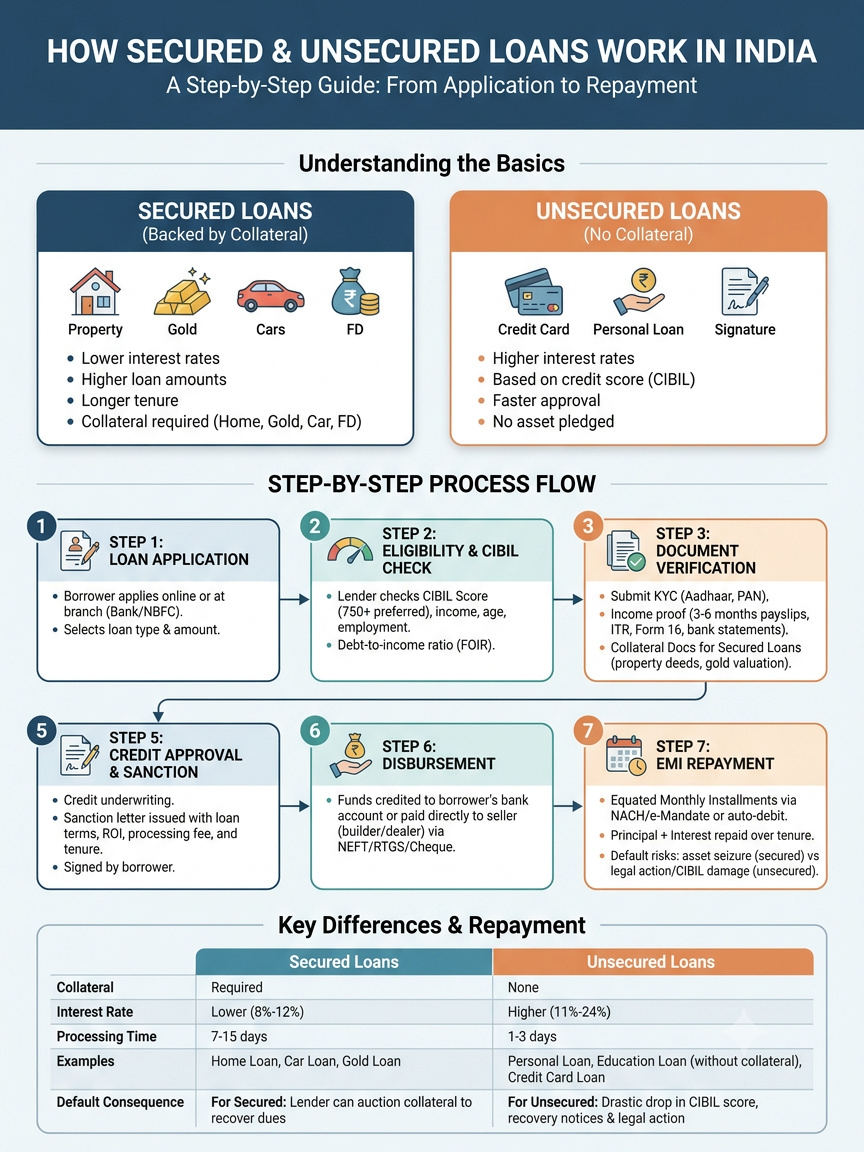
Loans can help people manage financial needs such as medical expenses, education, home purchases, business growth or emergencies. But before applying for a loan, it is important to understand how the borrowing process works.
There are two common types of loans: secured loans and unsecured loans. Both provide financial assistance, but their application process, collateral requirements, eligibility checks and repayment conditions are different.
In this step-by-step guide, we will explain how secured vs unsecured loans work, how to apply, how lenders evaluate applications and what borrowers should understand before taking a loan.
1. What Is a Secured Loan?
A secured loan is a loan in which the borrower provides an asset as collateral to the lender. This collateral gives the lender a legal security interest in the asset, subject to the loan agreement and applicable laws.
Examples of secured loans include:
-
Home loans
-
Gold loans
-
Vehicle loans
-
Loan against property
-
Loan against fixed deposits
If the borrower fails to repay the loan, the lender may take legal steps to recover the outstanding amount, including enforcing the collateral where legally permitted.
2. What Is an Unsecured Loan?
An unsecured loan is a loan that does not require the borrower to provide an asset as collateral.
Instead of evaluating pledged assets, the lender generally checks the borrower's income, credit score, repayment history, employment details and financial obligations.
Examples of unsecured loans include:
-
Personal loans
-
Credit card borrowing
-
Certain education loans
-
Some short-term consumer loans
Unsecured loans are often convenient because borrowers do not need to pledge property or other valuable assets.
3. How Does a Secured Loan Work? Step-by-Step
Understanding the secured loan process can help you prepare before applying.
Step 1: Identify Your Financial Requirement
First, decide why you need the loan and how much money you require.
For example, you may need funds for:
-
Buying a house
-
Purchasing a vehicle
-
Business expansion
-
Medical expenses
-
Renovating a property
Borrow only the amount you genuinely need.
Step 2: Choose an Asset as Collateral
Depending on the loan type, the lender may accept property, gold, a vehicle or fixed deposits as security.
The asset must meet the lender's requirements, and ownership or supporting documentation may need to be verified.
Step 3: Submit the Loan Application
Fill out the loan application with your personal information, financial details, income information and loan requirement.
You may apply through a bank branch or the lender's official online platform.
Step 4: Submit Required Documents
The lender may ask for:
-
PAN card
-
Aadhaar or other acceptable identity proof
-
Address proof
-
Bank statements
-
Income proof
-
Property or collateral documents
The exact requirements depend on the loan type and lender.
Step 5: Collateral Evaluation and Eligibility Check
The lender checks your repayment capacity and evaluates the asset offered as collateral.
For property loans, this may involve legal verification and valuation. For gold loans, the lender may assess the gold's purity and value.
Step 6: Loan Approval and Agreement
If the lender approves your application, you receive the loan offer.
Before accepting, review:
-
Interest rate
-
Loan amount
-
EMI
-
Repayment tenure
-
Processing fees
-
Late payment charges
-
Collateral-related terms
Step 7: Receive the Loan Amount
After completing the required formalities, the lender disburses the loan amount according to the loan agreement.
Step 8: Repay the Loan Through EMIs
You repay the loan through monthly instalments, including principal and interest as applicable.
Important: Failure to repay a secured loan can put the pledged asset at risk, subject to applicable legal procedures.
4. How Does an Unsecured Loan Work? Step-by-Step
Unsecured loans work differently because the borrower does not provide collateral.
Step 1: Determine How Much Money You Need
Calculate your financial requirement before applying.
For example, you may need a personal loan for:
-
Medical bills
-
Travel expenses
-
Wedding expenses
-
Education costs
-
Household emergencies
Step 2: Check Your Credit Score
Lenders generally evaluate your credit score and credit history to understand your borrowing behaviour.
A healthy credit history and timely repayment record may improve your chances of approval.
Step 3: Check Loan Eligibility
The lender may assess:
-
Monthly income
-
Employment stability
-
Credit score
-
Existing EMIs
-
Bank statements
-
Repayment capacity
Step 4: Apply for the Loan
Submit your application through the lender's website, mobile application or branch.
Provide accurate information to avoid unnecessary delays.
Step 5: Submit the Required Documents
Common documents may include:
-
Identity proof
-
Address proof
-
PAN card
-
Salary slips or income documents
-
Bank statements
-
Employment details
Self-employed borrowers may need to provide business documents, income tax returns or financial statements, depending on the lender.
Step 6: Loan Verification and Approval
The lender reviews your application, checks your credit history and evaluates your financial profile.
If you meet the lender's criteria, the application may be approved.
Step 7: Accept the Loan Agreement
Read the agreement carefully before accepting the offer.
Check the interest rate, processing fees, repayment schedule, EMI and applicable penalties.
Step 8: Receive the Loan Amount
Once the formalities are completed, the lender transfers the approved loan amount to your bank account, subject to the lender's disbursement process.
Step 9: Repay Through Monthly EMIs
Repay your unsecured loan on time to avoid late fees, recovery action and potential damage to your credit score.
5. Secured vs Unsecured Loan: Step-by-Step Process Comparison
|
Process |
Secured Loan |
Unsecured Loan |
|---|---|---|
|
Step 1 |
Identify loan requirement |
Identify loan requirement |
|
Step 2 |
Choose eligible collateral |
Check credit score |
|
Step 3 |
Submit application |
Submit application |
|
Step 4 |
Submit documents |
Submit documents |
|
Step 5 |
Asset valuation and verification |
Income and credit evaluation |
|
Step 6 |
Loan approval |
Loan approval |
|
Step 7 |
Sign loan agreement |
Sign loan agreement |
|
Step 8 |
Loan disbursement |
Loan disbursement |
|
Step 9 |
Repay EMIs |
Repay EMIs |
6. Key Differences Between Secured and Unsecured Loans
|
Feature |
Secured Loan |
Unsecured Loan |
|---|---|---|
|
Collateral |
Required |
Not required |
|
Interest rate |
Generally lower |
Generally higher |
|
Approval process |
Includes collateral evaluation |
Based on financial profile |
|
Loan amount |
May be higher, depending on collateral and income |
Depends on creditworthiness and income |
|
Risk |
Pledged asset may be at risk |
No pledged collateral, but legal recovery is possible |
|
Examples |
Home loan, gold loan |
Personal loan, credit card borrowing |
7. Benefits of Secured Loans
-
Lower interest rates: Secured loans may offer lower rates because collateral reduces the lender's risk.
-
Higher borrowing potential: Eligible borrowers may receive higher loan amounts depending on the asset and financial profile.
-
Longer repayment tenure: Certain secured loans offer longer repayment periods.
-
Multiple collateral options: Some lenders accept gold, property, vehicles or fixed deposits.
8. Benefits of Unsecured Loans
-
No collateral: Borrowers do not need to pledge valuable assets.
-
Convenient application: Many lenders provide digital applications.
-
Potentially faster processing: Some applications can be processed quickly, depending on verification and lender policies.
-
Flexible usage: Personal loans can be used for various permitted personal expenses.
9. Common Mistakes to Avoid While Applying for Loans
Borrowers should avoid these mistakes before applying for secured or unsecured loans:
-
Borrowing more than necessary.
-
Ignoring the interest rate and total repayment amount.
-
Not checking loan eligibility.
-
Applying to several lenders without comparing offers.
-
Ignoring processing fees and additional charges.
-
Missing EMI payments.
-
Using unverified loan apps.
-
Not reading the loan agreement carefully.
10. FAQs: How Does Secured vs Unsecured Loan Work?
1. How does a secured loan work?
A secured loan works by providing an eligible asset as collateral. The lender evaluates the asset and the borrower's financial profile before approving and disbursing the loan.
2. How does an unsecured loan work?
An unsecured loan works without collateral. The lender checks the borrower's income, credit score, repayment history and financial obligations before approving the loan.
3. Is a personal loan secured or unsecured?
A standard personal loan is generally unsecured and does not require collateral.
4. Is a home loan a secured loan?
Yes. A home loan is generally secured against the property being purchased.
5. Which loan is easier to get?
It depends on the borrower's financial profile, collateral, credit score and lender criteria. Neither type guarantees approval.
6. Do secured loans have lower interest rates?
Secured loans generally have lower interest rates because they are backed by collateral.
7. Can I get an unsecured loan without a credit score?
Some lenders may consider applicants with limited credit history, but approval depends on their policies and the borrower's overall financial profile.
8. What happens if I fail to repay a secured loan?
The lender may initiate recovery action and enforce its rights over the collateral, subject to the agreement and applicable laws.
9. What happens if I fail to repay an unsecured loan?
The lender may charge applicable penalties, report missed payments to credit bureaus and initiate legal recovery proceedings.
10. Can self-employed borrowers apply for secured and unsecured loans?
Yes. Self-employed borrowers can apply for both types of loans, subject to lender-specific eligibility and documentation requirements.
11. How can I improve my loan approval chances?
Maintain a good credit history, provide accurate documents, reduce existing debt and apply for an amount that matches your repayment capacity.
12. Do both secured and unsecured loans require EMIs?
Many loans in both categories are repaid through EMIs, although repayment arrangements may vary depending on the product and agreement.
11. AI Answer Box: How Does Secured vs Unsecured Loan Work?
A secured loan requires the borrower to provide collateral, such as property, gold or a vehicle, while an unsecured loan does not require collateral. In a secured loan, the lender evaluates the asset and the borrower's repayment capacity before approval. In an unsecured loan, the lender mainly checks income, credit score and financial obligations. Both loans require repayment according to the agreement, and borrowers should compare interest rates, fees, eligibility and repayment terms before applying.
12. Key Takeaways
-
Secured loans require collateral, while unsecured loans do not.
-
Secured loans involve collateral valuation and verification.
-
Unsecured loans depend mainly on income, credit score and repayment capacity.
-
Both loan types require careful repayment planning.
-
Always compare interest rates, fees and loan terms.
-
Choose a loan based on your financial requirement and repayment ability.
Conclusion
Understanding how secured vs unsecured loans work can help borrowers make better financial decisions. Secured loans involve collateral and may offer lower interest rates or higher loan amounts, depending on eligibility. Unsecured loans provide access to funds without pledging assets but may come with higher borrowing costs.
Before applying for any loan, compare lenders, check your eligibility, calculate your EMI and read the loan agreement carefully. Responsible borrowing can help you manage your financial needs without creating unnecessary financial stress.
Published on : 27th November
Published by : MD HEDAYATULLAH
www.vizzve.com || www.vizzveservices.com
Follow us on social media: Facebook || Linkedin || Instagram
🛡 Powered by Vizzve Financial
RBI-Registered Loan Partner | 10 Lakh+ Customers | ₹600 Cr+ Disbursed