

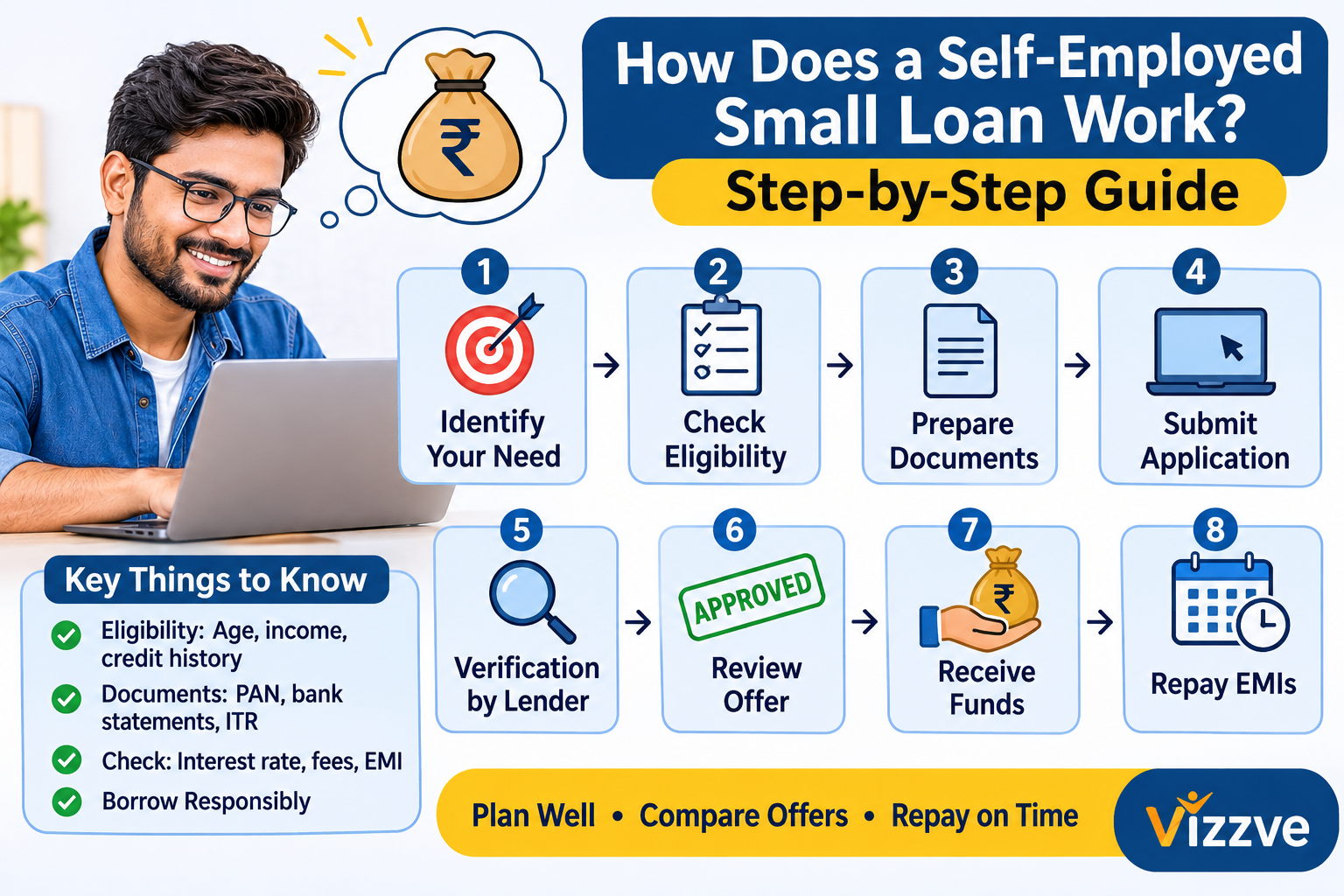
AI Answer Box: How does a self-employed small loan work?
A self-employed small loan works by allowing eligible individuals who earn through a business, freelancing or independent professional services to borrow a relatively small amount from a lender. The borrower submits an application and supporting documents, such as bank statements, income tax returns and identity proof. The lender evaluates income stability, credit history, existing debts and repayment capacity before deciding whether to approve the loan.
If approved, the borrower receives a loan offer explaining the interest rate, fees, repayment period and EMI. After accepting the terms, the funds are disbursed according to the lender's process, and the borrower repays the amount through scheduled instalments.
1. Introduction
Self-employed individuals often manage their own income, business expenses and financial responsibilities. Unlike salaried employees, they may not receive a fixed monthly salary or regular payslip.
Freelancers, shop owners, consultants, independent professionals and small business operators may sometimes need extra funds for personal expenses or eligible business requirements.
A self-employed small loan can be one possible financing option. However, understanding the application and repayment process is important before borrowing.
In this guide, we explain how a self-employed small loan works, step by step, including eligibility checks, required documents, income verification, loan approval, disbursement and repayment.
2. What is a self-employed small loan?
A self-employed small loan is a relatively low-value loan that may be offered to individuals who earn income independently instead of receiving a regular salary from an employer.
Depending on the lender and loan product, applicants may include:
-
Small business owners
-
Shopkeepers and retailers
-
Freelancers and consultants
-
Independent contractors
-
Self-employed professionals
-
Online sellers
-
Service providers and traders
The loan may be intended for personal or business-related needs, depending on the product's permitted usage and agreement.
3. How does a self-employed small loan work?
The process generally follows eight stages:
-
Identify your financial requirement
Decide why you need the loan and calculate the amount required.
-
Check eligibility
Review the lender's age, income, credit-history and business requirements.
-
Prepare documents
Arrange PAN, identity and address proof, bank statements, ITRs and other requested records.
-
Submit the application
Apply through the lender's official website, branch or authorised digital platform.
-
Complete verification
The lender reviews your income, bank transactions, credit profile and existing financial commitments.
-
Review the loan offer
Check the APR, interest rate, processing fee, KFS, EMI and repayment schedule.
-
Receive the funds
If approved and accepted, the loan amount is disbursed according to the lender's terms.
-
Repay the loan
Pay the scheduled EMIs on time until the outstanding loan is fully repaid.
4. Step-by-step guide to applying for a self-employed small loan
Step 1: Calculate how much money you need
Start by identifying the purpose of borrowing.
For example:
-
Purchasing business supplies
-
Repairing equipment
-
Managing an urgent household expense
-
Paying an eligible professional expense
-
Handling a temporary cash-flow requirement
Avoid borrowing more than necessary. A larger loan can increase your EMI and total interest cost.
Step 2: Check your loan eligibility
Lenders may assess several factors before accepting an application.
|
Eligibility factor |
What may be reviewed |
|---|---|
|
Age |
Whether you meet the lender's age limits |
|
Income |
Amount and consistency of earnings |
|
Business activity |
Nature and continuity of work |
|
Credit history |
Previous borrowing and repayment behaviour |
|
Existing debt |
Current EMIs and outstanding balances |
|
Bank transactions |
Income deposits and financial activity |
|
Repayment capacity |
Ability to pay the proposed EMI |
Eligibility conditions differ across lenders. Meeting basic requirements does not guarantee approval.
Step 3: Collect the required documents
Self-employed applicants may need different income documents from salaried employees.
|
Document |
Why it may be required |
|---|---|
|
PAN card |
Financial and identity verification |
|
Aadhaar or accepted ID |
Identity verification |
|
Address proof |
Residential address verification |
|
Bank statements |
Reviewing income and cash flow |
|
Income Tax Returns |
Assessing declared income |
|
GST returns |
Business information, where applicable |
|
Business registration proof |
Evidence of business activity, where applicable |
|
Financial statements |
Reviewing business performance, where requested |
The lender may request additional documents depending on the loan product.
Step 4: Choose a suitable lender
Compare loan offers from banks and regulated NBFCs. Consider:
-
Interest rate and APR
-
Processing fees and applicable taxes
-
Loan amount and tenure
-
EMI affordability
-
Prepayment or foreclosure conditions
-
Late-payment charges
-
Customer support and complaint channels
Do not select a lender only because it advertises instant approval.
Step 5: Submit your loan application
Complete the application through the lender's official channel.
You may be asked to provide:
-
Personal details
-
Contact information
-
Business or professional details
-
Estimated income
-
Bank account information
-
Loan amount and purpose
-
Required supporting documents
Check all information carefully before submission. Avoid providing false income or business details.
Step 6: Complete income and credit verification
The lender may review:
-
Bank statement deposits
-
Income tax returns
-
Business transaction records
-
Credit report and repayment history
-
Existing loans and financial obligations
Some lenders may also request additional business information or verification.
Step 7: Review the approval offer and loan agreement
If the lender approves your application, carefully review the offer before accepting it.
Check the following:
-
Approved loan amount
-
Interest rate and APR
-
Processing fee and applicable taxes
-
EMI and repayment dates
-
Total repayment amount
-
Loan tenure
-
Late-payment charges
-
Prepayment and foreclosure conditions
Read the Key Facts Statement (KFS) and loan agreement. Do not accept terms that you do not understand.
Step 8: Receive the loan amount and repay EMIs
After completing the required formalities, the lender disburses the approved amount according to its process.
Once the repayment schedule begins:
-
Keep enough funds available for each EMI.
-
Track due dates and payment confirmations.
-
Maintain copies of receipts.
-
Contact the lender early if you expect repayment difficulty.
-
Avoid taking additional loans just to pay existing EMIs.
5. How do lenders verify self-employed income?
Income verification is an important part of the loan assessment process because self-employed earnings may change from month to month.
Lenders may examine:
-
Bank statements: To understand deposits, withdrawals and cash flow.
-
Income Tax Returns: To review declared income.
-
GST returns: Where applicable, to assess business activity.
-
Business records: To understand the nature and continuity of the business.
-
Existing liabilities: To check current EMIs and other repayment commitments.
For example, a freelancer may submit bank statements and ITRs to demonstrate earnings from different clients. A shop owner may provide bank transactions and applicable business records.
The documents accepted and the assessment method depend on the lender.
6. Illustrative example: A small loan for a self-employed borrower
Imagine a freelance graphic designer who needs ₹25,000 to purchase equipment for work.
The designer applies for a small loan and submits the documents requested by the lender. The lender reviews the applicant's income records, credit history and existing financial obligations.
If approved, the lender provides a loan offer with the repayment schedule and applicable charges.
Illustrative loan details
Loan amount
₹25,000
Interest rate
18% p.a.
Repayment period
12 months
Estimated EMI
₹2,292
Approximate reducing-balance EMI. This is only an example, not a lender offer. Actual rates, fees, taxes and repayment amounts vary.
Before accepting, the borrower should check whether the EMI can be paid even during months when freelance income is lower.
7. What happens after loan approval?
After approval, the borrower should receive the relevant loan documents and details of the agreed terms.
These may include:
-
Sanction or approval details
-
Key Facts Statement (KFS)
-
Loan agreement
-
Interest rate and APR
-
Repayment schedule
-
Applicable fees and charges
-
Customer support and grievance details
For digital loans covered by RBI's Digital Lending Directions, 2025, regulated lenders have specific requirements relating to creditworthiness assessment, borrower disclosures, disbursement, repayment and customer protection.
8. Benefits of self-employed small loans
-
May provide access to funds without a traditional salary slip.
-
Can support eligible personal or business-related needs.
-
May offer a structured repayment schedule.
-
Different loan products may suit different income profiles.
-
Timely repayment may help build a positive credit history when reported to credit bureaus.
9. Costs and charges to understand
Before accepting a loan, look beyond the advertised interest rate.
|
Cost |
What it means |
|---|---|
|
Interest |
Cost of borrowing the principal |
|
APR |
Annualised measure of the overall cost of credit |
|
Processing fee |
Fee for processing the loan |
|
GST |
Applicable tax on relevant fees |
|
Late-payment charges |
Charges for overdue payments, if applicable |
|
Prepayment charges |
Charges or conditions for early repayment, where applicable |
|
EMI |
Scheduled instalment paid by the borrower |
Compare the total repayment amount and review the KFS before signing the agreement.
10. Common reasons a self-employed loan application may be rejected
A lender may decline an application for reasons such as:
-
Income is insufficient for the requested loan amount.
-
Income records are incomplete or inconsistent.
-
Credit history shows missed or delayed repayments.
-
Existing EMIs create a high debt burden.
-
Business activity or income cannot be adequately verified.
-
The applicant does not meet the lender's eligibility requirements.
-
Incorrect or inconsistent information is submitted.
A rejection does not mean every lender will reach the same decision. Review the reason, correct any documentation issues and avoid making repeated applications without understanding your eligibility.
11. Safety tips before applying
Self-employed borrower safety checklist
For digital lending, RBI's 2025 Directions also address lender responsibility, borrower disclosures, data use and grievance redressal. Review the actual regulated lender behind a digital lending platform before proceeding.
12. How to manage loan repayments with irregular income
Self-employed borrowers may not receive the same income every month. A repayment plan should account for this uncertainty.
-
Set aside money for upcoming EMIs when income is received.
-
Keep a separate record of loan due dates.
-
Maintain an emergency reserve if possible.
-
Avoid taking another loan to repay an existing EMI.
-
Review business cash flow before choosing a repayment tenure.
-
Contact the lender early if you anticipate difficulty making a payment.
A comfortable EMI is more important than borrowing the maximum amount offered.
13. Frequently asked questions (FAQs)
1. How does a self-employed small loan work?
A borrower applies with personal and income documents. The lender checks eligibility, income, credit history and repayment capacity before deciding whether to approve the loan.
2. Can self-employed people apply for small loans?
Yes. Freelancers, shopkeepers, business owners and independent professionals may apply if they meet the lender's requirements.
3. Is a salary slip compulsory for a self-employed loan?
Usually not. Lenders may accept bank statements, ITRs, GST returns or other income records instead.
4. How do lenders verify self-employed income?
They may review bank statements, income tax returns, business records and other documents that demonstrate earnings.
5. Can freelancers apply for personal loans?
Yes. Freelancers may qualify depending on income consistency, credit history, existing debts and lender policies.
6. How much can a self-employed person borrow?
The eligible amount depends on the loan product, lender limits, income, credit profile and repayment capacity.
7. Does a self-employed borrower need business registration?
Not necessarily for every loan. Document requirements depend on the lender and the type of business or professional activity.
8. How long does self-employed loan approval take?
Processing times vary by lender, loan product, document completeness and verification requirements.
9. Can I get a small loan with irregular income?
You may be eligible if the lender accepts your income profile and considers your overall repayment capacity.
10. What is the difference between a personal loan and a business loan?
A personal loan is generally intended for permitted personal expenses, while a business loan is designed for eligible business requirements. Their terms and eligibility criteria may differ.
11. Is collateral required for a self-employed small loan?
Some loan products are unsecured, while others may require security or a guarantee. Check the specific loan terms.
12. What is APR in a small loan?
APR is the annualised cost of borrowing. It helps borrowers compare the overall cost of different loan offers.
13. Can I repay a self-employed small loan early?
This depends on the loan agreement and applicable prepayment conditions or charges.
14. What happens if I miss an EMI?
A missed EMI may result in applicable charges and negatively affect your credit history if reported. Contact the lender promptly if you anticipate difficulty.
15. How can I improve my chances of loan approval?
Maintain accurate income records, file applicable tax returns, manage existing debt, pay EMIs on time and apply for an amount that fits your repayment capacity.
14. Key takeaways
-
Self-employed small loans can provide financing to eligible independent earners.
-
The process starts with calculating your requirement and checking eligibility.
-
Bank statements, ITRs and business records may help verify income.
-
Lenders assess credit history, income stability and existing financial commitments.
-
Always read the KFS and loan agreement before accepting an offer.
-
Compare APR, fees, EMI and total repayment.
-
Plan repayments around your actual cash flow.
15. Expert insights: Borrow with a repayment plan
For self-employed individuals, managing cash flow is just as important as earning income. Before borrowing, estimate your average monthly earnings and consider the months when business may be slower.
A practical borrowing strategy includes:
-
Keeping business and personal finances organised.
-
Maintaining an emergency fund where possible.
-
Avoiding unnecessary borrowing.
-
Selecting an affordable EMI.
-
Reviewing all loan terms before accepting an offer.
Conclusion
A self-employed small loan generally involves checking eligibility, preparing income documents, submitting an application, completing lender verification, reviewing the offer and repaying the loan through scheduled EMIs.
Understanding each step can help freelancers, business owners and independent professionals make better financial decisions. Before applying, compare loan costs, verify the lender and choose an EMI that fits your income pattern.
Published on : 25th November
Published by : Siva Nagaiah K
www.vizzve.com || www.vizzveservices.com
Follow us on social media: Facebook || Linkedin || Instagram
🛡 Powered by Vizzve Financial
RBI-Registered Loan Partner | 10 Lakh+ Customers | ₹600 Cr+ Disbursed