

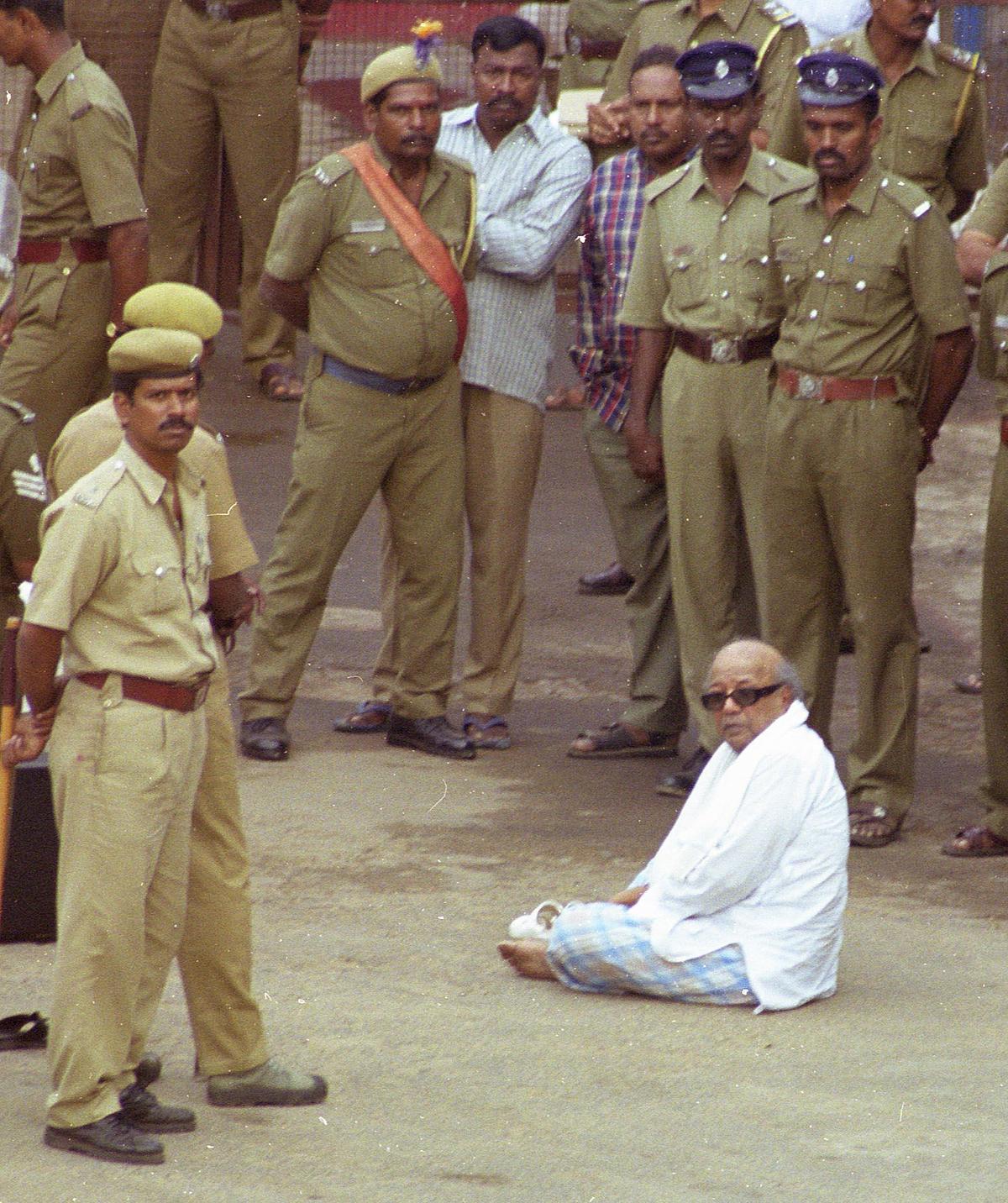
How Tamil Nadu Witnessed the Dramatic Arrest and Release of Karunanidhi and Stalin in 2001
In the early hours of June 30, 2001, Tamil Nadu’s political scene was thrown into turmoil when former Chief Minister M. Karunanidhi, then 77, was arrested from his Gopalapuram residence in Chennai. The arrest, carried out by the police under the AIADMK government led by J. Jayalalithaa, was televised live and shocked the entire nation.
The visuals of police personnel dragging the veteran DMK leader from his bed, while he cried out in pain, became one of the most controversial moments in Tamil Nadu’s political history. Alongside Karunanidhi, his son M.K. Stalin, then the Chennai Mayor, and several others were arrested in connection with alleged irregularities in the construction of 10 flyovers in Chennai during DMK’s previous tenure (1996–2001).
The Midnight Arrest That Shook the State
The arrests took place around 1:30 a.m. Police broke open the doors of Karunanidhi’s house and forcibly took him away. DMK supporters gathered outside, raising slogans and clashing with the police. The scenes were broadcast by television channels across India, sparking outrage among opposition parties and civil society.
Jayalalithaa’s government claimed the arrests were based on corruption charges related to the flyover projects, alleging massive financial irregularities. The CB-CID was tasked with the investigation.
Nationwide Outcry and Political Fallout
The dramatic visuals drew condemnation from across the political spectrum. Then Prime Minister Atal Bihari Vajpayee expressed deep concern, and the Union Home Ministry sought an explanation from the state government.
Several opposition leaders described the act as “political vendetta.” Human rights groups, too, criticized the way Karunanidhi was handled during the arrest. Within hours, protests erupted across Tamil Nadu, with DMK cadres blocking roads and railways.
Stalin’s Arrest and Quick Release
M.K. Stalin, along with senior DMK members, was also arrested later that day. The arrests led to clashes between DMK workers and the police in several districts.
However, as the political pressure mounted, the Madras High Court intervened. Within two days, Karunanidhi and Stalin were granted bail. The case eventually lost momentum over the following years and was later closed due to lack of evidence.
The Political Impact
The 2001 arrests left a deep imprint on Tamil Nadu’s political psyche. While Jayalalithaa faced criticism for her government’s heavy-handed approach, the incident also reinforced the DMK’s narrative of political persecution.
Karunanidhi emerged from the episode with renewed sympathy, and in later years, DMK regained its political strength. The arrest became a defining moment that symbolized the intense rivalry between the DMK and AIADMK, two parties that dominated Tamil Nadu politics for decades.
Legacy of the 2001 Arrests
Today, the 2001 arrests are remembered not just for their drama but for their influence on Tamil Nadu’s political culture. The visuals of Karunanidhi being dragged from his home remain one of the most powerful symbols of political vendetta in Indian democracy.
The incident also shaped the public image of M.K. Stalin, then seen as a rising political heir, who went on to become the Chief Minister of Tamil Nadu in 2021.
FAQs on Karunanidhi and Stalin’s 2001 Arrest
1. Why were M. Karunanidhi and M.K. Stalin arrested in 2001?
They were arrested in connection with alleged corruption and irregularities in the construction of 10 flyovers in Chennai during DMK’s tenure from 1996–2001.
2. Who ordered the arrest of Karunanidhi and Stalin?
The arrests were ordered by the then AIADMK-led government under Chief Minister J. Jayalalithaa.
3. What happened after the arrests?
After nationwide outrage and political pressure, both leaders were granted bail by the Madras High Court within days.
4. Were the corruption charges proven?
No. The case was later closed due to lack of substantial evidence.
5. How did this event affect Tamil Nadu politics?
The incident intensified the rivalry between DMK and AIADMK and strengthened the public sympathy toward Karunanidhi, helping DMK rebuild its political influence in later years.
Published on : 12TH November
Published by : SARANYA
Source Credit ; T. Ramakrishnan
🛡 Powered by Vizzve Financial
RBI-Registered Loan Partner | 10 Lakh+ Customers | ₹600 Cr+ Disbursed