

Introduction
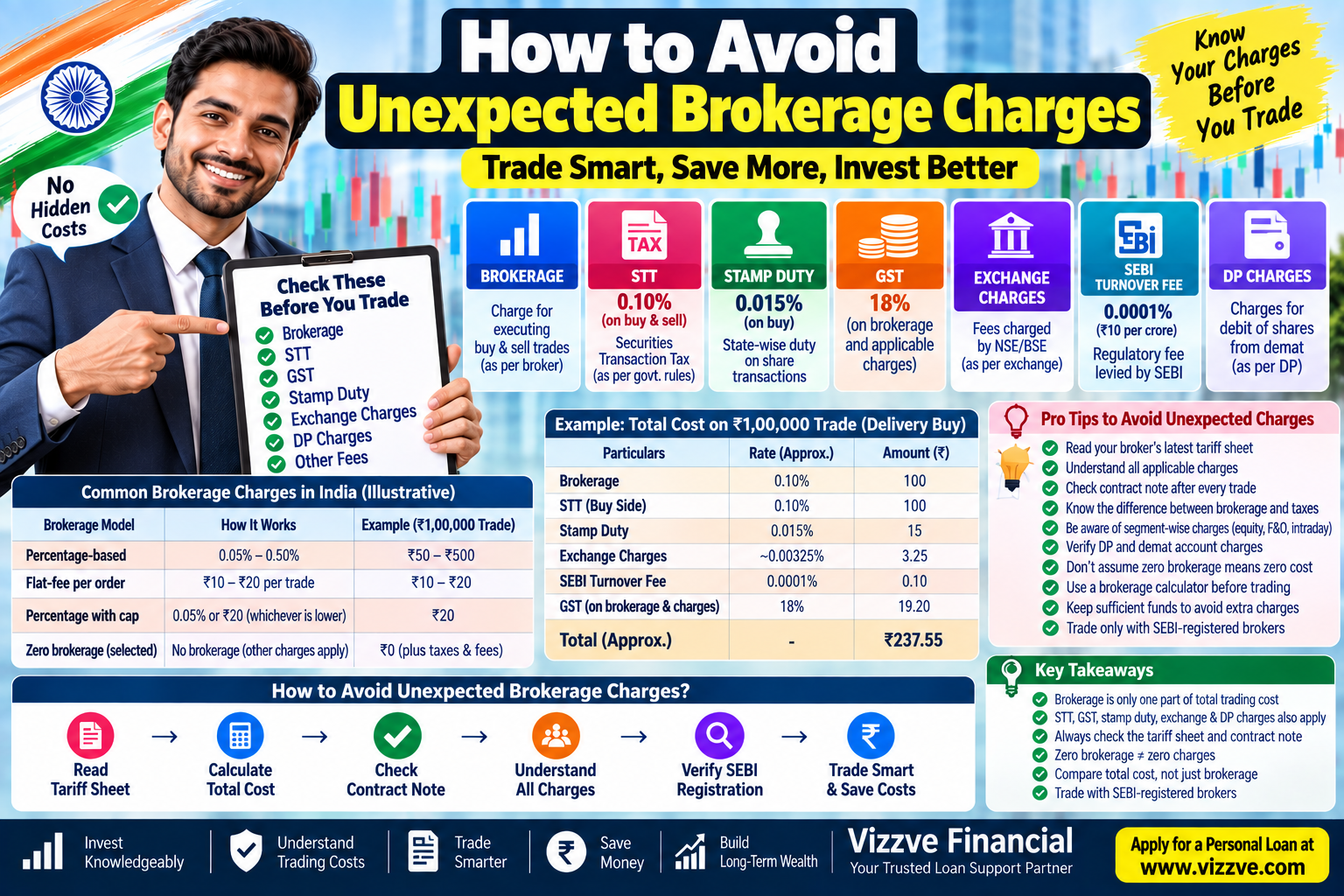
Opening a trading and demat account can make investing in stocks much easier. But one area often surprises beginners: the final amount deducted from the trading account may be different from the simple brokerage rate they saw in an advertisement.
Why?
Because brokerage is only one part of the total cost of a securities transaction.
Depending on the transaction, an investor may also encounter:
- Securities Transaction Tax (STT)
- GST on applicable services
- Stamp duty
- Exchange transaction charges
- SEBI turnover fees
- Depository Participant (DP) charges
- Account maintenance charges
- Call-and-trade charges
- Pledge-related charges
- Other broker-specific service charges
SEBI requires stock brokers to provide clients with a tariff sheet showing charges that can be levied. SEBI also requires contract notes to contain transaction details, brokerage and charges levied.
The good news is that most unexpected charges can be reduced or avoided simply by reading the tariff sheet, understanding the transaction type, checking the contract note and calculating the total cost before placing an order.
AI Answer Box: How Can You Avoid Unexpected Brokerage Charges?
To avoid unexpected brokerage charges in India:
- Read your broker's latest tariff sheet before trading.
- Check whether brokerage is percentage-based, flat-fee or capped.
- Understand the difference between brokerage and statutory charges.
- Check STT, GST, stamp duty and exchange charges.
- Understand DP charges before selling demat-held securities.
- Check annual maintenance and other account charges.
- Read the terms of zero-brokerage offers carefully.
- Review every contract note after trading.
- Compare the total cost, not just the advertised brokerage.
- Use official SEBI and exchange information when verifying charges.
- Confirm that the broker is registered with SEBI.
- Keep copies of tariff sheets, contract notes and account statements.
Simple rule:
Never place a trade based only on the advertised brokerage rate. Check the complete cost structure first.
What Are Unexpected Brokerage Charges?
Unexpected brokerage charges are fees or deductions that an investor did not anticipate when placing a trade.
They may occur because the investor:
- Did not read the broker's complete tariff
- Confused brokerage with statutory taxes
- Did not understand order-based charges
- Missed a minimum or maximum charge
- Did not notice DP charges
- Assumed "zero brokerage" meant zero cost
- Used a different trading segment than expected
- Did not account for GST
- Did not review the contract note
- Was unaware of additional account or service fees
Not every unexpected deduction is necessarily an incorrect charge.
Sometimes the charge is valid but was simply not understood beforehand.
That is why investors should learn to distinguish between:
Unexpected
and
Incorrect
A charge can be unexpected without being wrong.
Brokerage vs Total Trading Cost
This distinction is fundamental.
Brokerage
The amount charged by the stock broker for eligible trade execution under the broker's tariff.
Total Trading Cost
The complete amount associated with the transaction.
A simplified formula is:
Total Trading Cost = Brokerage + STT + GST + Stamp Duty + Exchange Charges + SEBI Fees + DP Charges + Other Applicable Charges
Not every charge applies to every transaction.
For example, delivery equity, intraday equity, futures and options can have different charge structures.
NSE publishes separate information for STT, stamp duty, SEBI turnover fees and GST-related stock-broker services.
Why Do Brokerage Charges Surprise Investors?
1. Advertised Brokerage Is Not the Complete Cost
A broker may advertise:
₹0 brokerage
or:
₹20 per order
But this does not necessarily mean that the complete transaction will cost ₹0 or ₹20.
Other applicable charges can remain.
2. Different Segments Have Different Charges
A broker's pricing may differ between:
- Equity delivery
- Intraday equity
- Futures
- Options
- Currency derivatives
- Commodity derivatives
- Other services
A pricing plan that looks attractive for one segment may not be the same for another.
3. Taxes Are Separate
Investors sometimes see STT or GST on their contract note and assume the broker has added an extra brokerage fee.
That is not necessarily the case.
STT is a statutory tax.
GST is a tax applicable to taxable services.
Stamp duty is a statutory duty.
These should not automatically be treated as brokerage.
What Charges Should You Check Before Trading?
| Charge | What It Means | What to Check |
|---|---|---|
| Brokerage | Broker's trading fee | Rate, flat fee, cap |
| STT | Securities Transaction Tax | Transaction type and applicable rate |
| GST | Tax on taxable services | Components on which GST is charged |
| Stamp Duty | Statutory transaction duty | Applicable security and side |
| Exchange Charges | Exchange-related cost | Current exchange tariff |
| SEBI Turnover Fee | Regulatory fee | Applicable rate |
| DP Charges | Depository-related charge | When it applies |
| AMC | Account maintenance | Annual/periodic amount |
| Call & Trade | Assisted trading charge | Per order/transaction |
| Pledge Charges | Pledge-related service | Applicable fee |
| Other Fees | Broker-specific services | Current tariff |
NSE's current levy page lists, among other items, a SEBI turnover fee of 0.0001% or ₹10 per crore for sale and purchase transactions in securities other than debt securities, and a delivery-based stamp-duty rate of 0.015% payable by the buyer for the specified category.
Step 1: Read the Broker's Tariff Sheet
The tariff sheet is your first line of defence against unexpected charges.
SEBI's investor FAQ states that stock brokers are required to provide a tariff sheet to every client at onboarding, containing charges that can be levied.
Look for:
- Equity delivery brokerage
- Intraday brokerage
- Futures brokerage
- Options brokerage
- Maximum brokerage
- Minimum charges
- DP charges
- AMC
- Call-and-trade charges
- Pledge/unpledge charges
- Account-opening charges
- Other service fees
Practical tip
Do not save only a screenshot of the broker's marketing page.
Keep a copy of the actual tariff sheet or official charge schedule applicable to your account.
Pricing can change over time.
Step 2: Understand the Brokerage Formula
Before trading, determine how your broker calculates brokerage.
Percentage-Based Brokerage
Formula:
Brokerage = Transaction Value × Brokerage Rate
Example:
Transaction value = ₹1,00,000
Brokerage = 0.10%
Brokerage:
₹100
Flat-Fee Brokerage
Some brokers may charge a fixed amount for a qualifying executed order.
For example:
₹20 per executed order
If you execute two chargeable orders:
2 × ₹20 = ₹40
This is an illustration only.
Percentage With a Maximum Cap
A broker could have a hypothetical structure such as:
0.05% or ₹20, whichever is lower
For a ₹10,000 trade:
0.05% = ₹5
Brokerage = ₹5
For a ₹1,00,000 trade:
0.05% = ₹50
Maximum = ₹20
Brokerage = ₹20
Always check the actual terms of the broker.
Step 3: Check Whether the Charge Is Per Order or Per Trade
This is an important distinction.
An investor may assume:
"I placed one buy and one sell, so I will pay one brokerage charge."
But the broker may define charges based on:
- Executed order
- Trade
- Buy order
- Sell order
- Segment
- Contract
- Transaction value
Example
Suppose a broker charges ₹20 per executed order.
You place:
- Buy order → ₹20
- Sell order → ₹20
Total:
₹40
If one order is partially executed, the broker's tariff determines how the charge is calculated.
Step 4: Understand STT
STT means Securities Transaction Tax.
It is a statutory tax, not a broker's optional fee.
For example, NSE's current schedule shows that from April 1, 2026, qualifying equity-share purchases settled through actual delivery attract 0.10% STT payable by the purchaser, while qualifying delivery sales attract 0.10% payable by the seller.
Example
Purchase value:
₹1,00,000
STT at 0.10%:
₹100
This ₹100 should not be mistaken for brokerage.
Step 5: Check GST
GST can apply to stock-broking services.
NSE currently lists the GST rate for stock-broker services at 18%, collected from clients.
However, GST is not simply another percentage added to the entire trade value in every situation.
The applicable GST treatment depends on the taxable service components.
Therefore, investors should check the contract note and broker's charge explanation.
Step 6: Understand Stamp Duty
Stamp duty is another statutory charge.
NSE's current information lists 0.015% for transfer of securities other than debentures on delivery basis, payable by the buyer, and 0.003% for specified non-delivery transactions.
The rate depends on the transaction type.
Do not assume that one stamp-duty rate applies to every trade.
Step 7: Check Exchange Charges
Stock exchanges levy transaction-related charges according to their applicable schedules.
These are separate from brokerage.
When calculating your total trading cost, look at:
Brokerage + Exchange Charges
rather than treating both as the same fee.
Exchange charges can change, so use current exchange information when making calculations.
Step 8: Understand SEBI Turnover Fees
SEBI turnover fees are regulatory charges.
NSE currently lists:
0.0001%
for transactions in securities other than debt securities, equivalent to:
₹10 per crore
of transaction value.
Example
For ₹10 lakh of transaction value:
₹10 per crore works out to approximately:
₹1
The amount is small for many individual transactions, but it is still part of the total cost.
Step 9: Check DP Charges
DP means Depository Participant.
A DP provides demat-related services.
Depending on the transaction and account arrangement, DP charges may apply when securities are debited from a demat account.
This is particularly relevant when selling delivery holdings.
Important distinction
Brokerage ≠ DP Charge
They are separate charges.
An investor can have:
- Zero delivery brokerage
- But a DP charge on a qualifying securities debit
depending on the broker/DP tariff.
Step 10: Understand Annual Maintenance Charges
AMC means Annual Maintenance Charge.
This is generally associated with maintaining a demat account and is different from brokerage.
An investor can have:
AMC = Applicable
even when:
Brokerage = ₹0
because no chargeable trade was executed.
If you are comparing brokers, check both:
- AMC
- Brokerage
Do not assume that one automatically includes the other.
Step 11: Be Careful With "Zero Brokerage"
"Zero brokerage" is one of the most misunderstood phrases in online investing.
It generally means that brokerage is zero for a specified product or transaction under stated terms.
It does not automatically mean:
- Zero STT
- Zero GST
- Zero stamp duty
- Zero exchange charges
- Zero SEBI fees
- Zero DP charges
- Zero AMC
- Zero service charges
Ask these questions before accepting a zero-brokerage offer:
- Zero brokerage for which segment?
- Is it applicable to buying and selling?
- Is there a maximum order value?
- Are DP charges separate?
- Is AMC applicable?
- Are there other service fees?
- Is the offer permanent?
- Does the pricing change after a promotional period?
Step 12: Check the Contract Note
The contract note is one of the most important documents for verifying your actual transaction costs.
SEBI's stock-broker requirements state that the contract note should contain transaction records including order number, trade number, trade time, trade price, quantity, brokerage and all charges levied. SEBI's guidance also requires contract notes to be issued within the prescribed timeframe.
Check these fields:
- Trade date
- Security
- Quantity
- Buy/sell
- Trade price
- Transaction value
- Brokerage
- STT
- GST
- Stamp duty
- Exchange charges
- SEBI fees
- Other charges
- Net amount
Step 13: Compare the Contract Note With the Tariff Sheet
This is where investors can identify genuine discrepancies.
Example
Suppose your tariff says:
Delivery brokerage = ₹0
But the contract note shows:
Brokerage = ₹100
Do not immediately assume fraud.
First check:
- Was the transaction actually delivery?
- Was another product selected?
- Was the order executed under a different plan?
- Did the tariff change?
- Was the amount actually brokerage or another charge?
If the charge still appears inconsistent, contact the broker and request clarification.
Step 14: Keep Records
Maintain:
- Tariff sheet
- Account-opening documents
- Contract notes
- Ledger statements
- Demat statements
- Brokerage bills
- Email/SMS confirmations
- Relevant broker communications
Good record keeping makes it much easier to investigate unexpected deductions.
SEBI's investor guidance specifically emphasises understanding fees and maintaining appropriate records.
Common Unexpected Charges and How to Prevent Them
| Unexpected Charge | Why It Happens | How to Prevent Surprise |
|---|---|---|
| Brokerage | Pricing misunderstood | Read tariff |
| STT | Statutory tax | Check transaction type |
| GST | Tax on taxable services | Check contract note |
| Stamp duty | Statutory duty | Check current rate |
| DP charge | Securities debit | Check DP tariff |
| AMC | Account maintenance | Check annual tariff |
| Call & trade | Assisted order | Use digital order if appropriate |
| Pledge charge | Pledge service | Check service tariff |
| Delayed payment charge | Outstanding debit | Maintain sufficient funds |
| Platform/service fee | Special service | Read plan details |
How to Avoid Unexpected Brokerage Charges Before Placing a Trade
Use this pre-trade checklist.
Before clicking Buy or Sell:
-
Confirm the trading segment
-
Check brokerage
-
Check whether brokerage is flat or percentage-based
-
Check maximum/minimum brokerage
-
Check STT
-
Check GST
-
Check stamp duty
-
Check exchange charges
-
Check SEBI turnover fee
-
Check DP charges where relevant
-
Check whether AMC applies
-
Check other service fees
-
Confirm the order value
-
Review the final cost estimate if your platform provides one
This takes only a few minutes and can prevent confusion later.
How to Calculate Total Trading Cost Before Investing
A simplified calculation is:
Step 1: Calculate transaction value
Quantity × Price
Step 2: Calculate brokerage
Apply your broker's tariff.
Step 3: Add applicable statutory charges
Include:
- STT
- Stamp duty
- SEBI turnover fee
Step 4: Add applicable service taxes
Include GST on taxable components.
Step 5: Add other applicable charges
For example:
- DP charge
- Exchange charge
- Service fee
Step 6: Calculate net amount
For a purchase:
Total Cost = Purchase Value + Applicable Charges
For a sale:
Net Proceeds = Sale Value − Applicable Charges
Example: How a ₹1 Lakh Trade Can Have Multiple Charges
Suppose you purchase qualifying equity shares worth:
₹1,00,000
Assume, purely for illustration:
- Brokerage = ₹20
- STT = 0.10%
- Stamp duty = 0.015%
- SEBI turnover fee = 0.0001%
- Exchange charges = applicable
- GST = applicable to taxable service components
STT
₹1,00,000 × 0.10%
= ₹100
Stamp Duty
₹1,00,000 × 0.015%
= ₹15
SEBI Turnover Fee
₹1,00,000 × 0.0001%
= ₹0.10
The total cost would then include the brokerage and the applicable exchange, GST and other charges.
The important lesson is:
₹20 brokerage does not necessarily mean ₹20 total trading cost.
Brokerage vs STT vs GST vs DP Charges
| Charge | Nature | Usually Paid To / Collected For |
|---|---|---|
| Brokerage | Trading/service fee | Stock broker |
| STT | Statutory tax | Government |
| GST | Indirect tax | Government |
| Stamp Duty | Statutory duty | Government/state mechanism |
| SEBI Fee | Regulatory levy | SEBI |
| Exchange Charges | Market infrastructure fee | Exchange |
| DP Charge | Depository-related service | DP/broker |
Understanding this table can eliminate much of the confusion around trading-account deductions.
How to Compare Stock Brokers Without Getting Misled
Do not ask only:
"Who has the lowest brokerage?"
Instead, compare:
1. Delivery brokerage
Important for long-term investors.
2. Intraday brokerage
Important for active traders.
3. F&O brokerage
Important if you trade derivatives.
4. DP charges
Important for delivery-based securities transactions.
5. AMC
Important for demat-account maintenance.
6. Other service charges
Look at the complete tariff.
7. Platform quality
Cost should not be evaluated without considering the actual service you need.
8. Regulatory registration
SEBI maintains a searchable database of registered intermediaries. As of September 25, 2026, SEBI's database listed 4,991 registered stock brokers in the equity segment.
How to Verify a Stock Broker's Registration
Before opening an account:
Step 1
Go to the official SEBI website.
Step 2
Open the recognised-intermediaries section.
Step 3
Search for the broker by:
- Legal name
- Trade name
- Registration number
Step 4
Check the relevant market segment.
SEBI's current database allows investors to search registered stock brokers and their registration details.
Avoid relying solely on:
- Social-media advertisements
- WhatsApp messages
- Unverified websites
- Unofficial "broker" representatives
- Promises of guaranteed returns
What to Do If You Find an Unexpected Charge
Do not immediately panic.
Follow a structured process.
Step 1: Identify the charge
Find the exact description in the contract note or ledger.
Step 2: Check your tariff sheet
Compare the charge against the agreed tariff.
Step 3: Check the transaction type
Confirm whether the trade was:
- Delivery
- Intraday
- Futures
- Options
- Another product
Step 4: Contact the broker
Ask for a written explanation.
Step 5: Keep documentation
Save the response.
Step 6: Escalate if necessary
If the issue remains unresolved, use the broker's formal grievance mechanism and the applicable exchange/SEBI investor grievance channels.
SEBI's investor charter notes that investors can raise queries concerning excess brokerage and other charges and use the prescribed dispute-resolution mechanisms.
Warning Signs of Poor Charge Transparency
Investors should be cautious when a platform or representative:
- Refuses to provide a clear tariff
- Cannot explain a fee
- Changes charges without clear communication
- Requests payment outside normal broker channels
- Promises guaranteed trading profits
- Uses pressure to make immediate deposits
- Does not provide proper transaction records
- Cannot provide valid registration information
A transparent broker should be able to explain its charges clearly.
Pros and Cons of Comparing Brokerage Before Trading
Pros
- Helps reduce unnecessary costs
- Makes broker comparison easier
- Improves understanding of net returns
- Reduces billing surprises
- Helps identify incorrect deductions
- Encourages disciplined trading
- Makes financial planning more accurate
Cons
- Tariff structures can be complicated
- Charges can change over time
- Different products have different costs
- Comparing only brokerage can be misleading
- Promotional pricing may have conditions
The solution is not to ignore charges but to compare the complete cost structure.
Real-World Investor Experience
Consider an investor who makes only two equity-delivery transactions each year.
For that investor, a small difference in brokerage may not be the biggest cost consideration.
Now consider an active trader making hundreds of orders.
For that investor, a seemingly small per-order difference can accumulate substantially.
For example, a hypothetical ₹5 difference across:
1,000 chargeable orders = ₹5,000
This is why trading frequency should always be part of a brokerage comparison.
Expert Commentary: The Best Way to Think About Brokerage
The most useful question is not:
"What is the lowest brokerage?"
It is:
"What will my total annual trading cost be based on how I actually invest?"
A long-term investor, an intraday trader and an F&O trader can have completely different cost structures.
Therefore, a practical cost comparison should consider:
- Number of trades
- Average trade value
- Trading segment
- Brokerage structure
- DP charges
- AMC
- Taxes and statutory levies
- Other services
- Account requirements
This approach is more reliable than comparing a single promotional number.
How to Avoid Brokerage Charges From Becoming a Problem
1. Trade With a Plan
Avoid unnecessary transactions.
2. Know Your Costs
Calculate before trading.
3. Read Every Contract Note
Do not ignore small deductions.
4. Keep Records
Save important documents.
5. Review Your Broker Periodically
Pricing structures can change.
6. Avoid Unnecessary Services
Do not subscribe to paid services you do not need.
7. Understand the Segment
Equity delivery and derivatives do not necessarily have the same charges.
10-Point Brokerage Safety Checklist
Before trading, ask:
- Is my broker SEBI registered?
- What is my exact brokerage?
- Is it flat or percentage-based?
- Is there a maximum cap?
- What statutory charges apply?
- Are DP charges applicable?
- Is AMC applicable?
- Are there service or platform charges?
- Can I access the tariff sheet?
- Can I verify every deduction in my contract note?
If you can answer all ten questions, you are much less likely to be surprised by your trading bill.
2026 Regulatory and Charge Update
The Indian securities market's regulatory framework continues to evolve.
SEBI's current regulations page lists the Securities and Exchange Board of India (Stock Brokers) Regulations, 2026 among its 2026 regulations.
NSE's current levy information, updated April 17, 2026, reflects Finance Act 2026 changes, including STT rates applicable from April 1, 2026. For qualifying delivery-based equity shares, the listed STT remains 0.10% on purchase and 0.10% on sale.
This makes one point especially important:
Do not rely on old brokerage articles or outdated screenshots when calculating current trading costs.
Always check the latest:
- Broker tariff
- NSE/BSE charge information
- SEBI guidance
- Depository/DP tariff
before making a transaction.
Key Takeaways
- Brokerage is only one component of the total cost of trading.
- Read your broker's tariff sheet before placing trades.
- Check whether brokerage is flat, percentage-based or capped.
- Understand whether charges apply per order or according to another basis.
- STT is a statutory tax and is separate from brokerage.
- GST can apply to taxable stock-broking services.
- Stamp duty is a separate statutory charge.
- Exchange charges and SEBI turnover fees are separate cost components.
- DP charges may apply to certain demat transactions.
- AMC is different from brokerage.
- Zero brokerage does not necessarily mean zero trading costs.
- Always check the contract note after a trade.
- Keep copies of important account and transaction records.
- Verify your broker through SEBI's registered-intermediary database.
- Compare total annual costs rather than one advertised fee.
- Check current official sources because rates and rules can change.
Frequently Asked Questions
1. How can I avoid unexpected brokerage charges?
Read your broker's latest tariff sheet, understand the complete charge structure, check statutory levies and review every contract note after trading.
2. What is the biggest mistake investors make about brokerage?
One common mistake is assuming that brokerage is the only trading cost. STT, GST, stamp duty, exchange charges, SEBI fees and other applicable charges can also contribute to total cost.
3. Does zero brokerage mean zero charges?
No. Zero brokerage generally applies only to a specified brokerage component and product under stated terms. Other applicable charges can remain.
4. How can I check my brokerage charges?
Check the broker's tariff sheet and compare the applicable rate with the brokerage shown on your contract note.
5. What is a stock broker tariff sheet?
It is a document that lists the brokerage and other charges a broker can levy on a client's account. SEBI requires stock brokers to provide clients with a tariff sheet.
6. What is a contract note?
A contract note is an official transaction record containing details such as trade information, brokerage and other charges levied.
7. What is STT?
STT means Securities Transaction Tax. It is a statutory tax applicable to specified securities transactions.
8. Is GST charged on brokerage?
GST can apply to taxable stock-broking services. NSE currently lists an 18% GST rate for stock-broker services.
9. What are DP charges?
DP charges are charges associated with depository participant services and may apply to certain demat transactions.
10. How can I reduce brokerage costs?
Compare brokers, understand your trading frequency, select an appropriate pricing structure and avoid unnecessary trades.
11. Does brokerage differ between equity and F&O?
Yes. Brokers can use different pricing structures for equity, futures, options and other segments.
12. How do I know whether a broker is SEBI registered?
Use SEBI's recognised-intermediaries database and search for the broker by legal name, trade name or registration details.
13. What should I do if my broker charges more than expected?
First identify the charge, compare it with the tariff sheet, check the transaction type and request an explanation from the broker. If unresolved, use the applicable grievance-redressal process.
14. What is the current SEBI turnover fee?
NSE currently lists the SEBI turnover fee for transactions in securities other than debt securities at 0.0001%, equivalent to ₹10 per crore.
15. How often should I review my broker's charges?
Review them whenever the broker announces a pricing change, before starting a new trading segment and periodically as part of your account review.
Published on : 27th September
Published by : G REDDY KUMAR
www.vizzve.com || www.vizzveservices.com
Follow us on social media: Facebook || Linkedin || Instagram
🛡 Powered by Vizzve Financial
RBI-Registered Loan Partner | 10 Lakh+ Customers | ₹600 Cr+ Disbursed