

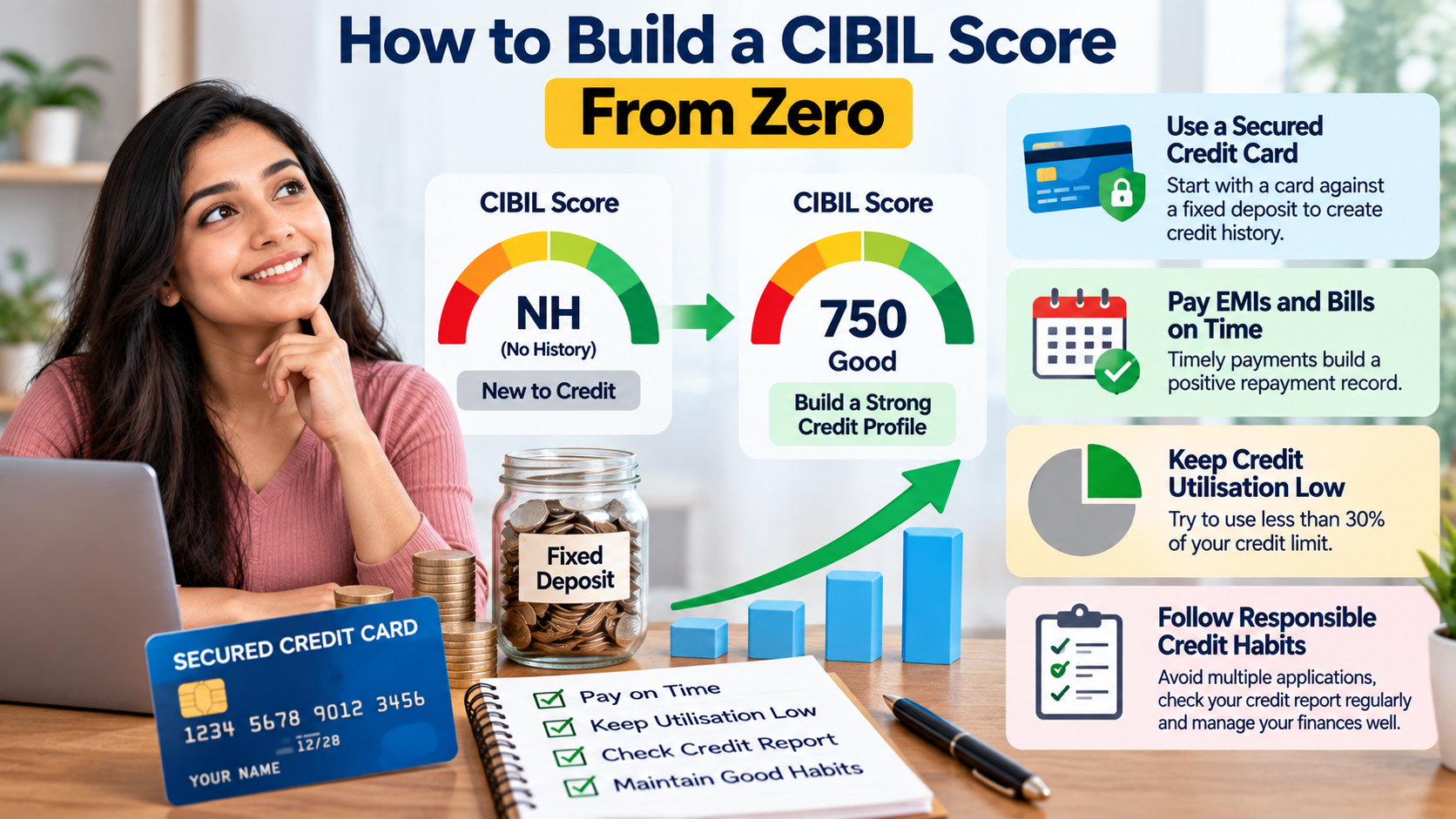
Building a CIBIL Score can feel confusing when you have never taken a loan or used a credit card. You may want to apply for your first personal loan, credit card, or two-wheeler loan, but lenders may have limited information to assess your repayment behaviour.
The good news is that you do not need to start with an existing credit score to build a credit history. You can establish one by using suitable credit responsibly and making repayments on time.
Before you begin, remember that having no credit history is not the same as having a poor credit score. If you are new to credit, your report may show “NH” (No History) or “NA” (Not Available), rather than a numerical score. TransUnion CIBIL explains that these statuses can indicate insufficient credit information to generate a score.
This guide explains how to build a CIBIL Score from scratch, which financial products may help, and the mistakes first-time borrowers should avoid.
AI Answer Box: How to Build a CIBIL Score From Zero
To build a CIBIL Score from zero, start by checking your credit report and understanding whether you have an existing credit history. If you have none, consider a suitable starter credit product, such as a secured credit card backed by a fixed deposit, if it fits your needs and budget.
Use the credit responsibly, pay every bill or EMI on time, keep credit card utilisation low, and avoid applying for multiple loans or cards at once. Monitor your credit report for errors and allow time for lenders to report your repayment activity.
You do not need to borrow money just to create a score. If you choose to use credit, borrow only what you can comfortably repay.
What Is a CIBIL Score?
A CIBIL Score is a three-digit number that summarises your credit history. It generally ranges from 300 to 900 and is based on information in your credit report, including your loan and credit card accounts, repayment history, outstanding balances, and credit enquiries.
Lenders may use your CIBIL Score while evaluating applications for:
- Personal loans
- Credit cards
- Home loans
- Car and two-wheeler loans
- Other credit facilities
A stronger credit profile may improve your chances of getting approved, but a high score does not guarantee a loan. Lenders also consider income, employment, existing EMIs, repayment capacity, and their own eligibility criteria.
Can You Have a CIBIL Score of Zero?
People often search for “CIBIL Score zero,” but a score of zero is not the usual way to describe having no credit history.
If you have never used a credit card or taken a loan, you may have a No History (NH) or Not Available (NA) status. This means the credit bureau may not have enough relevant information to generate a numerical score.
A low score and no score are different situations:
| Credit Profile | Meaning |
|---|---|
| No credit history | There may be insufficient information to calculate a score |
| Low CIBIL Score | A score has been generated, but it is relatively low |
| Established credit history | Credit accounts and repayment activity provide information about your credit behaviour |
Some lenders may be cautious about lending to applicants with no credit track record. However, the Government of India has stated that, under RBI's credit information reporting directions, credit institutions have been advised not to reject first-time borrowers' loan applications solely because they have no credit history. Lenders still assess applications under their applicable policies.
7 Ways to Build a CIBIL Score From Zero
1. Start With a Secured Credit Card
A secured credit card is one possible way to establish a credit history if you are new to borrowing.
These cards are generally issued against a fixed deposit. The deposit acts as security, and the bank provides a credit limit according to its policy.
For example, a bank may offer a secured credit card against an eligible fixed deposit. You can use the card for small, planned purchases and repay the bill by the due date.
How it can help:
- Creates an opportunity to establish a credit record.
- Allows you to practise responsible credit card use.
- May be easier to access than an unsecured card for some applicants.
Before applying, check the fixed deposit requirement, credit limit, annual fees, interest rate, and rules for closing the card.
Do not lock money into a fixed deposit if you may need that money for essential expenses.
2. Consider a Small Loan Only If You Need It
A consumer durable loan, two-wheeler loan, or another suitable loan may help establish credit when the lender reports the account to a credit bureau.
For example, if you genuinely need to purchase a laptop and can comfortably afford the EMI, a suitable loan may help create a repayment history.
However, do not take a loan solely to build your CIBIL Score. Interest, processing fees, and missed-payment risks can outweigh the potential benefit.
Before borrowing, calculate the total repayment amount and make sure the EMI fits your budget.
3. Pay Every EMI and Credit Card Bill on Time
Payment history is an important factor in your credit profile. Late payments and missed EMIs can negatively affect your CIBIL Score.
Make timely payments a priority from the first month.
Practical ways to avoid missed payments:
- Set reminders a few days before the due date.
- Maintain enough money in your repayment account.
- Use an automatic payment facility where appropriate.
- Check that the payment has been processed successfully.
- Keep payment receipts and transaction records.
If you use a credit card, paying the full statement balance by the due date can help you avoid interest on ordinary purchases, subject to the card's terms.
4. Keep Credit Card Utilisation Low
Credit utilisation is the proportion of your available credit limit that you are using.
For example, if your credit limit is ₹20,000 and your outstanding balance is ₹4,000, your utilisation is 20%.
| Credit Limit | Outstanding Balance | Utilisation |
|---|---|---|
| ₹10,000 | ₹2,000 | 20% |
| ₹20,000 | ₹6,000 | 30% |
| ₹30,000 | ₹24,000 | 80% |
A high utilisation ratio may negatively affect your credit profile. Keeping balances low is a useful credit management habit.
There is no need to spend more just to show credit activity. Use your card for planned expenses and pay the bill on time.
5. Avoid Applying for Multiple Loans at Once
When you apply for a loan or credit card, the lender may make a credit enquiry.
Multiple and frequent applications can lead to several enquiries in your credit report and may negatively affect your score.
Instead of applying to many lenders at the same time:
- Check the eligibility criteria first.
- Compare fees, interest rates, and repayment terms.
- Apply only when you genuinely need credit.
- Avoid submitting repeated applications simply to see which lender approves you.
Checking your own CIBIL Score is different from applying for new credit. A self-check does not reduce your score.
6. Keep Your First Credit Account in Good Standing
A well-managed credit account can help establish a repayment track record over time.
Avoid closing a credit card automatically just because you have received a new offer. First review its fees, usefulness, and effect on your finances.
You should not keep an expensive or unsuitable product only for the sake of your score. Choose credit products based on your needs and repayment capacity.
7. Check Your CIBIL Report Regularly
Monitoring your report helps you confirm whether your accounts and repayments are being reported correctly.
Look for:
- Incorrect personal details.
- Unfamiliar loan or credit card accounts.
- Payments incorrectly marked as late.
- Outstanding balances that have already been paid.
- Credit enquiries you do not recognise.
If you find an error, contact the lender and raise a dispute with the credit bureau where necessary.
TransUnion CIBIL provides consumers with one free CIBIL Score and Report per calendar year through its official website.
How Long Does It Take to Build a CIBIL Score From Zero?
There is no fixed timeline for everyone.
Your credit profile develops as lenders report account information and repayment activity. The time required to generate a score depends on the information available in your credit report and the bureau's scoring process.
CIBIL has explained that consumers generally need sufficient credit information before a score can be generated. Its educational material notes that a new-to-credit consumer may initially receive an NH or NA status.
Keep these points in mind:
- A score may not appear immediately after opening a credit account.
- Lenders need to report your account and repayment information.
- Different people may develop a score at different times.
- No lender or service can guarantee a particular score by a specific date.
Focus on consistent repayment behaviour rather than trying to achieve a particular number within a few weeks.
Example: Building a Credit History With a Secured Credit Card
Suppose you obtain a secured credit card with a ₹15,000 limit against an eligible fixed deposit.
You use it for planned monthly expenses and pay the full statement balance by the due date.
| Month | Example Activity | Good Practice |
|---|---|---|
| Month 1 | Use ₹2,000 | Pay the bill in full by the due date |
| Month 2 | Use ₹3,000 | Keep spending within your budget |
| Month 3 | Use ₹1,500 | Pay on time and check the statement |
| Month 4 onward | Continue planned spending | Monitor your credit report |
This example illustrates responsible use. It does not guarantee that a CIBIL Score will be generated within four months or that it will reach a particular number.
Can You Build a CIBIL Score Without a Credit Card?
Yes, it may be possible to establish a credit history without a credit card.
A loan that is reported to a credit bureau can also contribute to your credit profile. Examples may include an eligible consumer durable loan, two-wheeler loan, or personal loan.
However, taking a loan solely to create a score is not advisable. You will need to repay the amount with applicable interest and charges.
If you do not currently need credit, you can wait until a suitable financial need arises rather than borrowing unnecessarily.
Does Paying Electricity or Mobile Bills Build Your CIBIL Score?
Ordinary utility payments, such as electricity or mobile bills, do not necessarily build your CIBIL Score.
Your credit score is based on credit information reported by lenders and other relevant credit institutions. A normal utility bill is not automatically treated like a loan or credit card account.
Some products marketed as “pay later” or instalment facilities may be credit products. Their reporting treatment depends on the product and provider.
Before using one, check:
- Whether it is a credit facility.
- Whether the provider reports it to credit bureaus.
- What fees and penalties apply.
- What happens if you miss a payment.
Do not sign up for a credit product simply because it claims to build your score.
Common Mistakes to Avoid When Building Your CIBIL Score
1. Taking Unnecessary Loans
Borrowing money creates a repayment obligation. Do not take a loan just to create credit history.
2. Missing Your First EMI
A missed payment can undermine the repayment record you are trying to establish.
3. Using the Entire Credit Limit
High credit utilisation may negatively affect your credit profile.
4. Applying to Too Many Lenders
Repeated applications can result in multiple credit enquiries.
5. Paying Only the Minimum Credit Card Amount
Paying only the minimum may keep the account from being immediately overdue, subject to the card terms, but the remaining balance can attract interest. Paying the full statement balance is generally a better habit when affordable.
6. Believing in Guaranteed Score-Boosting Services
Be cautious of anyone promising a guaranteed CIBIL Score increase for a fee. No legitimate service can guarantee a specific score or approval outcome.
7. Ignoring Your Credit Report
Incorrect accounts, balances, or repayment entries should be investigated and disputed when necessary.
How to Check Your CIBIL Score for Free
You can check your score directly through TransUnion CIBIL.
- Visit the official website: https://www.cibil.com/freecibilscore
- Register or log in as instructed.
- Complete the required identity verification.
- Access your CIBIL Score and Report.
- Review your account and enquiry information.
TransUnion CIBIL states that a free Score and Report is available once per calendar year. Check the website for the current process and eligibility.
Checking your own score does not reduce it.
Key Takeaways
- Having no CIBIL Score is different from having a low score.
- A secured credit card may be a useful starting point for eligible first-time borrowers.
- A suitable loan can also establish credit history, but avoid borrowing unnecessarily.
- Pay every EMI and credit card bill on time.
- Keep credit card utilisation low.
- Avoid unnecessary loan applications.
- Monitor your credit report and dispute incorrect information.
- Building a credit history takes time; no specific score or timeline is guaranteed.
Frequently Asked Questions (FAQs)
1. How can I build a CIBIL Score from zero?
Start by checking your credit report. If you have no history, consider a suitable credit product, such as a secured credit card, and use it responsibly. Pay all dues on time, keep balances low, and avoid unnecessary applications.
2. Is a CIBIL Score of zero bad?
A score of zero is not the usual way to describe having no credit history. You may receive an NH or NA status if there is insufficient information to generate a score. This is different from having a low numerical score.
3. How long does it take to build a CIBIL Score?
There is no fixed timeline. It depends on the credit information reported and whether there is enough history to generate a score.
4. Can I build a CIBIL Score without a credit card?
Yes. A loan reported to a credit bureau may help establish credit history. However, do not take a loan solely to build a score.
5. Is a secured credit card good for beginners?
It may be suitable for some first-time borrowers because it is backed by a fixed deposit. Check the deposit requirement, fees, interest rate, and repayment terms before applying.
6. Does a debit card help build a CIBIL Score?
Ordinary debit card spending does not establish a credit repayment history because you are generally spending money from your own bank account rather than borrowing.
7. Can I get a personal loan without a CIBIL Score?
It may be possible, depending on the lender's policies and your overall eligibility. Some lenders may consider applicants with no credit history, while others may have stricter requirements.
8. Does checking my own CIBIL Score reduce it?
No. Checking your own CIBIL Score does not reduce it. A lender enquiry associated with a credit application is different.
9. Should I take a small loan to build my credit score?
Only if you genuinely need the loan and can comfortably afford the repayments. Interest and charges make unnecessary borrowing costly.
10. What is a good CIBIL Score for a first-time borrower?
A first-time borrower may not have a numerical score yet. Once a score is generated, lenders assess it along with income, repayment capacity, and other eligibility criteria.
11. Does paying credit card bills on time improve CIBIL?
Timely payments help establish a positive repayment history. The overall effect depends on your credit profile and the information reported.
12. Can using BNPL help build a CIBIL Score?
Some buy-now-pay-later products are credit facilities and may be reported to credit bureaus. Reporting depends on the provider and product. Check the terms before using one.
13. Does a high salary guarantee a good CIBIL Score?
No. Salary is not the same as credit history. Your score is based on credit-related information, while lenders may consider salary separately when assessing eligibility.
14. Can I improve my CIBIL Score quickly?
There is no guaranteed quick fix. Focus on timely payments, low credit utilisation, limited applications, and accurate credit reporting.
15. How often should I check my CIBIL Score?
You can check it periodically, especially before applying for credit or after correcting an error. TransUnion CIBIL offers one free Score and Report per calendar year.
Conclusion
Building a CIBIL Score from zero is about creating a responsible credit history, not borrowing as much as possible.
If you are a first-time borrower, start with a financial product that suits your needs and repayment capacity. A secured credit card may be one option, while a suitable loan can also establish credit history when reported to a bureau.
Pay on time, keep outstanding balances manageable, avoid unnecessary applications, and check your report for errors. With consistent financial habits, you can work towards establishing a healthy credit profile.
Published on : 26th September 2026
Published by : Shibam Nath
www.vizzve.com || www.vizzveservices.com
Follow us on social media: Facebook || Linkedin || Instagram
🛡 Powered by Vizzve Financial
RBI-Registered Loan Partner | 10 Lakh+ Customers | ₹600 Cr+ Disbursed